The Miracle Morning is a set-order morning routine built around six habits, created by the author Hal Elrod, who packages them under the acronym SAVERS. The pitch is that running all six early in the day, even for a minute each, leaves you calmer, clearer and more on top of things.
Some of those six habits have solid research behind them. Others rest on much thinner ground. Here is what each step is, how well the evidence supports it, and a stripped-back version you can do in a few minutes on an ordinary weekday.
What the Miracle Morning is
Hal Elrod set out SAVERS in his book The Miracle Morning, bringing six personal-development habits together under one routine. On his site he describes the aim as waking up to "create the life you've always wanted", and the letters stand for silence, affirmations, visualisation, exercise, reading and scribing.
The classic version is long. One popular summary of the method has Elrod suggesting ten minutes on each habit, for a one-hour routine, often done an hour or two before your working day starts. He also offers a much shorter version for tight mornings. The order stays fixed, the length does not.
Elrod presents SAVERS as his own framework, drawn from popular personal development, not as a set of clinical prescriptions. That is worth keeping in mind as we go through each step, because the six vary a lot in how much evidence sits behind them.
The six steps, and how the evidence holds up
Taken one by one, the SAVERS habits run from well-supported to wishful. Here is each letter, and what the research says.
Silence
Elrod's first step is a few minutes of quiet, through meditation, prayer or plain stillness. This is the step on the firmest ground. The US National Center for Complementary and Integrative Health reports that mindfulness meditation "may help reduce symptoms of stress, including anxiety and depression, and may help improve sleep", pointing to a review of 47 trials in more than 3,500 people that found moderate evidence for easing anxiety and depression. It also warns that a lot of meditation research is preliminary and may read more optimistically than the data warrant.
A few slow minutes at the start of the day is a fair bet, even if it is no cure-all. If sitting in silence feels like a stretch, a short breathwork practice gives your attention somewhere to go.
Affirmations
Here the picture gets messier. Elrod suggests reading or repeating positive statements about the person you want to be. The snag is that repeating a line you do not yet believe can rebound on you.
In a 2009 study, people with low self-esteem who repeated "I'm a lovable person" felt worse, not better, while those already high in self-esteem got only a small lift. The researchers concluded that such statements can "backfire for the very people who need them the most."
Affirmations built around values you already hold, or a small thing you are working towards, tend to land better than sweeping claims about a self you do not recognise. Our guide to positive affirmations has wording that steers around the trap.
Visualisation
The V asks you to picture your goals as already achieved. Handle this one with the most care of the six. Research led by the psychologist Gabriele Oettingen found that vividly fantasising about a wished-for future can quietly drain the drive to chase it, because the mind treats the imagined success as partly real. One review puts it plainly: "positive fantasies about a wished for future allows a person to enjoy future success already in the here and now, and thus it appears that no effort for fulfilling the wished for future is needed".
The form that holds up is mental contrasting. You picture the outcome, then picture the obstacles between you and it, which turns a daydream into a plan. If you visualise at all, give the hurdles as much time as the happy ending.
Exercise
A few minutes of movement is the fourth letter, and its case is easy to make. Harvard Health notes that even a "simple 20-minute stroll can clear the mind and reduce stress", because activity lowers stress hormones like cortisol and prompts the release of endorphins. Elrod means light morning movement, not a training session, so a short walk, a few stretches or a trip up and down the stairs all count. A morning stretch routine fits this slot if you would sooner stay indoors.
Reading
Step five asks for a few pages of a personal-development or other book. This is the thinnest of the six as a morning-specific claim. There is plenty to say for reading in general, but little to show that a few minutes of it before breakfast reshapes your day the way the routine implies.
Treat it as a learning habit you are parking on the morning because the morning is a handy spot to keep it, not because dawn holds special power over a paragraph.
Scribing
The last S is writing, and Elrod tends to point people towards gratitude and a short plan for the day. Journaling about what you are grateful for has decent support. Harvard Health describes gratitude as "strongly and consistently associated with greater happiness", and cites research where people who wrote about things they were grateful for over ten weeks felt more optimistic, felt better about their lives, and even exercised more. A line or two does the job. For a starting point, see our gratitude journal prompts.
A shorter Miracle Morning that fits a real life
Open our free printable: A shorter morning routine (PDF). Save or print it to use alongside this guide. No sign-up needed.
Running six practices for an hour before work suits some lives and flattens others. The honest read is that the worth is in the individual habits, most of which stand up on their own, so you can keep the ones that earn their place and shrink or drop the rest and still have something real.
Here is how to build a version you will still be doing next month.
- Keep the steps with the strongest case. Silence, movement and a line of gratitude give the most for the least time. Start there. Visualisation and affirmations are optional, and if you use them, use the sturdier forms above.
- Cut each step to a minute. A minute of quiet, a minute of movement and one line in a notebook is a complete morning if that is what the day allows.
- Anchor it to something you already do. A new routine survives when it is tied to an existing habit instead of to willpower. James Clear, who wrote Atomic Habits, calls this habit stacking, and the shape is plain: "After/Before [CURRENT HABIT], I will [NEW HABIT]". "While the kettle boils, I take five slow breaths" beats "do my Miracle Morning".
- Decide the bad-day version now. Pick the one step you will protect when everything is against you, while you are calm enough to choose well. On a rough morning, that single step keeps the whole habit alive.
Then write your version down as a couple of lines. Here is a blank to fill in and a worked example.
My short Miracle Morning:
After I ________, I will ________, then ________.
The one step I protect on a bad day: ________.
My short Miracle Morning:
After I switch the kettle on, I will take five slow breaths, then write one thing I'm grateful for.
The one step I protect on a bad day: the five breaths.
If the wider idea of a morning routine appeals, our guide to building a morning routine walks through the design from scratch, the morning routine checklist hands you a tick-box list to copy, and morning routine ideas is a wider menu to pick from.
You will miss mornings, and the routine can take a knock without breaking. There is no streak to guard and no missed day to make up. Pick the one small step back up the next morning and carry on. If low mood or exhaustion is grinding on for weeks rather than days, it is worth a word with your GP.
A place to keep the short version

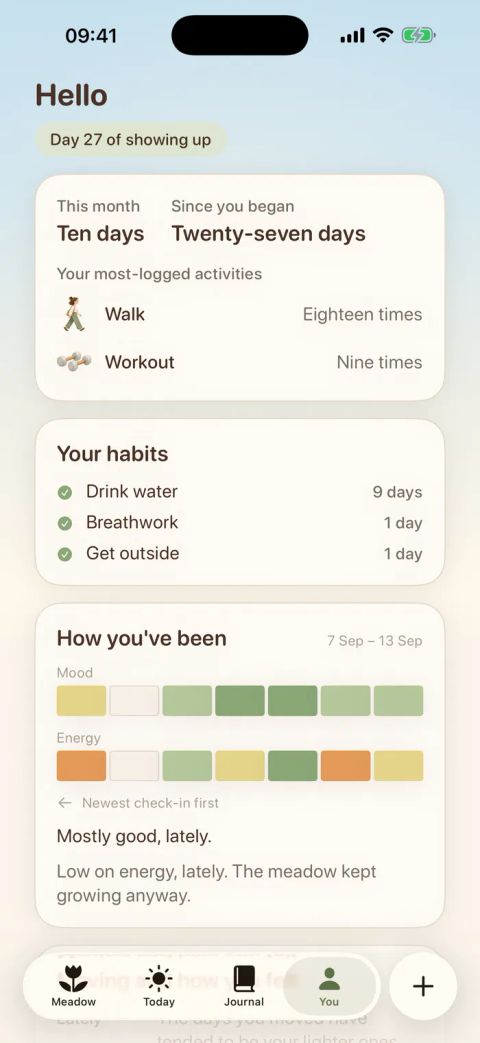
If you would like the shrunken routine to live somewhere other than a sticky note, Meadow holds most of SAVERS in one app for iPhone. You log a few minutes of movement, tick off a small habit like a moment of quiet, note your mood and energy, add a daily win, and read a short affirmation to start the day. Each morning you show up grows a wildflower in your own meadow, with rare flowers and little animal visitors turning up as it fills in. There are no streaks, so a morning you skip resets nothing you have built.
Common questions
Is the Miracle Morning based on science? Partly. The habits vary. Meditation, movement and gratitude journaling have reasonable research behind them, while morning affirmations and goal visualisation are weaker and can even backfire in the simple forms Elrod describes. The six-part package as a whole has not been tested as a single method.
Do I have to do all six steps? No. Elrod presents SAVERS as a set, but the habits work on their own, so keeping two or three you will repeat beats forcing all six and quitting by Saturday.
Do I have to wake up early? Elrod suggests starting before your working day, often an hour ahead, but the evidence for the habits does not hinge on the hour. A steady version at your normal waking time does more good than an early one you drop after a week.
How long should it take? Anywhere from a few minutes to an hour, depending on the morning you have. A minute a step, done most days, is a real Miracle Morning.
What if affirmations feel fake? That is a common and reasonable reaction. Swap grand statements for ones tied to your values or a small thing you are working on, or skip the step and put the minute into quiet or movement instead.
Tonight, write one line on a scrap of paper by the kettle: after you switch it on tomorrow, you will take five slow breaths and note one thing you are grateful for. That two-step version is a Miracle Morning you can keep, and you can add a step once it sticks.
AUTHOR
Co-founder of Meadow.
Ash is co-founder of Meadow, a habit and movement tracking app that turns small acts of self-care into a growing wildflower meadow.
See how far you've come
Your habits, moods and little wins, all in one place
Meadow keeps track of the walks, the water and the good days, so you can look back and watch your effort add up.
Download Meadow