A Sunday reset is a short block of time near the end of your weekend when you tidy a bit, look at the week ahead, and set up a few small things so Monday lands more softly. Done well it takes under an hour, and it leaves you rested rather than wrung out.
That last part is where most reset routines go wrong. They swell into a three-hour deep clean and a colour-coded plan for a life you do not lead, and by Sunday night you are more tired than when you started. This guide keeps it small on purpose. We will cover what a reset is for, why a light one helps the week that follows, a menu to build your own from, and how to stop it turning into another job.
What a Sunday reset is
Strip away the aesthetic videos and a Sunday reset is two ordinary things done together: a little catching up, and a little planning of the days to come. You clear some of the mess the week left behind, and you make a few decisions now so your future self has fewer to make when they are tired.
It does not have to be Sunday. If your week starts on a Tuesday, or your quiet evening is a Monday, reset then. The day is a convention, not the point. What helps is doing it at roughly the same time each week, so it turns into something you do without deciding to.
And it is yours. A reset for someone with three kids and two jobs looks nothing like a reset for a student, and neither is doing it wrong.
Why a lighter reset helps the week ahead
You spend fewer decisions on Monday morning. Every choice you make costs a little mental energy, and they add up. Researchers describe decision fatigue as the impaired ability to make decisions and control behaviour as a consequence of repeated acts of decision-making. The reserve drains through the day, and later choices get worse. Deciding on Sunday what you will eat on Wednesday, or laying out Monday's clothes tonight, moves those small choices to a moment when you have the energy for them. UCLA Health makes the same case for routine in general, saying it removes the burden of decision-making, as well as the pressure and guilt that often go with it.
Sunday night gets calmer. A lot of people feel a low dread creep in as the weekend closes, the so-called Sunday scaries. Cleveland Clinic explains it as anticipatory anxiety, worrying about events that have not yet occurred, where your mind runs the worst version of Monday before Monday has arrived. Some of that dread is vaguer than it feels. When you write down what next week holds, the shapeless worry turns into a list of specific, mostly manageable things. Cleveland Clinic's psychologist points at this directly, suggesting people ease the anxiety by wrapping up things at the end of the work week so you are not as anxious when you start on Monday.
The week has a bit more structure to lean on. UCLA Health notes that people with structured routines tend to have lower levels of anxiety and depression than people who live without them, because a predictable rhythm reduces mental fatigue and stress. A weekly reset is the hinge a daily rhythm hangs off.
Here is the honest bit. None of this means a bigger reset works better. Load it with fifteen tasks and it becomes the thing you dread instead of Monday, and you will quietly drop it by week three. The version that helps is the version you will do most weeks.
A menu to build your own reset
There is no correct list. Pick three or four things that would take real weight off your week, and leave the rest. Most of these take five to fifteen minutes.
Tidy and refresh:
- Run a load of laundry while you do everything else.
- Reset the main rooms: clear the surfaces, deal with the post pile, empty the bins.
- Change the bed. A fresh bed on a Sunday night is a small, reliable pleasure.
Look at the week:
- Open your calendar and read the week out loud. Note anything that needs prep the night before.
- Write a short to-do list for the week, then pick the two or three things that would make the biggest difference.
- Check for anything with a deadline hiding in your inbox.
Sort food:
- Decide three or four evening meals so you are not staring into the fridge at 6pm.
- Do a shop, or an online order, against that plan.
- Prep one thing ahead if you have it in you: chop some veg, batch a lunch, boil a few eggs.
Clear admin:
- Pay the bill, book the appointment, send the one email that has been following you around all weekend.
- Deal with your dreaded small task, the one you keep skipping, so it stops taking up room in your head.
Look after yourself:
- A proper shower or bath, hair washed, nails done, whatever your version of feeling human is.
- Ten minutes of reading, or nothing at all with your phone in another room.
- Set out Monday's clothes and pack your bag, so the morning is half done before it starts.
A slow walk earns its own line. Twenty minutes outside with no pace goal is a good way to mark the shift from weekend to week without turning the reset into a workout.
A sample Sunday reset
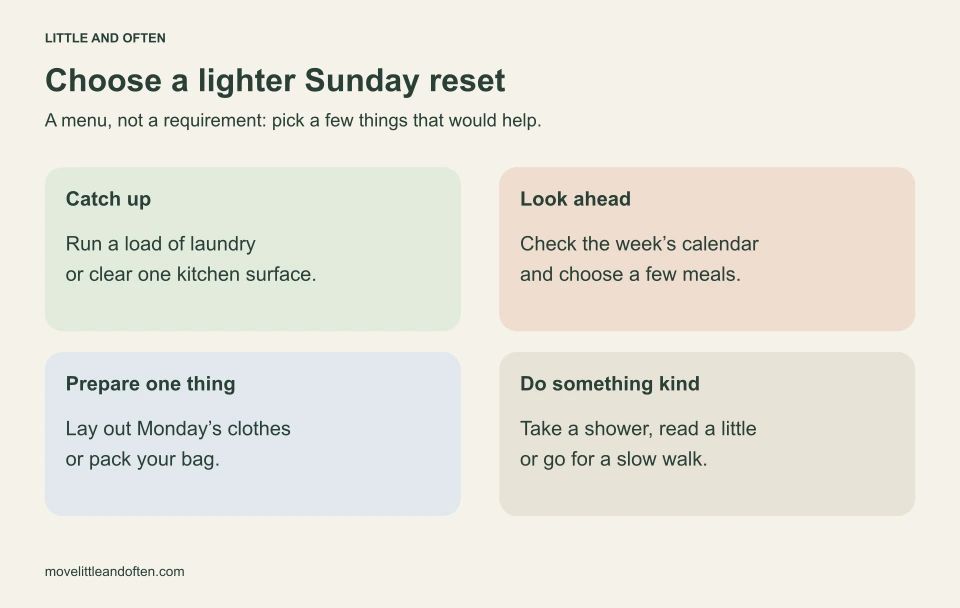
You do not need every item above. Here is what a real 45-minute version might look like, and a blank to write your own.
My reset happens: Sunday, after dinner
I catch up on: one load of laundry, clear the kitchen counters, change the bed
I look ahead by: reading the week's calendar, choosing three meals, laying out Monday's clothes
One kind thing: a long shower and ten minutes with a book
My reset happens: ________
I catch up on: ________
I look ahead by: ________
One kind thing: ________
Fill the blank in now, while the week feels calm. Deciding it in advance is the whole trick, because a tired Sunday-evening you will always vote for the sofa.
How to keep it kind, not a chore
The fastest way to kill a reset is to make it a performance. A few guardrails keep it light.
Start with one thing. If a full menu feels like a lot, do the single item that would help most, probably the meal plan or the week's calendar, and let the rest come later. The how to stick to a routine guide goes deeper on building it up slowly.
Pin it to something you already do. James Clear's habit stacking is a neat way in. The formula is after I do a current habit, I will do the new one, and it works because the old habit is already wired in. "After I finish Sunday dinner, I write out the week" sticks better than "I'll reset at some point".
Keep a two-minute version for flat weekends. Some Sundays you have nothing left. On those, do the smallest possible reset: read the week's calendar and put a wash on. That is enough to count, and it keeps the habit alive for the week you have more to give.
Let it move and let it shrink. UCLA Health suggests keeping a backup plan so you are not thrown when life disrupts your routine. A reset you can do in ten minutes on a bad week is worth far more than a perfect two-hour one you manage once a month.
Miss one and pick it back up. Skipping a Sunday undoes nothing. Next week you reset as usual, in the usual spot, with no catching up on two weeks at once.
A gentle weekly check-in

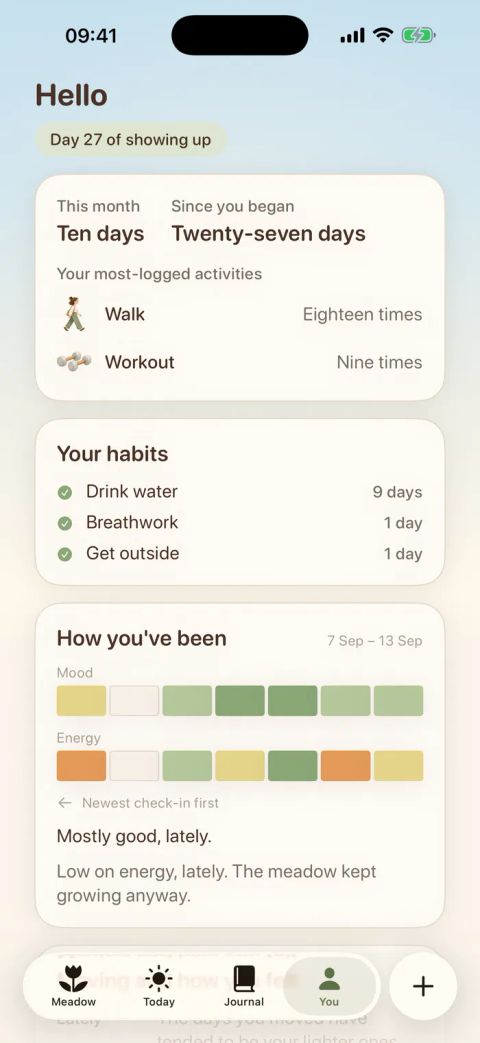
If you like the idea of a weekly look at how you are doing, Meadow gives it a home. It is a habit app for iPhone from Wildcard Wellness where you note your mood and energy, tick off small daily habits, log any movement, and jot down a daily win, so glancing back over the week becomes part of the reset itself. Each day you show up grows a wildflower in your own meadow, and because there are no streaks, a weekend you skip entirely resets nothing you have built.
Common questions
What day should I do it? Whichever evening is quiet and lands near the start of your week. Sunday suits most people because the working week follows it. Pick the same evening each week and the day itself stops mattering.
How long should it take? Aim for thirty to sixty minutes. If it regularly runs past that, you have put too much on the list, and it will start to feel like chores rather than a reset.
How is it different from a normal tidy-up? A reset pairs the catching up with the planning. The planning half is what carries you into the week, so if you only have time for one part, plan the week and leave the cleaning.
What if Sundays already make me anxious? If the reset itself feeds the Sunday dread, shrink it right down and move the planning to Friday afternoon instead, so the weekend stays clear. Cleveland Clinic's point about wrapping things up before the week ends works well on a Friday too.
Is this the same as a morning routine? No. A reset is weekly and sets up the days ahead, while a morning routine and an evening routine are daily and handle the start and end of each day. The three fit together well.
This Sunday, do one thing: sit down for five minutes and read next week's calendar out loud. That alone turns a vague Sunday-night dread into a short list you can see the edges of, and you can grow the rest of your reset around it from there.
AUTHOR
Co-founder of Meadow.
Ash is co-founder of Meadow, a habit and movement tracking app that turns small acts of self-care into a growing wildflower meadow.
See how far you've come
Your habits, moods and little wins, all in one place
Meadow keeps track of the walks, the water and the good days, so you can look back and watch your effort add up.
Download Meadow