Breathwork means changing the way you breathe on purpose, usually to steady yourself when stress rises. When you feel wound up, your breathing tends to speed up and move high into your chest, and slowing it back down is one of the few calming things you can do anywhere, with no kit, no privacy and no one noticing.
Here is a version to try right now. Breathe in gently through your nose, then let the air flow out through your mouth so the out-breath runs a little longer than the in-breath, and keep it soft and regular for a minute or two. That single pattern, a slow and unhurried exhale, sits at the centre of most of the techniques below.
This guide covers what breathwork is, how it works on your nervous system, five techniques with step-by-step cues, what the evidence shows, who should take care, and how to make it a habit.
What breathwork is, in ordinary terms
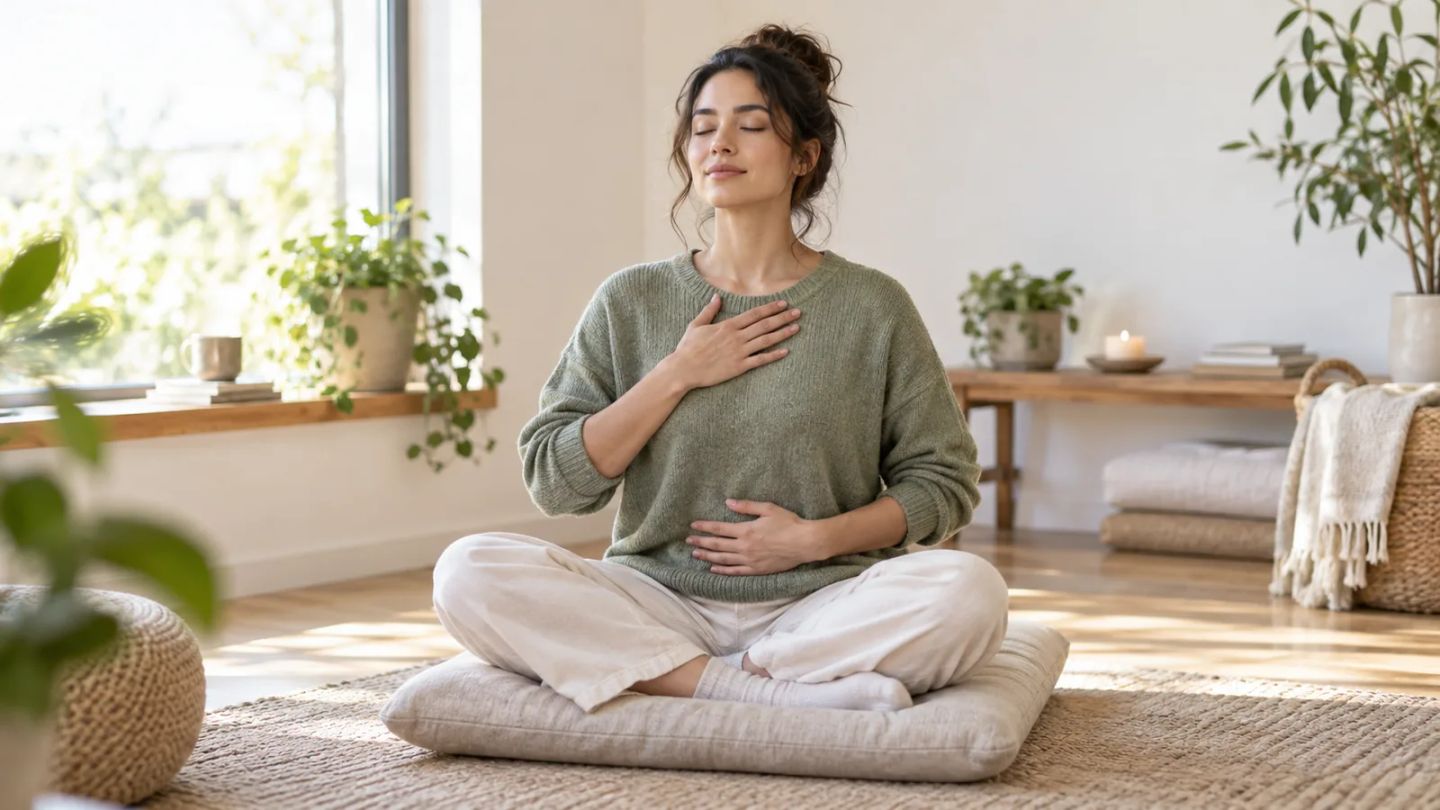
Breathwork is an umbrella word for breathing you shape deliberately, rather than the automatic breathing your body handles all day without your attention. For a few minutes you take the wheel, slowing the pace, drawing the breath lower into your belly, and often stretching the exhale.
Most popular techniques trace back to yogic breathing, or pranayama, repackaged with tidy names and counts that are easier to remember under pressure. The counts are a scaffold, not a rule. What matters is a slower, gentler rhythm than the one stress pushes you into.
The appeal is how little it asks. You can do it at your desk, on the bus, lying in bed, or waiting for the kettle, so it is a tool you might reach for on an ordinary day rather than only in a crisis.
How it works on your nervous system
Your body runs on two broad settings. One is the stress response, which speeds the heart and quickens the breath to ready you for action. The other is the calming, rest-and-digest side, and slow breathing is one of the simplest ways to nudge yourself toward it.
The link runs through the vagus nerve, the main pathway of that calming system. A systematic review of slow breathing describes how bringing your rate down promotes a predominance of the parasympathetic system over the stress side, working through vagal activity, with a matching rise in heart rate variability. The same review reports that these changes tend to travel with feelings of comfort, relaxation and alertness, and with lower anxiety.
The exhale does a lot of the work. A long, slow out-breath gently slows the heart and signals safety, which is why so many of the techniques below lean on the breath out rather than a bigger breath in. Slow, in this research, means fewer than ten breaths a minute, with around six a minute cropping up as a comfortable sweet spot.
You do not need to grasp the biology to benefit, but knowing there is a real mechanism helps a few slow breaths feel like a lever you can pull.
Five techniques worth knowing
Learn one first and get comfortable before adding another. Each suits a slightly different moment.
Box breathing
Named for its four equal sides, box breathing is the one to reach for when you want to feel steady and composed, not sleepy. Cleveland Clinic notes it is used by United States Navy SEALs and stressed-out people everywhere, and that regulating your breath this way can lower levels of the stress hormone cortisol.
- Breathe out slowly, emptying your lungs.
- Breathe in through your nose for a count of four.
- Hold for a count of four.
- Breathe out through your mouth for a count of four.
- Hold for a count of four, then begin again.
Run three or four rounds, dropping to three counts if four feels long. It suits the moments before a meeting or interview, when you want to walk in clear-headed.
4-7-8 breathing
This one tilts toward calm and sleep, because the long exhale and the pause between breaths pull you firmly toward the rest-and-digest side. Cleveland Clinic traces the method to the integrative medicine doctor Andrew Weil, with older roots in pranayama.
- Breathe in quietly through your nose for a count of four.
- Hold your breath for a count of seven.
- Breathe out through your mouth for a count of eight.
- Repeat for three or four cycles.
The counts are a ratio, so slow them to whatever you can hold comfortably. Beginners sometimes feel a little lightheaded at first, which is a good reason to do this one sitting or lying down, often as a wind-down at bedtime.
The physiological sigh
When you need to take the edge off fast, this is the quickest tool here. It is two breaths in followed by one long breath out, and you can do it standing, eyes open, mid-conversation.
- Breathe in through your nose.
- Without breathing out, take a second, smaller sip of air on top to fully fill your lungs.
- Let it all go slowly through your mouth in one long exhale.
One or two rounds can be enough for an acute spike of stress, or repeat it for a few minutes. It was the standout for calming down quickly in the Stanford trial below.
Coherent, or slow, breathing
This is the everyday practice rather than the emergency one. You slow your breathing to roughly six breaths a minute and hold that easy rhythm, which is the pace the research keeps landing on for lifting heart rate variability.
- Breathe in gently through your nose for a count of about five.
- Breathe out through your nose or mouth for a count of about five.
- Keep it smooth and unforced, and carry on for five minutes or so.
There is nothing to count beyond the in and out, which makes it a calm daily anchor and the version most worth building into a routine. Lengthen the out-breath a touch if that feels better.
Alternate nostril breathing
A slower, ritual-like practice from yoga, sometimes called nadi shodhana, it gives your hands and attention something to do, which some people find grounding when the mind is busy.
- Rest your right thumb lightly by your right nostril and your right ring finger by your left.
- Close the right nostril and breathe in slowly through the left.
- Close the left, release the right, and breathe out through the right.
- Breathe in through the right, then swap and breathe out through the left.
- Continue for a few minutes, keeping the breath soft and quiet.
Keep it easy and drop any breath-holding, especially if your blood pressure runs high. It suits a quiet few minutes at home more than a snatched public moment.
What the evidence does and does not show
Breathwork has real support and is also oversold in places, so it is worth being clear about both. The most talked-about recent trial came from Stanford. Researchers had 111 people practise one of three breathing techniques or mindfulness meditation for five minutes a day over a month. All groups improved, and the breathing groups reported greater gains in positive mood than meditation, with the physiological sigh producing the biggest daily lift, an effect that grew over the month.
That is encouraging, and it is one study of healthy volunteers over a short window. The wider picture is more measured. The US National Center for Complementary and Integrative Health, reviewing relaxation techniques including breathing, reports modest benefits across conditions such as anxiety and blood pressure, while noting that many studies are small and of low quality. Paced breathing showed a signal for easing menopausal hot flushes, and slow breathing was described as a reasonable first step for slightly raised blood pressure.
The slow breathing review makes the same caveat from the research side, pointing to the lack of a standardised method across studies. Effects are associated with slow breathing rather than guaranteed by it, and they vary from person to person.
The fair summary is that breathwork is a low-cost, low-risk way to take the edge off everyday stress, with decent evidence for calming you in the moment and modest effects over time. It is not a cure, and treating it as one sets you up to feel let down.
Safety and when to take care
For most healthy people, gentle breathing is safe. A few sensible cautions still apply.
Breath-holds and faster techniques can cause lightheadedness, so do those sitting or lying down, and never while driving or in water. If any technique leaves you dizzy, stop and breathe normally.
Slow it down or skip the holds if you are pregnant, or if you live with a heart or respiratory condition, and check with your GP before anything more intense. If breathing already feels hard for you, breath control is not the place to push.
There is a mental health caveat too. NCCIH notes that a small number of people report increased anxiety, intrusive thoughts or a fear of losing control with relaxation practices, and it flags rare concerns for people with epilepsy or certain psychiatric conditions, or a history of trauma. If slow breathing makes you feel worse, it is fine to set it aside.
Breathwork is a wellbeing tool for ordinary stress, not a treatment for an anxiety disorder or depression. If low mood, worry or panic carries on for weeks, gets in the way of daily life, or feels like more than you can manage, the NHS points you to talk to your GP, which is a sensible next step, not a sign the breathing has failed you.
Building a small daily practice
Finding a breathing technique you like is the easy part. Remembering to use it, on the flat days as well as the fraught ones, is where good intentions fade, and the fix is to give it a fixed home rather than a vague plan to breathe more.
Attach it to something you already do. "After I sit down at my desk, I take five slow breaths" ties the new habit to a cue that happens anyway, so you are not relying on willpower to remember. A doorway, the first cup of tea, the moment your head hits the pillow, pick one anchor and let it carry the habit. Our guide to tiny habits covers why small and attached beats big and vague.
Decide your smaller version now, before a hard day forces the question. When five minutes feels beyond you, three slow breaths still count, and a short go keeps the thread alive. If you miss a day, you have undone nothing, because your breath is right there the next time you think of it, so pick the next ordinary moment and start again.
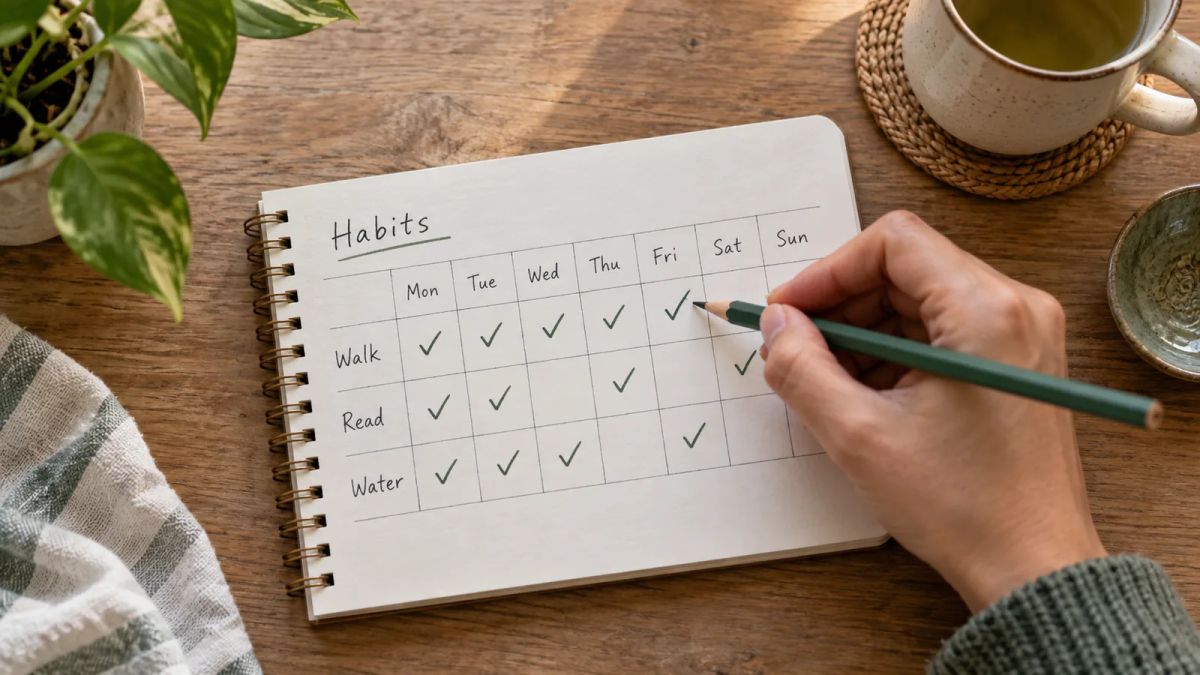
A small record helps you notice slow breathing becoming part of your week. Keep one on paper, writing the habit and cue, then ticking the days you show up.
Habit: Five slow breaths Cue: after I sit down at my desk
Mon ☐ Tue ☐ Wed ☐ Thu ☐ Fri ☐ Sat ☐ Sun ☐
A filled week might look like this, gaps and all.
Habit: Five slow breaths Cue: after I sit down at my desk
Mon ☑ Tue ☑ Wed ☐ Thu ☑ Fri ☑ Sat ☐ Sun ☑
If a paper grid is not your thing, our habit tracker guide covers gentler ways to keep score, and self-care ideas has more small practices to build in alongside it.
Meadow, without the streak
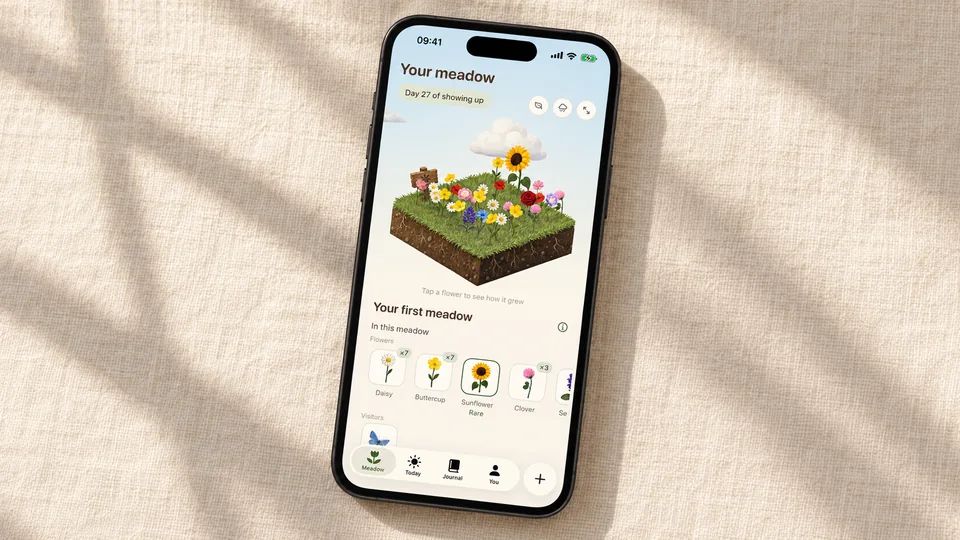
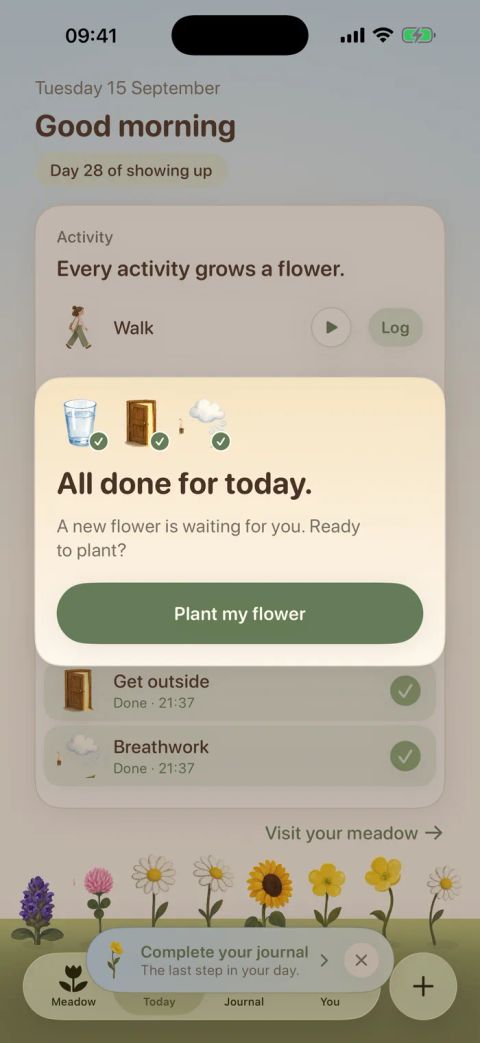
Another app worth checking out is Meadow, because it treats a missed day kindly, which is what a new calming habit needs. It is a gentle habit tracker for iPhone made by Wildcard Wellness, with breathwork as one of its built-in habits, so you can tick it off after your chosen cue alongside a note on your mood, a daily win and an affirmation. Every day you show up grows a wildflower, and rare flowers and small animal visitors turn up over time. There are no streaks to break, so a skipped day resets nothing and your flowers never wilt. It costs $39.99 a year or $9.99 a month after a seven-day free trial.
Frequently asked questions
Is there real evidence for breathwork?
Yes, with limits. Slow breathing reliably shifts you toward the calmer side of your nervous system and lifts mood in the moment, and a Stanford trial found five minutes a day improved mood over a month. The wider evidence is modest and many studies are small, so treat it as a helpful everyday tool, not a cure.
Which technique is best for sleep?
A long, slow exhale suits winding down, which is why 4-7-8 breathing is a common bedtime choice. Coherent breathing at around six breaths a minute works well too. Do either lying down.
What should I use in a moment of panic?
The physiological sigh, two breaths in and one long breath out, is the fastest to settle you and can be done standing with your eyes open.
How long and how often should I practise?
For a stress spike, one to three minutes is usually enough. As a daily habit, around five minutes once or twice a day is a sensible target, and consistency matters more than length.
Can breathwork replace therapy or medication?
No. It sits alongside other support, not in place of it. If anxiety or low mood is persistent or overwhelming, speak to your GP.
The one thing to do today is small. Pick one technique from above, try it for two minutes now, and choose the everyday moment tomorrow it will follow.
Every little bit counts
Five minutes counts. So does a dance in the kitchen.
Log the movement you enjoy and the small habits that help you feel good, and watch them bloom into something you can see.
Join the Meadow waitlist