Positive affirmations are short, kind sentences you say to yourself on purpose, usually to steady your confidence or soften a hard moment. They can help a little, the evidence is more modest than the glossy version suggests, and they work best when the line is one you can almost believe rather than a bold claim your own mind argues with.
Most of the lists you will find online promise a lot: repeat these words in the mirror and watch your life change. That is not quite how it goes. What follows is the honest version, plus a generous set of affirmations sorted by the parts of life women tend to carry, and a simple way to make one a daily habit that survives a busy week.
What an affirmation is, and what it is not
An affirmation is a phrase you choose to return to, meant to point you towards how you want to think about yourself. Confidence, calm, kindness towards your own body, a sense of being worth something on a day when you feel invisible.
What it is not is a treatment, or a spell. Saying "I am wealthy" does not move money. Saying "I am calm" does not end a panic. A kind sentence can change the tone of the voice in your head for a moment, which is a small and worthwhile thing, and it will not carry weight it was never built for.
Plenty of women come to affirmations carrying a heavy invisible load. The mental list of who needs what. The sense of being last on your own to-do list. The early starts of a caring role or a shift pattern. A line to yourself will not lighten any of that on its own. Kept small and believable, it can still be a steadying two minutes in a day that gives you few of them.
What the evidence does and does not support
Here is the clear-eyed part, because it changes how you should use these.
The research psychologists trust is not about mirror chanting. It studies self-affirmation, which means reflecting on the values that matter to you, like family, honesty, creativity or fairness. Reviewing that work, psychologist David Sherman describes how affirming an important value can reduce stress by setting a threat inside the bigger picture of who you are, so a single knock feels less total.
That effect shows up in careful studies. In one brain-imaging study, people who reflected on a core value showed more activity in the brain systems tied to self-worth and reward, and that pattern was linked to a later drop in sitting still. In another, self-affirmation improved problem-solving under pressure, but the lift showed up mainly in people who were already highly stressed. Both were small studies, and their authors are careful about how far the findings reach.
A recent meta-analysis in American Psychologist pooled 129 tests and found self-affirmation had small but real positive effects on wellbeing and self-perception, lasting rather than fleeting. Small and real is the fair headline. Not life-changing, worth having.
Now the part the cheerful lists leave out. Repeating a flattering line can backfire. A well-known study found that when people with low self-esteem repeated "I am a lovable person", they felt worse, not better, while people who already felt good about themselves got a mild lift. The authors concluded that positive self-statements can help some people and backfire for the very people who reach for them most. If a line feels false, your mind rejects it and the exercise turns against you.
So the takeaway is neither "affirmations work" nor "affirmations are nonsense". Grounded, believable, values-based lines have something behind them, and grand hollow ones can leave you flatter than before.
Word them so you can almost believe them
A hollow affirmation is one you would argue with. Tell yourself "I am completely calm" mid-panic and a quiet voice answers "no you are not". The believable version leaves room for where you are.
Reach for reminders rather than declarations. "I can handle the next hour" is easier to accept than "I can handle anything". "I am allowed to rest" lands better than "I love every part of my life". Ground the line in something you value, because "I want to be patient with my kids" has something real underneath it that a generic confidence slogan does not.
If a line makes you wince, it is too big for now. Shrink it until it feels almost true, then let it grow. A sentence that fits your actual Tuesday will still be there in a month, which the grand ones rarely are.
Affirmations for different parts of life
Borrow any of these, or reword them until they sound like you. Read each list and notice which one you could half believe on an ordinary morning. That is the one to keep.
For confidence
- "I have handled harder things than this."
- "I am allowed to take up space in this room."
- "I can be nervous and still do the thing."
- "I know more than I give myself credit for."
- "My opinion is worth saying out loud."
- "I do not have to feel ready to begin."
For stress and overwhelm
- "One thing at a time is enough right now."
- "I can only do the next small step, and that is allowed."
- "This feeling will pass, the way it has before."
- "Not everything on the list has to happen today."
- "I can put this down for ten minutes."
- "I am doing my best with a hard day, and that counts."
For your body, without the pressure to love it
- "My body carried me through today."
- "I can treat my body kindly whether or not I like how it looks."
- "I am allowed to eat without earning it first."
- "My worth has nothing to do with my size."
- "Comfort is allowed to matter more than the mirror."
- "I can thank my body for what it does on a day I cannot praise how it looks."
For work
- "I was chosen for this for a reason."
- "I can ask a question without looking foolish."
- "My work does not have to be perfect to be good enough."
- "I am allowed to log off when the working day is done."
- "I can say no to protect the work that matters."
- "A hard day at work is not proof I am failing."
For motherhood and caring
- "A good enough day is a good day."
- "I can love them and still need a break."
- "I am allowed to be a person as well as a mum."
- "My patience running out does not make me a bad mother."
- "Asking for help is part of caring well, not a failure at it."
- "Looking after someone else does not mean I stop counting."
For self-worth
- "My worth is not measured by how much I get done."
- "I do not have to earn rest, love or kindness."
- "I can be a work in progress and still be enough."
- "What I need is allowed to take up room."
- "I can speak to myself the way I would speak to a friend."
- "I am allowed to matter to myself."
Make it a small daily habit
The reason most affirmation habits fade has little to do with wanting it enough. The plan was vague. "I will say something kind to myself each day" has no home in your day, so it quietly disappears.
The American Heart Association suggests attaching a new action to a routine you already have. Pick a cue that happens anyway, most days, without you deciding: the kettle boiling, the first red light on the school run, sitting down at your desk, brushing your teeth. "While the kettle boils, I say my one line" gives the habit somewhere to live, so the cue does the remembering for you. This is the same logic behind tiny habits in general, and it works because the moment already exists.
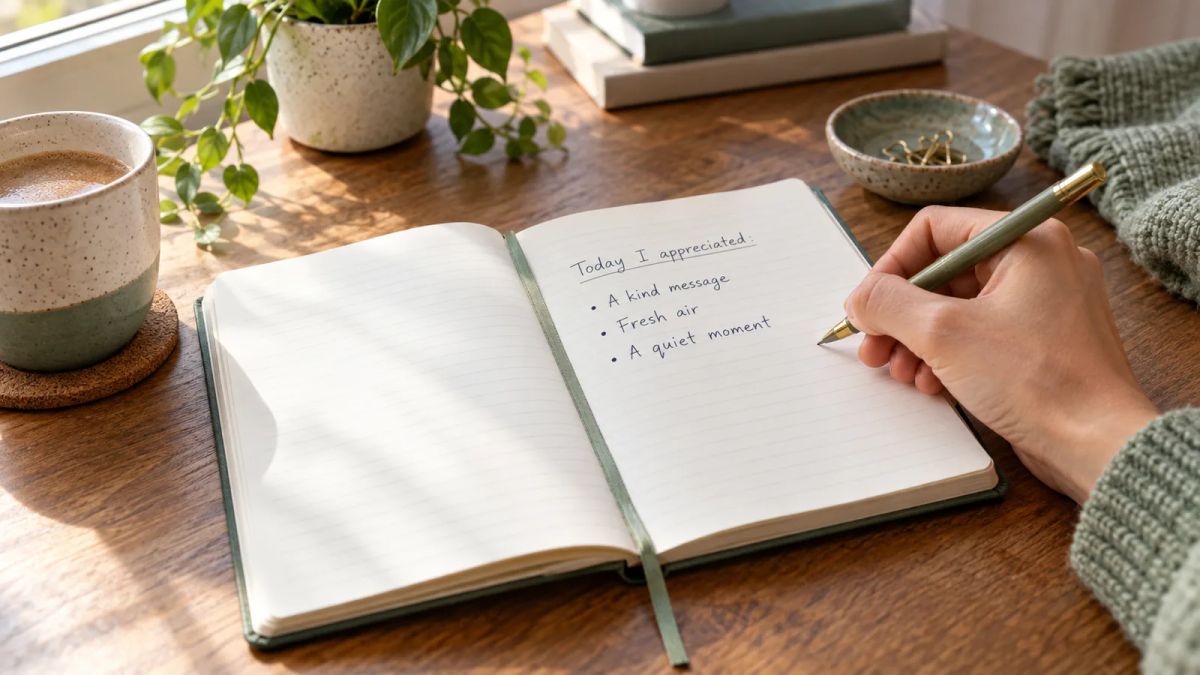
Keep it to one line and one cue to begin with. A stack of ten affirmations scattered across the day is a plan you will drop by Thursday. If you like the idea of writing more than one sentence, a short round of gratitude journal prompts sits well next to a morning affirmation, and if stress is the thing you are steadying, a minute of breathwork does more for a racing chest than any phrase.
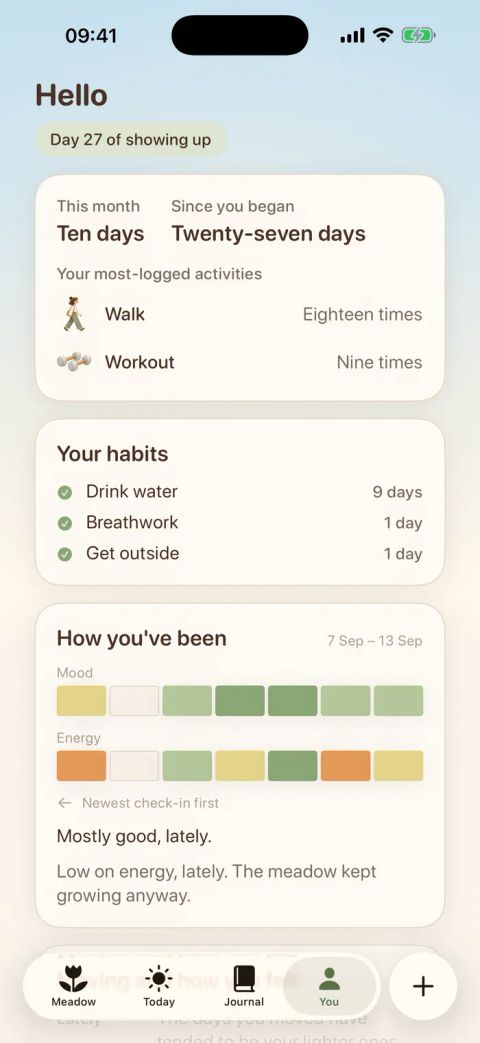
Some women like to see the days add up. Keeping track of a habit is associated with being more likely to follow through, in a large review of monitoring studies, whether that tracking is a tick on a calendar or a note in an app.
A daily affirmation in Meadow
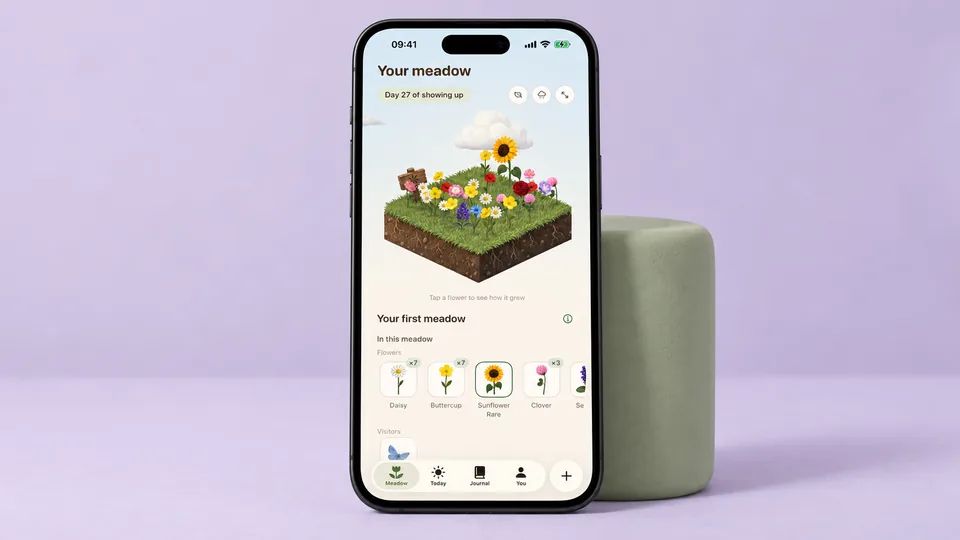
Another app worth checking out is Meadow, because noting a daily affirmation is one of the small things it asks you to do, alongside logging a bit of movement you enjoy, your mood and a daily win. It is a gentle habit tracker for iPhone from Wildcard Wellness. Every day you show up grows a wildflower, and rare flowers and little animal visitors turn up over time. There are no streaks to break, so if you miss a day nothing resets and your flowers never wilt, which takes the sting out of a gap. It costs $39.99 a year or $9.99 a month after a seven-day free trial.
When it is a stiff, busy or heavy day
Decide your smaller version now, before you need it. On a morning when everything is already loud, the whole habit can shrink to one breath and one line, said in your head while you do something else. That still counts. A short version keeps the thread going, and keeping the thread going is what builds the habit.
Time-to-automatic varies a lot from one person to the next, and a well-known study of how habits form found that missing a single day made no meaningful difference to the process. A missed morning undoes nothing. Choose the next cue, say your line, and carry on as though there was no gap, because as far as the habit is concerned there was not.
Affirmations are wellbeing support, not treatment. If low mood, anxiety or stress is sitting with you most days, a kind sentence is not the answer, and it is worth speaking to your GP. The NHS describes mindfulness as one option here, while being candid that it does not suit everyone. Being gentle with yourself can also mean reaching for more than words, so a few practical self-care ideas are worth having to hand.
Pick your one line now, the one that felt almost true when you read it earlier. Decide the everyday moment tomorrow it will follow, the kettle, the tap, the desk, and say it once when that moment comes.
See how far you've come
Your habits, moods and little wins, all in one place
Meadow keeps track of the walks, the water and the good days, so you can look back and watch your effort add up.
Join the Meadow waitlist