An ADHD-friendly morning routine works by moving the hard parts of the morning out of your head and into the room around you. Instead of leaning on memory and willpower to run the same steps in the same order, you set up cues, lists and prompts that hold the routine for you, so starting is easier and a forgotten step is easy to catch.
This is a how-to for adults, built around the way ADHD makes mornings hard, not around a tidy sunrise routine that assumes your brain hands you focus on request. It's general support for building a morning habit, not treatment for ADHD, and there's a note near the end on when to talk to a GP. Here we cover why mornings are harder with ADHD, how to hang the routine on your surroundings instead of your working memory, how to do tomorrow's deciding tonight, and how to pick the whole thing back up when a morning gets away from you.
Why mornings are hard when you have ADHD
A morning is a stack of small jobs done in a row, and each one asks the exact things ADHD makes unreliable. You have to start without a deadline pushing you, remember the order, and keep half an eye on the clock, all before you're properly awake.
That's executive function, which CHADD describes as "the brain's ability to prioritize and manage thoughts and actions". When it's running short, the morning doesn't fail because you don't care. It stalls at the joins: the gap before the first step, the switch from one task to the next, the missing sense of how long you've spent in the shower.
The fix is to carry less in your head, not to push harder. Every step you can pin to the room, or decide the night before, is one your morning brain doesn't have to generate from nothing. The general morning routine guide builds a routine from scratch for any brain, and the ideas here are the ADHD-specific layer on top.
Put the routine somewhere you can see it
Open our free printable: A morning list you can see (PDF). Save or print it to use alongside this guide. No sign-up needed.
The most useful move is to stop storing the routine in your memory and store it on a wall instead. A short visual checklist, kept where your morning already passes, does the remembering for you. By the kettle, on the bathroom mirror, stuck to the back of the front door.
Ticking each item as you go does more than mark progress. A meta-analysis of 138 studies found that monitoring your progress towards a goal makes you more likely to reach it, and the effect was stronger when people recorded it somewhere physical. Each tick is a small hit of done that pulls you towards the next line.
Keep it to five or six items. A long list turns back into the overwhelming morning you were trying to escape. Here's one to copy and cut down, and there's a general, non-ADHD version to borrow from in the morning routine checklist.
My morning list
☐ Drink a glass of water
☐ Take my meds, if I take them
☐ Open the curtains, light on my face
☐ Move for five minutes: a walk, a stretch, the stairs
☐ Eat, or grab, breakfast
☐ Bag and keys from the launch pad, out the door
And the same list, shrunk for a morning where everything is against you.
The bad-morning version
☐ Water, a few sips
☐ Meds, if I take them
☐ Grab the launch pad and go
Decide that shrunk version now, while things are calm, so you're not trying to invent it at 7am with your shoes in one hand.
Do tomorrow's deciding tonight
Half of what makes an ADHD morning hard is the sheer number of tiny choices, each one a fresh chance to stall or drift off. The trick is to make those choices the night before, when you have a little more in the tank, and leave your morning self almost nothing to decide.
Build a launch pad. One spot by the door where everything you leave the house with lives, packed and ready. Keys, wallet, bag, water bottle, headphones, whatever you'd otherwise spend ten frantic minutes hunting for.
Tonight's launch pad
☐ Clothes out, socks and shoes included
☐ Bag packed and by the door
☐ Keys, wallet, phone charger in the tray
☐ Breakfast decided, or on the counter
☐ Water bottle filled
A bag packed at 10pm doesn't need packing at 8am, and a decision made once doesn't need making again half-asleep. None of it has to be a perfect evening to work. Your evening routine is where this belongs, and the two hang together: a calm last hour tonight buys you a softer start tomorrow.
Make breakfast and clothes zero-decision
Some mornings the smallest choice is the one that sinks you. Standing at the wardrobe or the cupboard, unable to pick, watching the clock while nothing happens.
Take the choice away. Pick one or two breakfasts you can eat every day without thinking, and stock only those. Lay out one outfit the night before so there's no wardrobe to stand in front of. A default you don't have to like, only follow, beats a wide-open choice that leaves you stuck.
You can still vary things on a good day. The aim is to protect the fragile first hour from decisions that cost far more effort then than they do at any other time of day.
Borrow someone's focus for the step you can't start
Task initiation is the classic ADHD wall. You know exactly what to do, you want to do it, and you still can't make the first move. For that specific problem there's a strategy with a name: body doubling.
Body doubling means doing your own task while another person is present, in the room or over a video call, each of you working on your own thing. The Attention Deficit Disorder Association describes it as working "while having another person beside them", where the other person stays quiet and independent rather than helping or supervising. Their presence gives you something to start alongside, and a mild sense that "I can't waste this gift of time."
In practice for a morning, that's a friend on a silent video call while you both get ready, a partner pottering in the same room, or a co-working stream playing on a laptop. If nobody's about, a podcast or a favourite playlist gives you a lighter version of the same nudge to move.
Give time a shape you can see
Time blindness is the other quiet saboteur. Ten minutes and forty minutes feel much the same when you're mid-task, so a shower swallows the morning and you can't say where it went.
Make time visible instead of leaving it to a sense you don't have. A visible countdown, an analogue clock you can watch empty out, or a set of alarms staged through the morning all turn an invisible thing into something you can glance at. One alarm to start moving, one that means leave now. Vibrating or motion alarms help if a sound is easy to snooze and forget.
When the morning falls apart anyway
It will. A bad night, a flat day, a morning where the routine doesn't happen at all. This is the part most routine advice gets wrong for ADHD brains, treating a slip as a failure to feel bad about instead of a normal Tuesday to shrug off.
Progress doesn't have to be daily to count. ADDitude puts it plainly: "a few days out of the week is enough to make progress and keep overwhelm at bay," and a routine "does not demand perfection." There's no streak to protect here, so a missed morning breaks nothing.
The habit research backs the same relaxed approach. A well-known study on how habits are formed found that the time an action takes to feel automatic varies widely from one person to the next, and that missing a single day didn't stop the habit forming. Treat the early weeks as practice, not a test you can fail.
So when a morning collapses, drop to the bad-morning version and let that be a win. Water, meds if you take them, grab the launch pad. Pick the fuller list back up the next day, in its usual spot, with no attempt to make up the gap. The whole design is built to be restarted, over and over, without penance.
Somewhere to tick the steps off
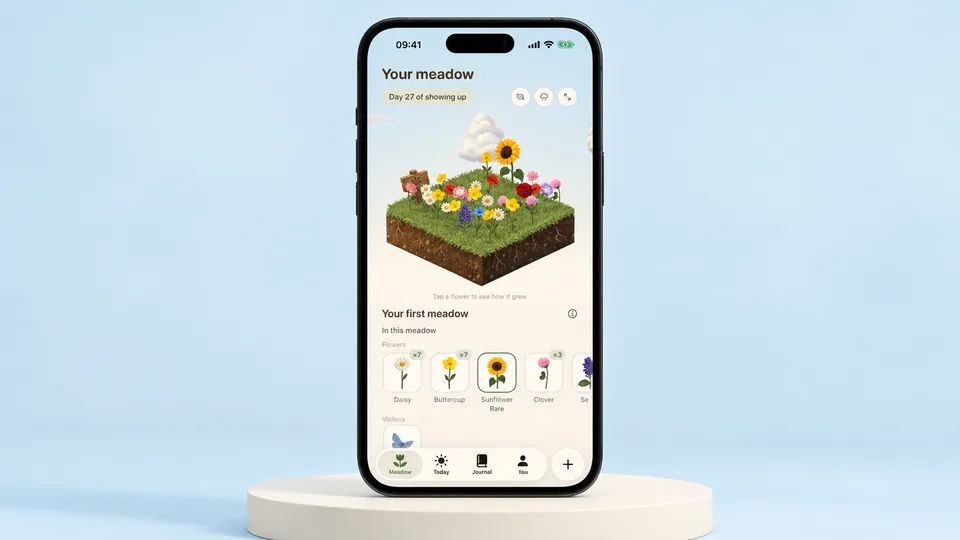
Some mornings run to plan and plenty don't, and Meadow is built for both. It's a habit app for iPhone from Wildcard Wellness where you tick off small daily steps like water, meds or a short walk, log any movement you manage, and note your mood and energy. Each day you show up grows a wildflower in your own meadow, with rare flowers and little animal visitors turning up as it fills in. There are no streaks, so a morning that fell apart resets nothing you've built, and you pick it up again whenever you're ready.
A note on getting support
A morning routine is a coping tool, not a treatment. If your ADHD symptoms are wearing you down at work, in your studies or in your relationships, that's worth proper support rather than another life hack. The NHS advises that if your ADHD symptoms are affecting your studies, work or relationships, you should make an appointment with a GP to find out what help is available. If you've never been assessed and mornings like these are a lifelong pattern, that same appointment is the place to start.
Common questions
How long should an ADHD morning routine be? Short enough that you'll finish it on a bad day. Five or six small items, ten to twenty minutes. A brief list you keep beats a long one you abandon by Wednesday.
What if I can't get started at all? Shrink the first step until it's almost nothing, and add a body double if you can. One sip of water, or a friend on a video call while you both get ready, lowers the wall enough to move.
Should I check my phone first thing? Try to hold off for the first ten minutes or so. The phone tends to swallow the quiet window where the useful bits of the morning fit, and once you're scrolling the list rarely gets done.
Do I have to wake up at the same time every day? A roughly regular wake time helps more than an early one, but don't let a strict clock become one more rule to break. Anchor the routine to waking itself, whenever that lands.
Is a paper list or an app better? Whichever you'll look at without fail. A sticky note by the kettle works. So does a checklist on your phone. The best one is the one that's in your eyeline when you need it.
Tonight, before bed, build your launch pad and write your morning list on something you'll walk past in the morning. Two small jobs, done while you're awake enough to mean them, and tomorrow's routine is already half-run.
AUTHOR
Co-founder of Meadow.
Ash is co-founder of Meadow, a habit and movement tracking app that turns small acts of self-care into a growing wildflower meadow.
Every little bit counts
Five minutes counts. So does a dance in the kitchen.
Log the movement you enjoy and the small habits that help you feel good, and watch them bloom into something you can see.
Download Meadow