A morning checklist earns its place only when you can finish it on your worst morning, not when it looks impressive on a calm one. The useful version is short, written down, and tied to things you already do, so it runs on a bad night's sleep and a house that woke up before you did.
So here is a real one you can copy, shrink and make your own. Take the list below as a starting point, then read on for how to choose your own items, why the high-value ones are worth the minute they cost, and how to keep the whole thing going when a morning gets away from you.
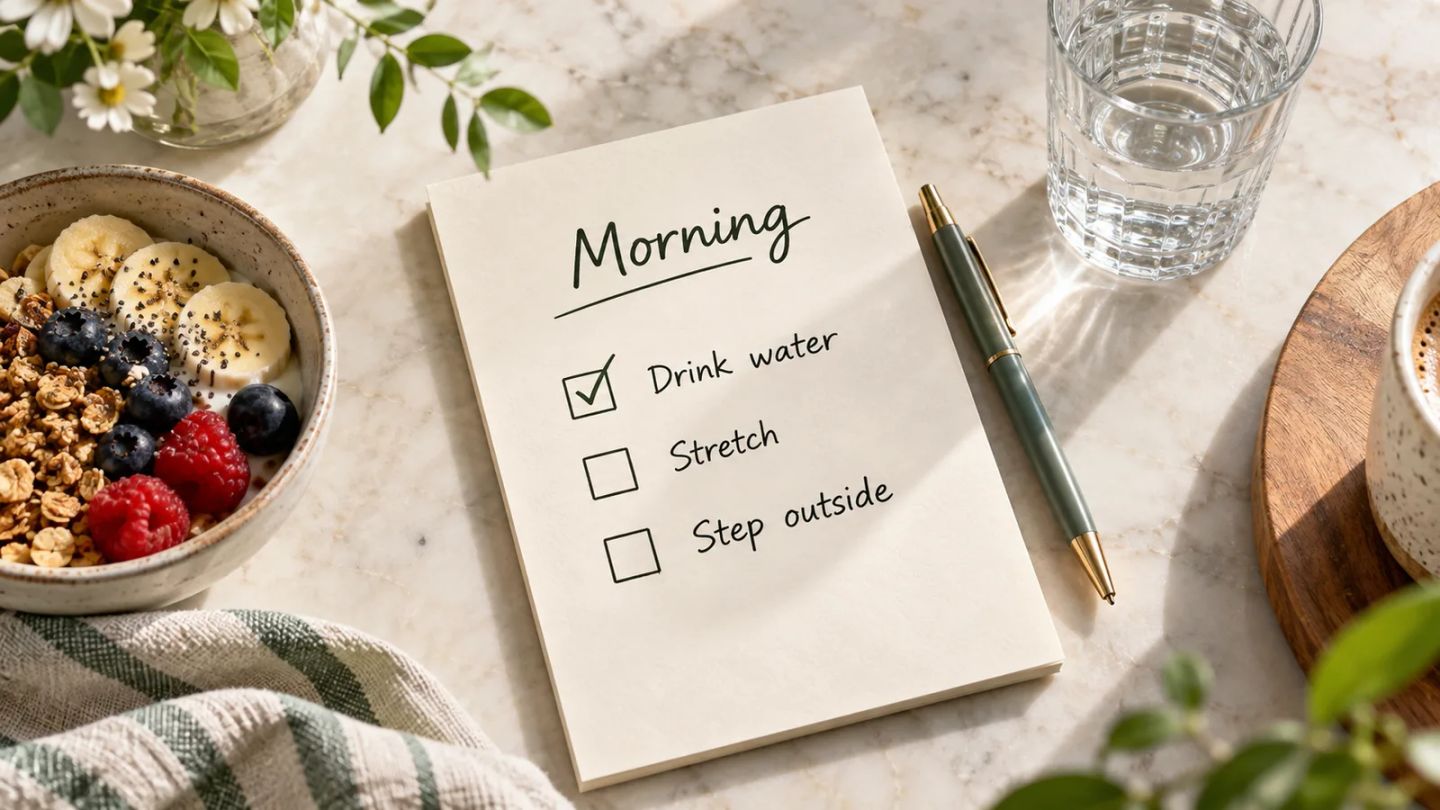
The morning checklist
Copy this as it is, or cross out what does not fit and swap in your own. Six small items, each one worth doing on its own.
Morning checklist
☐ Drink a glass of water
☐ Open the curtains and get some daylight on your face
☐ Move for five minutes: a short walk, a few stretches, or the stairs
☐ Eat, or set out, something for breakfast
☐ Take three slow breaths and name the one thing that matters most today
☐ Put what you need for the day by the door
That is the whole thing. It fits inside the morning you already have rather than asking you to find a spare half-hour that does not exist. Most of it can happen while the kettle boils and you find your shoes.
The five-minute version
Some mornings there is no time and no spare capacity. Decide your stripped-back version now, while things are calm, so you are not making the call when you are already behind.
Five-minute version
☐ A few sips of water while the kettle boils
☐ Curtains open, stand in the light for one minute
☐ One slow breath and one priority for the day
Three lines, sixty seconds of effort. A morning where you managed this is a morning you kept the checklist going, not one you failed. Keeping the thread alive on a hard day is what lets the fuller version grow back on a calmer one.
How to choose your own items
Think of the checklist as a few items picked from a short menu, not a set to complete. You are choosing what fits your morning and what you want more of, and two well-placed items you do most days will always beat five you abandon by Wednesday.
Pick three to five to begin with. Fewer feels too thin to notice, more starts to turn back into the dawn overhaul you were trying to avoid.
Weight your choices towards the gaps in your day. If you sit at a desk from nine onwards, lean into movement and daylight in the morning while you have the chance. If mornings are rushed and tense, a glass of water and one steadying breath may be plenty. There is no bonus for a longer list.
A quick way to choose: look at the four anchors below, keep the one or two that speak to your situation, and leave the rest.
Why these items earn their place
Each anchor is small, and each has a modest, real payoff behind it. None of this is a cure for anything, and none of it needs to be done perfectly to count.
A glass of water. Most of us wake a little short on fluid after a night's sleep, and a drink first thing is an easy win before the day gets loud. NHS guidance suggests six to eight cups or glasses a day, drinking regularly rather than all at once, and it notes that tea and coffee count towards that total. Your morning cuppa is already part of the picture, so a glass of water beside it needs no equipment and barely any time.
A few minutes of movement. This does not mean a workout. Harvard Health points out that even a short stroll can clear the mind and reduce stress, because movement lowers stress hormones and prompts the release of the brain's own mood-lifting chemicals. A lap of the garden, a walk to the postbox, or a few stretches by the bed all count. If mobility is your reason for choosing movement, a short morning stretch routine fits the same slot. If you have been inactive for a while or have a health condition, it is worth checking with your GP before you build up.
Daylight, early. Getting light on your face soon after waking is one of the simplest ways to help your body clock settle. The Sleep Foundation advises that if you want to wake up earlier, you should get light exposure in the morning, shortly after you wake up, because our internal rhythms evolved in response to bright days and dark nights. Stepping outside for a minute does it best, and on a morning when leaving the house is not an option, opening the curtains wide and standing at the brightest window is the smaller version of the same idea.
A wind-up for the day. This is the morning counterpart to a wind-down at night, a brief moment to point yourself at what is coming rather than being dragged straight into it. Three slow breaths, a glance at the one thing that matters most, or setting what you need by the door. It costs seconds and gives the rest of the morning a shape.
Making it stick
Choosing the items is the easy half. Getting them to happen on an ordinary, frazzled morning is where most plans come apart, and the fix has more to do with placement than with willpower.
The reliable move is to attach each item to something you already do without thinking. James Clear calls this habit stacking, and the formula is plain: after I do a current habit, I will do the new one. After I brush my teeth, I drink a glass of water. When the kettle clicks off, I stand at the window. As I put my shoes on, I take three breaths. The existing habit becomes the reminder, so you are not relying on memory at 6am for a plan you made the night before.
Be specific about the cue. "Move more" tends to evaporate. "Stretch by the bed before I make it" tends to happen, because it has a fixed place to live.
Expect it to take a while to feel automatic, and expect that to vary. A review of habit formation found automaticity plateaued on average around ten weeks, with wide variation between people and behaviours, and simpler actions like drinking water settling in faster than elaborate ones. There is no fixed number of days that works for everyone, so treat the early weeks as practice rather than a test.
You will also miss mornings, and that is fine. The same research found that missing a single day did not undo the progress already made, so there is no streak to mourn and nothing to restart from zero. Pick the checklist back up at the next natural opportunity, usually the following morning, without trying to make up for the gap. No double walk, no penance. The ordinary items go back in their usual spots, and that is enough. If you want more on the mechanics, our guide to healthy habits goes deeper.
Adapting it for shift work, parents and carers
A checklist built for a calm nine-to-five falls apart the moment real life does not cooperate. The point of anchoring each item to a cue is that the cue travels with you, whatever hour your morning starts.
If you work shifts, your morning is whenever you wake, not a clock time. Attach your items to waking itself and the first cup of the day rather than to sunrise. Daylight is the one anchor that shifts hardest against you, so if you wake after dark, a bright window or a light lamp stands in, and you catch real daylight whenever your day next allows it.
If small children get up before you do, assume your checklist has to survive being interrupted. Choose items you can do with a toddler underfoot or on your hip: sipping water, opening the curtains together, three breaths while the kettle boils. The five-minute version is often the honest one to keep on the fridge here, with the fuller list as a bonus on the rare quiet morning.
Carers face the same squeeze, where someone else's morning arrives ahead of your own. Pick the one or two items that steady you most and protect only those. A checklist that bends around a hard morning is one you still have next week.
Beyond the anchors here, our list of morning routine ideas has more small options to swap in.
Meadow, without the streak

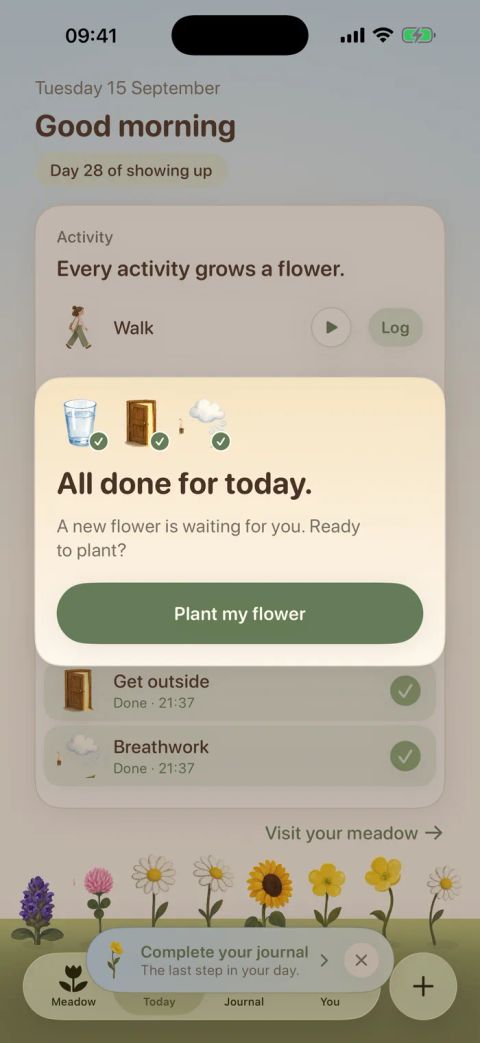
If seeing the thread helps you hold it, some people mark a tick on a wall calendar and others prefer an app. Another one worth checking out is Meadow, a gentle habit tracker for iPhone made by Wildcard Wellness, because it is built for exactly the stop-start rhythm of real mornings. You tick off small daily habits and log movement you enjoy, note your mood, a daily win and an affirmation, and each day you show up grows a wildflower, with rare flowers and little animal visitors turning up along the way. There are no streaks, so a missed morning resets nothing and your flowers never wilt. It costs $39.99 a year or $9.99 a month after a seven-day free trial, and a paper calendar on the kitchen wall does a plainer version of the same job if you would rather start there.
Tonight, before you sleep, write down three items from the list above and the cue each one will follow tomorrow. Three lines, decided in advance, and you have a morning checklist ready to begin.
Every little bit counts
Five minutes counts. So does a dance in the kitchen.
Log the movement you enjoy and the small habits that help you feel good, and watch them bloom into something you can see.
Join the Meadow waitlist