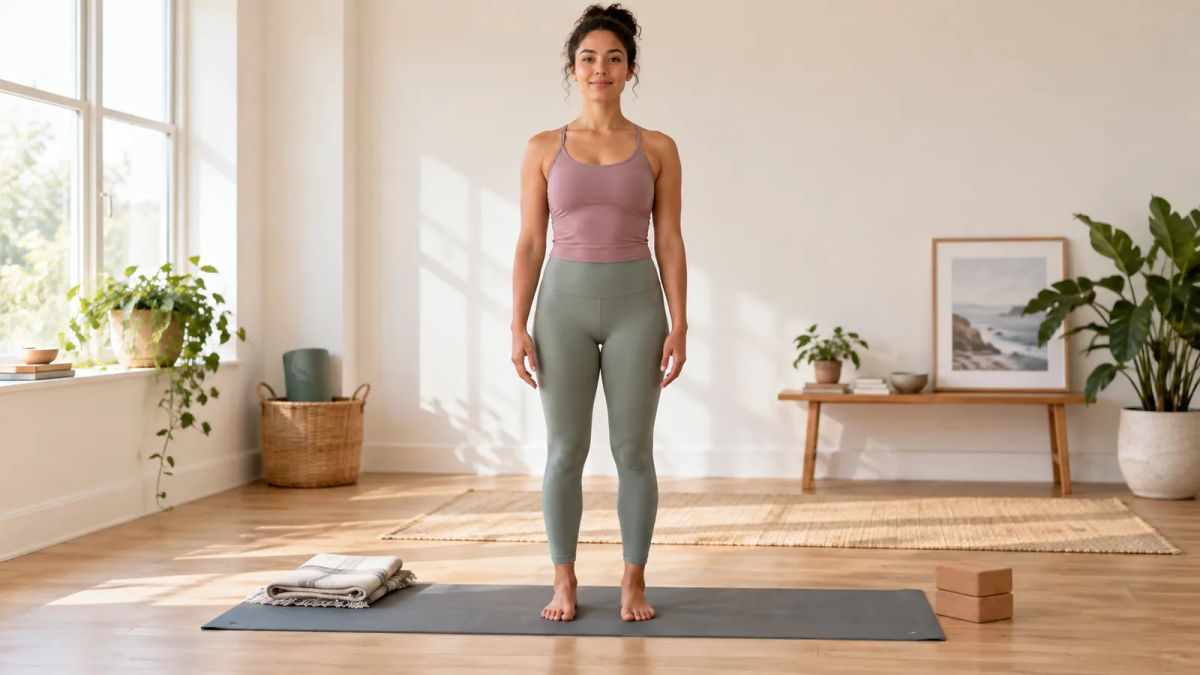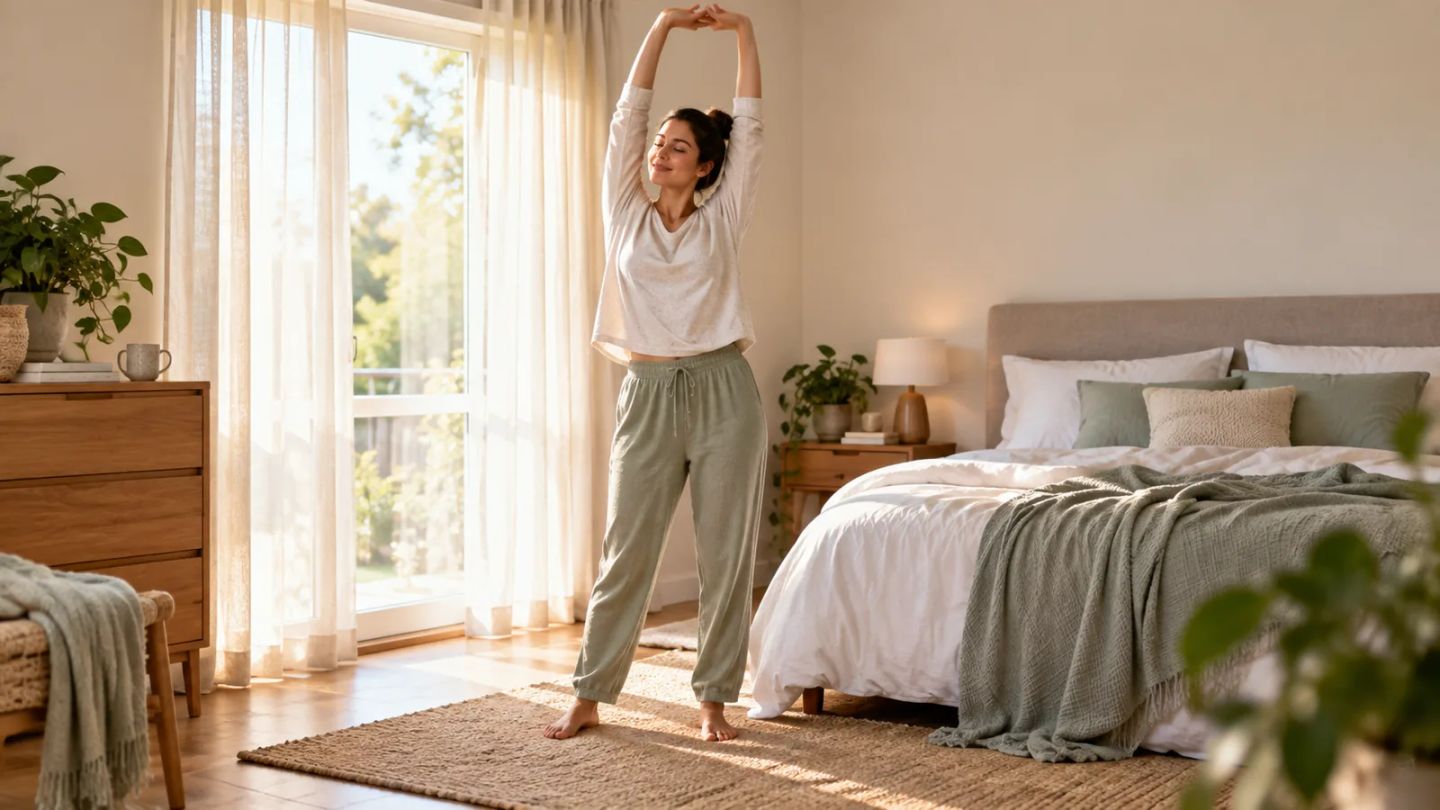
Waking up stiff is ordinary, and a few minutes of gentle stretching can take the edge off before the day gets moving. What follows is an ordered routine of eight easy stretches, working from your neck down to your calves, that you can do beside the bed or by the kettle in about five to ten minutes.
You have been lying still for hours, so your joints have settled and your muscles have cooled. The point of a morning stretch is to move each area through a comfortable range, feel a mild pull rather than a strain, and leave yourself a little looser and more awake. None of it needs equipment, floor work, or any flexibility you do not already have.
One honest note before the sequence. Stretching a cold body hard can do more harm than good, so this routine starts with soft, mobilising movements that warm you up as you go, then eases into the deeper holds. Harvard Health makes the same point, warning that stretching muscles before they are warmed up can hurt them and suggesting light movement first. The early stretches here are that light movement.
Move within comfort, and check first if you need to
Every stretch below should feel like a mild, tolerable pull, never a sharp or pinching pain. If a movement hurts, ease off and come out of it. The NHS gives the same general steer in its flexibility advice: move as far as is comfortable and build up the repetitions slowly over time.
If you have a joint problem, a recent injury, or a condition that affects how you move, it is worth checking with your GP or a physiotherapist before you start, so you know the movements suit you. That matters more than getting every stretch perfect. A short daily routine is a gentle thing, but your body is yours to look after.
The routine: eight gentle stretches, neck to calves
Do these slowly and in order. Breathe steadily throughout, and let each stretch be a mild pull rather than a test of how far you can reach. Where a stretch works one side at a time, do both.
- Neck release. Sitting or standing tall, turn your head slowly to look over one shoulder, then the other, keeping your chin level. Do three or four turns each way. Then drop one ear gently towards that shoulder until you feel a light stretch down the opposite side of your neck, and hold for around 15 seconds before swapping. This wakes up an area that holds a lot of the night's tension.
- Shoulder rolls. Lift both shoulders towards your ears, draw them back, and let them fall in a slow circle. Roll backwards five to eight times, then forwards a few times. Keep the movement unhurried and let your breath stay easy. There is nothing to hold here, it is loosening work.
- Chest opener. Clasp your hands behind your lower back, or rest them there, and gently draw your shoulder blades together so your chest opens towards the ceiling. If clasping is awkward, press the backs of your hands into a doorframe at shoulder height instead. Hold for 20 to 30 seconds, breathing into the front of your chest. A night curled on your side tends to round the shoulders forward, and this counters it.
- Cat-cow. On all fours, or seated with hands on your knees, alternate slowly between arching your back and rounding it. Breathe out as you round your spine towards the ceiling and let your chin drop, then breathe in as you drop your belly and lift your gaze. Flow through eight to ten slow rounds, matching the movement to your breath. This mobilises the whole spine and is one of the kindest ways to ease a stiff back.
- Standing side bend. Stand or sit tall, reach one arm up and over towards the opposite side, and lean gently until you feel a stretch along the flank of your raised arm. Keep it small and controlled, with no twisting. Hold for around 15 to 20 seconds each side. This opens the ribs and the long muscles either side of your spine.
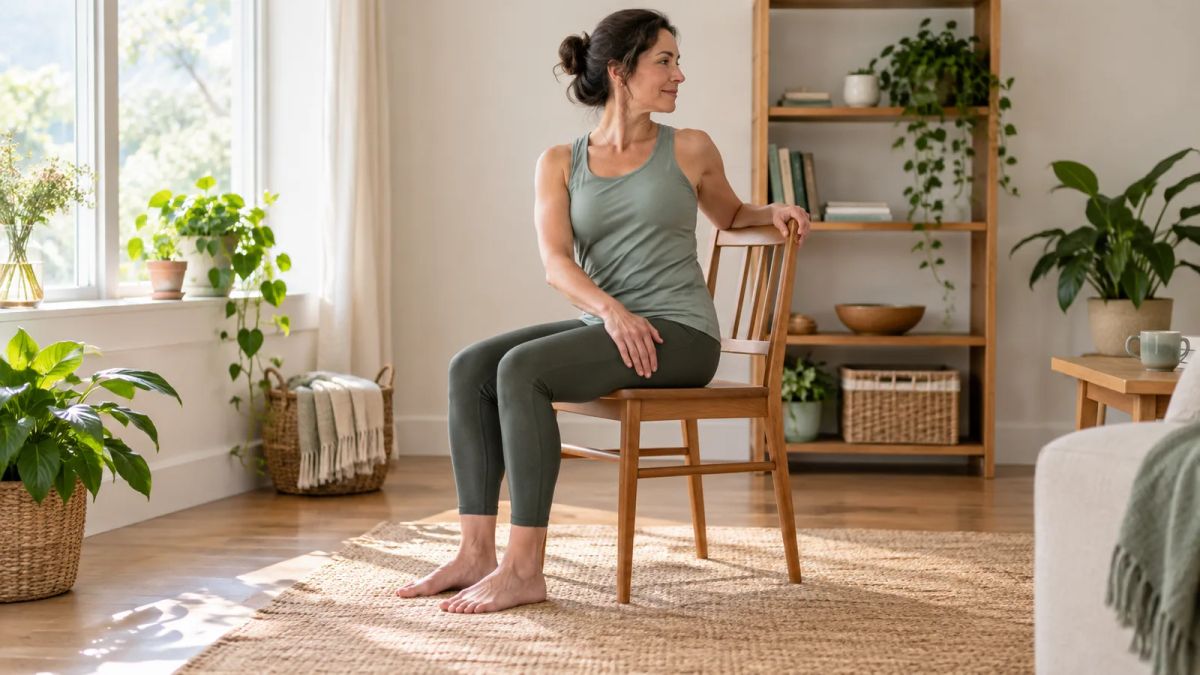
- Seated figure-four hip stretch. Sitting on the edge of the bed or a stable chair, rest one ankle across the opposite thigh so your bent knee opens outward. Sit tall, then hinge forward gently from the hips until you feel a stretch deep in the hip and outer thigh. Hold for 20 to 30 seconds, then swap. Tight hips are a big part of why standing up first thing feels awkward.
- Seated hamstring stretch. Stay seated, straighten one leg out with the heel on the floor and toes pointing up, and keep the other foot flat. Sit tall and hinge forward from your hips, chest leading, until you feel a stretch up the back of the straight leg. Hold for 20 to 30 seconds each side. Move from the hips rather than rounding your back, and do not force it.
- Calf stretch. Stand facing a wall or worktop, step one foot back with the heel pressed down and the leg straight, and lean forward gently until you feel the stretch up the back of your lower leg. Hold for 20 to 30 seconds, then swap. If standing is not comfortable, sit with the leg straight and draw your toes back towards you instead. Calves tighten overnight and make those first steps across the room feel stiff.
That is the whole sequence, top to bottom, in roughly five to ten minutes. On the deeper holds, both Harvard Health and Cleveland Clinic land in a similar place, with static stretches held for somewhere around 20 to 30 seconds and a total routine of ten to fifteen minutes being plenty.
What a morning stretch can and cannot do
Regular gentle stretching can help you move more freely. A study of community-dwelling older adults found that a ten-week stretching programme increased ankle range of motion by around nine degrees, a large improvement, though the researchers put it down to better tolerance of the stretch rather than any change in the tissue itself. Cleveland Clinic frames the everyday payoff well, noting stretching can help with ordinary tasks like climbing stairs and standing up from a chair.
Most people notice how it feels more than any measurable change. A slow stretch first thing gets you breathing, gets a little blood moving, and shifts you out of that heavy, half-asleep stiffness. That morning wake-up feeling is a fair reason to do it on its own.
The limits are worth being clear about too. Stretching is not a cure for a sore or injured body. A well-known review found that stretching before or after exercise produces only small, non-significant reductions in muscle soreness, so do not expect it to erase aches. Flexibility also comes slowly. Harvard Health notes it takes weeks to months of regular stretching to see change, and you have to keep it up to hold on to any gains. A five-minute routine will not transform your fitness or fix a longstanding joint problem, and it is no substitute for advice about a specific condition. If a particular area has been sore for a while, that is one to raise with your GP rather than stretch into.
How to make it a daily habit
A stretch you mean to fit in somewhere tends to slip. A stretch attached to a fixed point in your morning tends to survive.
The American Heart Association suggests tying a new action to a routine you already have, so it rides along with something automatic instead of competing for a fresh decision each day. Pick the moment that happens every morning without fail, the kettle boiling, the first cup of tea, cleaning your teeth, and let the stretch follow it. "While the kettle boils, I do my neck, shoulders and cat-cow" is the kind of plan that holds, because the cue is already built into your day.
Mornings suit this because your body has been still and the sequence is calm rather than demanding. If your mornings are chaotic with caring or shift work, anchor it to whatever quiet point you do have, even if that turns out to be lunchtime or the evening. The routine works whenever you do it.
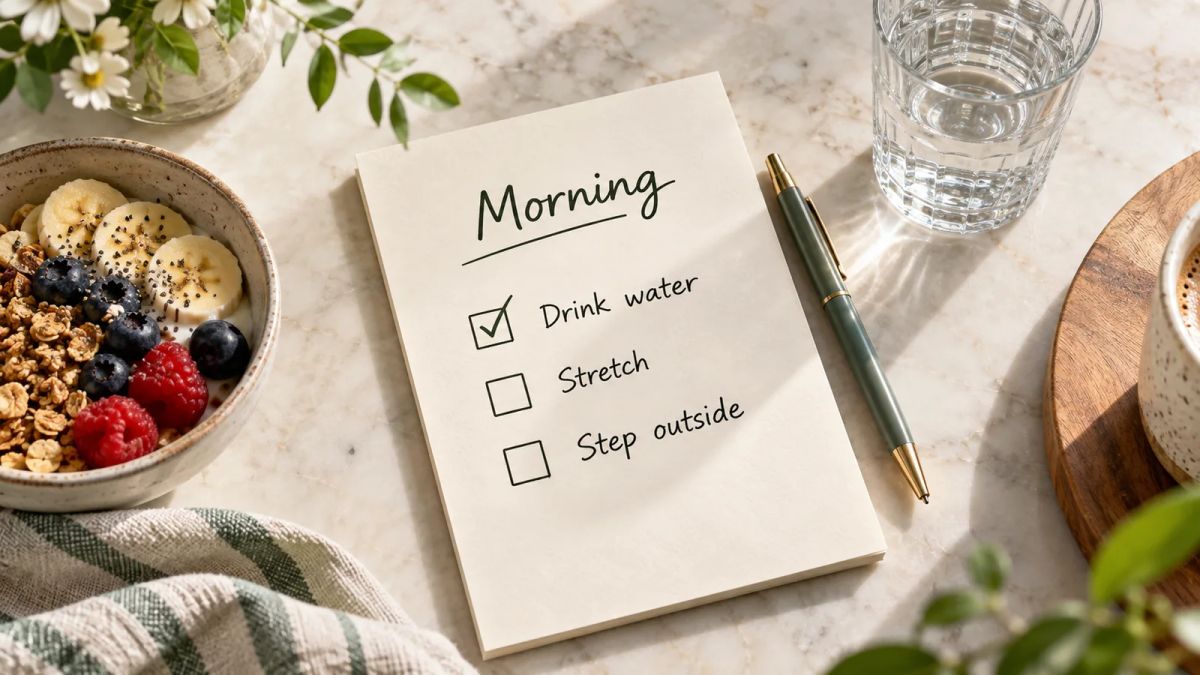
For a fuller start to the day, this sits neatly alongside a morning routine checklist. If you would like something a little more involved than stretching, gentle chair yoga or yoga for beginners covers similar ground with more structure.
On a hard day, and after a missed one
Decide your smaller version before you need it. On a stiff, rushed, or low morning, two slow neck turns, a few shoulder rolls, and one round of cat-cow still count. A minute of movement keeps the thread going, and keeping the thread going is what turns this into something your body expects rather than something you have to talk yourself into.
If you miss a day, or a week, nothing is undone. Stiffness after a gap is the result of staying still, not a mark against you, and the fix is the same as ever. Pick the next morning and do the neck and shoulders again. Starting small after a break is more reliable than trying to make up for lost time in one long session.
Meadow, without the streak

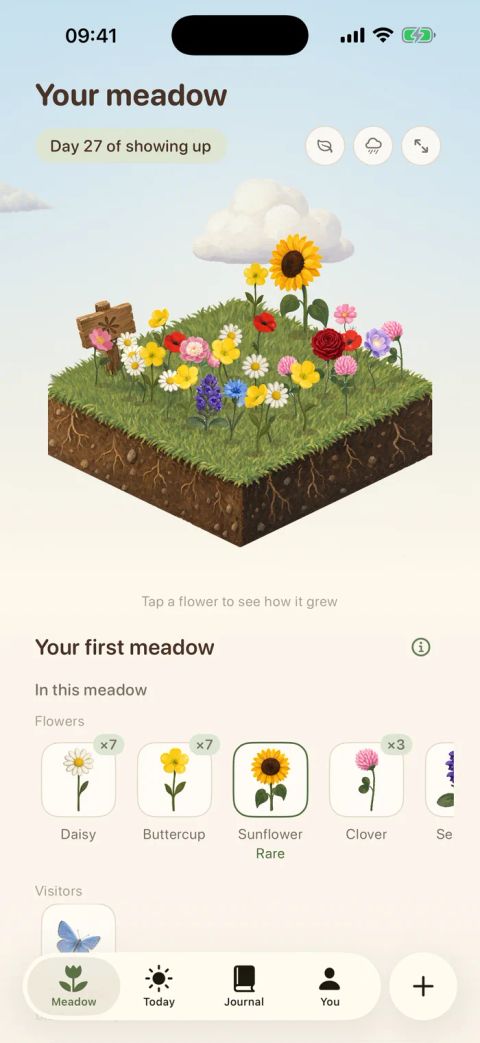
If seeing the thread you are building helps you keep it, a tracker can carry that quietly. Another app worth checking out is Meadow, because it is built to be gentle about it. It is a habit tracker for iPhone from Wildcard Wellness, and you log the movement you enjoy along with small daily habits, note your mood, a daily win, and an affirmation. Every day you show up grows a wildflower, and rare flowers and little animal visitors turn up over time. There are no streaks, so a missed day resets nothing and your flowers never wilt. It costs $39.99 a year or $9.99 a month after a seven-day free trial.
Tomorrow morning, pick your cue, the kettle or the first cup of tea, and do the neck release, shoulder rolls, and one round of cat-cow while it happens. That is enough to begin.
Little and often, with Meadow
Consistency, not intensity.
Meadow turns the movement you enjoy and the habits that help you feel good into a meadow of wildflowers. No streaks to break, and your flowers never wilt.
Join the Meadow waitlist