A morning routine that lasts is a short one built around the life you already have, not the one in a productivity video. The best routine for a parent mid school-run, a nurse coming off nights, or someone who wakes up flat and foggy is not the same routine, and it is almost never the five-a.m.-and-cold-plunge version that fills your feed.
What follows is a menu rather than a script. Pick one or two ideas that fit your morning, learn the small bit of science that makes them stick, then borrow one of the example routines or build your own. A morning where you did one useful thing counts. That is the bar.
The small science of making it stick
Most routines fail for a dull reason. They ask you to remember something new at the exact moment your morning is at its most chaotic.
The fix is anchoring, sometimes called habit stacking. You attach the new action to something you already do without thinking, so the old habit becomes the reminder. James Clear, who wrote Atomic Habits, gives it a plain shape: after a current habit, I will do the new habit. "By linking your new habits to a cycle that is already built into your brain, you make it more likely that you'll stick to the new behavior," he writes. So "while the kettle boils, I drink a glass of water" beats "drink more water", because the kettle turns up every morning and your good intentions do not.
Keeping a light eye on how it is going helps too. A meta-analysis of 138 studies found that monitoring your progress towards a goal makes you more likely to reach it, and the effect was stronger when people recorded it somewhere rather than keeping it in their head. A tick on a calendar is enough.
One more thing worth knowing before you start. There is no magic number of days. Research on how habits form found that the time it takes for an action to feel automatic varies enormously from one person to the next, and that missing a single day did not stop the habit forming. The goal is not an unbroken chain. It is a thing you keep coming back to.
A menu of morning ideas
Read these as options, not a checklist. One is a fine place to begin.
- A glass of water. You wake up a little dehydrated, and a drink first thing is an easy win. The NHS suggests six to eight cups or glasses a day, drinking regularly rather than in one go, and it notes that tea and coffee count, so your first cuppa is already helping.
- Daylight, early. Getting outside soon after waking is one of the better-evidenced morning habits. The Sleep Foundation notes that morning light helps reset your body clock and that your rhythm is most sensitive to light in the hour or so after you usually wake. A few minutes by an open door or window still does something on a grey day.
- A few minutes of movement. Not a workout. A short walk, a stretch, a lap of the kitchen while the toast browns. Harvard Health notes that exercise improves mood and sleep and lowers stress, and morning is a tidy time to fit it in before the day fills up.
- A slow set of breaths. On a tense morning, a minute of steady breathing settles you before the demands land. Sitting on the edge of the bed is fine.
- One line on paper. A single sentence of plan, gratitude or intention. Enough to feel you have arrived in the day rather than been dragged into it.
- A steadier wake-up time. The Sleep Foundation points to keeping your wake time consistent, even at weekends, as one of the stronger levers on how you feel in the morning. Treat this as an aim rather than a rule if your nights are broken.
Now for how those ideas shift depending on the morning you are working with.
If you are an early riser with time
If your morning has real space in it, you can string two or three anchors together without strain. A glass of water, ten minutes outside, and a few lines in a notebook is a full routine that still fits inside a quarter of an hour. The trap here is piling on so much that a normal-length morning can no longer hold it, so keep one or two anchors fixed and treat the rest as nice-to-haves.
If you work shifts
Shift work makes the standard advice hard, because "wake at the same time daily" is not on offer. Anchor to events instead of the clock. The first glass of water goes with your first drink of the shift, the walk goes with the commute, the wind-down breaths go with getting home, whenever home happens to be. Consistency of sequence matters more here than consistency of hour.
If you have small children
A parent's morning belongs partly to someone else, so the routine has to be things you can do with a child in tow or in ninety seconds flat. Drink your water while you make theirs. Step onto the doorstep together for your daylight. Take your slow breaths in the two minutes it takes them to find their shoes. The idea is to thread the habit through the morning you already have, rather than carve out a private slot that will not exist.
If you wake up low on energy
Some people wake flat, foggy or anxious, and a demanding routine only adds to the weight. Shrink everything. One sip of water, one minute of light, one slow breath, done from the edge of the bed if that is as far as you get. Low-energy mornings are exactly when the tiniest version earns its keep, because doing something small keeps the habit alive without asking for effort you do not have. If low mood or exhaustion is persistent and wearing you down, it is worth raising with your GP.
Example routines you can copy
Two worked examples, both built from the menu above. Take them wholesale or swap parts out.
A five-minute routine, for a tight morning:
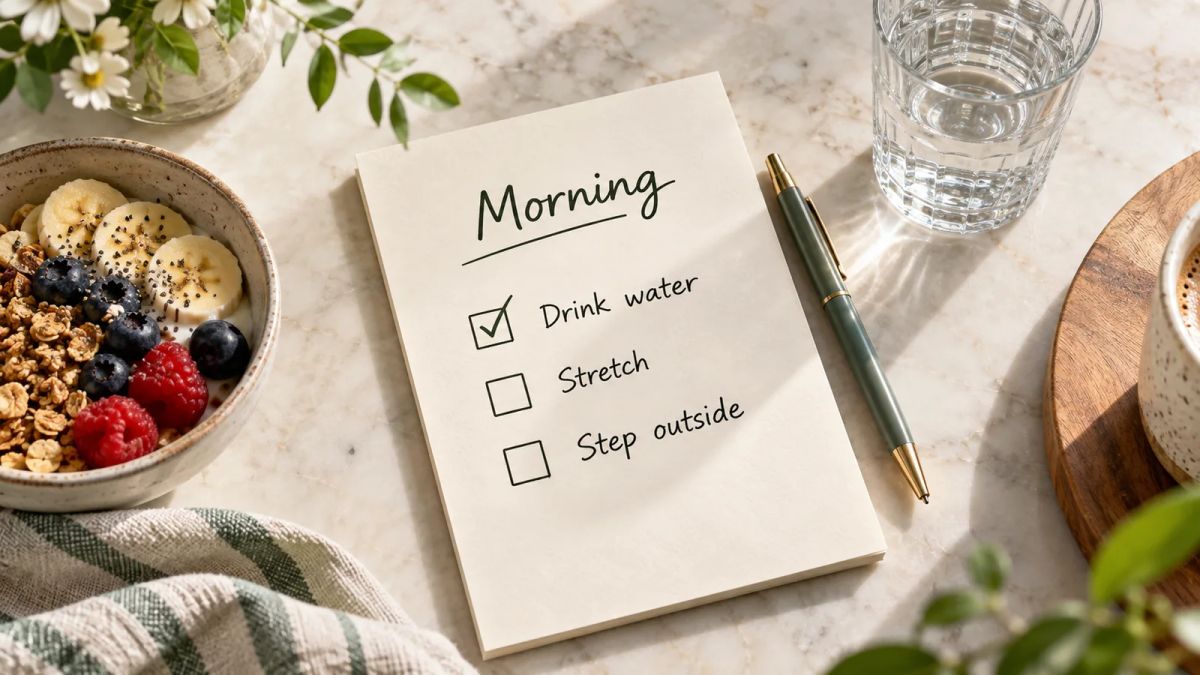
- Drink a glass of water while the kettle boils.
- Step outside or to an open window for one minute of daylight.
- Take five slow breaths before you pick up your phone.
A twenty-minute routine, for a slower start:
- Glass of water on waking.
- Ten minutes outside, a short walk or coffee on the step, for daylight and a little movement at once.
- Five minutes of gentle stretching to loosen a stiff body.
- Two minutes with a notebook: one thing you are grateful for, one thing that matters today.
Notice that each step is pinned to a moment or a place, not a precise time. That is the anchoring at work.
A short routine, spelled out
If you want a single concrete one to start tomorrow, use this. It takes about five minutes and needs no equipment.
While the kettle boils, drink a full glass of water. While it is still heating, open the back door or a window and stand in the daylight for a minute. Once you have your first hot drink in hand, take five slow breaths before you look at any screen. That is the whole thing. Three anchors, all hung on the kettle and the first drink you were going to have anyway.
What to avoid
The commonest way a morning routine dies is perfectionism. A rigid, ten-step, minute-by-minute plan looks impressive on day one and buckles the first time a child is sick or an alarm fails. Then the collapse feels like proof you cannot keep a routine, and that feeling is what makes people quit.
Guard against a few specific traps:
- Copying someone else's routine wholesale. A plan built for a childfree founder with a home gym will not survive your Tuesday.
- Front-loading it with things you dislike. If you hate cold showers, a cold shower will not become the reason you get up.
- Chasing an unbroken streak. One missed morning changes nothing, and treating it as a reset only tempts you to abandon the rest.
- Building it around your best mornings. Design for an average or bad morning, and the good ones look after themselves.
How to build your own
You do not need a template to make one that fits. Four steps.
- Pick one anchor action from the menu. One, to start. You can add a second once the first runs on its own.
- Name the existing habit it will follow. Be specific: the kettle, the toothbrush, the front door, sitting down with your first coffee.
- Write the sentence. "After I [existing habit], I will [new action]." Say it out loud once. That is your routine.
- Decide the tiny version now. Choose the shrunken action for hard mornings before you need it, so you are not making the call when you are already behind.
Add to it slowly. A routine that grows one anchor at a time, each new piece bedded in before the next, outlasts one you assemble all at once.
For more on picking what to keep, our guide to tiny habits and the wider piece on building healthy habits go deeper. If you would rather work from a ready-made list, the morning routine checklist gives you one to copy, and the morning stretch routine covers the movement piece in detail.
When a morning goes sideways
You will miss mornings. A broken night, a poorly child, a shift that ate the day. Missing one does nothing to whether the routine is yours, and the habit-formation research already told you a single gap does not undo your progress.
Pick it back up at the next natural chance, usually the following morning, with no attempt to make up the lost time. No double walk, no penance. The ordinary small action goes back in its usual spot, and that is enough.
Meadow, without the streak

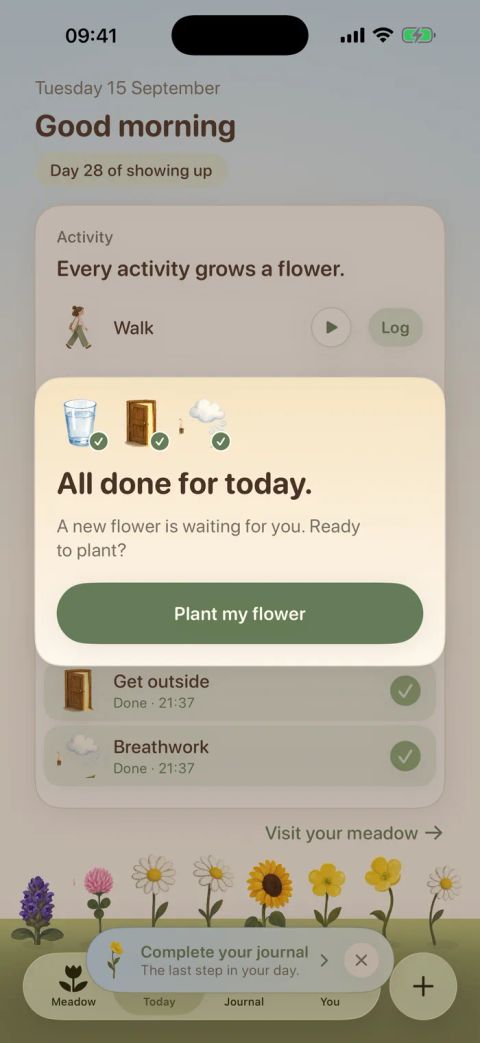
If seeing the thread helps you keep it, some people tick a wall calendar and others prefer an app. Another app worth checking out is Meadow, because it is built for the imperfect mornings this piece is about. It is a gentle habit tracker for iPhone, made by Wildcard Wellness, where you log the movement you enjoy and small daily habits like drinking water or getting outside, note your mood and a daily win, and watch a wildflower grow each day you show up. There are no streaks, so a missed day resets nothing and your flowers never wilt. It costs $39.99 a year or $9.99 a month after a seven-day free trial.
Common questions
What is a realistic morning routine? One or two small actions you can manage on your worst morning, attached to things you already do. If it only works on a calm, empty morning, it is not realistic.
How long should a morning routine be? As long as your actual mornings allow. Five minutes done every day beats forty minutes done twice.
What should I do first thing? Water and daylight are two of the easiest, best-supported choices. Both take under a minute and ask for no equipment.
Do I have to wake up early? No. A consistent wake time helps your body clock more than an early one, and for shift workers even that is negotiable.
Tonight, before you sleep, pick one action from the menu and name the existing habit it will follow tomorrow. One thing, one moment you already have. That single sentence is your morning routine, and you can grow it from there.
Every little bit counts
Five minutes counts. So does a dance in the kitchen.
Log the movement you enjoy and the small habits that help you feel good, and watch them bloom into something you can see.
Join the Meadow waitlist