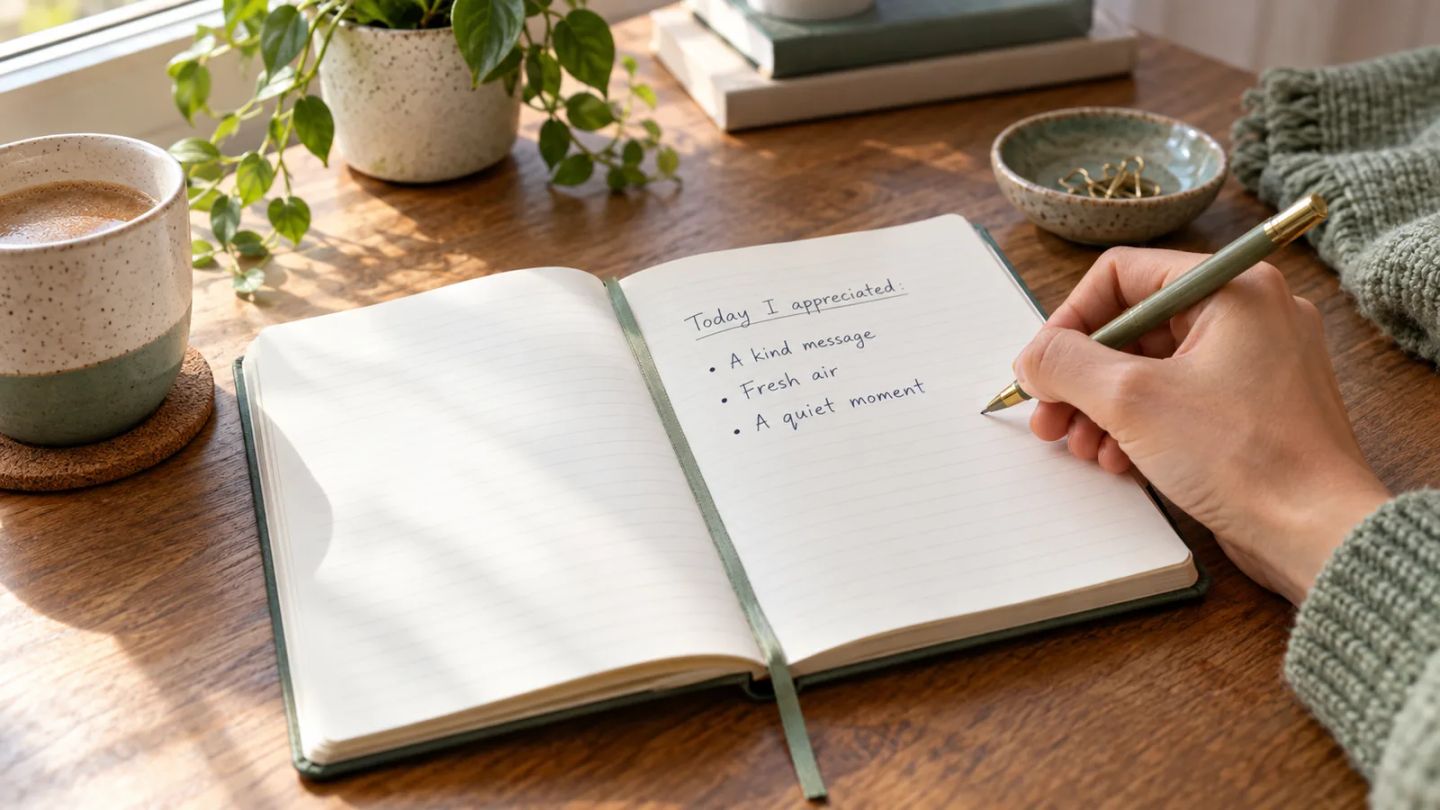
A gratitude journal is a small, regular habit of writing down a few things you are thankful for. That is the whole of it. If you want to start tonight, write three things from today that you were glad of, however ordinary, and stop there. A line about the tea someone made you, the bus that came on time, the friend who texted back. It does not need a beautiful notebook or the right words, and it does not need to be done every single day to be worth doing.
The point of a page of prompts is to solve the one problem that quietly kills most gratitude journals: the blank page. "What am I grateful for?" is a wide, vague question, and a tired mind tends to answer it with the same three words every night. A good prompt narrows it to something you can answer in one specific sentence. What follows is a generous set to draw from, grouped so you can pick by mood, plus an honest look at what this habit does and does not do, and how to keep it going past the first fortnight.
What gratitude journalling does, and what it does not
The research here points in a modest, hopeful direction, and it helps to be clear about how modest. In the study most often quoted, Emmons and McCullough asked people to write regularly about things they were grateful for, and found gains in wellbeing across several of their measures, though not all of them, with the lift in positive mood the steadiest result. Harvard Health, summarising this and later work, notes that people who wrote about gratitude tended to feel more optimistic and better about their lives, while being careful to say these studies show association rather than proof, and that gratitude journalling did not help everyone.
Later reviews keep that caution. A systematic review of gratitude interventions among workers found reductions in perceived stress and depression, but mixed effects on broader wellbeing, and rated the underlying studies as carrying a high risk of bias. So the fair summary is this. A gratitude journal is associated with feeling a bit better, often, for a lot of people. It is not a lever that always works, and it is a wellbeing practice rather than a treatment.
That honesty matters for a second reason. A gratitude journal is not an instruction to feel positive about things that are hard. Writing "I am grateful for my illness" or "I am grateful I lost my job" when you feel neither helps no one, and forcing a bright face onto real pain tends to leave people feeling worse and more alone. The NHS describes mindfulness as noticing what is going on inside and around you, and adds plainly that some people find these practices unhelpful or feel worse for them. A gratitude journal is the same. Notice what is true and good where you can find it, let the hard things stay hard, and if the writing leaves you flatter rather than steadier, put it down.
A generous set of prompts to draw from
You do not need to work through this list. Pick one prompt that suits the day and write a sentence or two. One good prompt an evening is plenty, and coming back to the same one on different days is fine.
Everyday moments
- Name one small thing that went the way you hoped today.
- What is something ordinary you would miss if it were gone tomorrow?
- Which part of today would you happily live over again?
- What went better than you feared it might?
- What is a task you got through today that you had been dreading?
- What did today give you that yesterday did not?
- What is one thing about your home that made today easier?
The people around you
- Who made your day a little lighter, and what exactly did they do?
- Who would you thank right now if they were in the room with you?
- Think of someone you would struggle without. What do they do that you rarely say out loud?
- Who taught you something this week, on purpose or by accident?
- What is a kindness a stranger showed you recently?
- Who checked in on you, and how did it land?
- Whose company, voice or messages do you look forward to?
Hard days
- What is one thing that held steady today when other things did not?
- What, or who, got you through the worst hour of today?
- What is a small comfort you reached for today and were glad of?
- What did you manage to do today, even though it was hard?
- What made a difficult day slightly more bearable?
- What is something you can be grateful is now behind you?
Yourself
- What is one thing your body let you do today, even if it protested?
- What is a decision you made today that your calmer self would approve of?
- Name a quality in yourself that showed up when you needed it.
- What is a mistake that taught you something worth keeping?
- What did you do today that a friend would be proud of?
- What is a part of your character you were quietly glad of today?
Small pleasures
- What did you eat or drink today that you enjoyed?
- What is a sound, smell or view that steadied you today?
- What made you laugh, or nearly?
- What is a small object that does its quiet job every day?
- What piece of music, book or programme gave you something this week?
- What did the weather offer you today, for better or worse?
- What is a comfort you are looking forward to tonight?
Seasonal and looking ahead
- What is something about this time of year you are glad of?
- What are you looking forward to, however far off?
- What is something this season lets you do that another does not?
- What is a tradition, big or small, that you would not want to lose?
- What is something you are grateful you learned this year?
- What is a change in the last month you did not expect to welcome?
- What would you like to still be grateful for a year from now?
What makes a prompt land
A few small habits make the writing count for more, and they come straight from the people who study this. The Greater Good Science Center at Berkeley, in its guide to keeping a gratitude journal, suggests going for depth rather than breadth. One thing written about in detail does more than five things listed in a rush.
Be specific. "I am grateful my neighbour brought the bins in while I was away" beats "I am grateful for my neighbour", because the detail is where the feeling lives.
Lean towards people over things when you can. The same guide notes that gratitude aimed at the people in your life tends to move you more than gratitude aimed at your possessions, which is why so many of the prompts above ask about a particular person and what they did.
Try subtraction now and then. Instead of listing what you have, picture the day, the person or the small comfort not being there at all, and notice what you would miss. It is a sharper way in than gratitude by rote, and it works well on evenings when the usual answers feel worn out.
Making it a small habit you keep
Finding good prompts is the easy part. Remembering to write, night after night, is where most gratitude journals quietly stop. The way through is to lean less on willpower and more on a cue that already happens. The American Heart Association, on making habits stick, suggests attaching a new action to an existing routine so it rides along with something you do anyway.
Before bed is a natural home for it. "After I get into bed, I write down one thing I was grateful for today" ties the habit to a moment that arrives every night, and keeping the notebook and a pen on the bedside table means the whole thing takes under a minute. If your evenings are chaotic, pick a different anchor. The first cup of tea in the morning, the walk back from the school run, the moment you sit down on the bus. One steady cue does more than any burst of motivation. If mornings suit you better, a gratitude line can slot neatly into a wider set of morning routine ideas.
The format is yours to choose. A short list of three works for most people, and the research above leaned on brief, regular entries rather than long ones. On a busy night, a single word standing for the day is a real entry. If you would rather write to someone, a gratitude letter, even one you never send, is a stronger version of the same idea. Some people prefer a weekly sit-down to a nightly line, which is fine, though evidence suggests very occasional entries, four times or fewer over a stretch, tend to do little. Little and often beats long and rare.
Decide your smaller version now, while you are calm, so a bad day does not end the habit for you. On a night when even one line feels like too much, letting a single word stand counts. "Warmth." "Rest." "Her." A short entry keeps the thread alive, and keeping the thread alive is what turns something you tried into something you do. If you miss a night, or a whole week, you have undone nothing. The notebook is still there. Pick the next evening and start again, with no need to make up the days you missed. A gratitude journal pairs well with other gentle self-talk practices too, such as positive affirmations, if you find that kind of thing steadying.
Meadow, without the streak
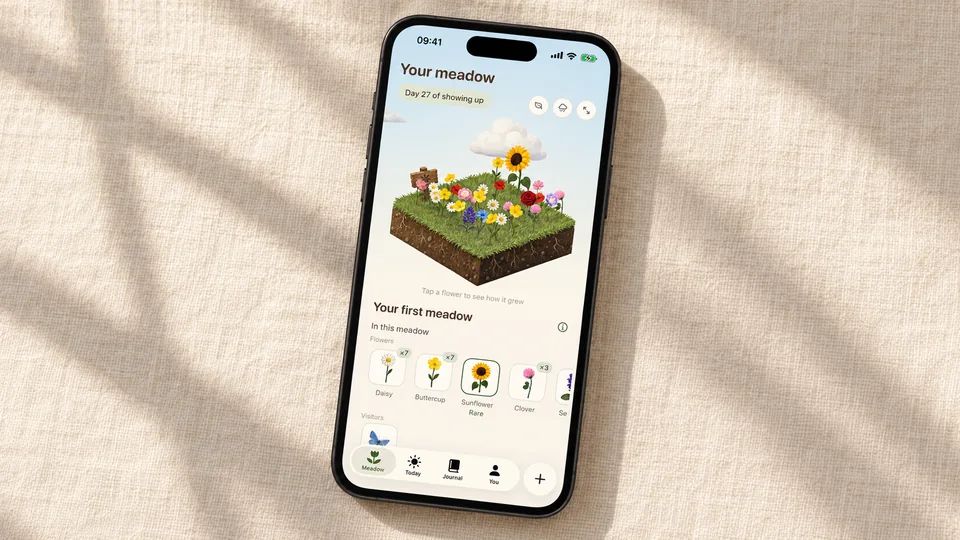
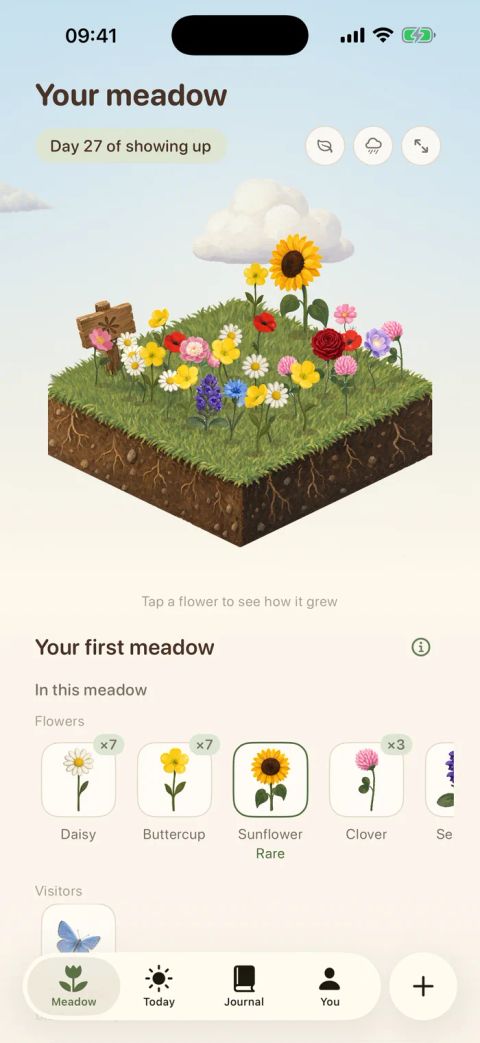
Some people like to see the run they are building, and a tick on a calendar does that job on paper. If you would rather have the nudge in your pocket, another app worth checking out is Meadow, a gentle habit tracker for iPhone made by the team behind this site. You can log a daily habit like this reflection, note your mood, and record a daily win, which sits close to the spirit of a gratitude line. Every day you show up grows a wildflower, and there are no streaks, so a missed day resets nothing and your flowers never wilt. It costs $39.99 a year or $9.99 a month after a seven-day free trial.
When to look for more support
A gratitude journal sits alongside the ordinary business of looking after yourself, next to sleep, movement and a bit of daylight, the sort of small acts covered in our self-care ideas. It is not a substitute for help when things are hard in ways a notebook cannot touch. If low mood or anxiety carries on for weeks, gets in the way of daily life, or feels like more than you can manage on your own, that is a good reason to talk to your GP. Reaching out is a sensible step, not a sign the journalling has failed you.
The one thing to do tonight is small. Put a notebook and pen by your bed, and before you turn off the light, write three things from today you were glad of.
Little and often, with Meadow
Consistency, not intensity.
Meadow turns the movement you enjoy and the habits that help you feel good into a meadow of wildflowers. No streaks to break, and your flowers never wilt.
Join the Meadow waitlist