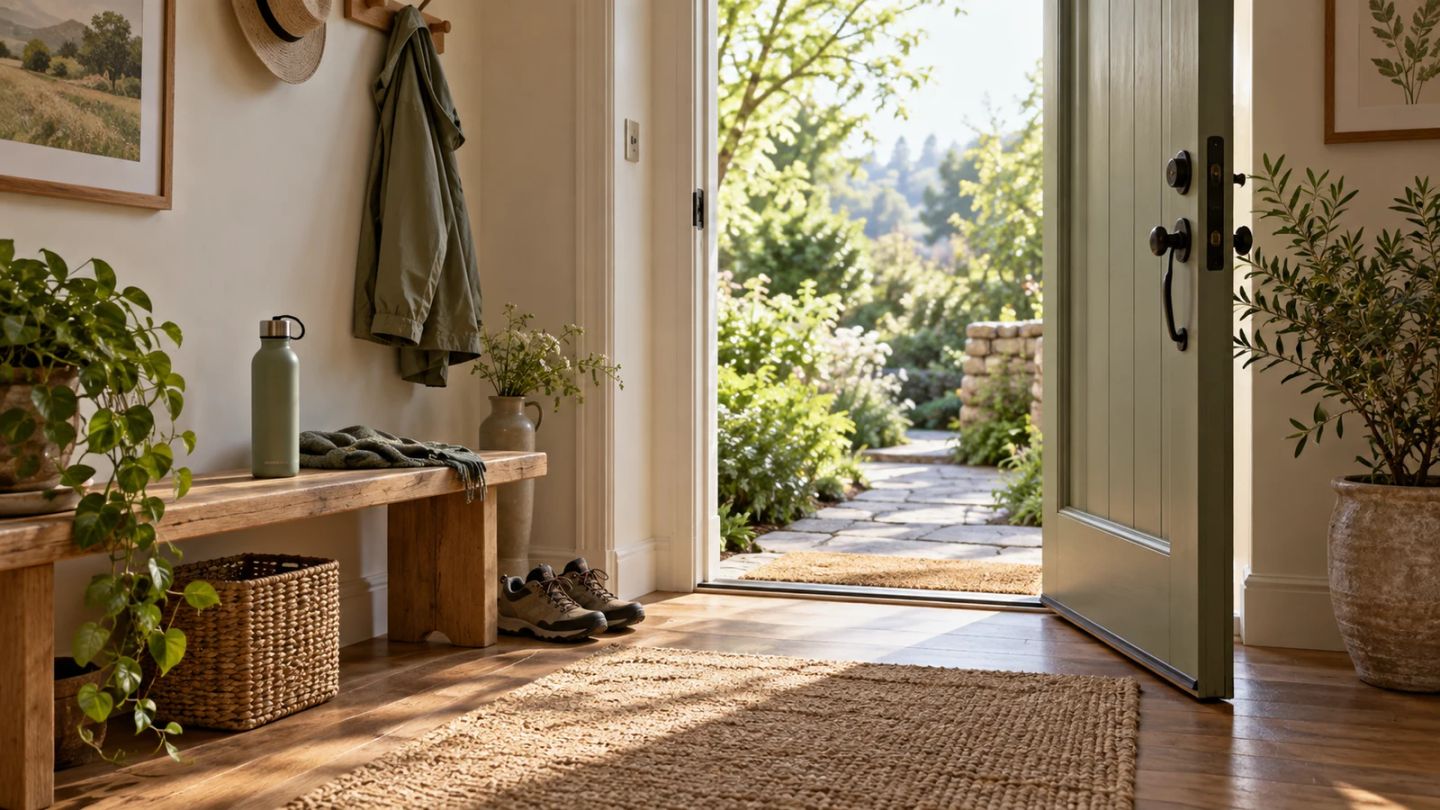
Self-discipline is the ability to keep doing the thing that moves you towards a goal when the pull to do something else is stronger. The surprising part, once you read the research, is that the people who look most disciplined rarely win by out-muscling temptation. They arrange their days so the temptation turns up less often, and so the good choice is the easy one.
For years the standard picture was willpower as a fuel tank you drain a bit at a time. That idea is on shakier ground than most self-help articles admit, and the honest version of the science is more useful anyway.
This guide covers what self-discipline is once you strip away the gritted-teeth mythology, why environment and habits carry more of the load than raw resolve, and a handful of tactics you can set up today. It also covers the parts that get skipped: what to do on a flat day, and how to come back after you slip.
What self-discipline looks like in practice
Picture the friend who always seems to have their life together. The easy assumption is that they spend all day resisting biscuits, snoozed alarms and the sofa, and want it more than you do. The evidence says something odd. People who score high on self-control report fewer battles with temptation, not more.
In a set of six studies, Brian Galla and Angela Duckworth found that people with better self-control tended to use less effortful inhibition in daily life, and that beneficial habits, more than white-knuckle resistance, linked self-control to good outcomes. Their study habits, sleep habits and exercise habits ran on their own, so there was less to resist in the first place.
The psychologist Denise de Ridder describes the same thing from another angle. As Scientific American reports, naturally self-controlled people build routines that rarely expose them to temptation, so the automatic choice is already the one they wanted. Discipline, in that picture, is less a fight and more a setup.
The goal, then, is not to become a person with a bigger willpower tank. It's to become a person who needs it less often.
Be careful with the willpower-as-muscle idea
You have probably heard that willpower is like a muscle that tires with use, so a hard morning leaves you weaker in the afternoon. That claim comes from a famous 1998 experiment by Roy Baumeister, in which people who resisted a plate of biscuits later gave up sooner on a tricky puzzle. The finding was named ego depletion, and it became one of the most cited ideas in psychology.
Then it ran into the replication crisis. In 2016, 23 labs re-ran the effect with about 2,000 people under agreed rules, and the pooled result was close to zero. A later multi-lab attempt found much the same. Baumeister still argues the effect is real, and some researchers think it happens for some people and not others, possibly driven by what you believe about your own willpower more than by any tank running dry. The debate isn't settled.
Here is the practical read. The strong version, where every act of restraint spends a fixed budget, does not hold up well. So don't plan your life around a willpower meter, and don't treat a tired afternoon as proof you're out of the stuff. Build the setup instead, so the hard choices get made once, in advance, when you're fresh.
Let your environment do the heavy lifting
Duckworth and colleagues call the strongest tactics situational strategies: you change your surroundings so the impulse is weaker before it ever arrives. The partygoer who sits away from the drinks, the dieter who asks the waiter to skip the dessert menu, the student who walks to the library leaving their phone at home. None of them is grinding through a craving. They removed the craving's trigger.
In two studies of nearly 20,000 teenagers preparing for exams, those who used at least one such strategy did more practice and scored higher, while relying on willpower alone predicted less. The effect per strategy was modest, but it stacked up, and it came from design, not effort.
You can copy the move for almost anything. Cut the number of steps between you and the thing you want to do, and add steps in front of the thing you don't.
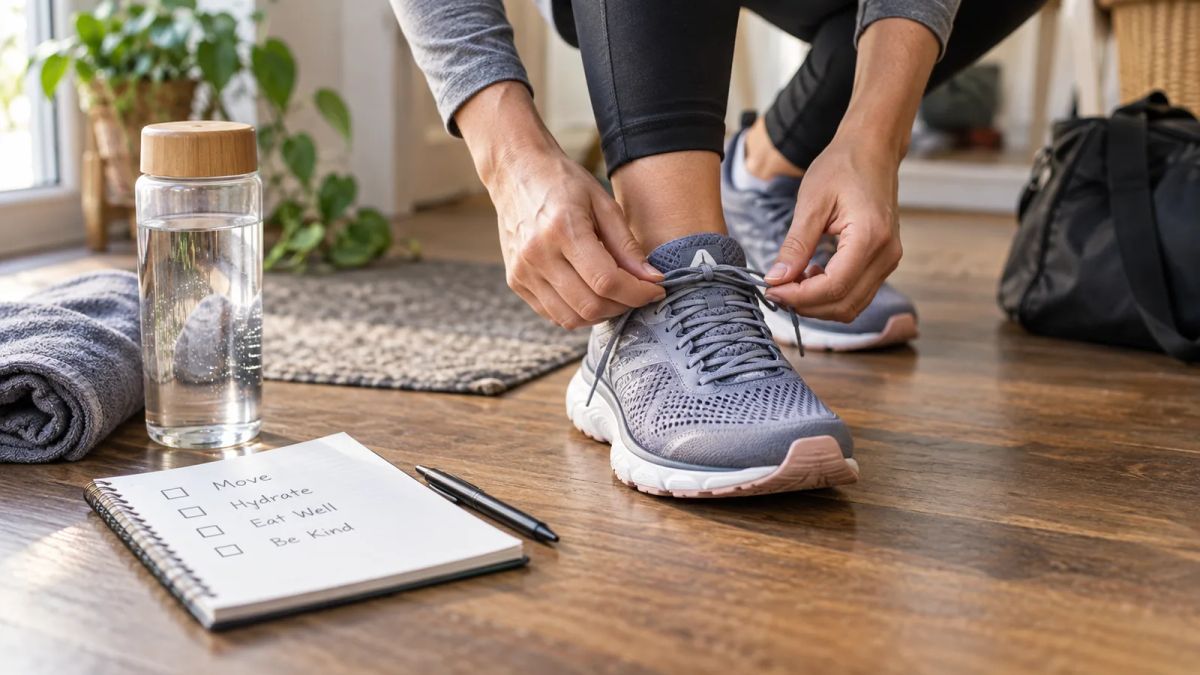
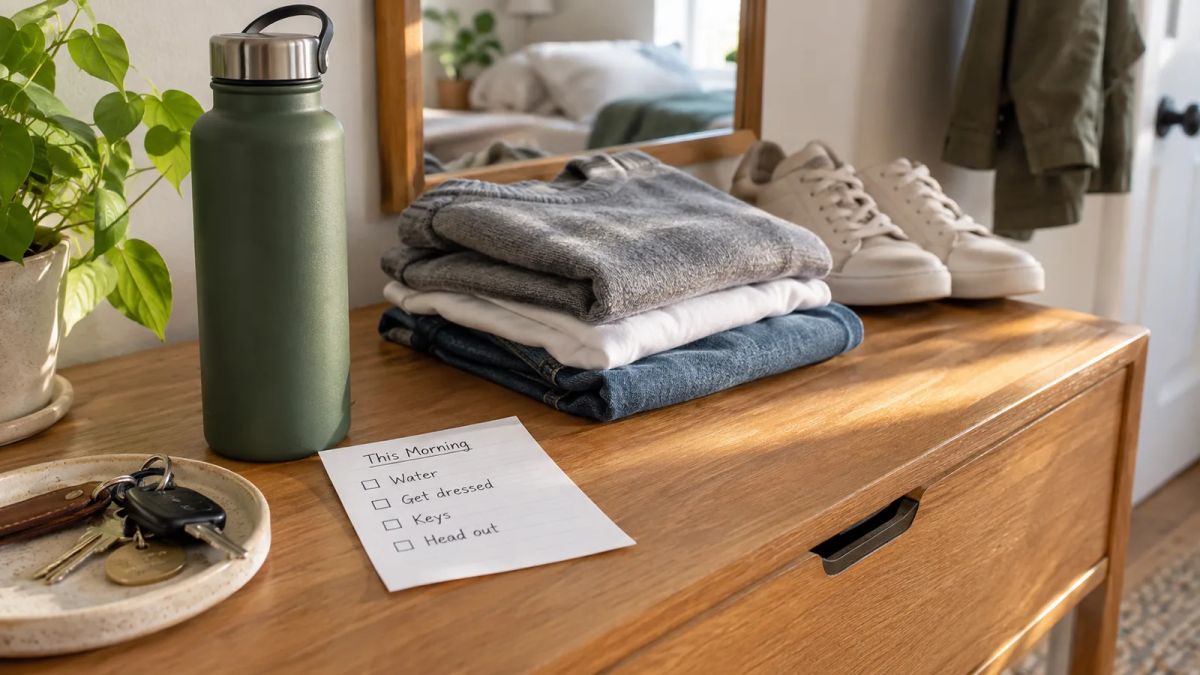
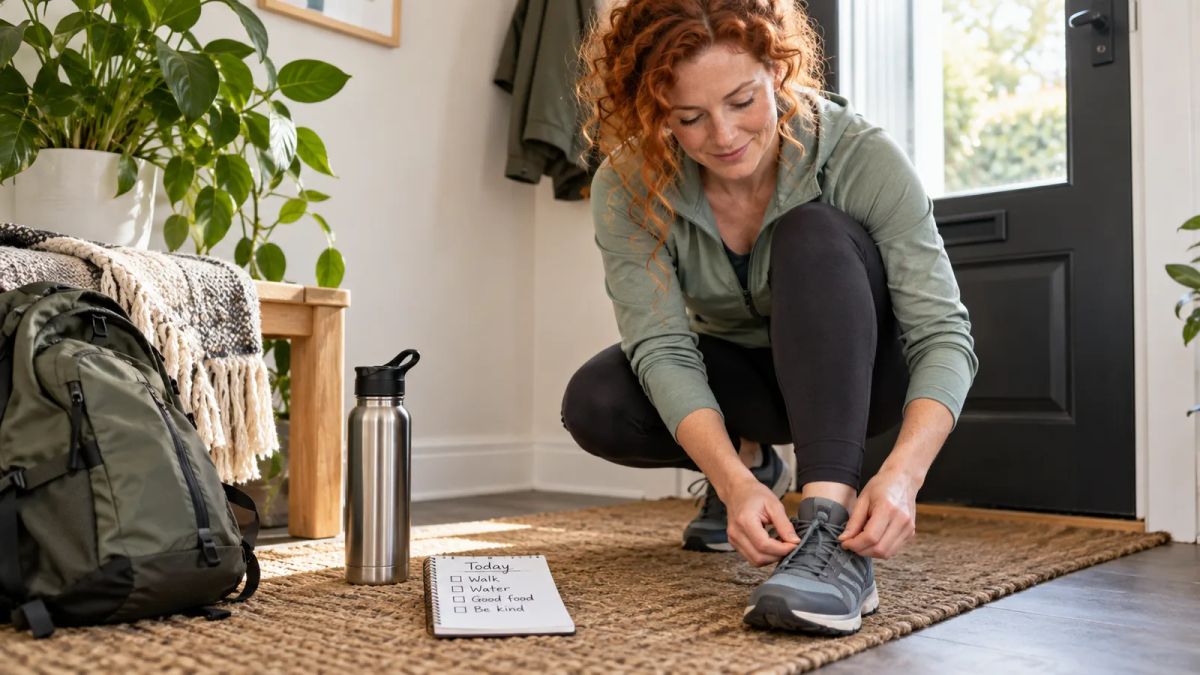
- Want to move in the morning? Lay your kit out the night before and put your trainers by the door.
- Want to drink more water? Fill a bottle and leave it where you sit, not in the kitchen two rooms away.
- Want to stop scrolling in bed? Charge the phone in another room and buy a cheap alarm clock.
- Want to snack less at your desk? Keep the biscuits in a cupboard you have to stand up and walk to.
Every extra step in front of a habit you're trying to drop, and every step you remove from one you're trying to keep, is a decision your future self no longer has to win.
Anchor the action to something you already do
A habit with no fixed moment drifts to a vague "later" that never comes. The fix is to bolt the new action onto a routine that already happens every day without you thinking about it. The American Heart Association's advice for making habits stick is to attach the new behaviour to an established one, so a cue you can't miss does the reminding for you.
The sentence to fill in is: after I [something I already do], I will [the new thing]. After I pour my morning coffee, I'll take my vitamins. After I sit down at my desk, I'll write one line in my journal. Pick an event, not a clock time, because "after my morning tea" survives a day that starts late while "at 8am" breaks the moment your morning slips.
Make rules, not decisions
Willpower gets worn down by negotiation. Every time you ask yourself "should I today?" you open a debate you might lose. A rule closes the debate.
Compare "I'll try to cut back on wine" with "I don't drink on weeknights." The first is a decision you have to make afresh every evening, tired, with a glass in reach. The second is settled, so there's nothing to argue about at 7pm on a Tuesday. Clear rules with sharp edges are easier to keep than fuzzy intentions, because you always know instantly whether you're keeping them.
Write your rule so a stranger could check it. "Walk after lunch" beats "be more active." "Phone away by ten" beats "get off screens earlier." The less room for interpretation, the fewer arguments you'll have with yourself.
Start smaller than feels worthwhile
The most common reason discipline collapses is that people build it for their best days, and their best days aren't most days.
Shrink the action until it's almost too small to skip. Not a workout but one set. Not thirty minutes of reading but one page. Not a run but your trainers on and out the front door. A version this small survives a rushed, tired, unmotivated evening, and those are the conditions a habit has to live through to last. On the days you have more in you, it grows on its own, but the official target stays tiny so a flat day still ends with the box ticked. We cover this in full in our guide to tiny habits.
Keep the ambition for the size of the goal and the patience for the size of the daily step. Adding one small piece at a time, letting each settle before the next, beats overhauling everything on Monday and burning out by Thursday.
A worksheet to set it up
Open our free Make the next action easy (PDF). Save or print it to use alongside this guide. No sign-up needed.
You can plan a whole habit on a scrap of paper in two minutes. Fill in the blanks, stick it where the action happens, and you've made the decisions in advance:
Goal: ________
Tiny daily action: ________
After I ________ , I will ________
One thing I'll make easier: ________
One thing I'll make harder: ________
My rule: ________
Bad-day version: ________
Filled in, it might read like this:
Goal: Move most days
Tiny daily action: A ten-minute walk
After I finish lunch , I will put my shoes on and step outside
One thing I'll make easier: Shoes by the door, coat on the hook
One thing I'll make harder: Work laptop shut at lunch, out of sight
My rule: No lunch counts as done until I've walked
Bad-day version: One lap of the block
Make showing up the easy option
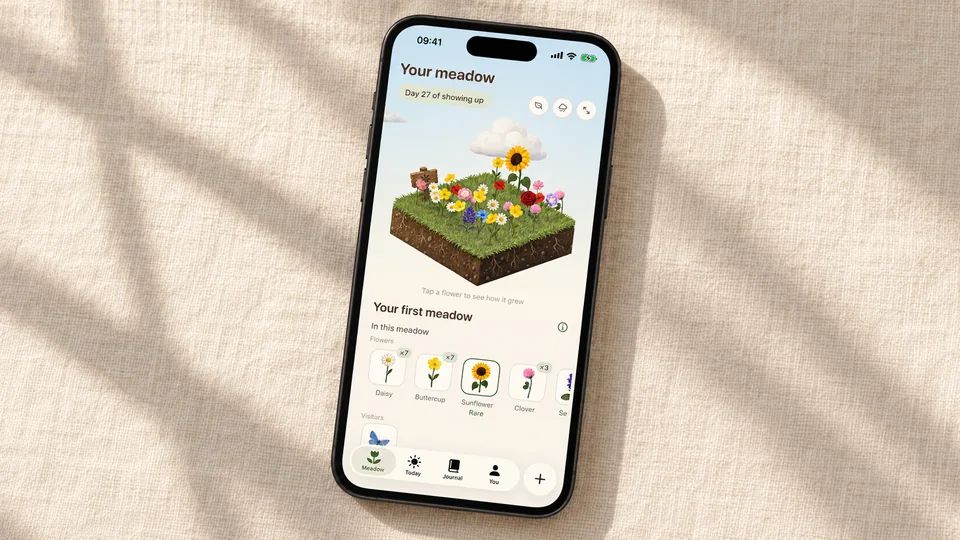
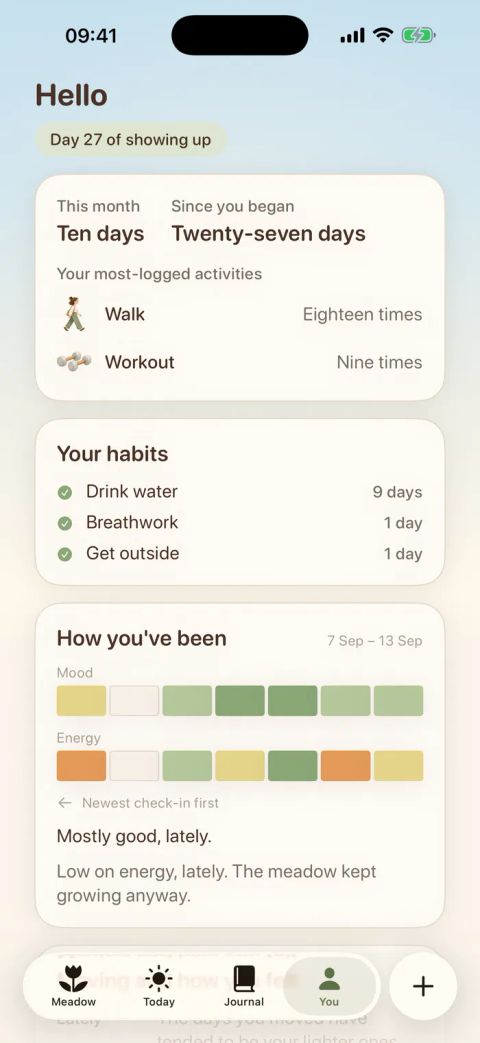
When the good choice is the one already in front of you, discipline asks far less of you, and that is the idea behind Meadow, a gentle iPhone app from Wildcard Wellness. You log a little movement or tick off a small habit, and each day you show up grows a new wildflower in a meadow that's yours, with a quick note on your mood and energy if you want one. There are no streaks, so a missed day resets nothing and the flowers you've already grown stay put, which takes the all-or-nothing pressure out of a slip and makes the practice easy to come back to. You can try it at Meadow.
Build rest in on purpose
Self-discipline gets thin when you're exhausted, and no amount of resolve fixes a sleep debt. If you keep losing the same battle every evening, the honest first question is often whether you're tired, hungry or stretched too far, not whether you're weak.
Treat recovery as scheduled, not stolen. A rest day, an early night, a lunch break away from the desk all keep the tank you do have topped up. A plan that leaves no room to rest is a plan you'll abandon, so put the gaps in yourself before your body forces them.
Be kind to yourself when you slip
You will miss days. A cold, a bad night, a work crisis, a birthday. What decides whether a single miss becomes a fortnight of nothing is the story you tell yourself afterwards.
The instinct is to give yourself a hard time, on the theory that a telling-off keeps you in line. It does the reverse. The self-compassion researcher Kristin Neff has spent years showing that harsh self-judgment undermines confidence and makes it harder to correct mistakes, while treating a setback with some understanding keeps you in a state where you can pick the habit back up. Talk to yourself the way you'd talk to a friend who missed a couple of runs. You wouldn't call them a failure. You'd tell them life happens and to go again tomorrow.
The rule worth holding onto is to never miss twice. One gap is an accident. Two in a row is the start of a new pattern, the one where you don't do the thing. Don't wait for Monday or the first of the month to restart, because those clean lines are excuses in disguise. The next chance is the next meal, the next morning, the next time your anchor comes round.
Common questions
Is self-discipline something you're born with, or can you build it? Both play a part, but the habits and setups that produce disciplined behaviour are learnable. The research on situational strategies and beneficial habits is about things anyone can put in place, not a personality trait you either have or don't.
How long does it take to get more disciplined? There's no fixed number, and anyone who quotes you a tidy figure like 21 days is guessing. It varies a lot between people and between habits, and a simple daily action settles in far sooner than a demanding one. Judge yourself on whether you're still turning up, not on whether it feels automatic yet.
What's the difference between self-discipline and motivation? Motivation is the feeling that makes you want to act, and it comes and goes with your mood and energy. Self-discipline is what carries the action on the days the feeling doesn't show. If you're trying to get moving in particular, our guides to exercise motivation and how to be consistent go deeper.
Why do I lose it every evening? Because you're usually more tired, hungrier and more negotiated-with by the end of the day. The fix is less about trying harder at 9pm and more about moving the hard choices earlier, or removing them, so evening-you has less to decide.
Pick one goal and fill in a single line for it: after [something you already do every day], I will [the smallest honest version of the action]. Then change one thing in the room to make that action easier. That's the whole method, and it's small enough to set up before you close this page.
AUTHOR
Co-founder of Meadow.
Ash is co-founder of Meadow, a habit and movement tracking app that turns small acts of self-care into a growing wildflower meadow.
See how far you've come
Your habits, moods and little wins, all in one place
Meadow keeps track of the walks, the water and the good days, so you can look back and watch your effort add up.
Download Meadow