Most routines don't fall apart because you're lazy. They fall apart because they were built for a version of your week that rarely turns up. A routine that only works when you wake at six, have a quiet house and feel motivated is a routine that breaks the first morning a child wakes early or a deadline lands on your desk.
The way to make one stick isn't more willpower. It's a routine loose enough to bend on a bad day and specific enough to happen on a good one, tied to something you already do so you don't have to remember it from scratch.
This guide covers why routines slip and how to build one that survives normal weeks, messy ones, travel, illness and the odd day you skip entirely.
The science of why routines work
A routine's real job is to take decisions off your plate. Researchers writing in the American Journal of Lifestyle Medicine describe how habits and routines let useful behaviours run with less conscious effort and fewer decisions, which frees up attention and tends to go hand in hand with steadier wellbeing. Fewer choices to make first thing means fewer chances to talk yourself out of the thing.
Underneath that is how a habit forms in the first place. In a review of habit formation for everyday health behaviours, Gardner, Lally and Wardle describe a habit as an action that has become an automatic response to a cue, learned by repeating it in a consistent setting until the context itself starts to trigger it. That's the mechanism a good routine borrows. Anchor an action to a stable cue, repeat it, and over time the cue carries more of the load while your willpower carries less.
Why routines fall apart
Four things tend to be going on when a routine stops sticking.
The first is rigidity. A single fixed time, a single fixed way, and no room to move. When Katy Milkman and John Beshears paid more than 2,500 Google employees to exercise, one group was rewarded for going to the gym inside a set two-hour window and another for going whenever they liked. The flexible group built the stickier habit. They kept exercising more once the payments stopped, because they'd learned how to fit a workout in even when their usual slot vanished. The rigid group had only ever practised one way, so when that way wasn't available, the whole thing stalled. As Milkman put it, too much rigidity is the enemy of a good habit.
The second is trying to change everything at once. New wake time, new workout, new breakfast, new bedtime, all from Monday. Each new action needs attention while it's young, and attention runs out fast. Stack five and you're relying on a fuel tank that empties by mid-morning.
The third is a routine with no cue. Wendy Wood and David Neal's work in Psychological Review describes how strong habits are triggered by features of the context that have gone with the action before, things like a time of day, a place, or the action that comes right before it. A routine floating free of any of those has nothing to switch it on. You're left trying to remember to do it, and remembering is the part that fails.
The fourth is all-or-nothing thinking. You miss a day, decide the run is broken, and quietly drop the whole thing. That instinct isn't backed by how habits form. In Phillippa Lally's study following people building everyday habits, missing a single day made no meaningful dent in the automatic-ness they were building. One skipped day is a skipped day, not a failure.
Build the routine around an anchor
The most reliable way to make a routine happen is to hang it off something you already do without thinking. Wood and Neal's research points the same way. Existing moments in your day, the kettle going on, the school drop-off, sitting down at your desk, already fire reliably, so you borrow their reliability for the new thing.
The American Heart Association gives the same advice for making habits stick: attach the new action to a routine that's already part of your day.
There's a simple way to write this down that psychologists have tested for decades. Peter Gollwitzer calls it an implementation intention, an if-then plan in the shape "when situation X happens, I'll do Y". A review pulling together 94 studies of these if-then plans found they had a medium-to-large effect on whether people carried out what they meant to do, well ahead of a vague intention to get to it at some point.
Don't write "stretch more". Write "after I put the kettle on, I'll stretch until it boils". The cue does the remembering for you.
Pick an anchor that already happens every single day. Brushing your teeth, making your first coffee, closing your laptop. Skip anything you only do sometimes, because a shaky anchor makes a shaky routine.
Start with one keystone action
When people rebuild a routine, they usually try to reinstate all of it at once. Start smaller than feels worthwhile. One action, done daily, beats five actions done for three days and then abandoned.
Choose the one thing that makes the rest easier to reach. For a lot of people that's laying clothes out the night before, or a five-minute tidy that clears the kitchen for the morning. Get that one anchored, let it run for a week or two until it feels normal, and only then add the next piece.
This is where small, repeatable actions earn their keep. If you want the mechanics of building one habit at a time, tiny habits and how long it takes to build a habit both go deeper than there's room for here.
Keep it flexible enough to survive real life
A routine that only has one shape will meet a day it doesn't fit, and lose. So give every part of it a smaller version you can drop to when the day is short or you're wiped out.
The full version might be a 30-minute walk. The smaller version is a walk to the end of the road and back. The full version is 20 minutes of yoga. The smaller version is three stretches on the bedroom floor. On a good day you do the full thing. On a bad day you do the small thing, and here's the part that counts: the small thing still counts. You didn't miss. You flexed.
That flexibility is exactly what made the Google gym-goers stick. Practising the behaviour in different forms and at different times taught them to keep going when the ideal conditions weren't there. A rigid routine only knows one way to succeed and a dozen ways to fail.
Try to keep no more than one or two things fixed, and let the rest move.
Plan for the days that blow up
Ordinary weeks aren't what break routines. Travel, illness, a bad night's sleep and the first fortnight back at work after a holiday are what break them. The trick is deciding what you'll do before those days arrive, not in the moment when you're tired and improvising.
Write a travel version and a rough-day version in advance. Same if-then shape as before.
- When I'm away from home, I'll do 10 squats by the bed instead of my usual session.
- When I've slept badly, I'll do the smaller version and skip the rest with no guilt.
- When my morning gets hijacked, I'll move the routine to lunch rather than write it off.
Because you've decided ahead of time, there's no negotiating with yourself at 7am. You follow the plan you already made.
Restart without shame
You will miss days. Everyone does, and it changes nothing as long as you come back.
The mistake isn't the missed day. It's treating the miss as proof the routine has failed and then not restarting, which turns one skipped day into three skipped weeks. Lally's data is reassuring here: a lapse doesn't undo the habit you're building. What undoes it is stopping and staying stopped.
Make restarting the easy default. No catch-up owed, no punishment session, no starting the count from zero. You do the next scheduled instance at the next anchor. Missed this morning's walk? The next one is tomorrow after the school run, same as always.
If a routine keeps collapsing in the same spot, that's information, not a character flaw. The step is probably too big, or the anchor's wrong. Shrink it or move it and try again.
A place to keep the routine going

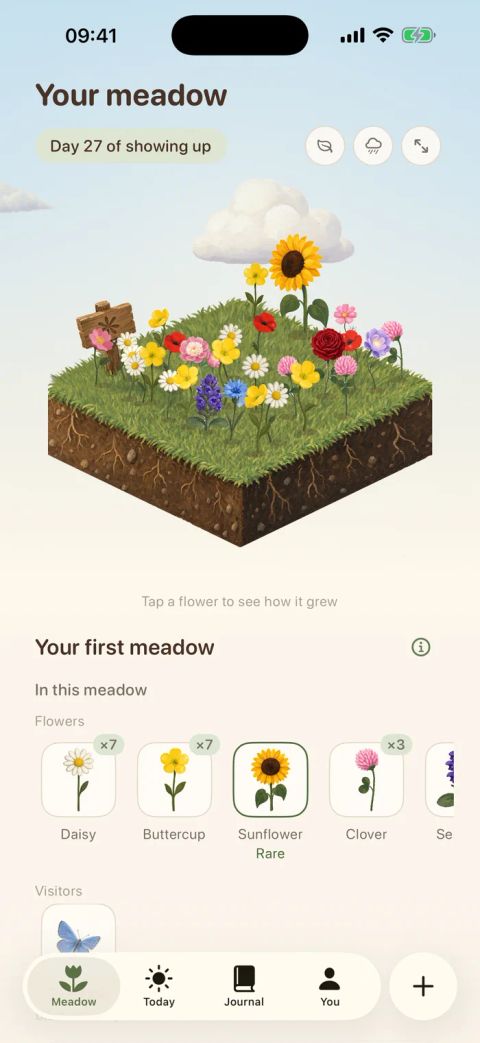
Some weeks hold together and some come apart, and Meadow is built for both. You log a walk or a few minutes of movement, tick off the small habits you're anchoring, and note your mood and energy, and each day you show up a new wildflower blooms in a meadow that's yours. There are no streaks, so a missed Tuesday or a week away resets nothing you've grown. You pick the routine back up whenever you're ready, which is the whole game. You can grow your own over at Meadow.
A plan you can fill in
Here's a template you can copy onto paper or your phone. Fill in one anchor, one action, a smaller version for hard days, and your restart rule. Keep it to a single routine to begin with.
Blank version:
Anchor (something I already do daily): ______
Action: ______
Smaller version for hard days: ______
When I miss it: I start again at the next anchor, no catch-up owed.
Filled-in example:
Anchor (something I already do daily): after I put the kettle on in the morning
Action: five minutes of stretching while it boils and brews
Smaller version for hard days: one long stretch, standing at the counter
When I miss it: I start again at the next kettle, no catch-up owed.
Copy it, stick it where the anchor happens, and let the cue do the work.
Common questions
How long before a routine feels automatic?
It varies a lot from person to person and habit to habit. Lally's study found habits took a wide range of time to feel automatic, with a lot of variation between people, so treat any single "X days" figure with suspicion. Judge it by whether the action is getting easier to start, not by a date on the calendar.
Why can't I stick to any routine?
Usually it's one of the four things above: the routine's too rigid, you took on too much at once, there's no clear cue to trigger it, or one missed day is talking you into quitting. Rebuild around a single daily anchor and one small action and see how that goes before blaming yourself.
Is a strict or a flexible routine better?
Flexible, for most people and most goals. The research on lasting habits keeps finding that being able to adapt when life interferes builds a stickier routine than holding rigidly to one time and one way. Keep one or two things fixed and let the rest flex.
What's the difference between a habit and a routine?
A habit is usually a single action your brain runs more or less automatically, like reaching for water when you sit down. A routine is a sequence of them strung together, like your whole morning. Routines stick when the individual habits inside them are anchored and small. If you want the broader picture, healthy habits and building a morning routine both build on the same foundations.
Your one next step
Don't redesign your whole day. Pick one thing you already do daily, decide on one small action to attach to it, and write the if-then sentence down: "after I ____, I'll ____." Do that one line today, and let it hold for a week before you add anything else.
AUTHOR
Co-founder of Meadow.
Ash is co-founder of Meadow, a habit and movement tracking app that turns small acts of self-care into a growing wildflower meadow.
Little and often, with Meadow
Consistency, not intensity.
Meadow turns the movement you enjoy and the habits that help you feel good into a meadow of wildflowers. No streaks to break, and your flowers never wilt.
Download Meadow