The research on habits is more useful than the headlines make it sound, and a lot less tidy. There's no magic number of days and no single trick that works for everyone, but there is a short list of methods that reliably tilt the odds in your favour: repeating an action in a stable setting, planning exactly when and where you'll do it, bolting it onto a routine you already have, cutting the effort of starting, pairing it with something you enjoy, timing it to a natural fresh start, and letting a missed day go. Each one has evidence behind it. Each one has limits worth knowing.
Willpower isn't on that list. The methods that hold up work by changing your situation or your plan so the habit needs less of you on the days you have less to give.
This is a tour of what the science supports, with the honest caveats attached. Pick one habit and one or two of these, not the whole set at once.
What makes a habit stick in the first place
A habit is an action your brain runs on a cue, with barely any thought. Wendy Wood and David Neal describe habits as responses triggered by a stable context, built up by doing the same thing in the same setting until the context alone brings the action to mind, largely regardless of what you happen to want in the moment (their review of habits and goals sets this out). Repetition is the engine. The context is the ignition.
Gardner, Lally and Wardle put the same idea into a GP's terms. Habits are actions triggered automatically by contextual cues, and the practical move is to attach the new one to a cue inside a routine you already run every day (Making health habitual). That is why most of the methods below are about the moment before the action, not the action itself.
Write an if-then plan before you start
Deciding to do a thing is weaker than deciding exactly when and where you'll do it. An implementation intention is an if-then plan: if it's this moment or this place, then I do this action. If the kettle's on at seven, then I take my vitamin.
Peter Gollwitzer and Paschal Sheeran pulled together 94 studies with more than 8,000 people and found these plans had a medium-to-large effect on whether people reached their goals, around d = 0.65, which is a solid result for something you can write in one line (summarised here). The plan works by handing the decision to the situation, so you don't have to win the argument with yourself each time.
Two things keep it honest. The cue has to be specific, an event you can't miss, not a vague "in the morning". And an if-then plan gets you started far more than it makes the habit permanent, because the slow work of automaticity still comes from repeating the action. If your life changes, rewrite the plan rather than forcing the old one to fit.
Stack it onto a habit you already have
The easiest cue to find is one that already happens. James Clear calls this habit stacking, with the formula "after [current habit], I will [new habit]" (his guide to the method). After I pour my coffee, I do one stretch. The old habit is the reminder, so you aren't leaning on a phone alert or a spare scrap of motivation.
Clear's one rule is to be specific about the anchor, because a fuzzy cue drifts to a later that never arrives. "After I close my laptop for lunch" holds up. "At some point today" does not. Our guide to tiny habits goes further into anchoring and keeping the new action small enough to survive a rough day.
Cut the friction to almost nothing
Every extra step between you and the action is a chance to skip it. Because habits answer to the situation and not to good intentions, changing the situation is one of the surest ways to change the behaviour. Wood and Neal's work makes that point about context, and it holds for effort too.
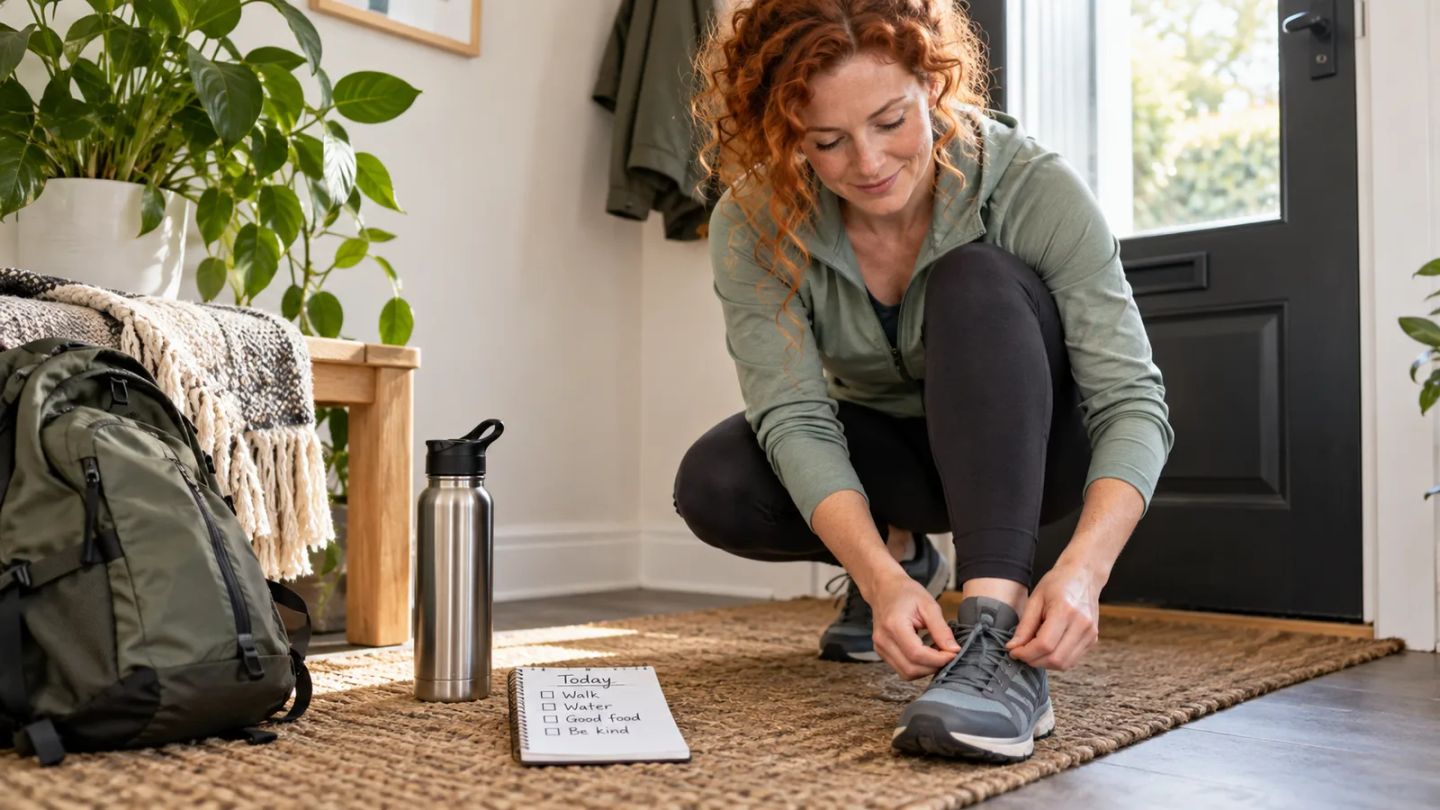
Put the trainers by the door. Fill the water glass the night before. Leave the book on the pillow so it's the last thing you see. None of this is dramatic, and moving where things sit does a share of the work that gritting your teeth can't keep up. The flip side works too, when you want less of something: add steps, hide the biscuits at the back of the cupboard, log out of the app.
Bundle it with something you look forward to
If a habit feels like a chore, tie it to a treat you'll only let yourself have during it. Katy Milkman and colleagues call this temptation bundling. In their gym experiment, people who could listen to page-turner audiobooks only at the gym went 51% more often than a control group at the start, and a lighter nudge to save the audiobooks for the gym lifted visits by 29% (the field study is here).
The honest footnote sits in the same paper. The effect faded over the weeks, and a Thanksgiving break knocked it back further. So a bundle is a strong way in that needs topping up. Keep the treat something you want, ration it to the habit, and expect to renew the deal now and then.
Time it to a fresh start, but don't wait for one
People reach for their goals more readily at the start of something. A Monday, the first of the month, a birthday, the new year.
Hengchen Dai, Katy Milkman and Jason Riis called this the fresh start effect. Looking at gym data, dieting searches and goal commitments, they found aspirational behaviour rose after these landmarks, with student gym visits up 33% at the start of a week and 47% at the start of a semester (Harvard Business Review covers the study). A landmark seems to draw a line under the old you and hand the new one a clean page.
Use one if there's a landmark coming. The catch is the one everybody meets in January: the surge of starting says nothing about whether you keep going. Pair the fresh start with the methods above, and if today is a perfectly good day, don't sit on your hands until next Monday.
Forgive the missed day and get back on
You'll miss a day. In Phillippa Lally's habit study, missing one had little effect on the habit forming, though a run of misses did add up over time (the British Psychological Society summary has the detail). One gap does not undo the weeks behind it.
The real damage comes from the story afterwards, the "I've blown it now" that turns one skipped day into a fortnight off. There's evidence that letting yourself off the hook helps in its own right. Students who forgave themselves for procrastinating before one set of exams went on to procrastinate less before the next, because they carried less bad feeling into the gap (Wohl and colleagues, via the BPS). Keep whatever record you were keeping, drop the guilt, and do the next rep.
Be honest about how long it takes
No dependable number exists, and anyone selling you "21 days" is repeating a myth that traces back to a plastic surgeon's notes on how long patients took to adjust to surgery, not to any study of habits (Gardner and colleagues track it down).
Lally's volunteers took a median of 66 days to reach their peak of automaticity, but the spread was huge, running from 18 days to a predicted 254, and about half of them hadn't got there by the time the study ended. A simpler action bedded in sooner than a demanding one. Gardner's team suggest telling people to expect roughly ten weeks and to treat that as a loose guide, not a deadline.
So judge yourself by whether you're still turning up, not by the calendar. If the timeline is what's nagging you, we go deeper in how long it takes to build a habit.
Keep the plan where you'll see it
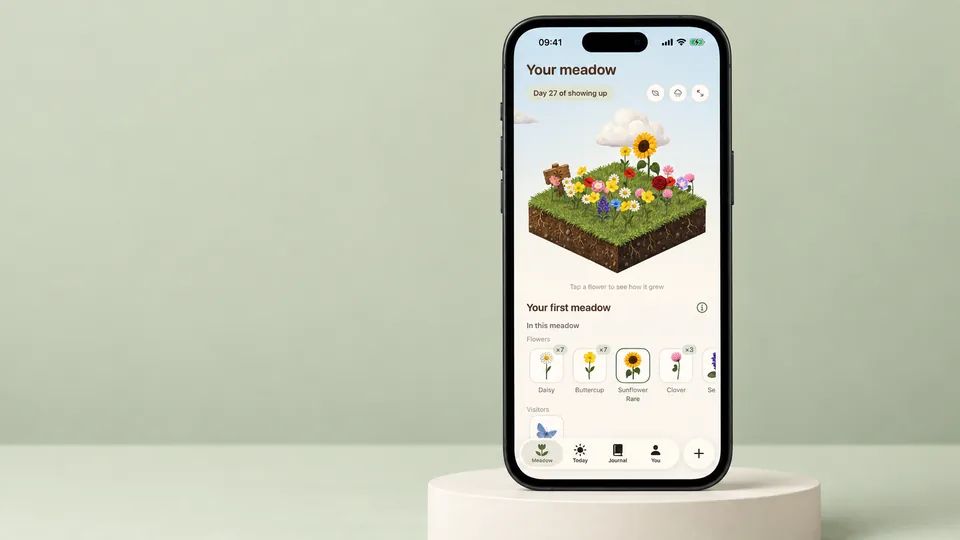
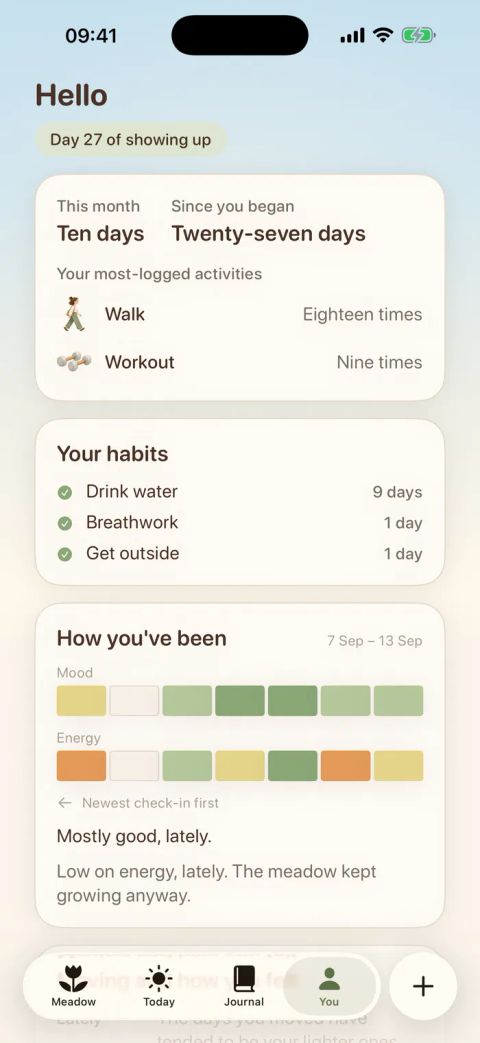
A plan you can see beats one you half-remember, and Meadow gives it a home on your phone. It's a gentle habit app for iPhone where you tick off a small daily habit, log a walk or a few minutes of movement, and note your mood, a daily win and a short affirmation. Each day you show up grows a wildflower, and rare flowers and the odd animal visitor turn up as your meadow fills in. There are no streaks, so the missed day you're meant to forgive resets nothing you've built, which fits the evidence that one gap barely dents a habit taking shape.
Put it together in one line
Open our free printable: Small Habit Planner (PDF). Save or print it to use alongside this guide. No sign-up needed.
Most of these methods fit into a single sentence you can write now. Name the daily cue, the small action, the treat you'll pair it with, and the version for bad days, and you've used the plan, the stack, the bundle and the fallback all at once.
Here's the blank to fill in:
When I __________ (a daily cue), I will __________ (a small action), paired with __________ (something I enjoy). On a bad day: __________.
And a worked example:
When I finish lunch, I will walk for ten minutes, paired with a podcast I save for walks only. On a bad day: to the end of the road and back.
Keep it where the cue happens, by the kettle, on the fridge or in a habit app. If you're short of a first action, our list of healthy habits is full of small ones that fit this shape. The point is a home for the plan, not a perfect run of ticks.
Common questions
What's the best habit-building method? There isn't one best method, which is why this is a list. Start with an if-then plan tied to a daily cue, cut the friction around the action, and add a bundle or a fresh start if the habit is a slog. They stack together well.
Is willpower the main thing? No. Willpower runs high when you're fresh and low when you're tired, which is most evenings, so a habit built on it fails on exactly the days you needed it. The methods here lean on your situation and your plan instead, so a flat day can still end with the action done.
How many habits should I build at once? One. Get it running on its own before you add a second. Setting up five at once splits your attention and usually ends with none of them sticking by Thursday.
What if I miss a week, not a day? A longer gap is a pause, not a verdict. Go back to your cue, shrink the action right down for a few days to get the loop turning again, and pick up your record instead of tearing it up.
Does the "21 days to a habit" rule work? No. It came from a 1960s observation about people adjusting to surgery and was never a finding about building habits. Some very light habits do settle in around three weeks, and plenty take two or three months, so treat it as a myth, not a target.
Right now, write one line: when an everyday moment you already have, you'll do one small action, paired with something you enjoy, plus the smaller version for the days it all goes sideways. That sentence carries most of what the research supports, and it's small enough to start today.
AUTHOR
Co-founder of Meadow.
Ash is co-founder of Meadow, a habit and movement tracking app that turns small acts of self-care into a growing wildflower meadow.
See how far you've come
Your habits, moods and little wins, all in one place
Meadow keeps track of the walks, the water and the good days, so you can look back and watch your effort add up.
Download Meadow