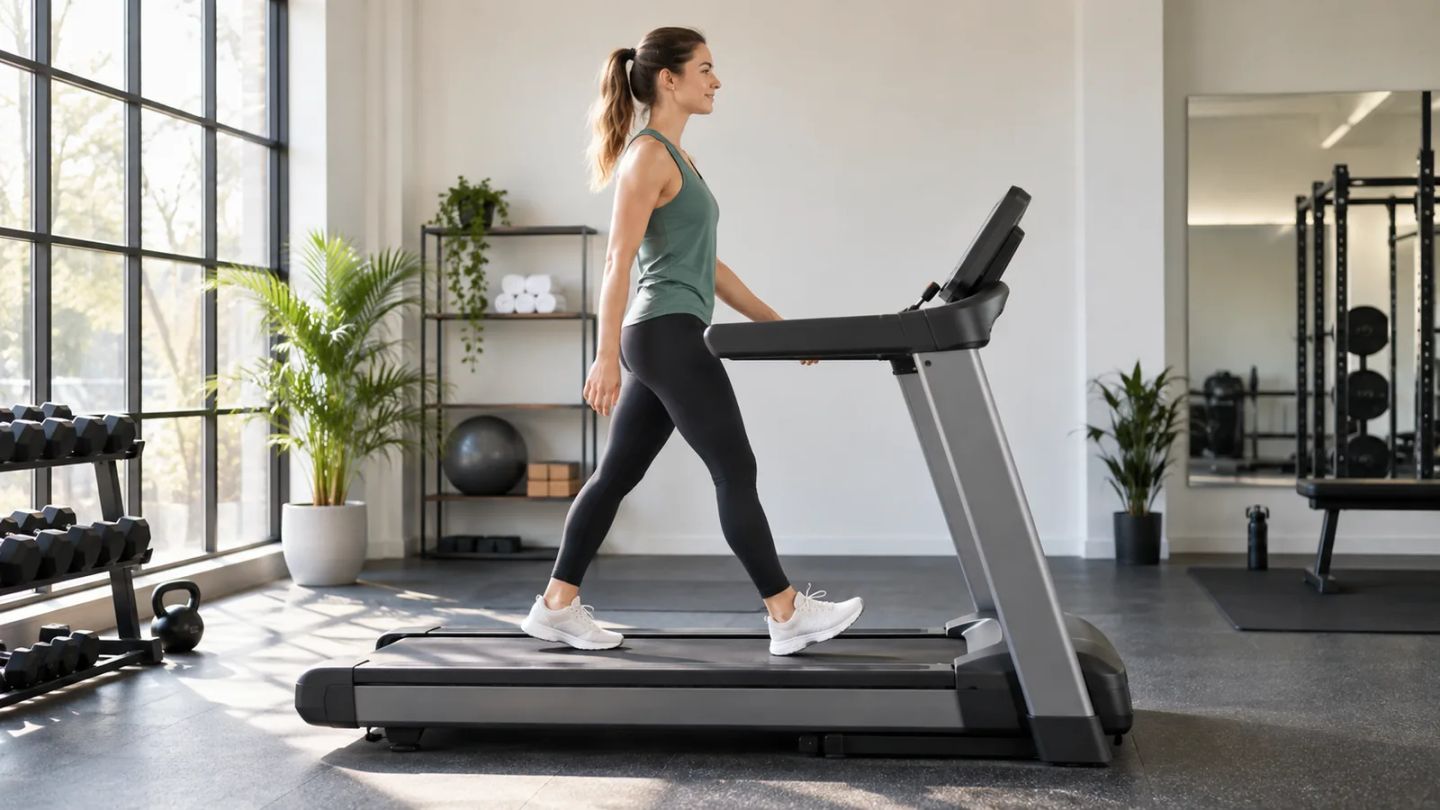
A treadmill walking workout is a structured walk indoors where you change the speed, the incline and the length of each stretch on purpose, instead of plodding at one setting until the timer runs out. Set up well, it gives you a good chunk of a run's cardio work with far less pounding through your knees, and you can follow the whole session below from the first minute to the last.
You get a complete 30-minute session written to be followed step by step, a gentler 20-minute version for a first go, incline options for when you want more, a five-minute version for the days that come apart, and an honest read on what treadmill walking does and does not do.
The three dials, and how to read your effort
A treadmill hands you three things to change: speed, incline and time. Speed moves your legs faster, incline makes each step lift your body weight as well as carry it forward, and time is how long you hold each of those.
The dial that counts for least is the one you stare at. Your breathing tells you more than the display does. The NHS describes a brisk pace as one where you can still talk but cannot sing the words to a song, and that talk-not-sing feeling is the target for most of the work below.
If you prefer a number, cadence works too. A review of walking studies put moderate intensity at around 100 steps a minute, with vigorous nearer 125 to 135, though it noted your height and build can shift that by twenty steps either way.
The speeds below are in miles an hour, how a lot of treadmills read. If yours shows kilometres, add roughly sixty per cent, so 3 mph is about 4.8 km/h.
The 30-minute treadmill walking workout
Open our free printable: Your treadmill walking plan (PDF). Save or print it to use alongside this guide. No sign-up needed.
This is the session itself. It warms you up, alternates harder pushes with easy recovery so your average effort climbs without wrecking you, and brings you back down at the end. Each push is where you find that talk-not-sing pace, and each recovery is where you catch your breath. Follow it in order.
- Warm up, 5 minutes. Speed 3.0 mph, incline 1 per cent. Loose and chatty, arms swinging, no strain. This is where your muscles and your heart get the memo.
- Find your brisk, 3 minutes. Speed 3.3 mph, incline 2 per cent. Ease up until you can feel your breathing deepen but you could still hold a conversation.
- Push, round one, 4 minutes. Either lift the speed to 3.6 mph at 2 per cent, or keep 3.0 mph and raise the incline to 6 per cent. Both land in the same effort. Pick one and hold it.
- Recover, 2 minutes. Drop to 2.8 mph, incline 1 per cent. Let your breath come back most of the way.
- Push, round two, 4 minutes. Same as round one, or a touch harder if the first felt easy.
- Recover, 2 minutes. Back to 2.8 mph, incline 1 per cent.
- Push, round three, 4 minutes. The last hard block. Keep your torso tall and let your glutes drive rather than gripping the handrails.
- Recover, 2 minutes. 2.8 mph, incline 1 per cent, breathing settling.
- Cool down, 4 minutes. Drop to 2.5 mph and take the incline to 0. Walk until your breath is easy and your heart rate has come down before you step off.
That is a full moderate-to-brisk workout of about 30 minutes, and it lands most people somewhere near 3,000 steps depending on stride and pace.
The 20-minute beginner version
If the intervals above sound like a lot, start here. This version holds one steady effort, no bursts and no steep climbs, which suits a first session, a stiff morning, or anyone easing back into movement after a while off.
- Warm up, 4 minutes. Speed 2.5 mph, incline 0. An easy stroll to loosen up.
- Build, 4 minutes. Speed 3.0 mph, incline 1 per cent. Find the pace where talking is still comfortable.
- Steady brisk, 8 minutes. Hold 3.0 to 3.2 mph at 1 to 2 per cent. This is the meat of it. Stay at the effort where you could talk but would not choose to sing.
- Bring it down, 2 minutes. Ease back to 2.8 mph, incline 1 per cent.
- Cool down, 2 minutes. Slow to 2.3 mph and flatten the incline until your breathing is back to normal.
Twenty minutes at this pace comes out around 2,000 steps, and it is a session you can repeat most days without needing a rest day after it.
Turning up the effort with incline over speed
When the workout starts to feel easy, most people reach for a faster belt. Incline is the kinder lever. Tilting the deck makes your glutes, hamstrings and calves take on more of the job. Harvard Health notes that walking up hills and stairs adds resistance that helps build the leg muscles, naming the quadriceps, hamstrings and calves, and it does that while your feet keep landing at a walking speed your knees are happy with.
You may have seen this idea online as the 12-3-30 routine, a 12 per cent incline at 3 mph for 30 minutes. It is a real workout, and harder than the tidy numbers suggest. Cleveland Clinic exercise physiologist Katie Lawton calls it "definitely on the harder side" and suggests treating it as a goal to build towards, pairing it with some strength work, and staying honest about food, because as she puts it, "you cannot out-exercise a bad diet." Start at a 4 to 6 per cent incline and build a percentage point at a time once the last session felt manageable. Our guide to incline walking goes deeper on how far you can take it.
The five-minute version for a bad day
Some days the full half-hour is not going to happen, and a shrunk workout beats a skipped one every time.
Set the belt to 2.8 mph, the incline to 2 per cent, and walk for five minutes. That is it. No intervals, no cool-down to fuss over, five honest minutes that keep the habit turning over. The point is not the calories. It is that you stay someone who does this, so the next full session is a continuation and not a fresh start.
If you have missed a week, or a month, do not pick up where you left off. Go back to the 20-minute beginner version, or even the five-minute one, and let your fitness catch up over a session or two. Missing days is normal. Treating a gap as a reason to quit is the only real way to lose the habit.
Who it suits and what it does for you
A treadmill walking workout suits a lot of people the gym forgets. If your knees or hips complain about running, walking gives you cardio work with a soft landing. If the weather, the dark or an unsafe road keeps you in, the belt is always the same temperature. And you can do the whole thing in front of a screen.
The benefits are those of regular brisk walking, on a machine you control. Harvard Health lists better heart health, a stronger immune system and easier weight management among what walking offers. You are also building towards the weekly total public health bodies point to. The CDC recommends about 150 minutes of moderate activity a week plus two strengthening days, and it is clear this can be broken into smaller chunks and that some activity is always better than none. Three of the 20-minute sessions above, plus a couple of longer ones, clears that bar. Our round-up of the benefits of walking goes through the evidence in more depth.
Now the part the workout videos skip. If your aim is weight loss, treadmill walking helps but will not carry it on its own. The research above describes averages across groups, not a promise about your particular fortnight, and a change on the scale depends on how you eat and sleep as much as how you move. A step count can be a useful nudge here, and our look at 10,000 steps a day unpacks where that famous number came from. Do the workout because it makes your day feel steadier, and treat anything the scale does as a bonus.
If you have been inactive for a while, are carrying a health condition, or are recovering from illness, have a quick word with your GP before you take on the harder intervals, and build your time and pace up gradually.
Staying safe on the belt
A treadmill is forgiving until it is not, and a few habits keep it that way.
- Clip the safety cord to your clothing. If you stumble, it stops the belt. This is the one thing most people skip and should not.
- Warm up before you push. The NHS advises warming up to prevent injury and make the session work better, which is why every routine here starts with easy minutes.
- Look ahead, not down at your feet. Watching your feet throws off your balance and your posture. Fix your eyes on a point in front of you.
- Let go of the handrails for the work. Gripping them takes the effort out of the incline and rounds your back. Use them to get on and off, not to hold yourself up mid-session.
- Step off carefully. Slow the belt right down first, because solid ground can feel oddly like it is still moving.
- Wear proper shoes. Trainers with a bit of cushioning, not socks and not old plimsolls.
Give the session somewhere to land

Finish a good workout and it is oddly easy to forget you did it by the time Thursday comes round. A record fixes that, on a paper calendar or your phone.
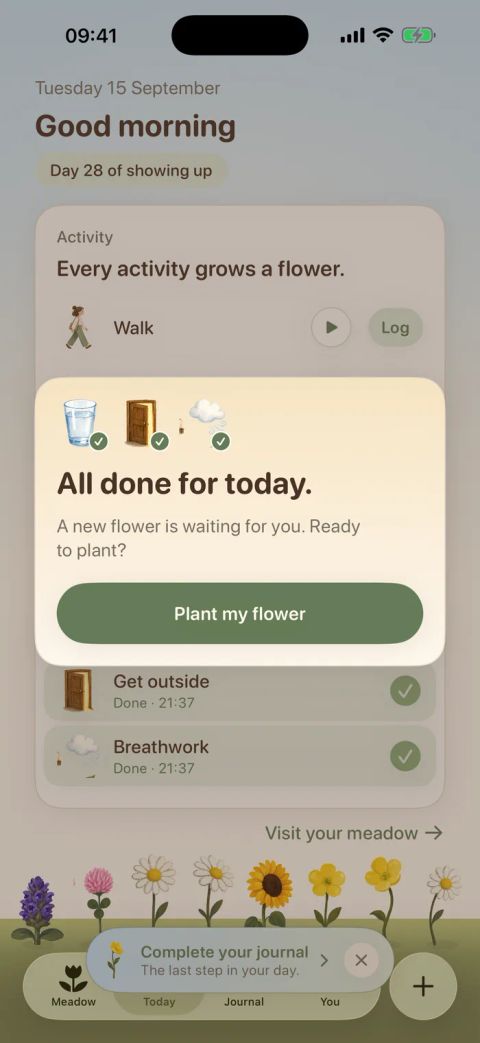
Meadow is a gentle habit app for iPhone with walking built in as one of its activities, so a treadmill session takes a few seconds to log, and each day you show up grows a wildflower in your own meadow, with rarer flowers and the odd animal visitor turning up as it fills in. It is made by Wildcard Wellness, and There are no streaks, so a session you shrink to five minutes or skip in a busy week resets nothing and your flowers never wilt.
Treadmill walking workout FAQ
Is walking on a treadmill as good as walking outside?
For your heart, blood sugar and mood, the movement is what counts, so a brisk treadmill session does much of the same work as a walk down the street. Outdoors adds daylight and fresh air. The treadmill adds a set pace, a controlled incline and a floor that is never icy or dark. On a wet winter evening, the belt beats the walk you would have talked yourself out of.
How long should a treadmill walking workout be?
Anywhere from 20 to 45 minutes covers most people and most goals. Twenty minutes at a steady brisk pace is a full session, and thirty with intervals asks a bit more. Start with a length you can finish comfortably and build the time before you build the speed or the incline.
Is treadmill walking good for weight loss?
It burns calories and it is easy to keep up, which both help, but no single workout guarantees weight loss on its own. Diet and overall activity count at least as much, which is why even the fans of the steep 12-3-30 routine warn that you cannot out-exercise a bad diet.
What speed should I set for a walking workout?
Let your breathing pick the speed, not the other way round. Aim for the pace where you can still talk but could not sing, which for many people sits somewhere between 3.0 and 3.5 mph, though it will be different for you. If you want it harder, raise the incline before you raise the speed.
Should I hold onto the handrails?
Only to get on and off, or for a moment if you feel unsteady. Holding on through the workout lets your arms carry weight your legs should, which cancels out much of the effort of an incline and pulls your posture out of shape. Let them swing the way they would on a normal walk.
How many days a week should I do it?
Most people do well on three to five sessions a week, mixing the steady 20-minute walks with the occasional interval session. Spread them across the week, and keep at least the short version going on the days a full workout will not fit.
One thing to do today
Step on, clip the safety cord, and walk five minutes at 2.8 mph with the incline at 2 per cent. That is the five-minute version in full, and the one you can repeat tomorrow before you decide whether to give it the whole half-hour.
AUTHOR
Co-founder of Meadow.
Ash is co-founder of Meadow, a habit and movement tracking app that turns small acts of self-care into a growing wildflower meadow.
Every little bit counts
Five minutes counts. So does a dance in the kitchen.
Log the movement you enjoy and the small habits that help you feel good, and watch them bloom into something you can see.
Download Meadow