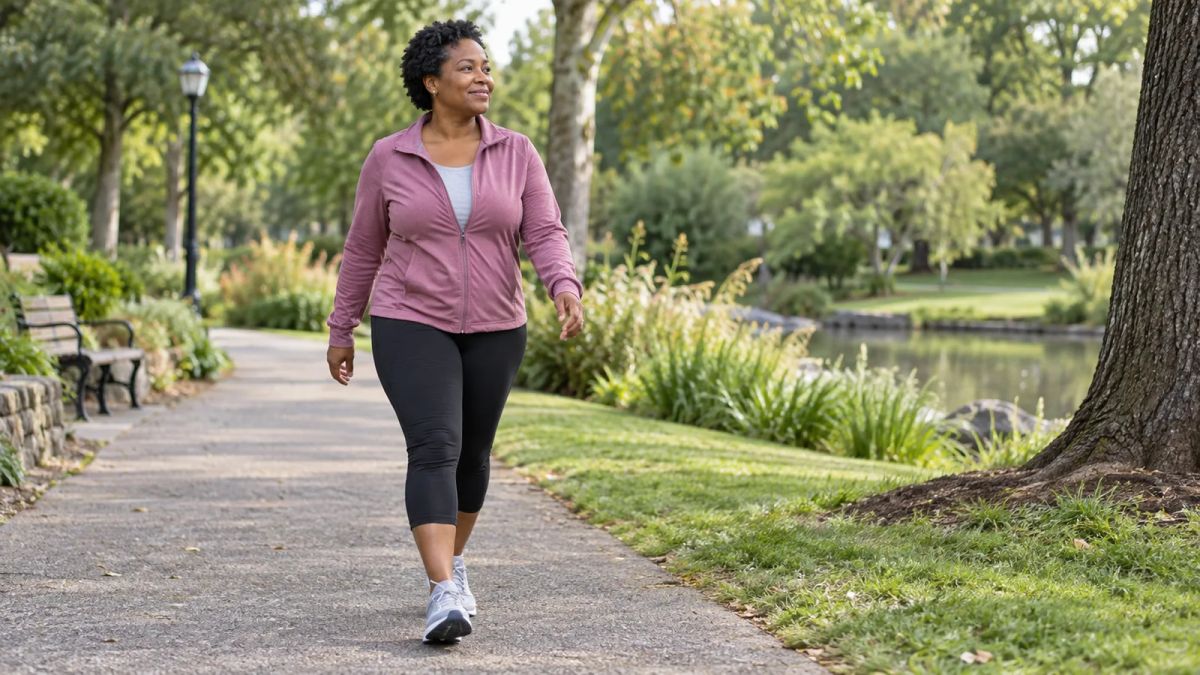
Walking with a weighted vest means strapping extra load to your torso so every step asks more of your legs, heart and bones, without you walking any faster or any further. Done sensibly it can build strength, nudge up the calories you burn, and add useful load to a walk you were taking anyway.
The honest version is more mixed than most of the internet lets on. The bone-density case is real but narrower than the headlines suggest, and the wrong weight on the wrong back does more harm than good.
Here is what a weighted vest walk does, what it does not, how much weight to start with, and who should leave it on the shelf.
What walking with a weighted vest involves
A weighted vest is a snug garment loaded with small weights, worn close to your trunk so the load sits over your centre of gravity. Because it rides on your torso and not your wrists or ankles, it adds resistance evenly and leaves your natural walking stride mostly intact.
The idea is old. Soldiers have marched under loaded packs for centuries, and the fitness version of that, "rucking", is the same principle with a tidier bit of kit. Tilt the demand up by adding weight, keep the movement low and repetitive, and an ordinary walk turns into something closer to gentle strength work.
You are changing one thing: how hard your body works per step. Your pace can stay exactly where it was.
What the evidence shows, and where it stops
Three benefits come up again and again. The strongest evidence sits with strength and everyday function, the calorie and cardio bump is straightforward, and bone density is the one people most often get wrong.
Strength and staying steady on your feet
This is where the research is most encouraging. In a small randomised controlled trial of community-dwelling older adults (average age 68), one group did three supervised sessions a week for 12 weeks wearing a vest loaded to 10 per cent of body weight, while the other did the same work without it.
The vest group came out meaningfully ahead. Their six-minute walk distance improved by about 93 metres against 30 metres in the control group, and their score on a 30-second sit-to-stand test rose by roughly six repetitions against three, both statistically significant differences. Sit-to-stand ability is a decent proxy for the leg strength that keeps you independent, so that is a benefit worth having.
More calories, a harder-working heart
Carry extra weight and your body spends more energy moving it, so a vest walk burns a few more calories and pushes your heart rate up compared with the same walk unloaded. Harvard Health notes that a weighted vest on a walk puts pressure on your bones and raises the cardiovascular demand of the session.
Keep the figure in proportion. A modest vest adds a modest amount, not a transformation, and no single walk out-runs your overall diet and activity. If burning more is the goal, one expert points out that you can get there without any kit at all.
Bone density: the part the headlines oversell
Weight-bearing load can prompt bone to hold or build its strength, and one long study is the reason weighted vests keep getting linked to bone health. Over five years, postmenopausal women who did weighted-vest exercise combined with jumping three times a week held onto hip bone density, with a small 1.54 per cent gain at the femoral neck, while a comparison group lost more than 4 per cent over the same period.
Read that finding closely and the catch appears. The exercise that protected bone paired the vest with jumping, not steady walking, and jumping is what drives the sharp, high load bone responds to. Walking on its own, even loaded, is a gentler stimulus.
A 2025 trial makes the limit plainer. In the INVEST study, 150 older adults with obesity lost weight over 12 months, and the group that wore a vest for around seven hours a day (replacing most of the weight they had shed) still lost hip bone density at the same rate as everyone else. Wearing load did not stop weight-loss bone loss, and the results were published in JAMA Network Open.
Treat a weighted walk as a helpful piece of a bone-friendly routine, not the whole answer. If bone density is your main worry, speak to your GP, and expect proper impact or resistance work to do the heavy part.
How much weight to start with
Start lighter than you think you need. A sensible opening load is around 5 per cent of your body weight, which is roughly 3.5 kg for a 70 kg adult, and there is no shame in starting lower while your back and joints work out what is going on.
There is a firm ceiling. Harvard Health advises that a walking vest should not exceed 10 per cent of your body weight, so about 7 kg for that same 70 kg person. More is not better here, and piling on load is the quickest route to a sore back or a grumbling knee.
Change one thing at a time. If you add weight this fortnight, hold your distance, speed and terrain steady, then let the next change come only once the current one feels comfortable rather than survivable. Here is a four-week way in that does that for you.
Weeks 1 to 2: no vest. Walk 15 to 20 minutes on flat ground at your usual pace, and pay attention to how your back and knees feel the next morning.
Week 3: add the vest at about 4 to 5 per cent of body weight. Keep it to 15 minutes, flat, easy pace.
Week 4: same weight, stretch the time to 20 to 25 minutes if week 3 felt fine.
From week 5: raise one variable only, either a little more time, a gentle hill, or a small weight increase of 1 to 2 kg, never two at once, and back off if anything hurts in a way that feels wrong.
You do not need to reach the 10 per cent cap to get something out of this. A comfortable, repeatable vest walk beats an ambitious one you abandon after a week of aching.
Staying safe, and who should skip it
The vest sits over your spine, and that is the main thing to respect. Harvard Health is direct about it: weighted vests are not right for people with back or neck problems, because the load presses on the spine and can cause trouble for anyone with spinal stenosis or significant disc degeneration.
Benjamin Gordon, a physiology and kinesiology professor at the University of Florida, adds the wider warning. Loading weight onto a repetitive activity like walking, where you take thousands of steps, "exponentially increases the risk of injury", and the extra load lands on your joints as well as your bones. His advice for anyone starting out is the same as the plan above: "start low, go slow", and do not add a vest to everything on a whim.
A few practical guards keep it sensible:
- Choose a vest that fits close and spreads the weight evenly, so it does not drag your posture forward.
- Warm up with a few minutes unloaded before you add the vest.
- Keep your stride and posture normal. If the weight changes how you walk, it is too heavy.
- Stop for back pain, neck pain, joint pain, dizziness, numbness or any change in your gait.
Some people should hold off until they have had advice. If you have back, neck, joint or balance problems, poor joint health, osteoarthritis, or you have been inactive or unwell recently, have a word with your GP or a physiotherapist before you load up. That is standard for weighted work, and a physio can build something around your body instead of a generic plan. For most people the answer is not "never", it is "not yet, and not that heavy".
Log the walk and let it add up

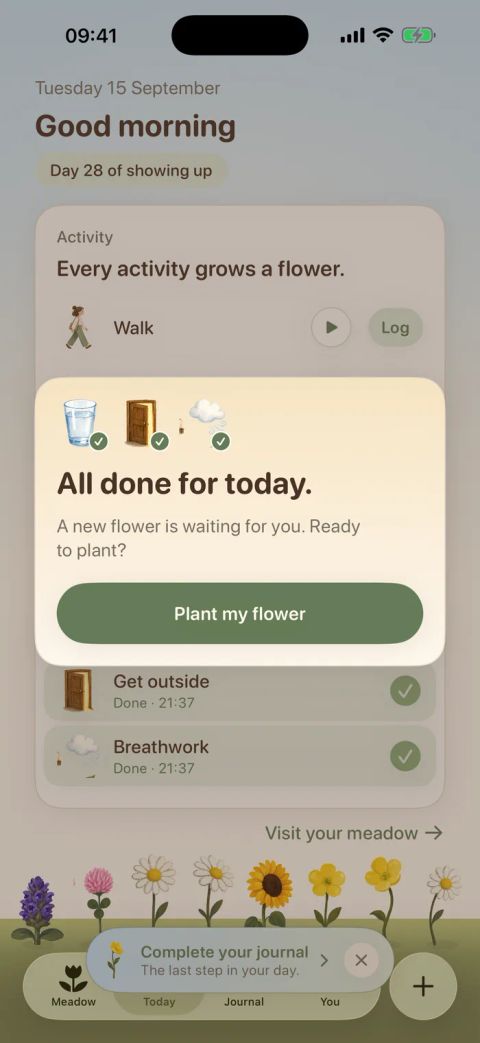
Seeing the walks stack up is often what keeps a new habit alive, and that holds whether or not you ever put a vest on. If you would rather keep the record on your phone, Meadow has walking built in as one of its activities, so a vest walk takes a few seconds to log and the days accumulate on their own. It is a gentle habit app for iPhone from Wildcard Wellness, and each day you show up grows a wildflower in your own meadow, with rare flowers and the odd animal visitor turning up as it fills in. It counts consistency, so there are no streaks, and a walk you skip because your back is twingy resets nothing you have built.
Weighted vest walking FAQ
Does walking with a weighted vest build muscle?
It builds leg strength and endurance more than it adds bulk. The clearest evidence is functional: in a 12-week trial, older adults who walked and trained in a vest improved their sit-to-stand and walking-distance scores more than those who did the same work unloaded. Treat it as a top-up to strength work, not a swap for it.
Is a weighted vest good for bone density?
It can contribute, but on its own it is a weak stimulus. The study most often cited paired the vest with jumping, and a 2025 trial found vests did not prevent bone loss during weight loss. If bones are your priority, ask your GP and expect impact or resistance training to do the main job.
How heavy should my weighted vest be for walking?
Start around 5 per cent of your body weight and keep it under 10 per cent, so roughly 3.5 to 7 kg for a 70 kg adult. Build up slowly and change one thing at a time.
Is it safe to walk every day with a weighted vest?
For many people a few loaded walks a week is plenty, with ordinary unloaded walks in between. Daily vest use is a lot of repeated load on your spine and joints, so build the habit first and add weight last. Anyone with back, neck, joint or balance issues should check with a GP or physiotherapist before making it a daily thing.
Weighted vest or incline walking?
Both make a walk harder without more speed. A vest adds load your whole body carries, while a hill shifts the work towards your legs and lungs and keeps your spine out of it, which can suit anyone wary of back strain. Our guide to incline walking covers that route in full.
One thing to try today
Take your normal walk with no vest, and as you go, notice your posture and how your back and knees feel. That baseline is the thing you will compare against when you do add weight, and it is the difference between building this sensibly and guessing. When you are ready to load up, start at 4 to 5 per cent of your body weight and no more. If you want the wider case for the plain, repeatable version first, our guide to the benefits of walking and to how many steps a day is a good place to start.
AUTHOR
Co-founder of Meadow.
Ash is co-founder of Meadow, a habit and movement tracking app that turns small acts of self-care into a growing wildflower meadow.
Every little bit counts
Five minutes counts. So does a dance in the kitchen.
Log the movement you enjoy and the small habits that help you feel good, and watch them bloom into something you can see.
Download Meadow