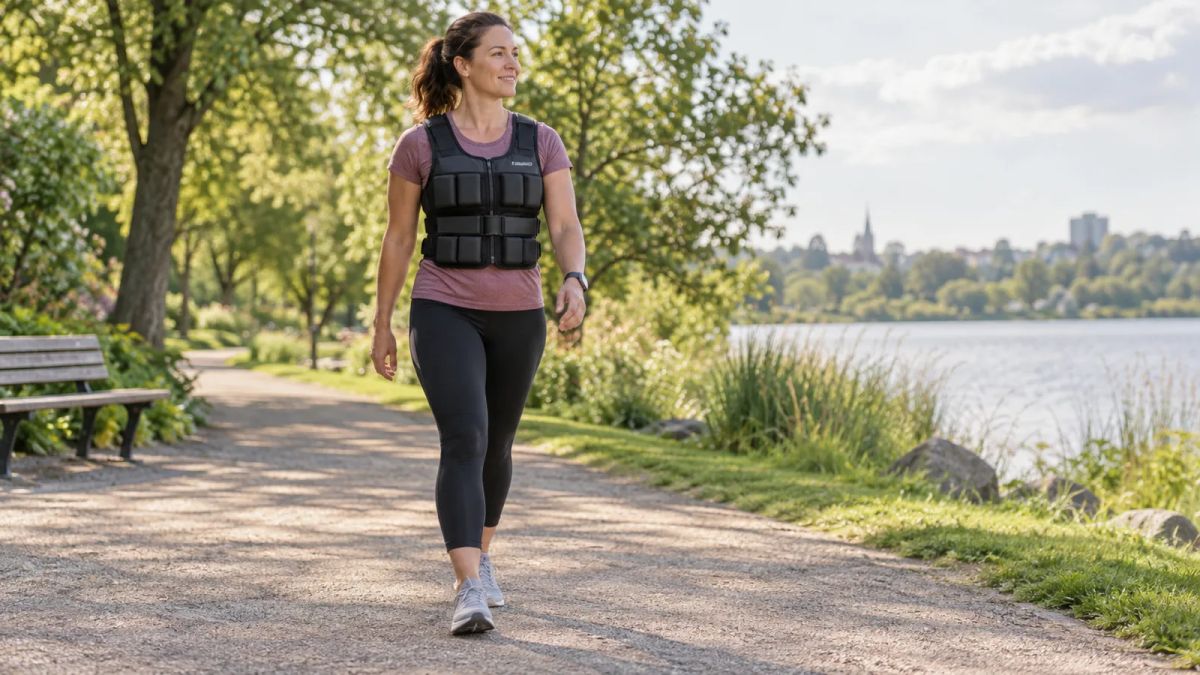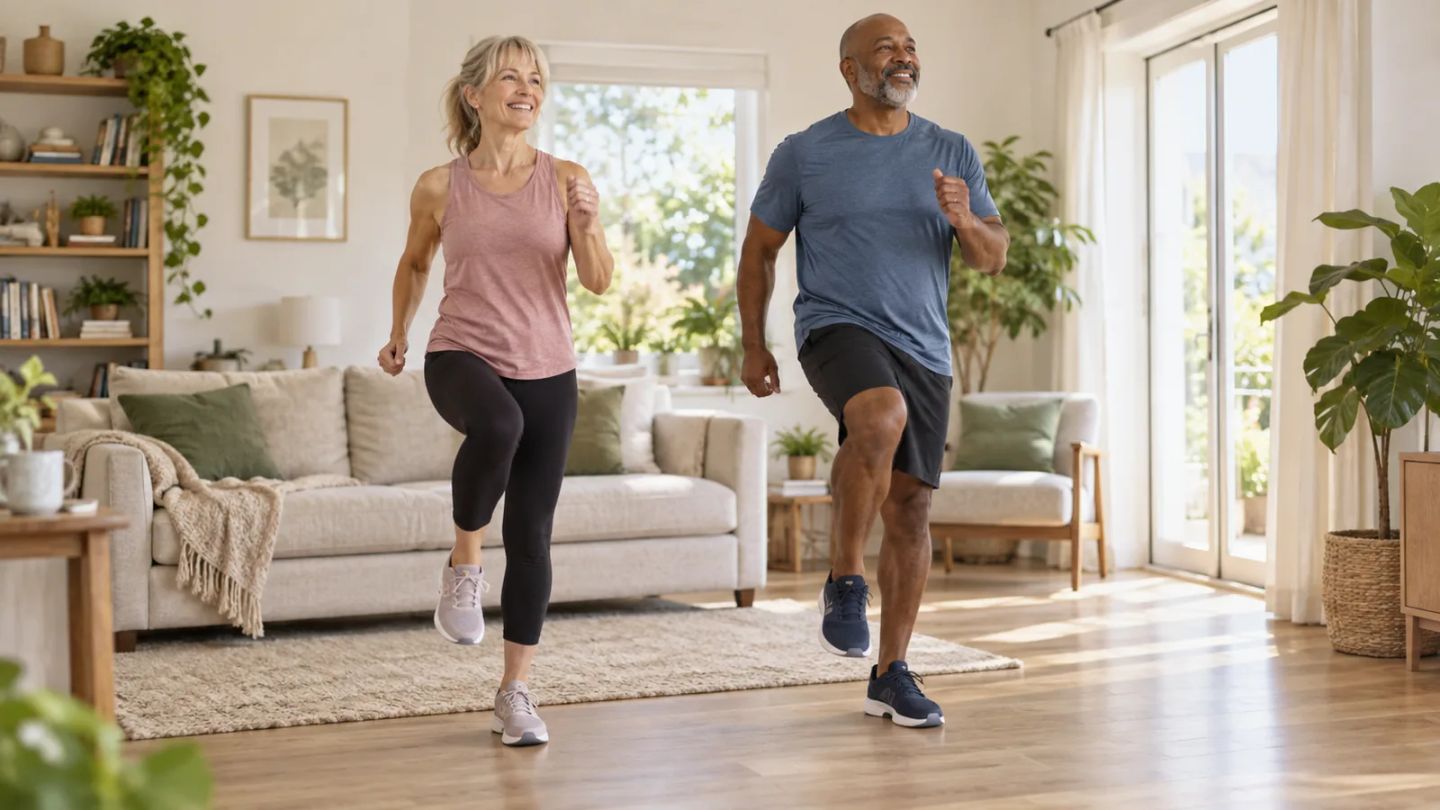
An indoor walking workout is a set routine of walking-style moves you do on the spot at home, no treadmill and no equipment, and you can start one in the next five minutes from wherever you are reading this. Push the coffee table aside, stand up, and the floor becomes your route.
This is the routine itself, written to be followed. The moves that stand in for a walk, a beginner version and a brisker version laid out step by step, how to add intensity when you want more, what it does for you when you check the evidence, and how to fit it into a normal day.
If you want a multi-week build rather than a single session, our indoor walking challenge turns these same moves into a four-week plan.
The moves that stand in for a walk
A walk is a rhythm, not a location. These five moves recreate that rhythm on a patch of floor about the size of a bath mat, and once you know them you can string them into any length of session.
- March on the spot. Stand tall with your feet hip-width apart, lift one knee, lower it, and swap. Let your arms swing naturally, opposite arm to opposite leg, the way they do when you walk down the street. This is your steady base, the move you come back to between the harder ones.
- Walk in place. A softer version of marching where you roll through the foot, heel to toe, and barely lift the knee. Use it to warm up in the first minute or two and to cool down at the end.
- Side steps. Step your right foot out to the side, bring your left to meet it, then reverse. Keep it low and light at first. Side steps wake up the muscles on the outside of your hips that a forward walk tends to skip.
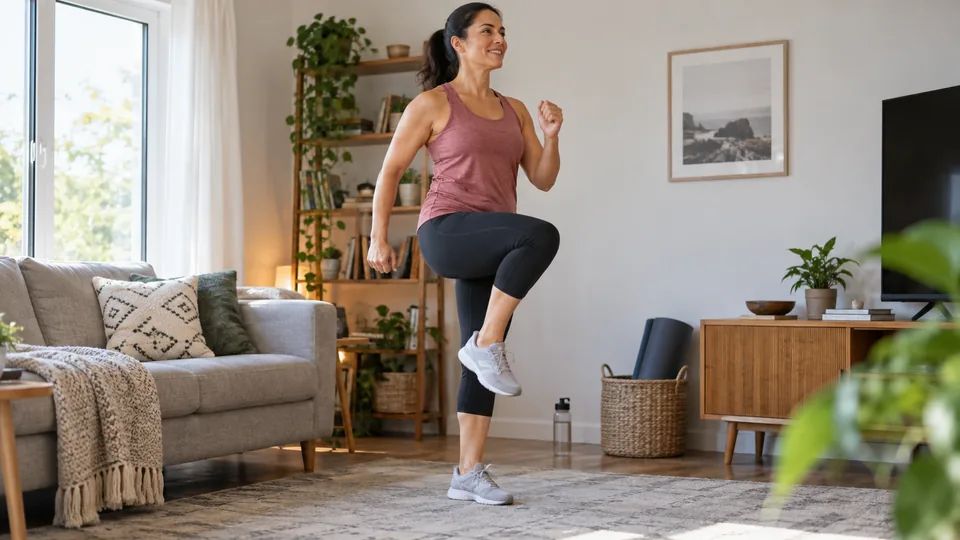
- Knee lifts. Drive one knee up towards waist height while the opposite arm reaches forward, then alternate with a bit of purpose. The higher the knee and the stronger the arm drive, the harder your heart and core work.
- Adding arms. Any of the above gets more demanding the moment your arms join in properly. Pump them at your sides, punch them forward, or sweep them overhead as you side-step. Arms above the heart raise your heart rate without asking anything more of your knees.
Mix three or four of these in a session and the time passes without you watching the clock.
The beginner routine, about 20 minutes
Start slow and finish easy. This version keeps everything low and gentle, with no jumping and no fast turns, so it suits stiff mornings, a first go, or anyone easing back into movement. Follow it in order.
1. Warm up, 3 minutes
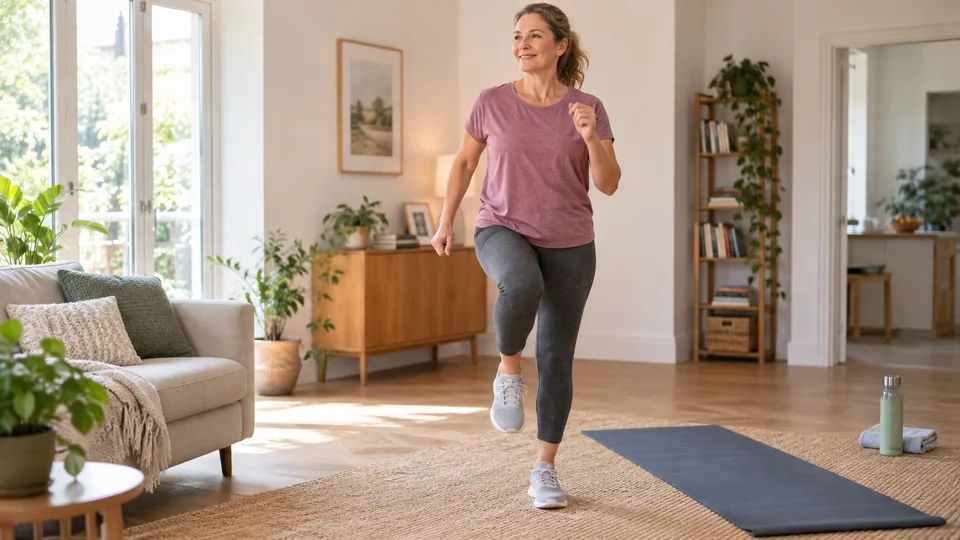
Walk in place at a comfortable pace, arms swinging low. Roll through each foot. You should be able to chat the whole time.
2. Steady march, 4 minutes
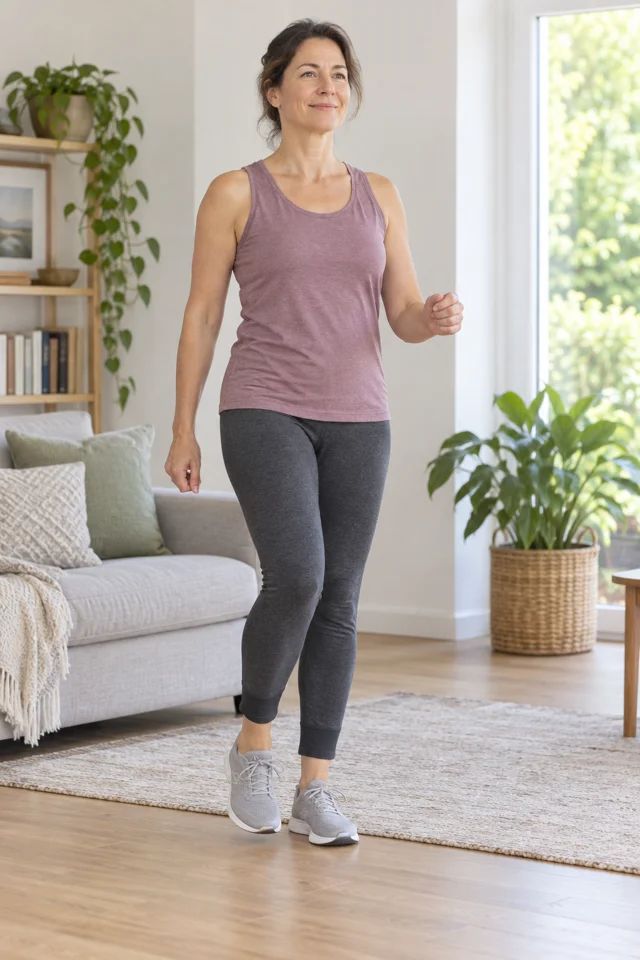
Lift the knees a little higher and pick up the pace until you feel your breathing deepen.
3. Side steps, 3 minutes

Step side to side with a small arm sweep. Keep your knees soft and your weight even.
4. March again, 3 minutes
Back to the steady rhythm to bring your breath back down halfway.
5. Gentle knee lifts, 3 minutes

Lift to a height that feels easy, opposite arm forward, no rush.
- Side steps with arms, 2 minutes. Add an overhead reach if it feels good, or keep the arms low if it does not.
- Cool down, 2 minutes. Slow to a soft walk in place, arms low, breathing settling, until you are back to a resting pace.
That lands most people somewhere around 2,000 steps, though it varies with your height and how high you lift.
The brisker version, about 30 minutes
Once the beginner routine feels comfortable, this one turns up the pace and the arm work and adds short faster bursts. The aim is the pace the NHS calls brisk, where you can still talk but could not sing the words to a song.
- Warm up, 3 minutes. Walk in place, then build to a steady march.
- Brisk march, 5 minutes. Hold a pace of about 100 steps a minute, arms pumping at your sides.
- Fast burst, 1 minute. Speed the feet up and lift the knees, aiming closer to 120 steps a minute, then ease back.
- Side steps with overhead reach, 4 minutes. Wider steps, arms sweeping up and down.
- Knee lifts, 4 minutes. Drive the knee high, opposite arm forward, keeping the rhythm strong.
- Fast burst, 1 minute. Another minute at your quicker pace.
- March with punches, 4 minutes. Steady feet, arms punching forward across your body.
- Stair steps or high march, 4 minutes. Step up and down a bottom stair with a handrail, or keep marching with high knees if you would rather stay on the flat.
- Cool down, 4 minutes. Slow the feet, drop the arms, and walk in place until your breath is easy again.
Alternating the harder minutes with steadier ones is what raises the average effort without leaving you flat on the floor.
How to add intensity without a treadmill
Speed is only one dial. The simplest way to know you are working at a moderate level is your cadence. A systematic review of walking studies concluded that around 100 steps a minute is enough for most adults to reach moderate intensity, with roughly 130 steps a minute counting as vigorous. Count your steps for fifteen seconds and multiply by four if you want a number to aim at. Building towards the weekly total of moderate activity that ACSM recommends, about 150 minutes with a couple of strengthening days, is far easier when a session can happen on any patch of floor.
Beyond pace, these all add load with no kit:
- Lift the knees higher. More range means more work for your hips and core.
- Get the arms above your heart. Overhead reaches and high pumps push your heart rate up on their own.
- Use the stairs. A few trips up and down a flight, hand on the rail, works your legs harder than flat ground.
- Hold something light. A tin of beans in each hand or a small water bottle adds a little resistance to the arm moves.
- Stretch the session. Adding ten minutes is its own kind of intensity, and short walking sessions stack up across a day.
For structured seated or standing options that go easier on the joints, our guide to low-impact workouts covers alternatives you can slot in on a sore day.
What an indoor walking workout does for you
Walking on the spot is still walking, and the movement carries most of what makes a walk worthwhile. The pattern is the same one your body knows outdoors, so the heart, lungs and legs get the work whether the scenery moves or not.
The immune effect is worth knowing. Harvard Health describes research in which people who walked at least 20 minutes a day, five days a week, had 43% fewer sick days than those who exercised once a week or less, and had milder symptoms when they did fall ill.
There is a mood and energy return most people feel the same day, which is often the reason a home routine sticks when a gym membership does not. Our fuller round-up of the benefits of walking goes through the evidence in more depth.
Now the part the fitness videos tend to skip. If your aim is weight loss, an indoor walking workout helps but will not carry it alone. The CDC points out that some activity is always better than none, yet a change on the scale depends on how you eat, sleep and live as much as how you move. These findings come from large groups and describe averages, not a promise about your particular fortnight. Do the workout because it makes your day feel steadier, and treat anything the scale does as a bonus.
If you have not been active for a while, or you live with a health condition, pain or any concerns about balance, have a word with your GP before you build up, and add time and pace gradually, not all at once.
Fitting it into a real day
You do not need a clear half-hour for this to count. The CDC notes that the weekly target of about 150 minutes of moderate activity can be broken into smaller chunks across the week, so three ten-minute sessions do the same job as one long one.
Two habits make it stick. The first is attaching the walk to something that already happens, like marching through the adverts of your evening programme or doing five minutes while the kettle boils. The second is timing a short session after a meal, which does quiet good beyond the steps.
On a stretched day, shrink the workout. Don't skip it. Five minutes of marching beats a planned half-hour you never start, and the habit survives on the small days far more than the big ones.
Tick off today's session

Marking the workout as done is a small act that keeps the routine turning up. A note on the calendar does it, and so can an app.
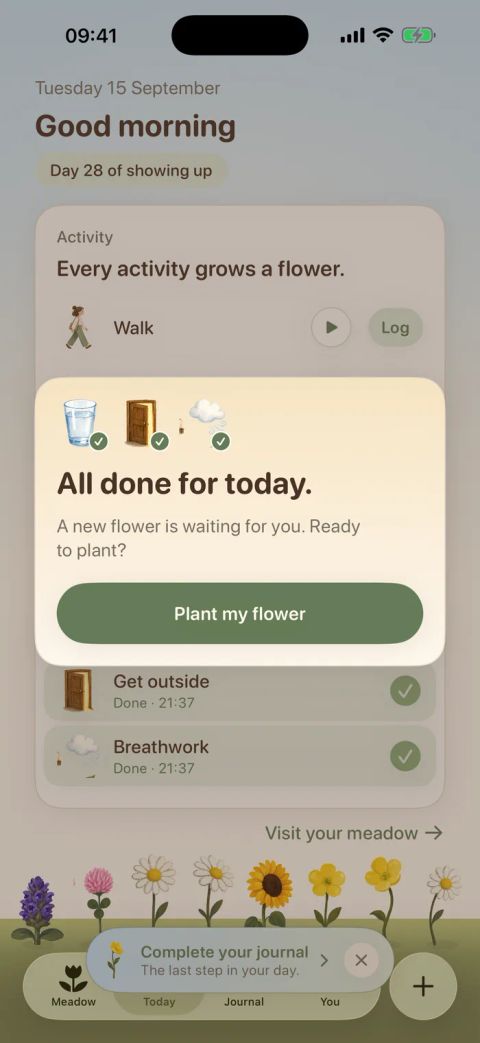
Meadow is a gentle habit app for iPhone with walking among its activities, so today's indoor session takes seconds to mark done, and each day you show up grows a wildflower in your own meadow. It is made by Wildcard Wellness and built for consistency rather than a spotless record. There are no streaks, so shrinking a workout or missing one resets nothing and your flowers never wilt.
Common questions
Do indoor walking workouts count as real exercise?
Yes. Marching, knee lifts and side steps raise your heart rate and use the same muscles as an outdoor walk, and at around 100 steps a minute they reach the moderate intensity that public health guidelines are built on. What matters for your heart, lungs and mood is the effort and the rhythm, not whether you covered any ground.
How many steps do you get from an indoor walking workout?
A 20-minute session lands most people near 2,000 steps and a brisker 30-minute one closer to 3,000 to 5,000, though it swings with your pace and stride. Marching on the spot registers on a phone or watch, so your indoor steps count towards your daily total the same as outdoor ones.
Is marching in place as good as walking outside?
For your heart, blood sugar and mood, what counts is the movement, not the view, so a brisk indoor session does much of the same work. Outdoor walking adds daylight and fresh air, but on a dark, wet or busy evening a good workout on your living room floor beats the walk you would have talked yourself out of.
What if I cannot stand or march for long?
Begin with what you can manage, even two or three minutes, and rest between rounds. If standing is hard, seated movement is a fair way in, and much of the same rhythm works from a stable chair. Anyone with pain, balance worries or a health condition should check with their GP before starting.
One thing to do today
Clear a bath-mat of floor, set a timer for five minutes, and march on the spot with your arms swinging until it goes off. That is a full indoor walking workout in its smallest form, and the version you can repeat tomorrow before you decide whether to make it twenty.
AUTHOR
Co-founder of Meadow.
Ash is co-founder of Meadow, a habit and movement tracking app that turns small acts of self-care into a growing wildflower meadow.
Every little bit counts
Five minutes counts. So does a dance in the kitchen.
Log the movement you enjoy and the small habits that help you feel good, and watch them bloom into something you can see.
Download Meadow