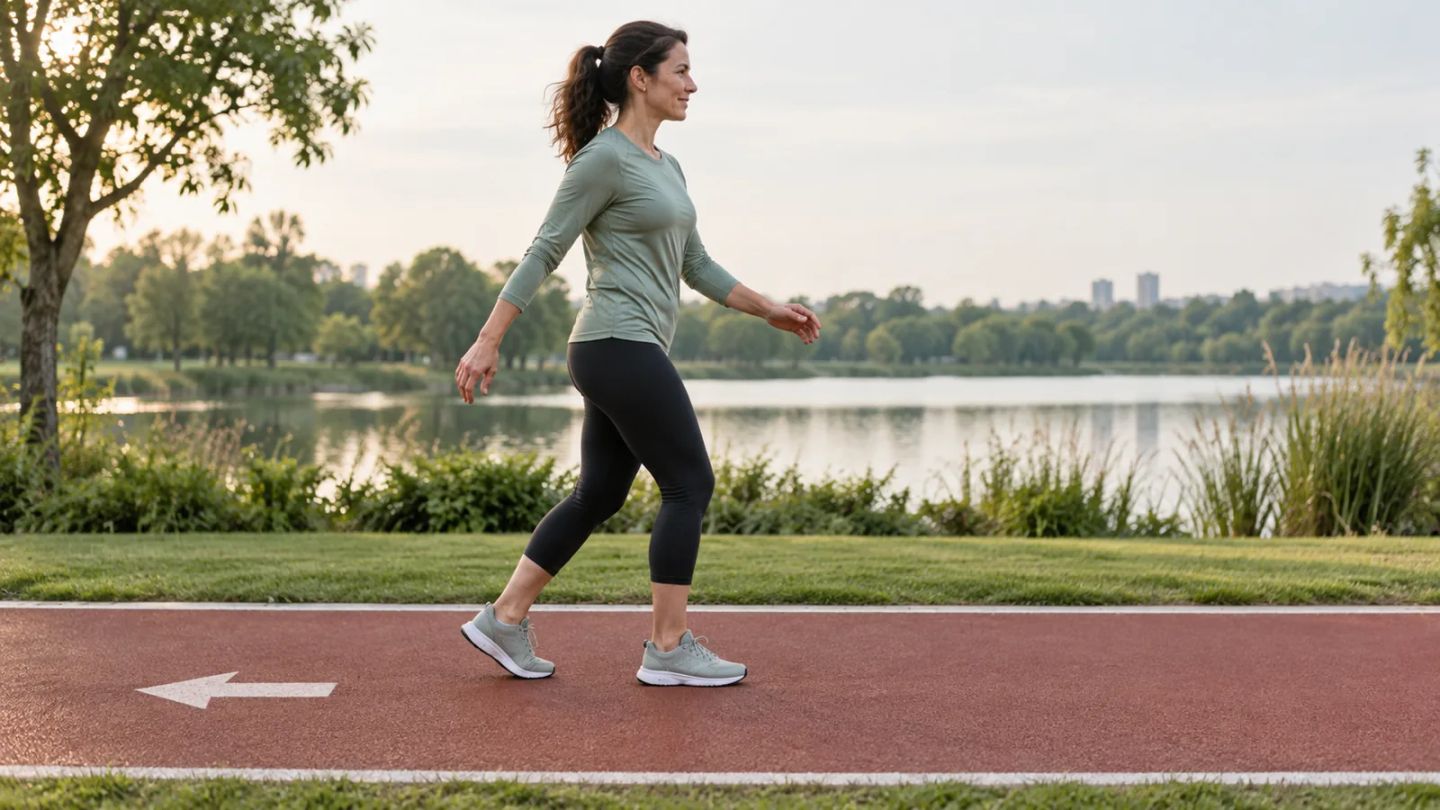
Backward walking, often called retro walking, is what it sounds like: walking in reverse, one careful step behind the other. It shows up in physiotherapy clinics and, lately, all over social media, usually sold as a way to strengthen your legs differently, sharpen your balance, and give a familiar habit a new challenge. A fair amount of that holds up. The catch is that the evidence is smaller and more specific than the headlines suggest, and there is a real safety trade-off to weigh before you set off in reverse.
The sensible way to picture it is a small variation on ordinary walking rather than a replacement for it. Forward walking is where the steady, well-tested benefits of walking sit, and it stays the foundation. Backward walking is a short, controlled add-on for people who want a different stimulus and can do it safely.
What retro walking involves
Walking in reverse changes the mechanics in ways you feel within a few steps. You cannot see where you are going, your stride shortens, your feet spread a little wider, and your body recruits different muscles to control each landing.
You step toe first instead of heel first, which shifts the work forward onto your thighs. Cleveland Clinic notes that backward walking uses more of your gluteal muscles, quadriceps and hip flexors than forward walking, and gives the small stabilising points through your legs and ankles an extra challenge.
That is the appeal for people who use it on purpose. It leans on your sense of where your body is in space rather than on your eyes, and it demands more concentration than a normal stroll. It also asks your quadriceps, the muscles at the front of the thigh, to work in a pattern that forward walking never quite calls for.
None of that makes it a miracle. It makes it a different, more demanding task to control, which is the same reason it carries more fall risk than walking forwards.
The honest evidence for the claimed benefits
Retro walking gets pitched for four things above all: knee and quad strength, balance, coordination, and brain engagement. Here is where each one stands.
Knee pain and quadriceps strength
This is the strongest corner of the evidence. A six-week randomised trial of 68 adults with mild-to-moderate knee osteoarthritis tested a retro-walking programme three days a week alongside routine physiotherapy. The backward-walking group saw bigger drops in pain and functional disability, and bigger gains in quadriceps strength and in a timed sit-to-stand-and-walk test, than the group getting usual care alone.
The walks started at ten minutes and built towards thirty as pain allowed. Worth flagging: a matched forward-walking group in the same trial improved too, and the difference between backward and forward walking was not statistically significant. So the picture is less "backward beats forward" and more that a structured walking programme helped, while backward walking held its own and stayed gentler on the front of the knee.
The researchers were candid about the limits. Small groups, no long-term follow-up, and an age range of 45 to 66 that tells you nothing about how it works for much older or younger people. This was rehab inside a clinic, not a general fitness routine.
Balance and coordination
The balance case is promising but thin. A focused systematic review of backward walking in Parkinson's disease pulled together nine studies and found within-group improvements in balance and gait after training, with backward-walking training edging out standing balance work on one common balance score.
The same review was blunt about the quality. Nine small studies, only two of them randomised, with mixed methods and no long follow-up. Its conclusion was measured: backward walking may help as a supplementary part of rehabilitation, but its specific benefit cannot be cleanly separated from the general effect of exercising more. That is a clinical population too, not the average person looking for a balance drill.
Brain engagement
You will see confident claims that walking backwards fires up your brain. There is a kernel of truth under the hype. Because you have no forward view, your brain relies more on internal control and on feedback from your joints and muscles, and researchers propose that backward walking draws more heavily on regions such as the motor and parietal cortex, thalamus and basal ganglia than forward walking does.
The review that describes this also says plainly that these mechanisms remain under-explored and lack clinical validation. The extra mental load is what makes it a useful training stimulus. It is also what turns a moment of distraction or an uneven surface into a stumble faster than it would facing forwards.
The bigger picture
Pull it together and the summary is narrow but fair. There is reasonable support for backward walking as an add-on within structured physiotherapy for specific knee and gait problems, and early, encouraging signals for balance. There is no good evidence that it beats ordinary walking for general fitness, and no reason to swap your daily walk for it. If you want a gentle way to vary your walking, Japanese walking and its interval structure is another low-risk option to sit alongside your usual routes.
The safety part, which matters most here
This is the section to read twice. Not being able to see your path is the whole hazard, and no benefit above is worth a fall to chase.
A kerb, a loose paving slab, a child's toy, a step down, a pet or another person can all arrive without warning. The Parkinson's review that found balance benefits still advised that backward walking be introduced with caution and practised in a safe setting with proper support. That caution applies to everyone, not to clinical groups alone.
If your balance is already unsteady, if you have had falls, or if you live with a condition affecting your movement, coordination, eyesight or inner ear, treat backward walking as something to try with a professional rather than alone. A physiotherapist or your GP can tell you whether it suits you and how to begin. The NHS points out that strength and balance activity deserves particular attention as we get older, and Cleveland Clinic makes the same point about knee and hip issues, warning that retro walking is not right for everyone with those problems and that you should check with a provider first.
There is no prize for pushing this one.
How to try walking backwards safely
If you are steady on your feet and want to give it a go, keep the first attempts small and dull. Boring is the goal here.
- Pick a flat, clear, familiar surface. A quiet stretch of hallway, an empty bit of garden path, a smooth paved path or a running track. Cleveland Clinic suggests a smooth paved path or flat grass. Clear anything underfoot first.
- Check over your shoulder before you start, and glance back now and then as you go so you know what is behind you.
- Keep it short and slow. A minute or two is plenty at first, in one- to two-minute chunks mixed into your normal forward walk. Take small steps and let your toes touch down before your heel.
- Stay well away from roads, slopes, stairs, water and crowds. Anywhere a stumble could turn into something worse is the wrong place to practise.
- Build up in minutes, not intensity. The knee trial added time gradually as people stayed comfortable. Stop the moment anything feels wrong in a knee, hip or ankle. This should feel like concentration, not strain.
A treadmill with side rails is a controlled option, but only if you are confident using one. Slow the belt right down before you try it, hold the rails, and step backwards gently. If gripping the rails feels like the one thing keeping you upright, the speed is too high or this is not the day for it.
On a hard day, and after you miss one
Backward walking is easy to shrink. On a stretched or tired day, thirty seconds of slow steps along the hallway keeps the pattern alive without asking much of you, and that beats abandoning it because a full session felt out of reach. This is a habit where less is often wiser, because fatigue is exactly when your balance is at its worst.
Missing days matters little. A study of how everyday habits form found that one missed occasion did not stop a habit taking hold, and that the time it takes to feel automatic varies widely from one person to the next. There is no streak to protect. When you skip a session, take the next chance rather than doubling up to make amends.
Meadow, without the streak

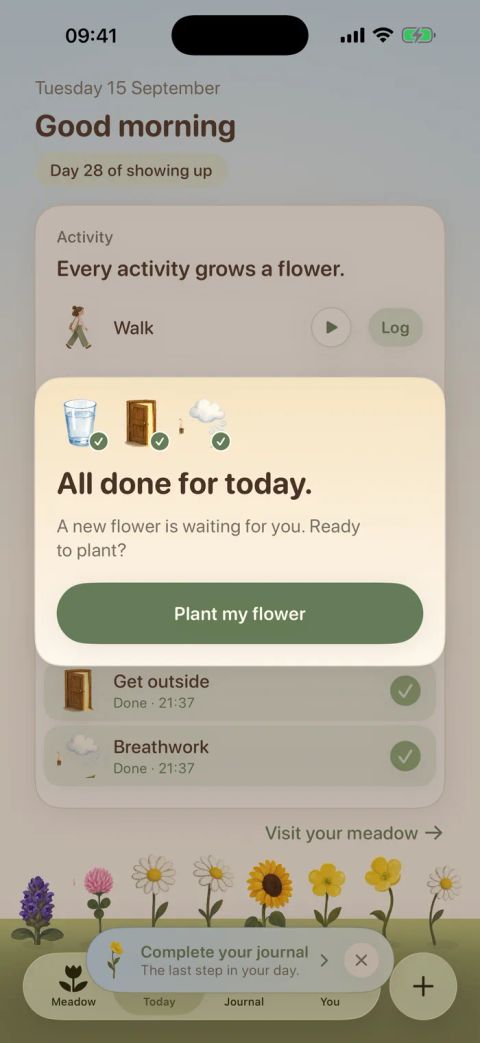
If you like watching a small habit build, a gentle record helps more than any target. Another app worth checking out is Meadow, because it is built around encouragement rather than pressure. It is a habit tracker for iPhone from Wildcard Wellness, where you log the movement you enjoy, whether that is a walk, a little yoga or a dance, note your mood, a daily win and an affirmation, and grow a wildflower for every day you show up. Miss a day and nothing resets, your flowers never wilt. It costs $39.99 a year or $9.99 a month after a seven-day free trial.
Here is the one action worth taking today. Find a flat, clear, familiar stretch indoors or in your garden, look over your shoulder, and walk backwards slowly for one minute. If it feels steady, keep it as a short add-on to your usual forward walks. If it feels shaky, that is useful information too, and a sign to ask a physiotherapist before you go any further.
Every little bit counts
Five minutes counts. So does a dance in the kitchen.
Log the movement you enjoy and the small habits that help you feel good, and watch them bloom into something you can see.
Join the Meadow waitlist