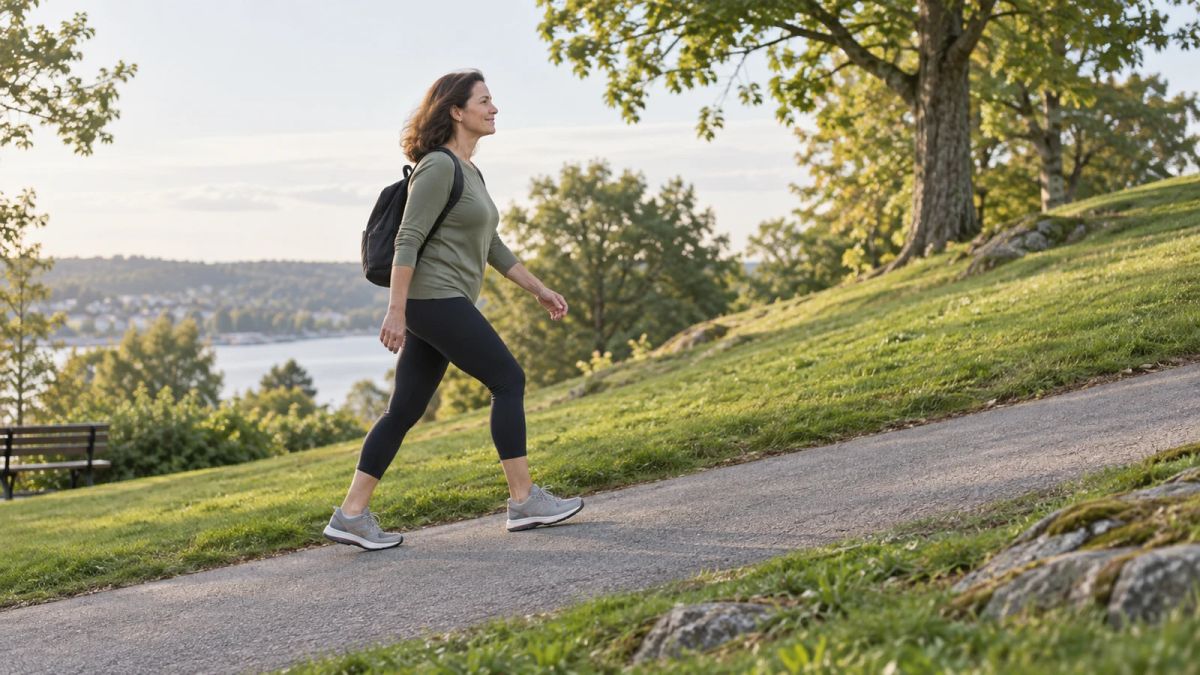
Incline walking is walking uphill, either on a treadmill set to a gradient or on real hills and slopes outdoors. Tilt the ground and every step has to lift your body weight as well as move it forward, so an easy walk quietly turns into a stronger cardio and lower-body workout without you moving any faster.
That is the whole trick. Same pace, same low impact, more work per step.
It has had a fresh burst of attention lately thanks to the "12-3-30" treadmill routine, but the idea underneath it is old and well studied. Below is what incline walking is, how it stacks up against flat walking, what the 12-3-30 method does and does not deliver, and how to build it in without hurting yourself in week one.
How incline walking compares to flat walking
The clearest difference is intensity. Because your muscles are doing extra work to raise you against gravity, your heart rate and your energy use climb, even though the number on the speed display has not changed.
Cleveland Clinic puts the effect plainly. Walking uphill "makes your body work harder on every single step," and at a 12 per cent incline the calorie burn is nearly double what it would be on a flat surface at the same speed.
How much harder can incline walking get? Hard enough to stand in for a run. In a 2025 study of physically inactive young adults, researchers matched a steep 20 per cent incline walk against level-grade jogging so that the two burned the same calories. Walking at 1.81 miles an hour uphill produced almost the same oxygen use and heart rate as jogging at 3.94 miles an hour, with no significant difference in perceived effort between them. You can get a jog's worth of work out of a walk, if the hill is steep enough.
The muscles it recruits also change. On the flat, walking is mostly a forward motion. Point the ground uphill and your posterior chain has to push, so your glutes, hamstrings and calves take on more of the job. Harvard Health notes that walking up hills and stairs "adds resistance that can improve endurance by building your leg muscles," naming the quadriceps, hamstrings and calves.
Then there is the kindest part: incline walking is gentle on your joints. The same research team that matched incline walking to jogging also measured the jolt travelling through the body on each footfall. At an equal calorie burn, the impact through the foot was less than half that of jogging (around 10.5 versus 22.1 in their units), and the jolt reaching the base of the spine was roughly half as large. You get a run-like effort with a walk-like landing, which is a large part of why people with cranky knees reach for it.
So the honest comparison looks like this:
- Intensity: higher than flat walking at the same speed, and it can climb into jogging territory on a steep grade.
- Calorie burn: meaningfully greater, up to close to double at a steep incline.
- Muscle use: more glute, hamstring and calf work than flat ground.
- Impact: far lower than running, close to ordinary walking.
The 12-3-30 method, explained plainly
If you have seen incline walking online, you have probably seen it wearing this uniform. The 12-3-30 workout is a treadmill routine popularised by the influencer Lauren Giraldo, and the name is the recipe: set the incline to 12 per cent, the speed to 3 miles an hour, and walk for 30 minutes.
It is a real workout with real benefits. It is also harder than the friendly numbers suggest.
Cleveland Clinic exercise physiologist Katie Lawton describes it as "definitely on the harder side", warning that a 12 per cent incline is steep enough to make the half hour drag. The catch: the routine is often shared as a beginner-friendly starting point, when for many people it works better as a goal to build towards.
Two more caveats are worth keeping in view. The first is that one fixed routine trains one pattern, so Lawton suggests pairing it with some strength work to challenge different muscles. The second is the quieter one: no amount of incline walking rescues an unbalanced diet, and as she puts it, "you cannot out-exercise a bad diet." Treat 12-3-30 as a solid cardio session, not a weight-loss guarantee.
If the full recipe feels punishing, change the numbers. A 6 or 8 per cent incline at 2.5 miles an hour is still incline walking, and still counts. The method is a template, not a test.
How to start incline walking safely
You do not need a treadmill for this. A hilly street, a footbridge, a multi-storey car park ramp or a local park with a slope will all tilt the ground for you. A treadmill is handy because it lets you set an exact grade and change it in small steps, but the effort is the same wherever the hill is.
Wherever you start, start lower than you think.
On a treadmill, a sensible first session is a few minutes flat to warm up, then five to ten minutes at a 3 to 5 per cent incline at a comfortable pace, then a flat cool-down. Add a percentage point or a couple of minutes only once the last session felt manageable rather than survivable. There is no prize for reaching 12 per cent in the first week.
Outdoors, pick a gentle slope and use the talk test to judge your effort. The NHS describes a brisk walk as one where you can still talk but cannot sing the words to a song, and it advises building up your distance and pace gradually. On a hill, that talk-not-sing feeling will arrive at a slower speed than it does on the flat, which is the point.
A short safety word. If you have been inactive for a while, are carrying a health condition, or are recovering from illness, have a quick chat with your GP before you take on anything more strenuous than a gentle stroll. Warm up first, and stop if something hurts in a way that feels wrong, not the ordinary burn of effort.
The honest benefits, and the limits
The benefits of regular incline walking are the benefits of regular moderate exercise, delivered in a low-impact package. Moderate aerobic activity tends to lower resting blood pressure, and the American College of Sports Medicine reports that regular aerobic exercise can drop systolic and diastolic blood pressure by an average of 5 to 7 mmHg in adults with hypertension, with its guidance pointing towards most days of the week. Add the extra leg-muscle work of the incline and the cardiovascular lift of a raised heart rate, and you have a session that earns its half hour.
Now the parts the fitness videos skip.
Studies like the ones above describe averages across groups of people, not promises to any single walker. Your numbers will be your own. Incline walking is not a treatment for any medical condition, and it is not a weight-loss scheme with a guaranteed result. Weight change depends on far more than one workout, diet included, and the research here is about fitness, muscle and blood pressure, not a figure on the scale.
One more honest note from the science. In that isocaloric study, participants found jogging more enjoyable than steep incline walking, even though the effort was matched. Incline walking is efficient, but grinding up a steep gradient can feel like a slog. If you dread it, drop the grade until it is bearable, because the walk you keep doing beats the brutal one you quit.
Fitting incline walking into your week
You do not have to choose between incline walking and everything else you do. It slots into a normal week the same way any walk does.
Aim to spread moderate activity across most days, not cram it into one heroic session. ACSM guidance leans towards moderate-intensity aerobic exercise on 5 to 7 days a week for the fullest blood-pressure benefit, and a couple of incline sessions can sit inside that alongside your ordinary walking.
Split it if a full block will not fit. Two shorter incline walks in a day still count, and the uphill leg of your commute or the school run can carry some of the load without any extra time set aside. If you want the wider case for keeping the everyday version going, our guide to the benefits of walking covers why the modest, repeatable walk tends to outlast the ambitious plan.
Incline walking also pairs neatly with other structured walks. If you like the idea of varying effort on purpose, the interval approach in our guide to Japanese walking does with speed what a hill does with gradient, and the two can take turns across your week.
Keep a record of your hills

Seeing your walks stack up is often the thing that keeps the habit alive, and a simple record does the job whether it lives on a paper calendar or a phone. If you would rather keep it on your phone, Meadow has walking built in as one of its activities, so an incline session takes a few seconds to log and the days add up on their own. It is a gentle habit app for iPhone made by Wildcard Wellness, and each day you show up grows a wildflower in your own meadow, with rare flowers and the odd animal visitor arriving as it fills in. There are no streaks, so a hill you skip in bad weather resets nothing and your flowers never wilt.
Incline walking FAQ
Is incline walking as good as running?
For effort and calorie burn, a steep incline can match a run. Research matching a 20 per cent incline walk to level jogging found similar oxygen use, heart rate and perceived effort, while the impact travelling through the foot and spine was roughly half that of jogging. If your joints dislike running, incline walking is a fair swap. If you enjoy running, keep running.
What incline should a beginner start at?
Lower than 12 per cent. A 3 to 5 per cent grade at a comfortable pace is plenty to feel the difference, and you can build from there over weeks. The 12-3-30 numbers are a target to grow into, not a starting line.
Does incline walking build muscle in your legs and glutes?
It works your glutes, hamstrings and calves more than flat walking does, and Harvard Health notes that hills add resistance that helps build leg muscles. It is more toning and endurance than heavy muscle-building, so treat it as a complement to resistance work, not a replacement.
Is incline walking good for weight loss?
It burns more calories than flat walking, which can support a weight goal, but no single workout guarantees weight loss on its own. Diet and overall activity matter at least as much, which is why even the routine's advocates warn you cannot out-exercise a bad diet.
How long should an incline walk be?
Anywhere from ten to thirty minutes works, depending on your fitness and the grade. Start with what you can finish comfortably and build the length before you build the steepness.
One thing to try today
Next time you are on a treadmill or heading out for a walk, add a gentle incline for five minutes. On a treadmill, nudge the grade to 4 or 5 per cent and keep your usual pace. Outdoors, pick a slope you would normally avoid. Notice how your breathing lifts while your feet barely change speed, and you have felt the whole point of incline walking in five minutes flat.
AUTHOR
Co-founder of Meadow.
Ash is co-founder of Meadow, a habit and movement tracking app that turns small acts of self-care into a growing wildflower meadow.
Little and often, with Meadow
Consistency, not intensity.
Meadow turns the movement you enjoy and the habits that help you feel good into a meadow of wildflowers. No streaks to break, and your flowers never wilt.
Download Meadow