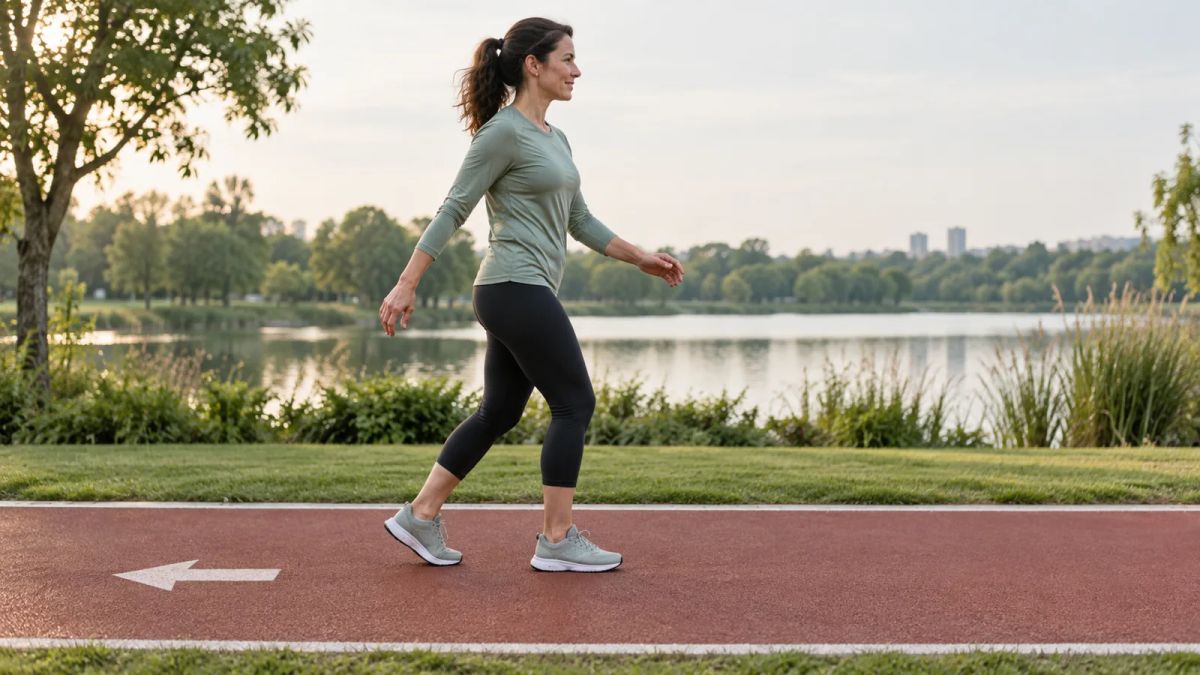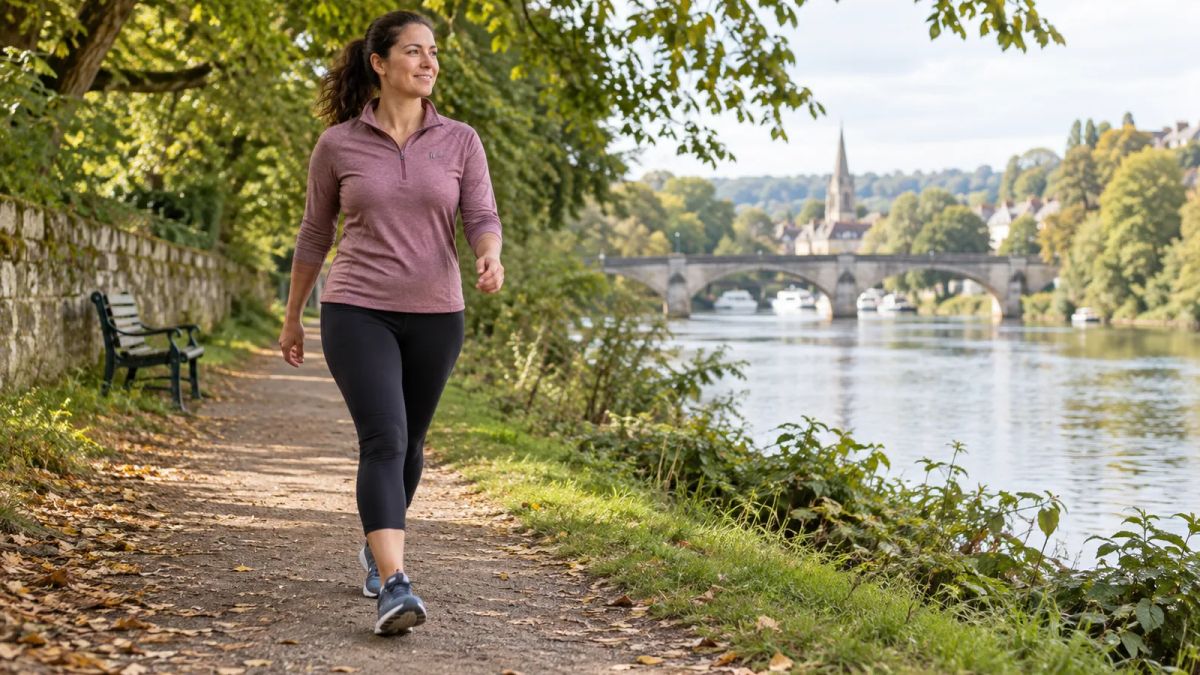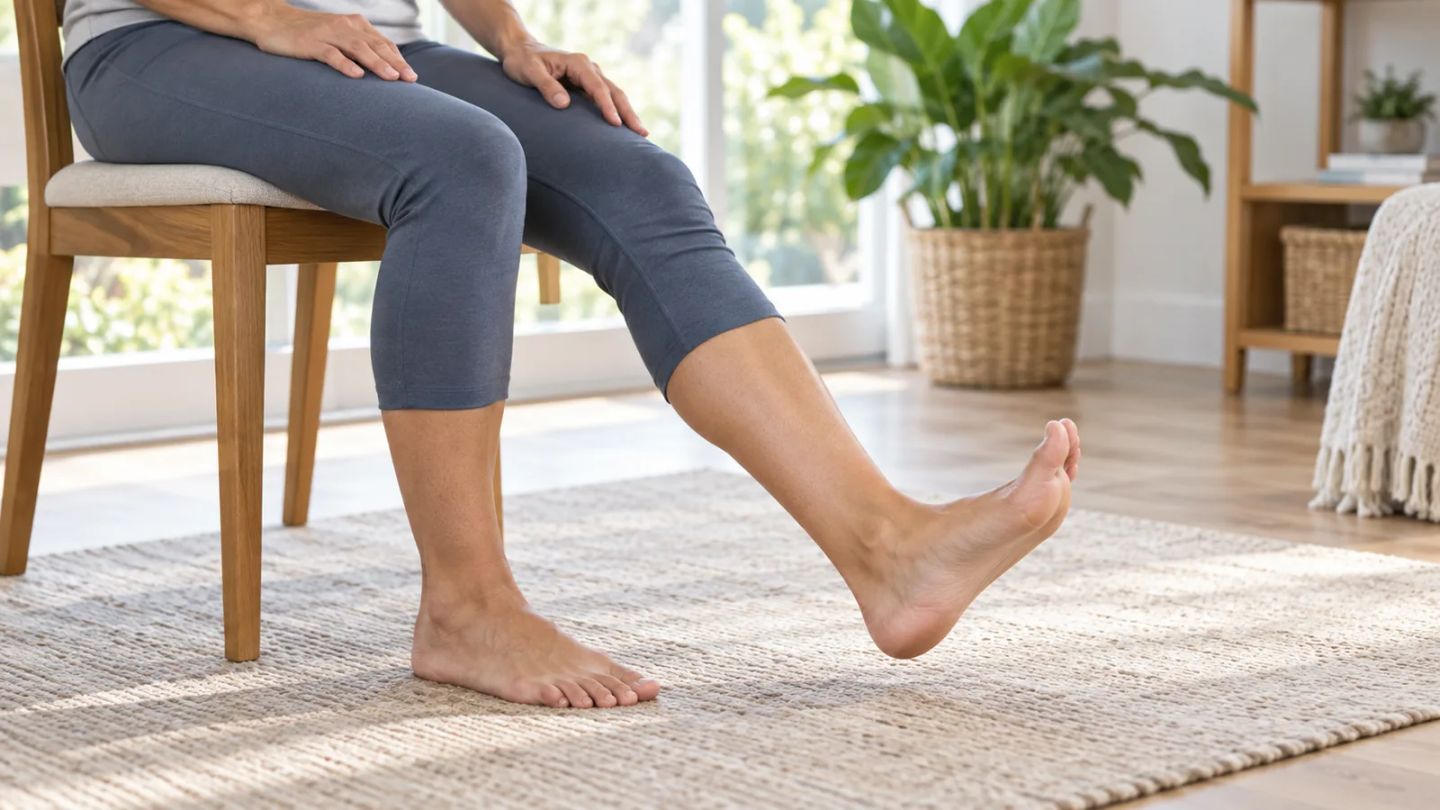
Ankle mobility is how far your ankle can bend and flex through its full range, and this is a routine of seven moves to build it. It takes about ten minutes, needs no kit beyond a wall and maybe a resistance band, and helps whether you're stiff from a day in shoes or you want to squat, walk and balance more easily.
Your ankles are small joints doing a big job. Every step, every stair, every time you lower into a chair or a squat, your shin has to travel forward over your planted foot. That forward travel is called dorsiflexion, and it's the movement that tends to run short.
When the ankle won't bend far enough, the movement has to come from somewhere. Your heel lifts, your knee drifts inward, or your back rounds to cover the gap. A freely moving ankle keeps that chain honest.
The routine below runs in a sensible order. It wakes the joint with easy circles and the alphabet, mobilises it under a little load, stretches the two calf muscles that hold the ankle back, then finishes with some strength. You can do all of it by a wall with a chair to hold.
Signs your ankles are stiffer than they should be
Stiff ankles rarely announce themselves. The clues tend to turn up further up the leg.
- Your heels lift off the floor when you squat, or you can only get low by tipping well forward.
- Your knees cave inward as you lower into a squat or step down a stair.
- You feel a tight pull low in the calf or Achilles when you walk uphill.
- One ankle feels different from the other, often the side you've sprained.
- Your toes catch on kerbs or uneven paving now and then.
None of these proves anything on its own. Two or three together are worth checking with the wall test below.
Walking needs more ankle bend than most people expect. A 2024 study in the Journal of Foot and Ankle Research put the figure at roughly 10 degrees of dorsiflexion for each step. Among its 70 healthy adults, those with less ankle bend walked with more rotation at the knee, thighs angling inward at the hip and less hip extension. That's the knee and hip picking up the slack.
Test your ankles against a wall first
Before you start, it helps to know where your ankles are. There's a simple check that physiotherapists use called the knee-to-wall test, and you can do it at home in a minute.
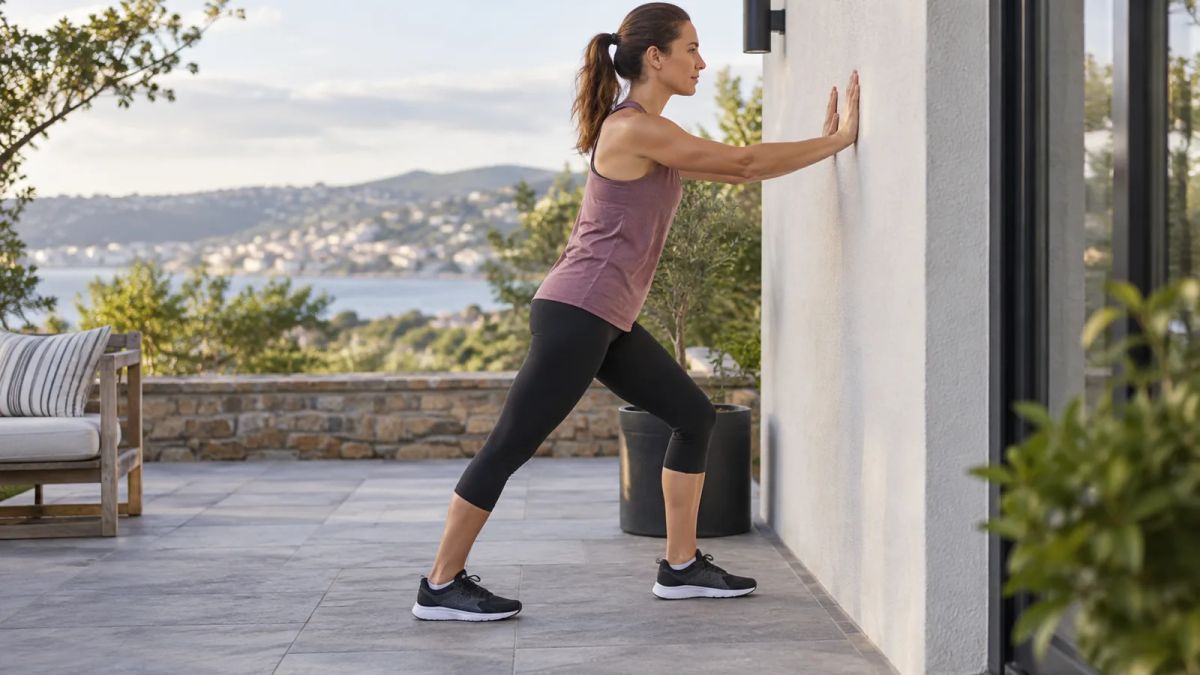
Stand facing a wall with one foot in front, toes a few centimetres away. Keeping your heel flat on the floor, bend your front knee and try to touch the wall with your kneecap. If you can, slide the foot back a bit and go again, until you find the furthest point where the knee still reaches the wall with your heel down. Measure from your big toe to the wall.
Physiotherapy guidance puts a normal result at 10 cm or more, with 4 to 9 cm counted as borderline and under 4 cm as a real restriction. Test both sides. It's common for one ankle to reach further than the other, often the side you've turned or sprained before. Jot the numbers down. Retest in a few weeks and you'll see whether the work is landing.
Why bendy ankles are worth ten minutes
Most of the trouble here is quiet. You don't feel a stiff ankle the way you feel a stiff neck, because the body is good at hiding it, borrowing range from the knee and hip instead.
Balance is where it tends to surface with age. A study of 88 older adults living independently found that 86% of them had limited ankle mobility, and that weight-bearing dorsiflexion was the strongest predictor of how well they performed dynamic balance tasks, the sort that involve moving and turning. Your ankle is the first joint to meet the ground. When it can't adjust, holding steady on a kerb or a slope asks more of everything above it.
Squatting and lunging lean on the same movement. If your shin can't travel over your foot, your heels come up and your knees lose their line, and that's where the wobble and the aches start.
Ankles respond to being worked, which is the encouraging part. A randomised trial of 30 female athletes with tight ankles ran an eight-week programme of three 30-minute sessions a week, mixing soft-tissue work, stretching and strengthening. Dorsiflexion improved by around seven degrees, with better scores on a dynamic balance test alongside it. Eight weeks of regular, repeated work shifted a stubborn joint. Your ten minutes is a smaller version of the same deal.
A quick word on staying safe
Every move here should feel like a mild pull or honest effort, never a sharp, pinching or radiating pain. Warm the joint before you load it. Harvard Health warns that stretching muscles before they are warmed up can hurt them, which is why the circles and the alphabet come first. The NHS gives the same steer for flexibility work, to move as far as is comfortable and build the reps up slowly.
If you're doing these because an ankle already aches, NHS inform's advice for ankle pain is to keep any pain during exercise at no more than 5 out of 10, and to stop if the exercises make things worse overall.
If you've had an ankle injury recently, or you have arthritis, swelling, or a condition that affects how you move, check with your GP or a physiotherapist before you begin. An old sprain that still catches or gives way deserves a look, not a stretch-through.
The routine: seven moves for freer ankles
Work through these in order. Keep the movements smooth, breathe steadily, and where a move is one side at a time, do both. Hold on to a worktop or a chair whenever you'd rather not think about balance. The whole thing takes roughly ten minutes.
- Ankle circles. Sit tall or stand holding something steady, and lift one foot off the floor. Draw slow, big circles with your toes, taking the ankle through its whole range in each direction. Do 10 circles one way, then 10 the other, and swap feet. This is your warm-up, so keep it loose and let the joint feel oiled.
- Ankle alphabet. Stay in the same position, lift one foot, and trace the letters of the alphabet in the air with your big toe, making each letter as large as your ankle will allow. Draw the whole alphabet once with each foot. Cleveland Clinic uses this exact drill because writing the letters moves the ankle in every direction, including the small in-between ranges the circles tend to skip.
- Knee-to-wall rocks. Face a wall in a short stride, front toes a few centimetres from it, heel planted. Rock your front knee forward towards the wall and back, staying at the edge of where your heel stays down. Do 10 to 15 slow rocks, then swap sides, and aim for two or three sets each. This is the loaded version of the movement you tested, and it's the one that trains the range you use walking and squatting.
- Straight-knee calf stretch. Stand facing the wall, hands on it, and step one foot well back with the heel pressed into the floor and that back leg straight. Lean forward until you feel a stretch up the thick top part of your calf. Hold for around 30 seconds, and repeat two or three times each side. A straight back knee puts the stretch on the gastrocnemius, the calf muscle that crosses behind the knee.
- Bent-knee soleus stretch. From the same wall position, keep the heel down and bend that back knee slightly, sinking your weight down until the stretch drops lower, towards your ankle and Achilles. Hold for 30 seconds, two or three times each side. Bending the knee takes the gastrocnemius out of it and puts the soleus, the deeper calf muscle underneath, on the stretch. Hinge Health flags this pair, the gastrocnemius and the soleus, as the two muscles that most often limit an ankle, so both stretches earn their place.
- Heel raises. Stand tall, holding your support, feet hip-width apart. Rise up onto the balls of your feet as high as you can, pause at the top, then lower your heels slowly under control. Do 10 to 15 reps, and build to two or three sets. This works the ankle through its pointing-down range and builds the calf strength that steadies you on your feet. To make it harder over time, do it off the edge of a step so your heels can drop below the toes.
- Banded ankle pulls. Sit on the floor with one leg out straight and loop a resistance band around the ball of your foot, anchored to something solid in front of you, so it pulls your toes forward. Slowly pull your foot back towards your shin against the band, then let it return under control. Do 10 to 15 reps each foot. No band handy? Do the same slow flex without one. This strengthens the muscle at the front of the shin that lifts your foot, the one that fades first and leaves toes catching on kerbs.
That's the full sequence. If ten minutes is more than you have, moves 1, 3 and 4 cover the most ground on their own. If your calves feel like the tightest link, our stretches for calves give you a few more ways to work on them.
One extra for balance
If feeling steadier is part of why you're here, add a single-leg stand at the end. Stand side-on to a worktop with a hand hovering over it, lift one foot and hold for up to 30 seconds, then swap. Once that feels easy, try it with your eyes closed, or while you brush your teeth.
Most of the evidence here comes from sport. A 2018 meta-analysis in the International Journal of Sports Physical Therapy found that athletes who did balance training had a 46% lower risk of ankle sprains than those who didn't, across more than 3,500 people. That's a younger, sportier group than most of us, so it's encouraging without being proof for everyone.
How often to do it, and when you'll notice
Short, regular sessions suit ankles well, and the research on stretching dose points the same way. A review in Sports Medicine that pooled 189 studies and more than 6,600 adults found flexibility gains levelled off at around ten minutes of static stretching per muscle group per week. How people split that time across the week made no clear difference, and neither did how hard they pushed the stretch or how old they were. Those who started out stiffest improved the most.
For your calves, that's easy to reach. The two wall stretches, three holds each, on four days a week comes to about twelve minutes for each calf.
Stretching isn't the only route. A 2025 consensus of international stretching researchers, published in the Journal of Sport and Health Science, noted that strength training through a full range of motion can improve range about as well as stretching, at least in the healthy younger adults most studies use. That's the case for taking heel raises all the way up and all the way down, off a step once you're ready.
Expect it to take a while. Physical therapists at Hospital for Special Surgery suggest giving an ankle programme at least six to eight weeks before you judge it, with stretching daily and strengthening every other day. Retest your knee-to-wall distance every three or four weeks, so you have something firmer than a hunch to go on.
What this can and can't change
Done regularly, this kind of routine can help you move through ordinary days with a fuller, freer ankle and steadier footing. That's the honest, everyday payoff, and it's a good one to have.
Keeping it is part of the deal. Harvard Health notes that becoming more flexible takes weeks to months of regular work, and that you have to keep it up to hold on to what you gain. One session leaves you looser for an hour or two. Lasting change is a slow build.
Be straight about the limits too. Mobility work isn't a treatment for a specific injury, and it won't fix an ankle that's been painful, catching or unstable for months. That's a physiotherapist's job, not a stretch's. The balance study also found ankle mobility linked to steadier movement, and a link isn't proof that loosening one ankle prevents a fall. What the routine reliably does is keep the range you have and, kept up, add a little to it. For a joint most of us ignore, that's worth ten minutes.
Quick answers on ankle mobility
Does walking strengthen your ankles?
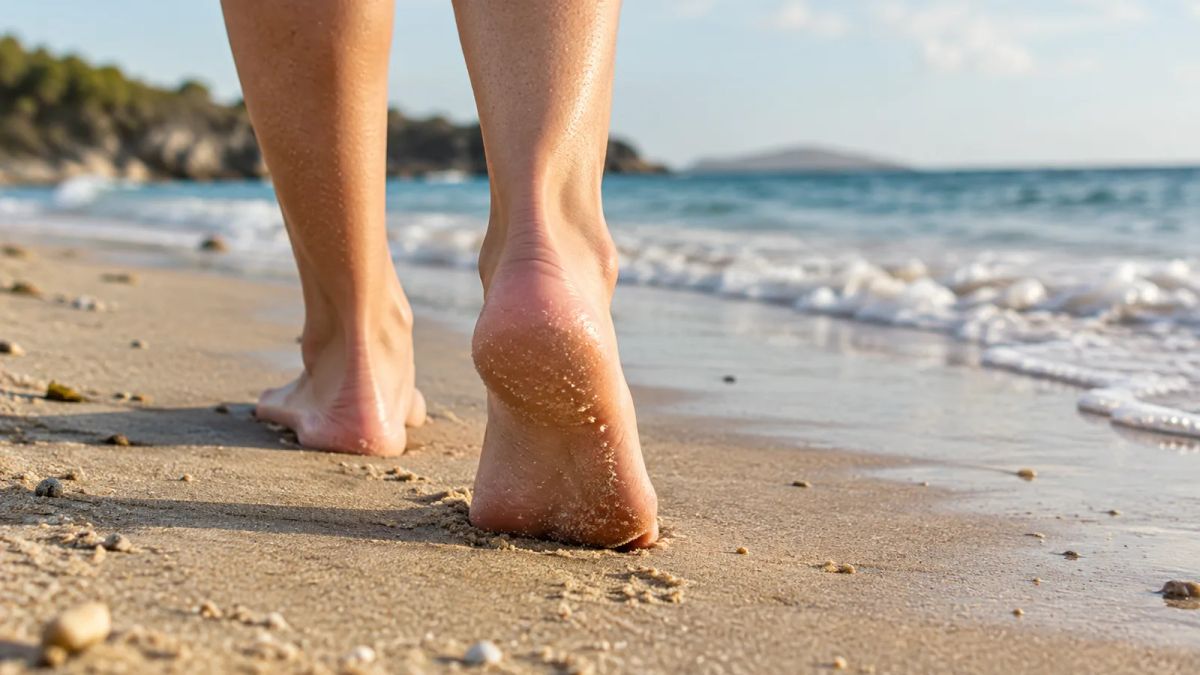
It helps. Every step asks each ankle for roughly 10 degrees of bend and puts your calves to work, so regular walking keeps everyday range and strength ticking over. What flat pavement doesn't do is take the ankle to the end of its range or test your balance much. The wall rocks, heel raises and single-leg stand fill that gap.
Why is one ankle stiffer than the other?
An old injury is a common reason. HSS physical therapists point out that ankles can weaken after a twist or a broken bone, and that inactivity weakens the muscles around them too. Pabau's knee-to-wall guide treats a gap of 2 cm or more between sides as worth noting. Give the tighter side an extra set of wall rocks each session.
How can I improve ankle mobility fast?
You'll feel looser within minutes of the circles and wall rocks, but that fades within hours. Lasting range takes weeks of short, regular sessions, so the fastest route is the version you'll repeat on most days.
Making it a habit you keep
A routine you mean to slot in somewhere tends to evaporate. One pinned to a moment that already happens tends to stay.
James Clear calls this habit stacking: you tie a new action to a routine you already have, so the old habit does the reminding. Our guide to habit stacking covers how to pick a good anchor. Pick a cue you never skip and hang the ankles off it. "After I put the kettle on, I do my ankle circles, the alphabet and a set of knee-to-wall rocks" is the kind of plan that holds, because the trigger is already there. The floor stretches suit the end of the day, when you're winding down anyway.
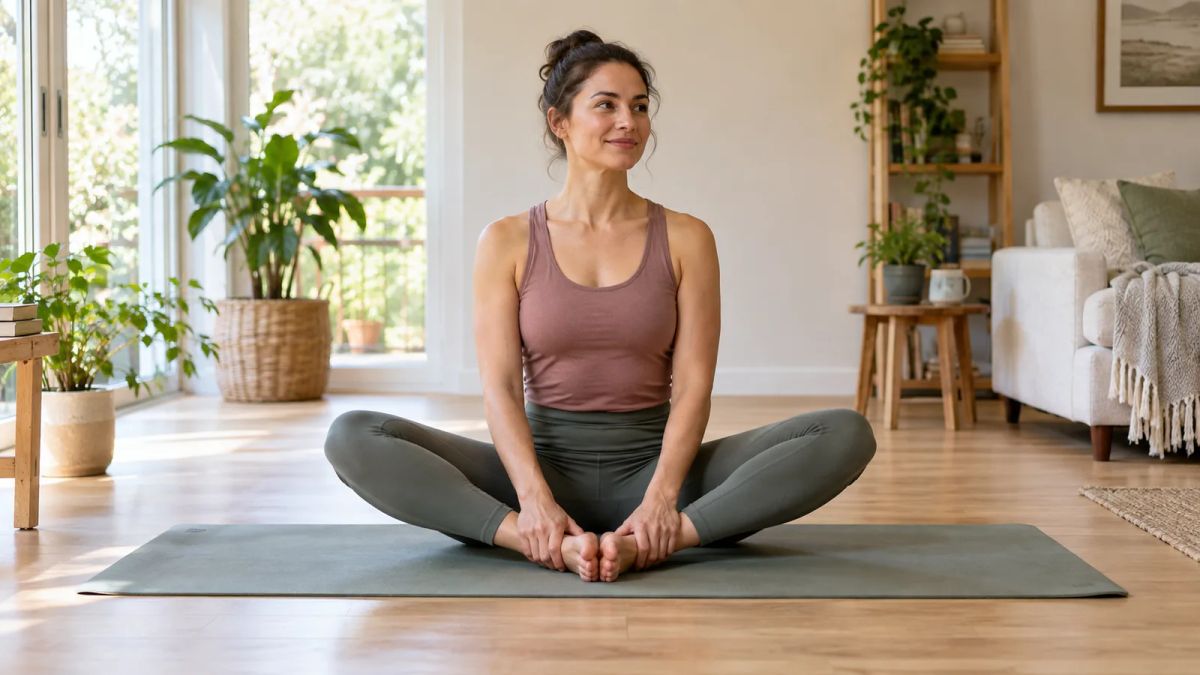
There's a neat overlap with other gentle movement, so you can fold this in beside something you may already do. It sits well after a morning stretch routine, and stiff ankles rarely travel alone, so the hip mobility exercises are a natural companion when the whole lower half feels tight. If getting down to the floor is the sticking point, chair yoga covers a lot of the same ankle and calf ground from a seat.
On a stiff, rushed or low day, decide your smaller version in advance. Ten ankle circles each way and one set of knee-to-wall rocks per side still count. A couple of minutes keeps the thread going, and keeping the thread going is what turns this into something your ankles expect.
If you miss a day, or a fortnight, nothing is undone. A stiff ankle after a gap is the result of sitting still, not a mark against you. Pick the next day, start with the circles, and carry on from there.
Watch the small sessions add up

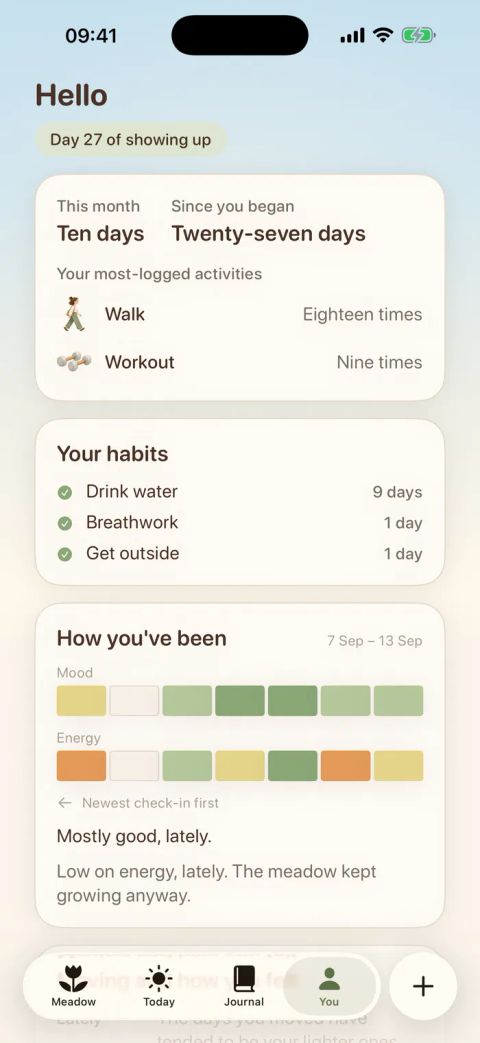
Some days you'll do all seven moves and some days you'll manage two, and Meadow is built for exactly that mix. It's a gentle habit app for iPhone where you log the movement you do, tick off small daily habits, and note your mood and energy, and each day you show up grows a wildflower in your own meadow. Ankle work counts as movement, so a few minutes by the wall earns its flower. There are no streaks, so the day you skip resets nothing and your flowers never wilt. You can find it at Meadow.
Tonight, do the knee-to-wall test on both ankles and write down the two numbers. That's your starting line, and it takes a minute.
AUTHOR
Co-founder of Meadow.
Ash is co-founder of Meadow, a habit and movement tracking app that turns small acts of self-care into a growing wildflower meadow.
See how far you've come
Your habits, moods and little wins, all in one place
Meadow keeps track of the walks, the water and the good days, so you can look back and watch your effort add up.
Download Meadow