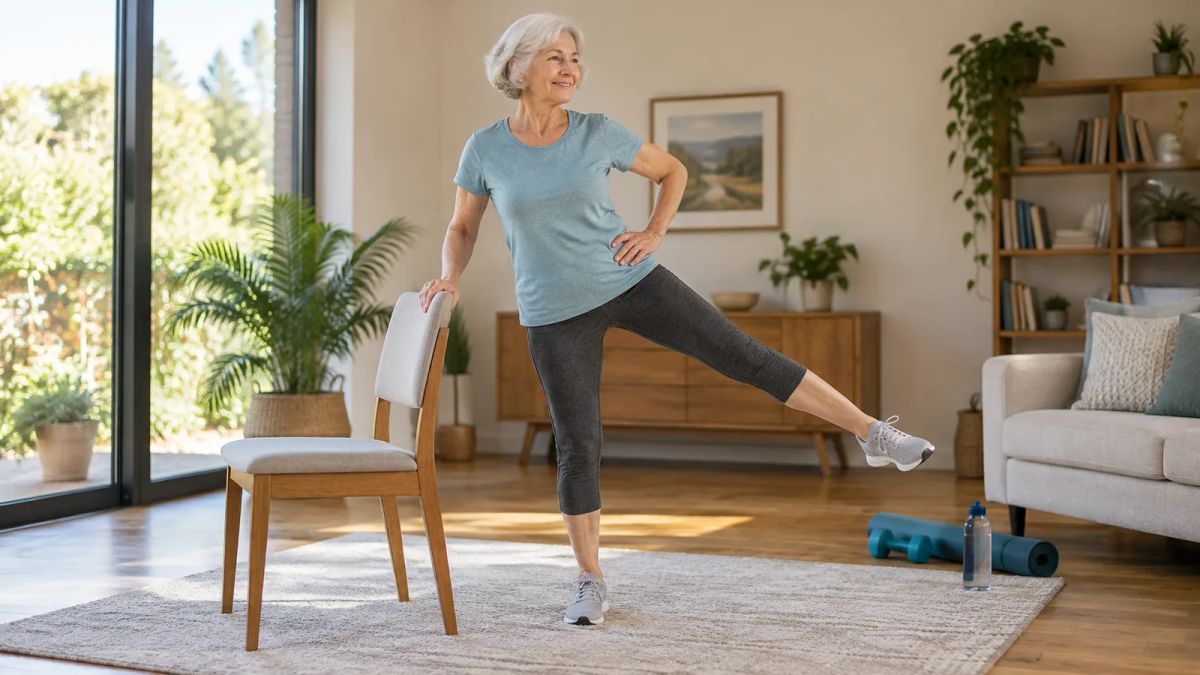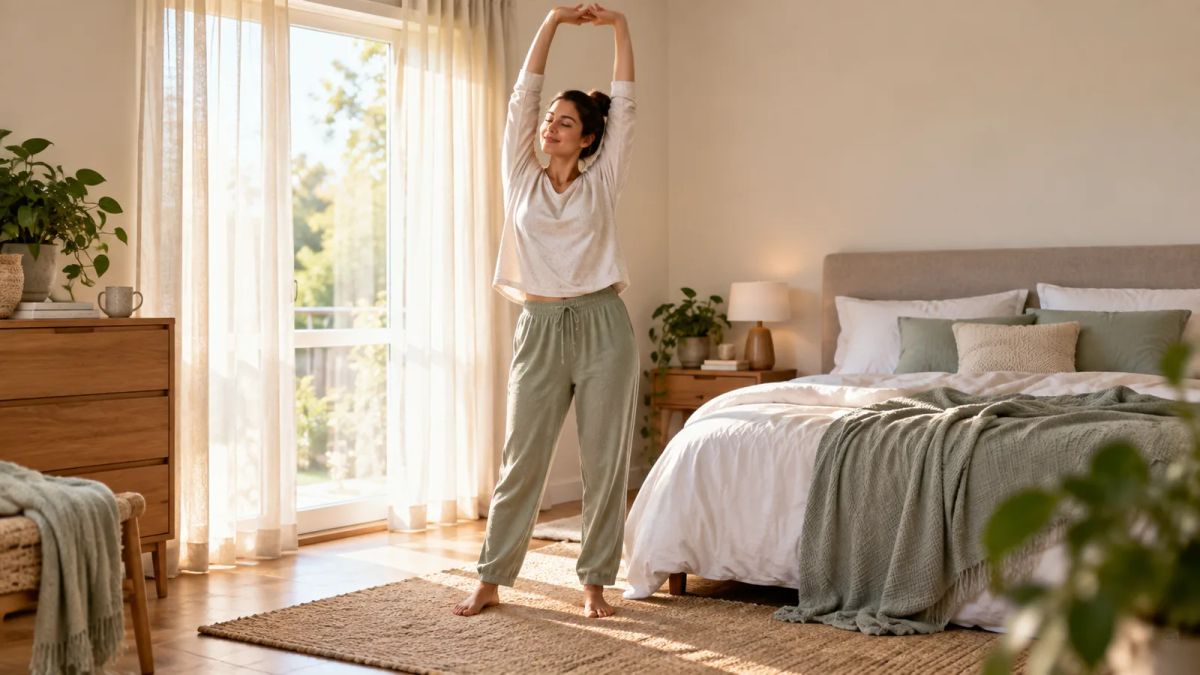
A full-body stretching routine works from your head down to your feet, one area at a time, so nothing gets missed. What follows is a complete sequence of eleven stretches covering your neck, shoulders, chest, back, sides, hips, glutes, hamstrings, quads and calves, with hold times for each. It takes about ten to fifteen minutes and needs no equipment beyond a wall and a bit of floor.
You can do the whole thing in one go as a standalone session, or use it to cool down after a walk or a workout. Either way, the aim is the same. Move each area through a comfortable range, feel a mild pull rather than a strain, and leave your body a little looser than you found it.
Before the sequence itself, it helps to know the two kinds of stretching and when each one belongs in your day.
Static and dynamic stretching, and when to use each
Static stretching is the kind most people picture. You take a muscle to the end of its comfortable range and hold it there. A review in the International Journal of Sports Physical Therapy describes it as holding a position with the muscle on tension to a point of a stretching sensation. The routine below is mostly static.
Dynamic stretching is movement. You take a limb through its full range and back, several times, without holding at the end. Arm circles, leg swings and slow shoulder rolls are dynamic.
The timing matters, and the two are not interchangeable. Cleveland Clinic recommends dynamic stretches before a workout and static stretching as part of your cool-down afterwards. The reason is practical. Holding a long static stretch on a cold muscle right before you sprint or lift can briefly dampen power, an effect the sports physio review calls stretch-induced strength loss. So save the deep holds for after, or for a session on its own when performance is not the point.
If you are doing this routine on its own, spend two or three minutes moving first so your muscles are not cold.
A short warm-up first
Cold muscles do not stretch well, and pushing them can do harm. Harvard Health is blunt about it, warning that stretching the muscles before they're warmed up can hurt them and suggesting five to ten minutes of light activity such as a quick walk first.
You do not need much. Run through these before the holds.
- Marching on the spot. Lift your knees and swing your arms for thirty to sixty seconds, until you feel a little warmer.
- Shoulder rolls. Roll both shoulders backwards eight times, then forwards eight times, slow and loose.
- Hip circles. Hands on hips, make eight slow circles one way, then eight the other.
That is enough to get some blood moving. Now for the routine.
The routine: eleven stretches, neck to calves
Open our free printable: Your full-body stretch card (PDF). Save or print it to use alongside this guide. No sign-up needed.
Do these in order, top to bottom. Every stretch should feel like a mild, tolerable pull and never a sharp or pinching pain. Breathe steadily throughout, and where a stretch works one side at a time, do both. Hold the static stretches for around thirty seconds each, which is where Harvard Health and the ACSM guidance settle for building flexibility.
1. Neck side stretch
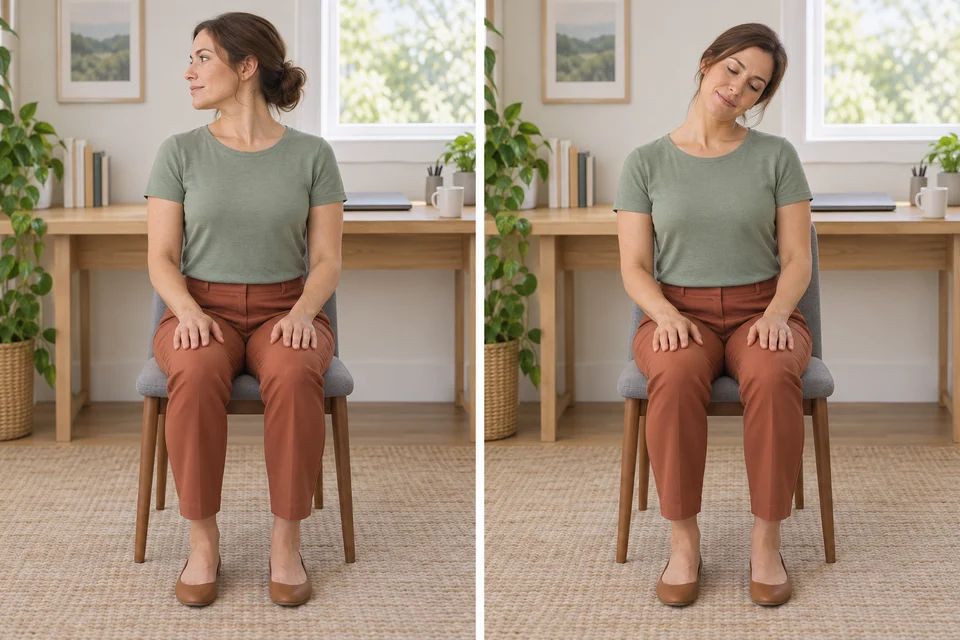
Sitting or standing tall, drop one ear gently towards that shoulder until you feel a light stretch down the opposite side of your neck. Keep your shoulders down and relaxed. Hold for around thirty seconds, then swap sides. This is where a lot of desk and phone tension collects.
2. Cross-body shoulder stretch
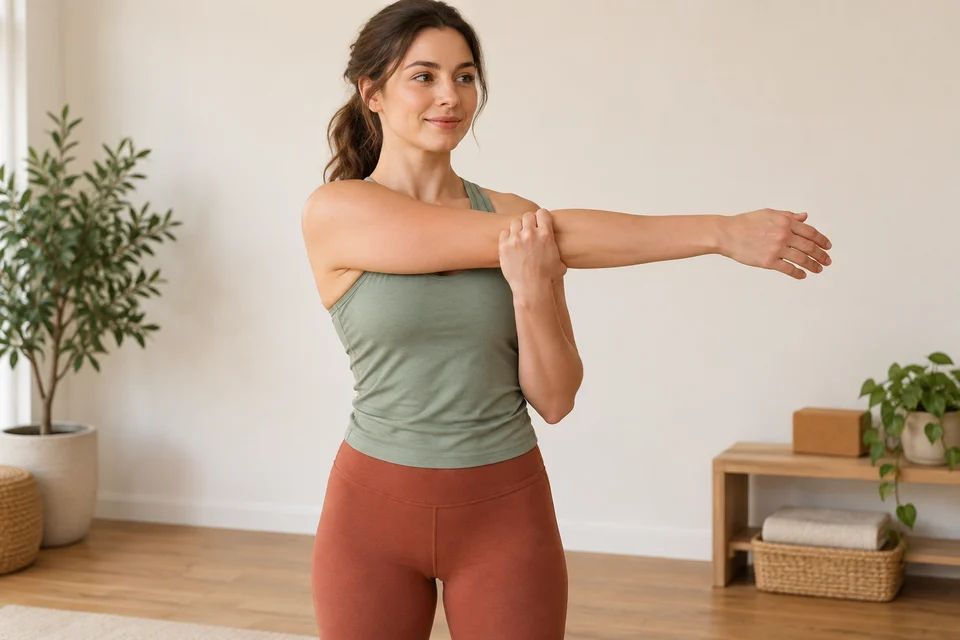
Bring one arm straight across your chest and use the other hand to draw it in gently, holding above the elbow. You should feel it in the back of the shoulder. Hold for thirty seconds each side.
3. Chest opener in a doorway
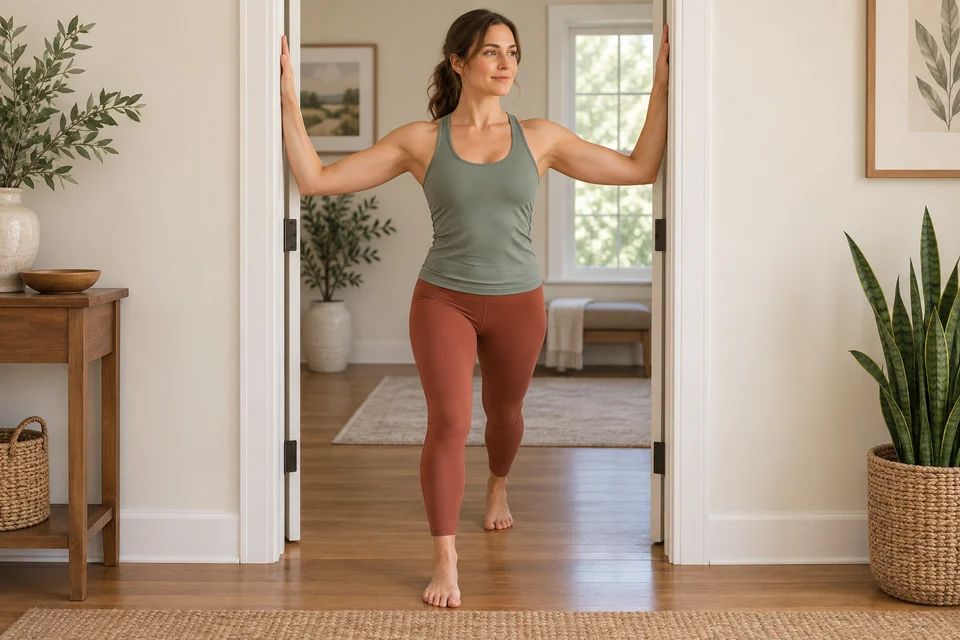
Stand in a doorway, forearms on the frame with your elbows at about shoulder height, and step one foot through until you feel a stretch across the front of your chest. Keep your ribs down and do not overarch your lower back. Hold for thirty seconds. Hours hunched forward tend to round the shoulders, and this counters it.
4. Cat-cow for the back
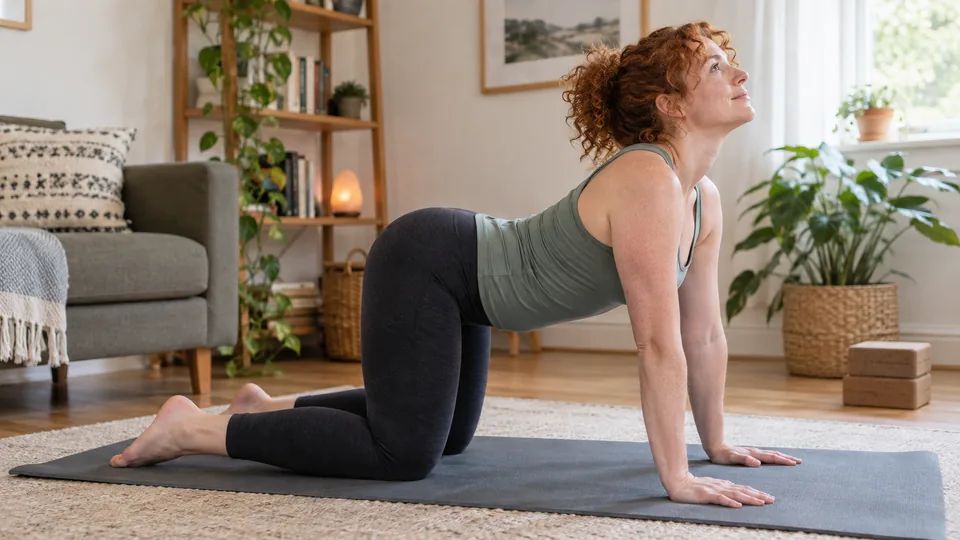
On all fours, breathe out as you round your spine towards the ceiling and let your head drop, then breathe in as you drop your belly and lift your gaze. Flow slowly through eight to ten rounds, matching movement to breath. This is one of the few here that stays moving, and it eases a stiff mid and lower back.
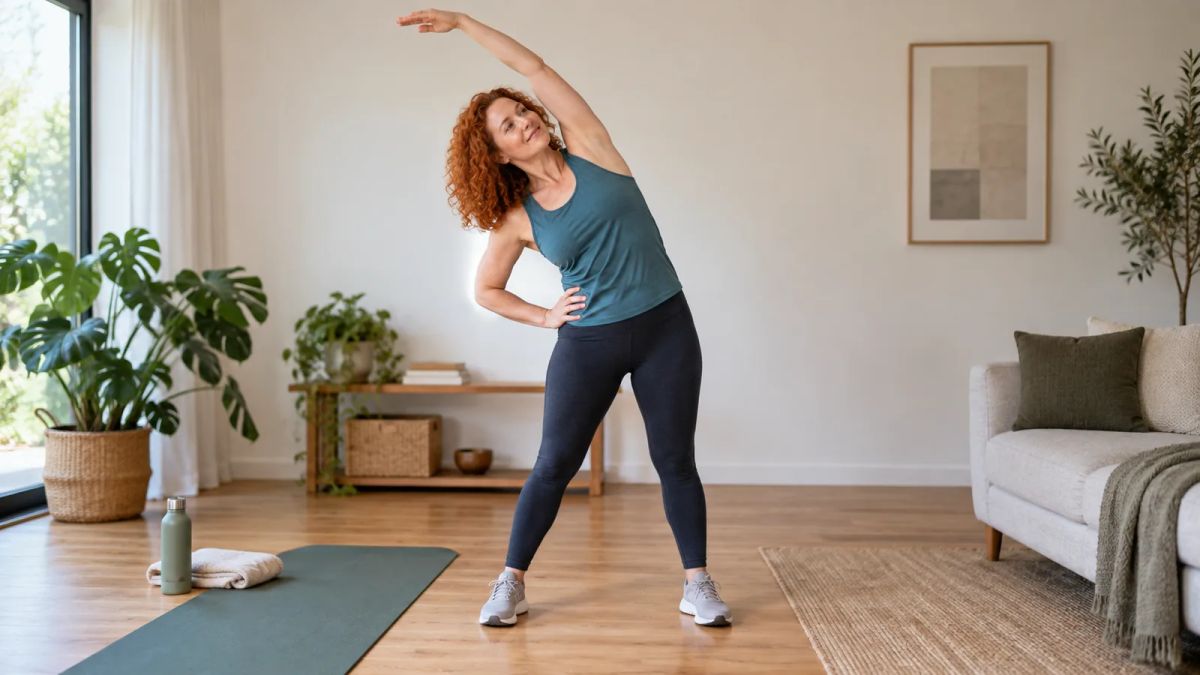
5. Standing side bend
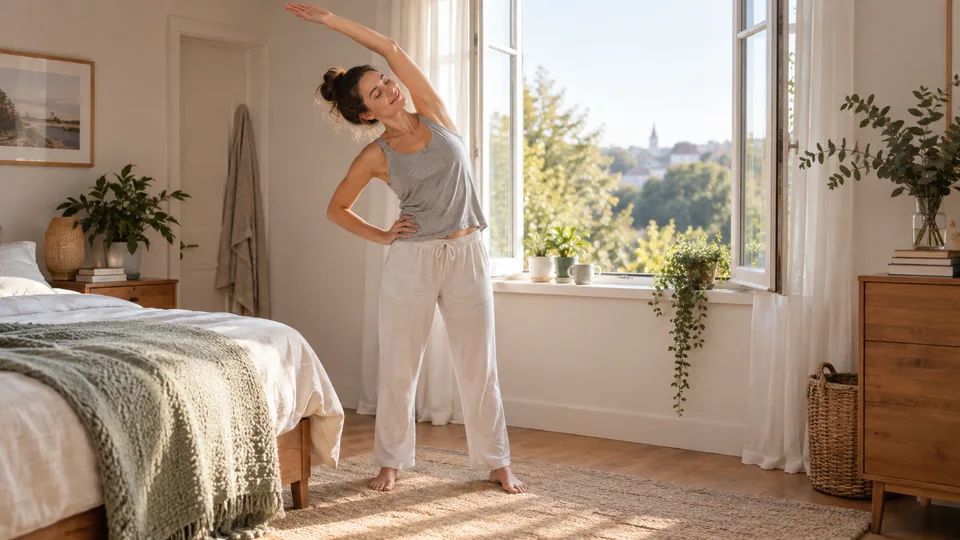
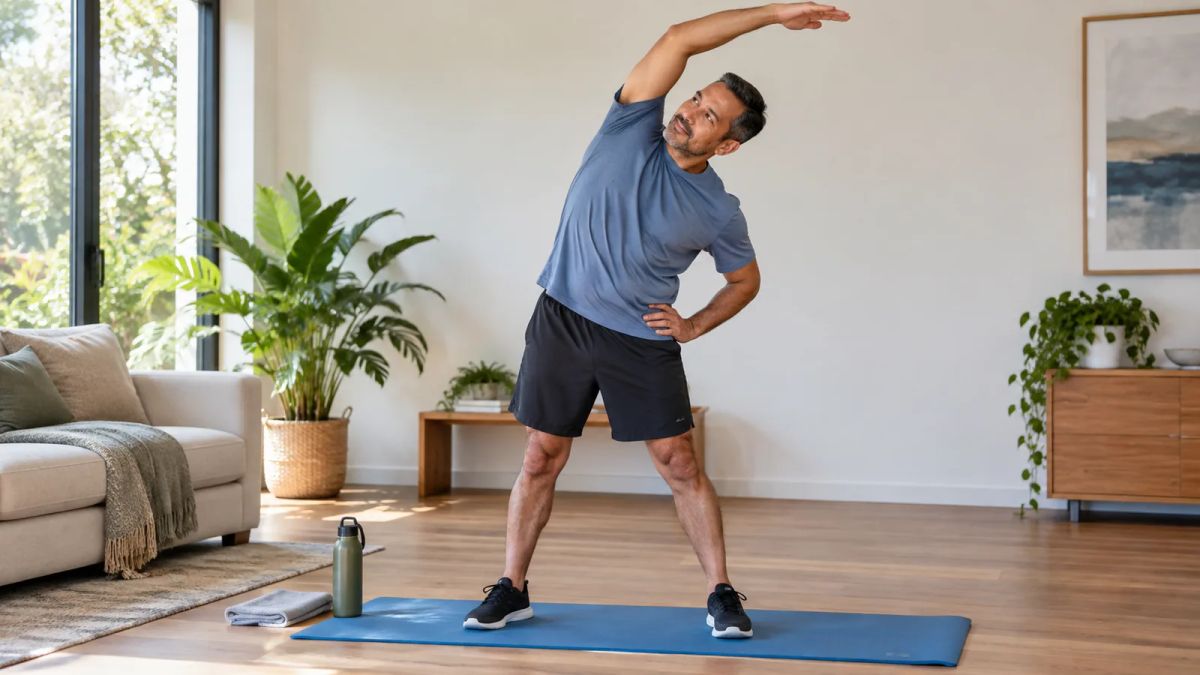
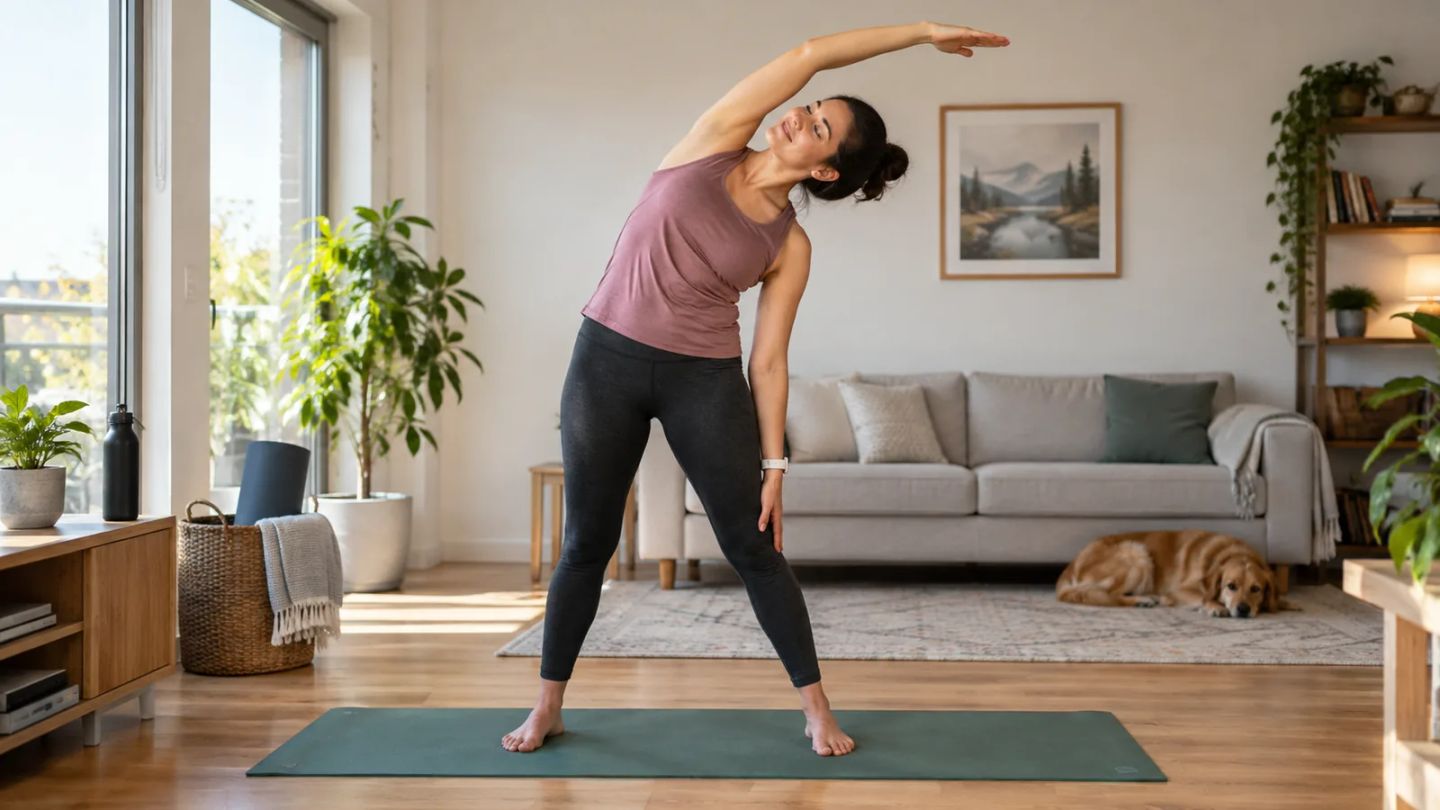
Standing tall, reach one arm up and over towards the opposite side and lean gently until you feel a stretch along your flank and ribs. Keep it small, with no twisting or leaning forward. Hold for around twenty seconds each side.
6. Kneeling hip flexor stretch
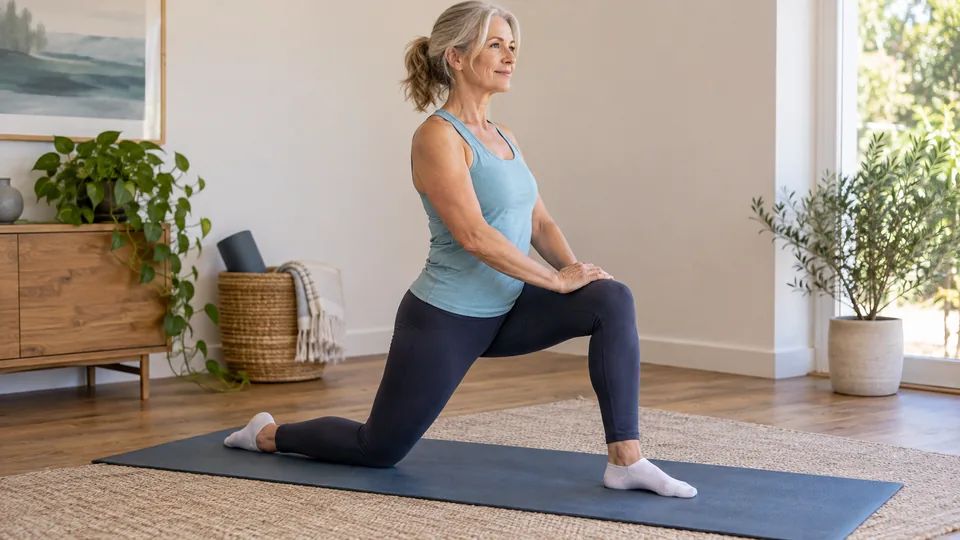
Kneel on one knee with the other foot flat in front, in a lunge shape. Tuck your tailbone under and press your hips gently forward until you feel a stretch across the front of the back leg's hip and thigh. Hold for thirty seconds, then swap. Sitting shortens these muscles, so most people feel this one straight away.
7. Figure-four glute stretch
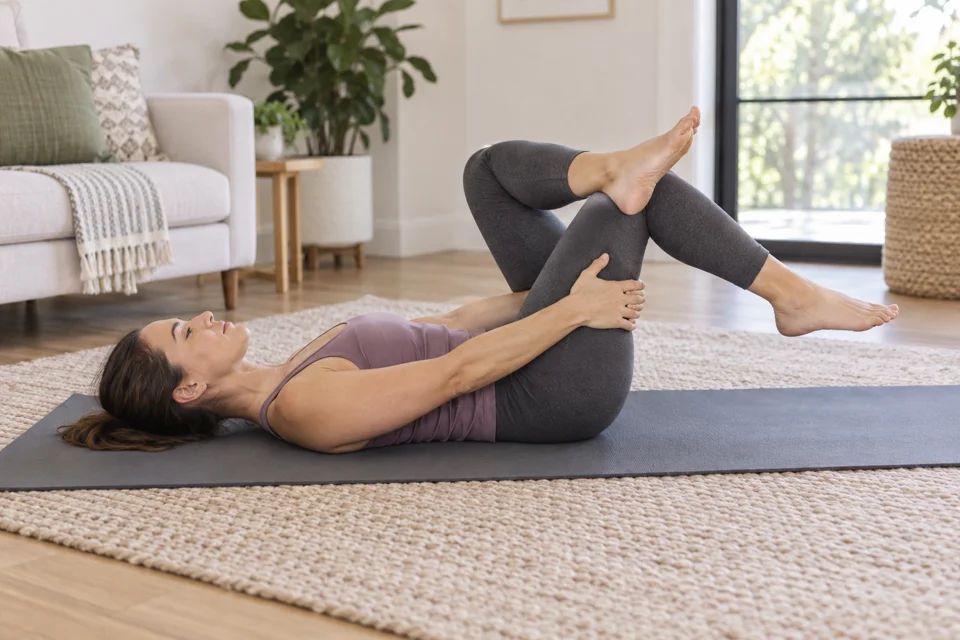
Lie on your back, cross one ankle over the opposite thigh, and draw that thigh in towards your chest until you feel a stretch deep in the buttock and outer hip. Hold for thirty seconds each side. You can do the same sitting on a chair by leaning gently forward instead.
8. Hamstring stretch
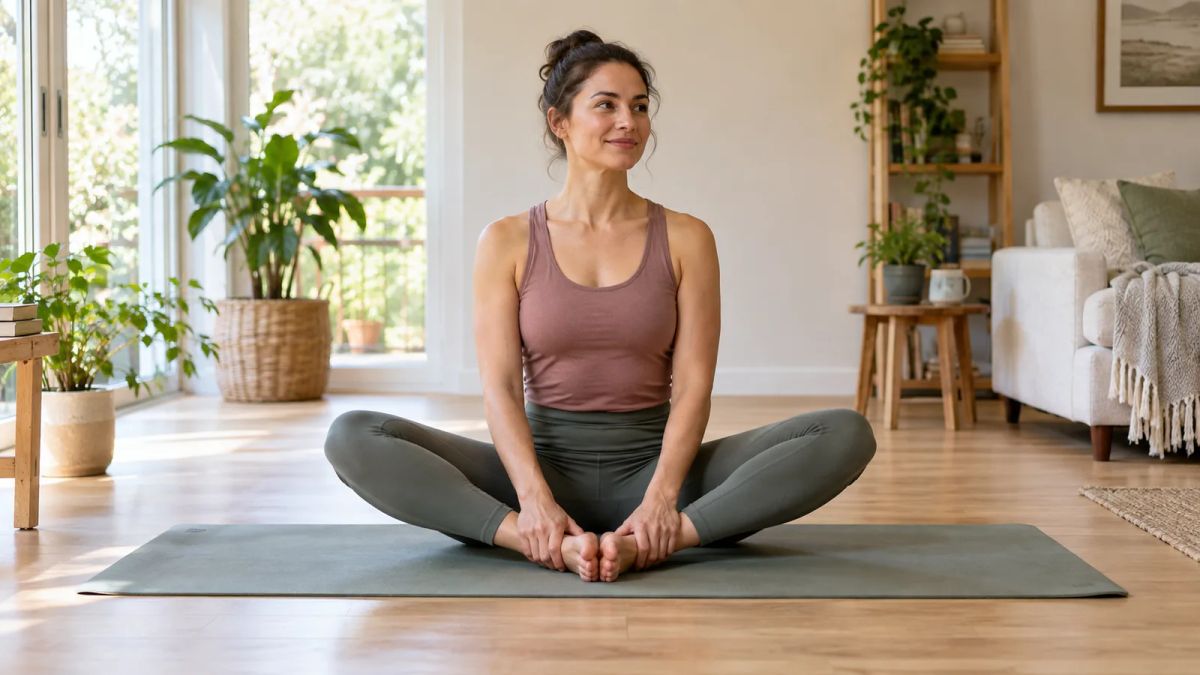
Sit with one leg straight out, heel on the floor and toes up, and the other foot tucked in. Sit tall and hinge forward from your hips, chest leading, until you feel a stretch up the back of the straight leg. Hold for thirty seconds each side. Move from the hips, not by rounding your back.
9. Standing quad stretch
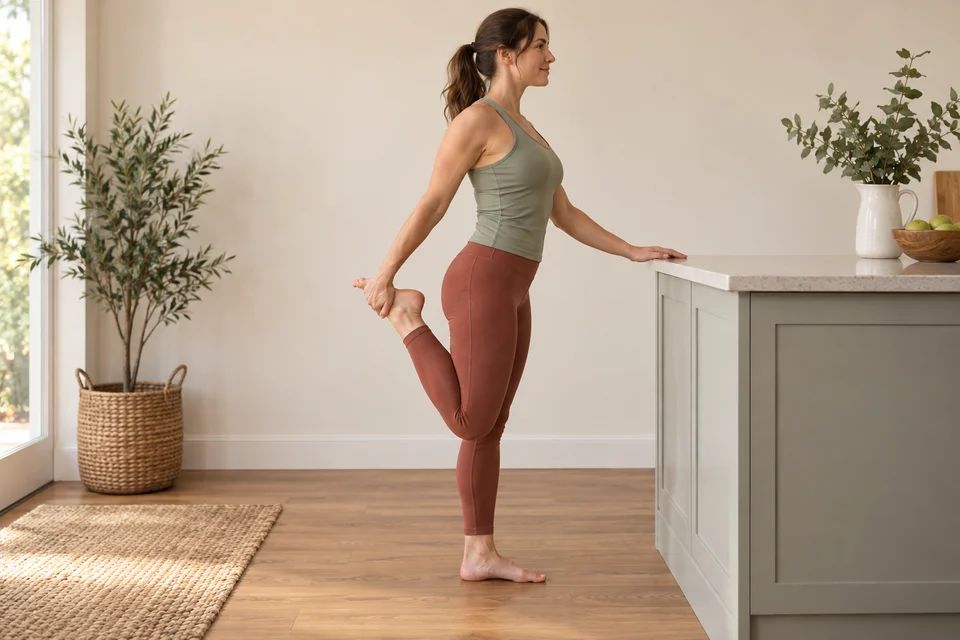
Stand near a wall for balance, bend one knee and take hold of that ankle behind you, drawing the heel gently towards your buttock. Keep your knees together and stand tall. Hold for thirty seconds each side. If reaching your ankle is awkward, loop a towel around it.
10. Calf stretch
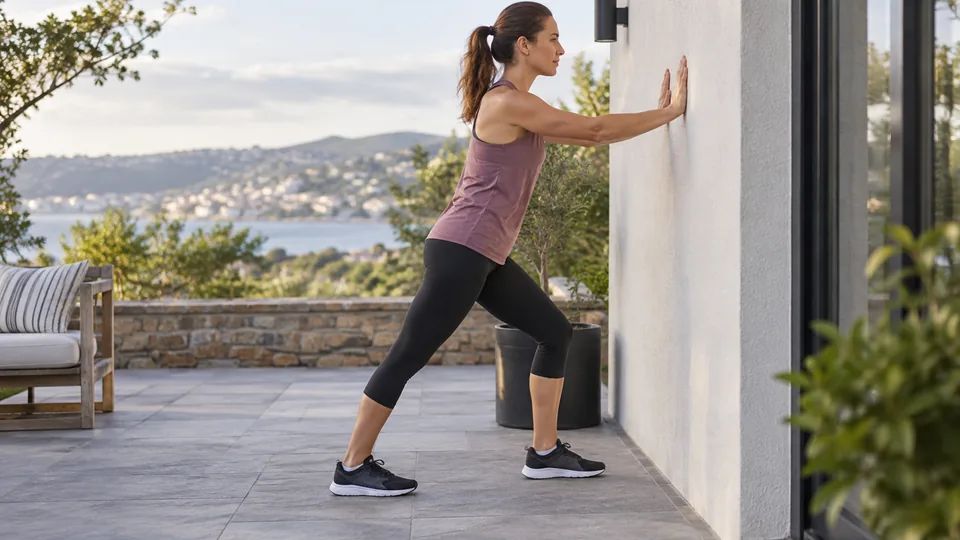
Face a wall, step one foot back with the heel pressed down and the leg straight, and lean forward until you feel the stretch up the back of your lower leg. Hold for thirty seconds, then swap. Bend the back knee slightly to shift the stretch lower towards the Achilles, and hold again if you like.
11. Ankle and foot circles
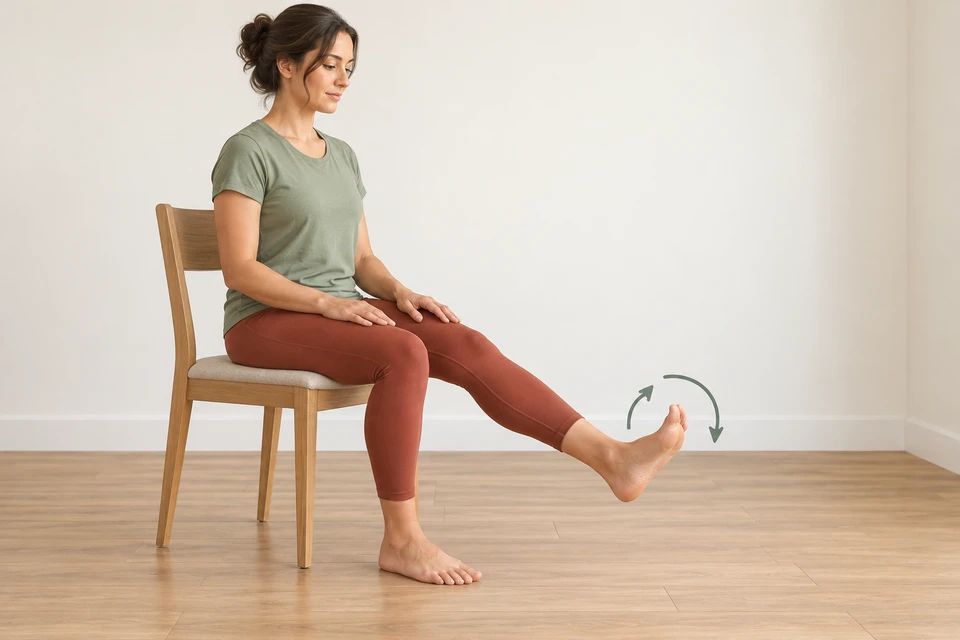
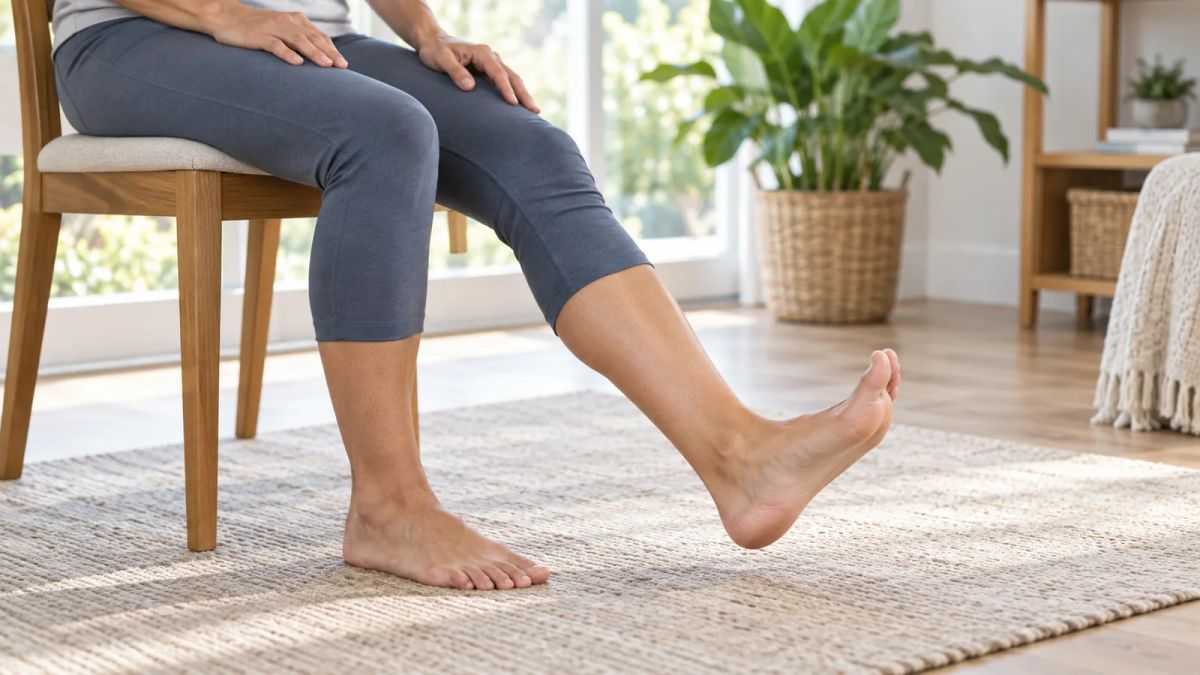
To finish, sit down, lift one foot and draw slow circles with the ankle, eight each way, then point and flex the foot a few times. Do the same on the other side. It is a small thing, but the feet and ankles carry you all day and rarely get any attention.
That is the full sequence, roughly ten to fifteen minutes depending on how long you rest between stretches. Cleveland Clinic lands in the same place, suggesting a routine of 10 to 15 minutes is plenty to start with.
Here is the routine at a glance, if you want something to glance at while you go:
Warm-up, 2 to 3 minutes: march on the spot, shoulder rolls, hip circles.
Then hold each stretch for around 30 seconds on both sides, in this order: neck side stretch, cross-body shoulder, doorway chest opener, cat-cow (8 to 10 slow rounds), side bend, kneeling hip flexor, figure-four glute, hamstring, standing quad, calf, then ankle circles.
How often, and how long before it helps
For flexibility to change, stretching has to be regular. Harvard Health suggests a programme of daily stretches, or at least three or four times a week. The sports physio review points to the ACSM position of static stretching at least 2 to 3 days per week. Somewhere in that range, done consistently, is the target.
Be patient with the timeline. Harvard Health is honest that it takes weeks to months to get flexible, and that you have to keep at it to hold on to any gains. A single session loosens you for the day. Lasting change is slower.
You do not need to hold each stretch for ages, though. The review notes the greatest change in range of motion happens between 15 and 30 seconds, so longer holds add little for most people. Thirty seconds is a sensible default.
What a stretching routine can and cannot do
Regular stretching can widen your range of motion, and that shows up in ordinary life. Cleveland Clinic points to everyday tasks like climbing stairs and standing up from a chair getting easier. Harvard Health makes a related point about tight muscles making it harder to straighten a knee or extend a leg, which in turn affects walking.
The gains are real but modest, and worth being clear about. A ten-week static stretching programme in older adults increased ankle range of motion by around nine degrees, a sizeable jump. The researchers were careful to note the change came from better tolerance of the stretch rather than any softening of the tissue itself. Your body learns to accept a wider range, which is still a useful thing.
What stretching will not do is prevent injury on its own. The review is clear that stretching has not been shown to be effective at reducing the incidence of overall injuries. It is not a warm-up substitute either, and it will not fix a longstanding joint problem. If a particular area has been sore or restricted for a while, or you have an injury or a condition that affects how you move, check with your GP or a physiotherapist before leaning on a routine like this.
Most people notice how stretching feels more than any number. A slow run through the body gets you breathing and shifts you out of stiffness, and that alone is a fair reason to do it.
Build it into your week
A stretch you mean to fit in somewhere tends to slip. A stretch pinned to a fixed point in your day tends to survive.
The American Heart Association suggests tying a new action to a routine you already have, so it rides along with something automatic instead of asking for a fresh decision each time. Pick a reliable anchor. After your evening shower, before bed, or as a cool-down every time you get back from a walk. "When I get in from my walk, I run through the routine" is the kind of plan that holds, because the cue is already there.
If a full fifteen minutes feels like a lot most days, you do not have to do all eleven. A shorter version most days beats a long one you keep putting off.
Two related routines pair well with this one. A morning stretch routine is shorter and gentler, aimed at loosening overnight stiffness by the kettle. And if one area is your sticking point, targeted hip mobility exercises go deeper on the hips than a general full-body pass can.
Keep the routine in view

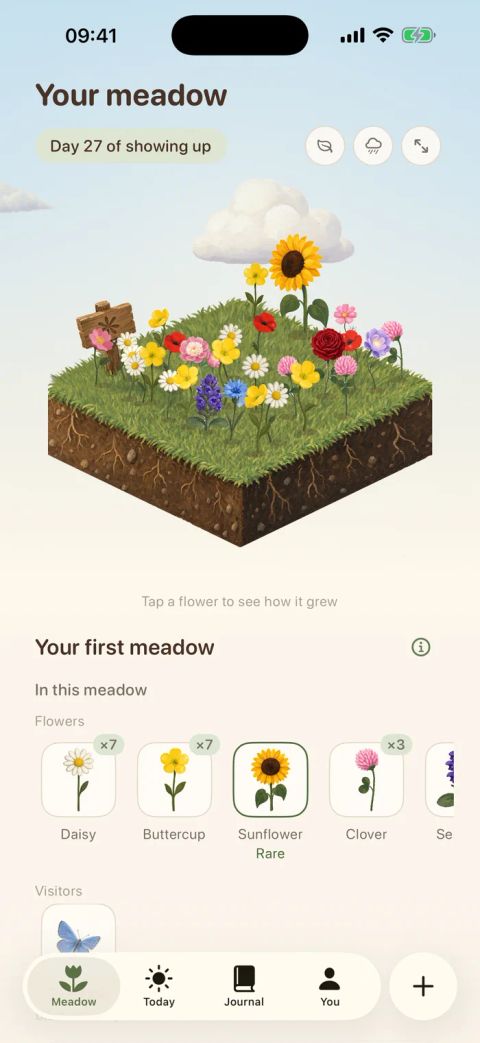
If a nudge on your phone helps you come back to it, Meadow gives the routine somewhere to live. It is a gentle habit app for iPhone from Wildcard Wellness where you log the movement you enjoy with a timer, whether that is a stretch session, a walk or a little yoga, and tick off small daily habits alongside it. Each day you show up grows a wildflower in your own meadow. There are no streaks, so a day you skip resets nothing and your flowers never wilt, which suits a habit meant to be built slowly over weeks.
On a hard day, and after a missed one
Decide your shorter version before you need it. On a tired or rushed evening, the neck, the hamstrings and the calves alone still count. Three stretches keep the thread going, and keeping the thread going is what turns this into something your body expects.
If you miss a day, or a fortnight, nothing is undone. Flexibility fades slowly with a gap, not overnight, and it comes back the same way it built, one session at a time. There is no lost ground to make up in a single marathon stretch.
Tonight, or after your next walk, run through the last three, hamstrings, quads and calves, and hold each for thirty seconds. That is enough to begin.
AUTHOR
Co-founder of Meadow.
Ash is co-founder of Meadow, a habit and movement tracking app that turns small acts of self-care into a growing wildflower meadow.
Little and often, with Meadow
Consistency, not intensity.
Meadow turns the movement you enjoy and the habits that help you feel good into a meadow of wildflowers. No streaks to break, and your flowers never wilt.
Download Meadow