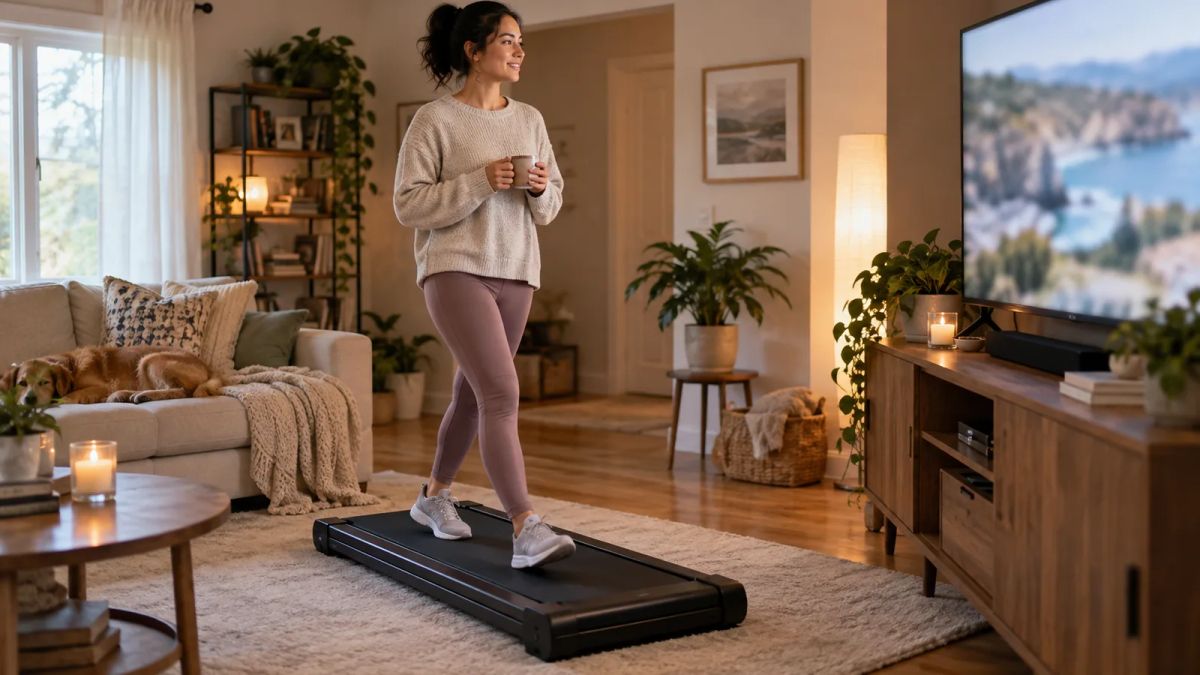
An indoor walking challenge is a fixed run of days where you walk inside your own home, adding a little more time each week, and you can start it today with nothing more than the floor you are standing on. No treadmill, no gym, no new trainers, which is the whole reason it survives a wet week or a packed schedule.
This is the plan in full. The moves that turn a living room into a walking route, a four-week progression you can follow as written, the benefits that hold up when you check them, and how to keep going on the days the habit would usually slip.
What an indoor walking challenge gives you
A challenge is a container. It puts a start date, an end date and a shape around something you might otherwise keep meaning to do, and that shape is most of why it works.
You are not signing up to walk for an hour. You are agreeing to short, repeatable indoor walks that grow week by week, so the version on day one is small enough that a busy evening cannot talk you out of it. The point is not to punish yourself into fitness in four weeks. It is to still be walking in week five, out of habit rather than willpower.
Ways to walk indoors without a treadmill
You have more walking surface at home than it looks. Here are the methods worth building a challenge around, from easiest to most demanding.
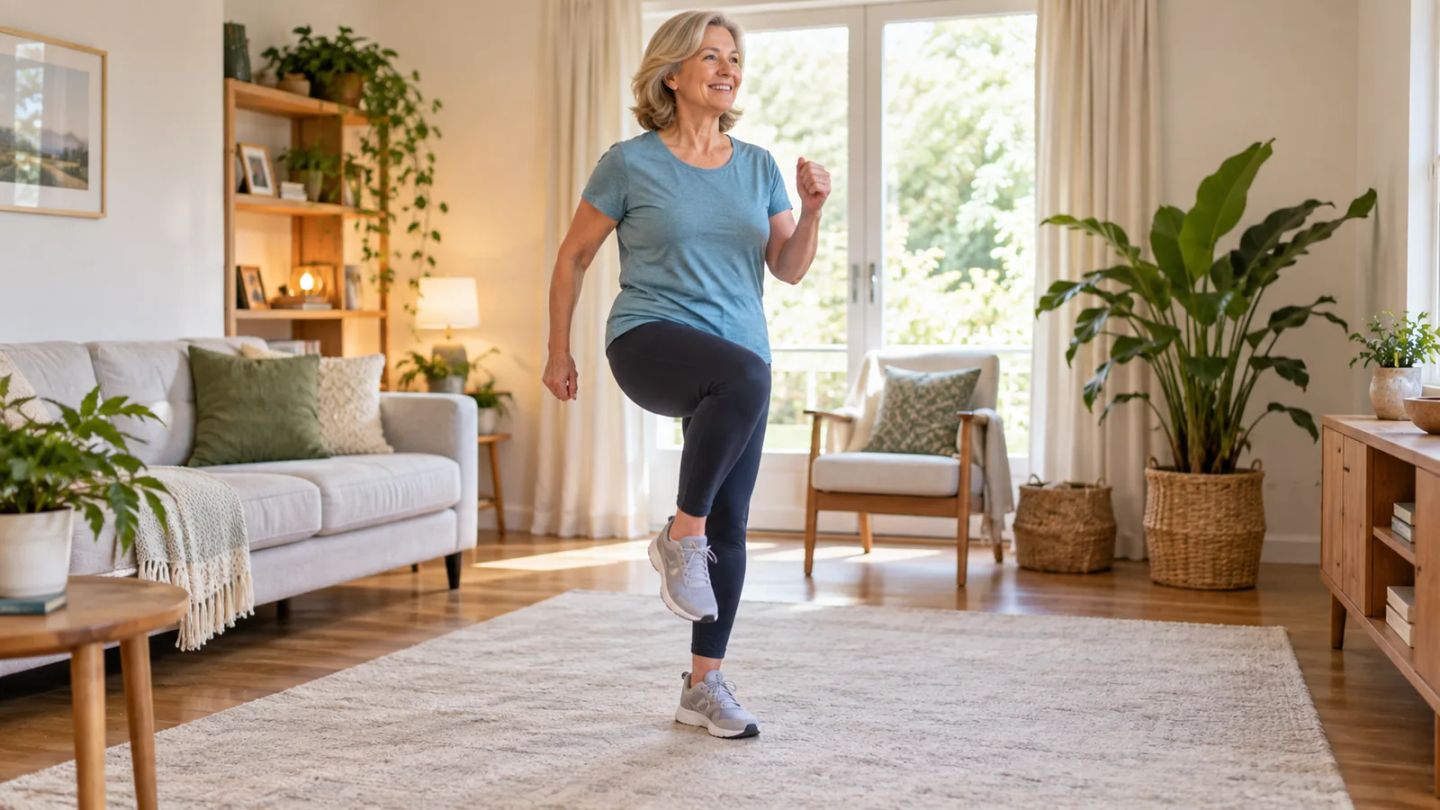
- March on the spot. Stand tall, feet hip-width apart, and lift your knees while you swing your arms. You can do it in front of the telly, and you control the pace by how high you lift and how fast you go. A comfortable rhythm is around 100 to 120 steps a minute.
- Walk laps of your home. A loop from the kitchen to the front door to the back room and round again is a real walk. Longer hallways and open-plan spaces suit this best, and turning often keeps your legs working.
- Use your stairs. A flight of stairs walked up and down a few times adds gentle intensity and works your legs harder than flat ground. Go at a pace where you could still hold a conversation, and use the handrail.
- Follow a walking video. Free follow-along indoor walking workouts, led by a trainer who counts you through marching, side steps and knee lifts, take the thinking out of it. You press play and copy along, which is why so many people stick with them.
- Walk while something else happens. Pace during a phone call, do a lap every advert break, or march through the last few minutes of a podcast episode. Movement you attach to something you already do asks very little of your memory.
Mix two or three of these in a single session and boredom stops being the thing that ends your challenge.
The four-week plan
Start where you are, not where you think you should be. The progression below builds from ten minutes to around forty, five days a week, with two rest days you choose. If ten minutes feels like plenty in week three, stay there. The plan is a guide, not a contract.
Week 1, find the rhythm. 10 minutes a day, 5 days. Mix: 5 min easy marching, 3 min laps, 2 min side steps.
Week 2, add a little. 20 minutes a day, 5 days. Mix: 8 min marching, 6 min laps, 3 min stairs, 3 min knee lifts.
Week 3, pick up the pace. 30 minutes a day, 5 days. Mix: 10 min brisk marching, 8 min laps, 6 min stairs, 6 min side steps and kicks.
Week 4, make it yours. 35 to 40 minutes a day, 5 days. Mix: 12 min brisk marching or a walking video, 10 min laps, 8 min stairs, 5 to 10 min of whatever you enjoyed most.
Here is one filled day from week two, so you can see how the blocks fit together across twenty minutes:
Monday, 20 minutes. 8 min marching (warm up slow, then lift the knees), then 6 min laps of the flat, then 3 min up and down the stairs, then 3 min knee lifts to finish. Roughly 2,000 to 2,500 steps.
Copy this blank tracker onto a scrap of paper or the back of an envelope, one week per row, and tick each day you move:
Week 1: Mon ☐ Tue ☐ Wed ☐ Thu ☐ Fri ☐ Sat ☐ Sun ☐
Week 2: Mon ☐ Tue ☐ Wed ☐ Thu ☐ Fri ☐ Sat ☐ Sun ☐
Week 3: Mon ☐ Tue ☐ Wed ☐ Thu ☐ Fri ☐ Sat ☐ Sun ☐
Week 4: Mon ☐ Tue ☐ Wed ☐ Thu ☐ Fri ☐ Sat ☐ Sun ☐
Aim for five ticks a week, not seven. Building in rest from the start means a day off is part of the plan, not a failure.
What indoor walking does for you, the honest version
Walking indoors is still walking, and the evidence for walking is steady and unflashy. A systematic review of organised walking found that people who took it up lowered their systolic blood pressure by about 3.7 mmHg and their diastolic by about 3.1 mmHg on average, with almost no injuries across more than 74,000 hours of walking. Those studies were outdoors in groups, but the movement is the same one you do on your living room floor.
You do not need a long session to get something back. A meta-analysis of short activity breaks showed that light walking, in bursts as brief as two to five minutes, blunted the rise in blood glucose after meals more than sitting or standing did. A few minutes of marching after lunch is doing measurable work.
There is an immune effect worth noting too. Harvard Health describes research in which people who walked at least 20 minutes a day, five days a week, had 43% fewer sick days than those who exercised once a week or less, and milder symptoms when they did fall ill.
The steps add up in ways that matter over years. A meta-analysis of 15 international studies following nearly 50,000 people found that taking more steps a day was associated with a lower risk of dying over the follow-up, with the benefit levelling off around 6,000 to 8,000 steps for adults over 60 and 8,000 to 10,000 for younger adults. Indoor walks count towards that total. Our guides to the benefits of walking and how many steps a day go deeper on both.
Now the honest part. If your goal is weight loss, walking helps but it will not do it alone. The CDC notes that the amount of activity people need varies a great deal from one person to the next, and that a healthy weight depends on how you eat as much as how you move. These findings are associations drawn from large groups, not promises about your particular four weeks. Do the challenge because it makes your days feel steadier, and let any change on the scale be a bonus, not the measure of success.
How brisk, and how much
Pace changes what you get, and the test for it is easy to carry indoors. The NHS defines a walk as brisk when you can still talk but cannot sing the words to a song, which works out at roughly three miles an hour. Aim for that on your marching and lap sections, and ease off when you need to.
For the week as a whole, adults are advised to build towards at least 150 minutes of moderate activity. By week four this plan has you close to that from indoor walking alone. If you have not been active for a while, or you live with a health condition or any concerns, have a word with your GP before you build up, and add time gradually, not all at once.
Keeping the challenge going
The tracker is not decoration. A meta-analysis of 138 studies found that monitoring your progress towards a goal makes you more likely to reach it, and the effect was stronger when that progress was written down or made visible. Ticking a box is a small act that quietly holds the whole thing together.
On a stretched day, shrink the walk. Don't skip it. Two minutes of marching while the kettle boils keeps the habit alive on the days that would otherwise break it, and a short walk you did beats a long one you planned and missed.
When you do miss a day, and you will, take the next chance and let the missed one go. James Clear calls this "never miss twice", the idea being that one slip is an accident and two starts to become the new pattern. There is no streak to protect here, no tidy number of days after which walking turns effortless, so a gap costs you nothing except the walk you missed.
Somewhere to watch the days add up
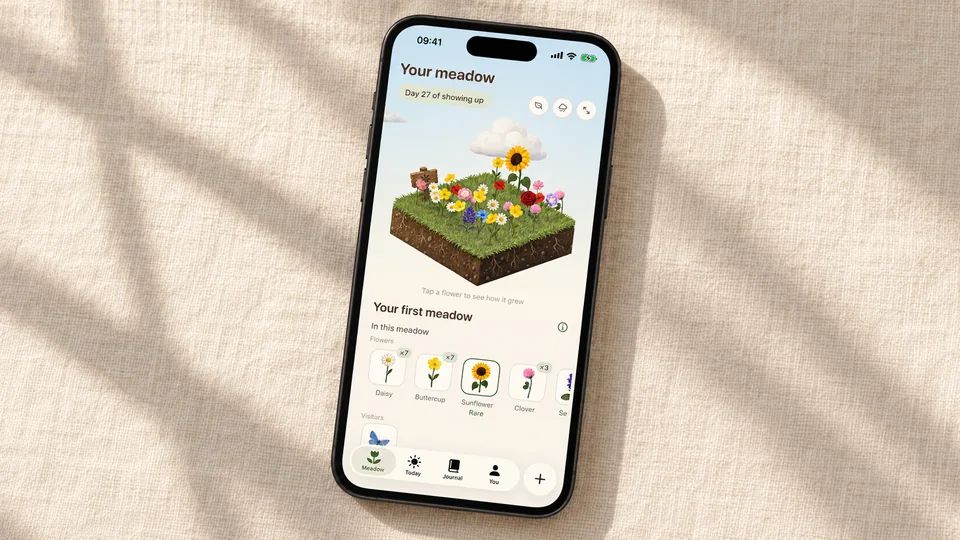
Watching your walks add up can be the thing that keeps you turning up, and a paper tracker does a lot of that work. So can an app.
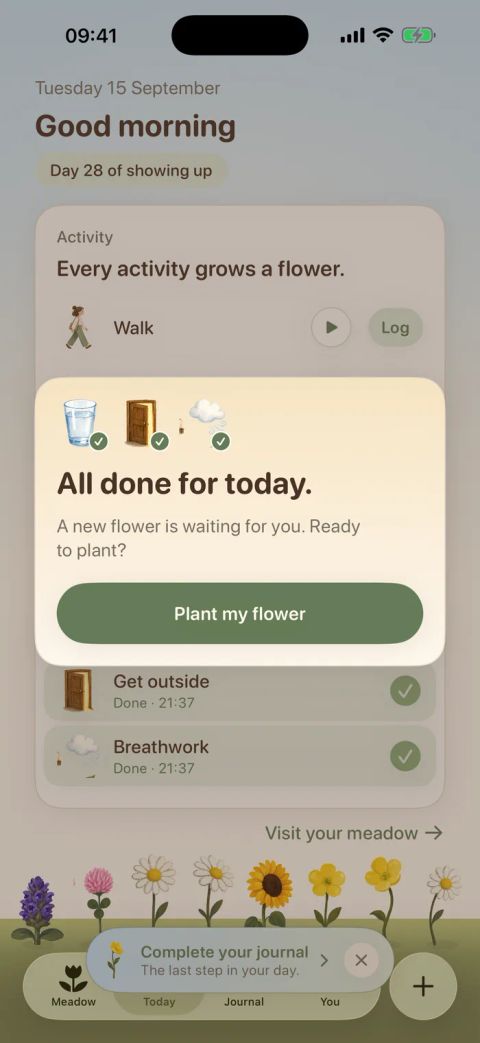
Meadow is one, a gentle habit app for iPhone with walking among its activities, so you can log each day of the challenge, note your mood and a small daily win, and watch a wildflower grow for every day you move. It is made by Wildcard Wellness and built around showing up rather than a run of perfect days. There are no streaks, so a missed day resets nothing and your flowers never wilt, which matters when the challenge runs across a wet week.
Common questions
Can you lose weight with an indoor walking challenge?
It can help, but on its own it is rarely enough. Indoor walking burns energy and supports the habits that make weight easier to manage, yet body weight depends on food, sleep, medication and health conditions as well as movement. Treat the challenge as a way to move more often and feel better, and pair it with how you eat if weight is your aim.
How many steps can you get walking indoors?
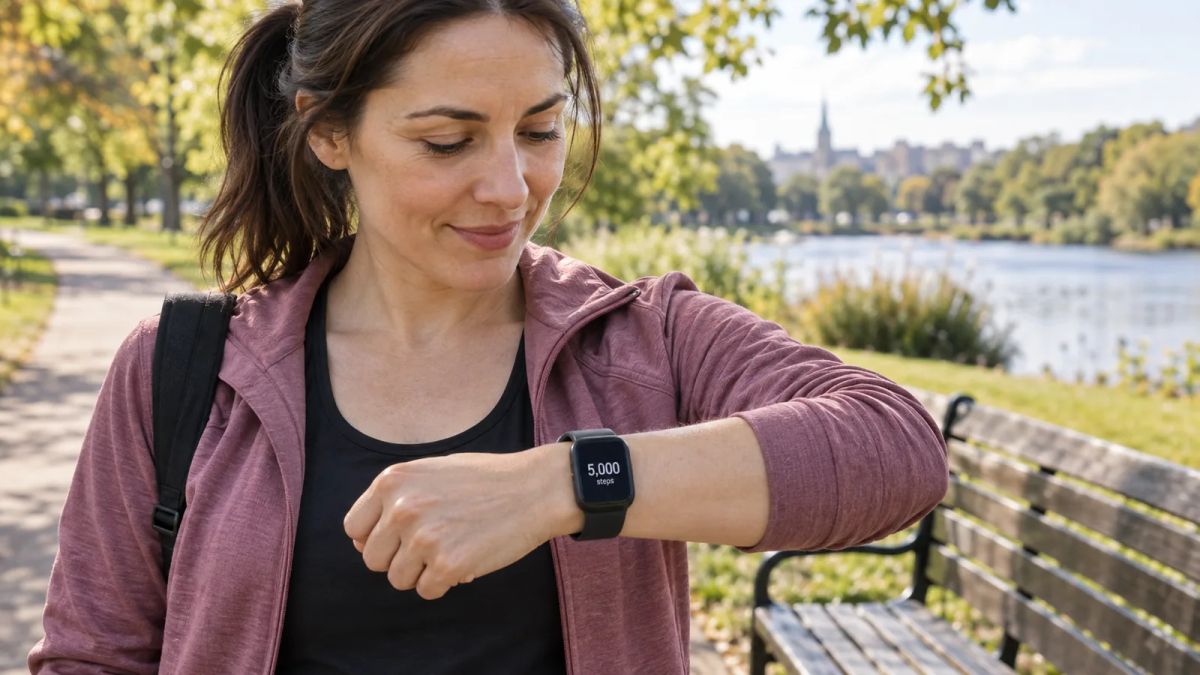
A moderate 30-minute indoor session lands most people somewhere around 3,000 steps, though it varies with your pace and stride. Marching on the spot and laps of the house both register on a phone or watch, so your indoor walks count towards your daily total the same as outdoor ones.
Is marching on the spot as good as walking outside?
For your heart, blood sugar and mood, what counts is the movement, not the scenery, so marching briskly indoors does much of the same work. Outdoor walking has its own perks, like daylight and fresh air, but on a dark or wet evening a good indoor session beats the walk you would have skipped.
What if I cannot stand or walk for long?
Start with what you can manage, even two or three minutes at a time, and rest between. If standing is difficult, seated movement is a fair way in, and our guide to chair yoga covers gentle options you can do from a stable chair. Anyone with pain, balance worries or a health condition should check with their GP before starting.
One thing to do today
Pick tomorrow's slot now, a set point that already happens, like your first coffee or the end of your working day, and march on the spot for ten minutes straight after it. That is day one of the challenge done, with none of the pressure a bigger target would bring.
AUTHOR
Co-founder of Meadow.
Ash is co-founder of Meadow, a habit and movement tracking app that turns small acts of self-care into a growing wildflower meadow.
Every little bit counts
Five minutes counts. So does a dance in the kitchen.
Log the movement you enjoy and the small habits that help you feel good, and watch them bloom into something you can see.
Download Meadow