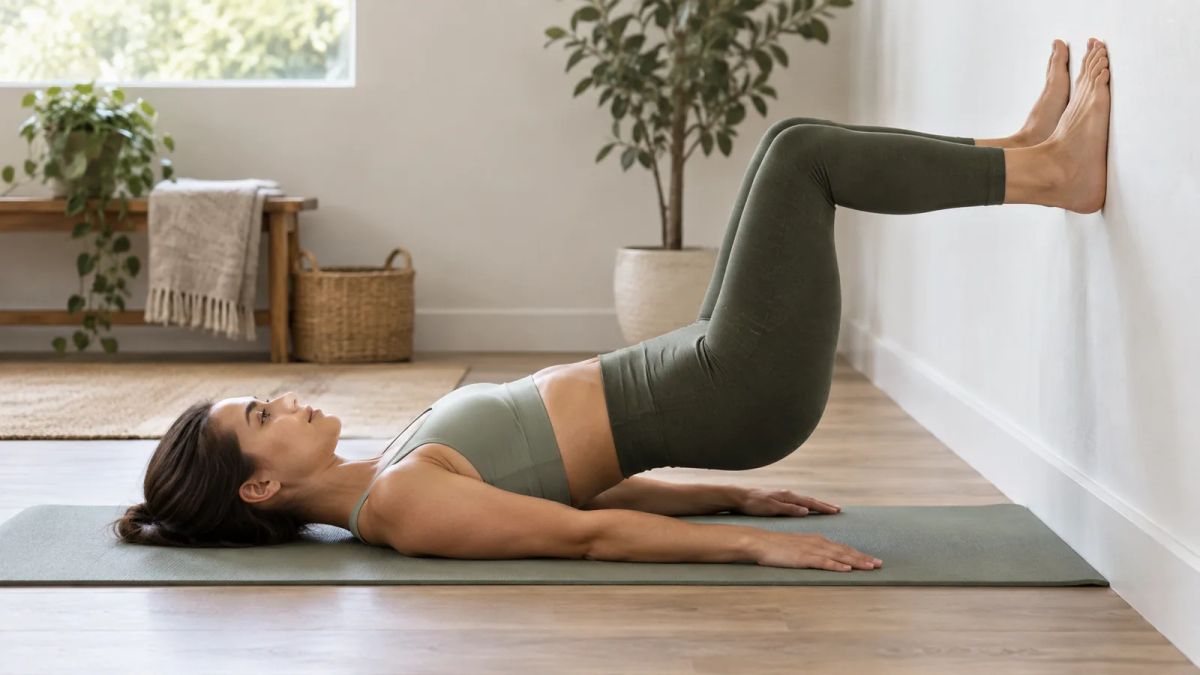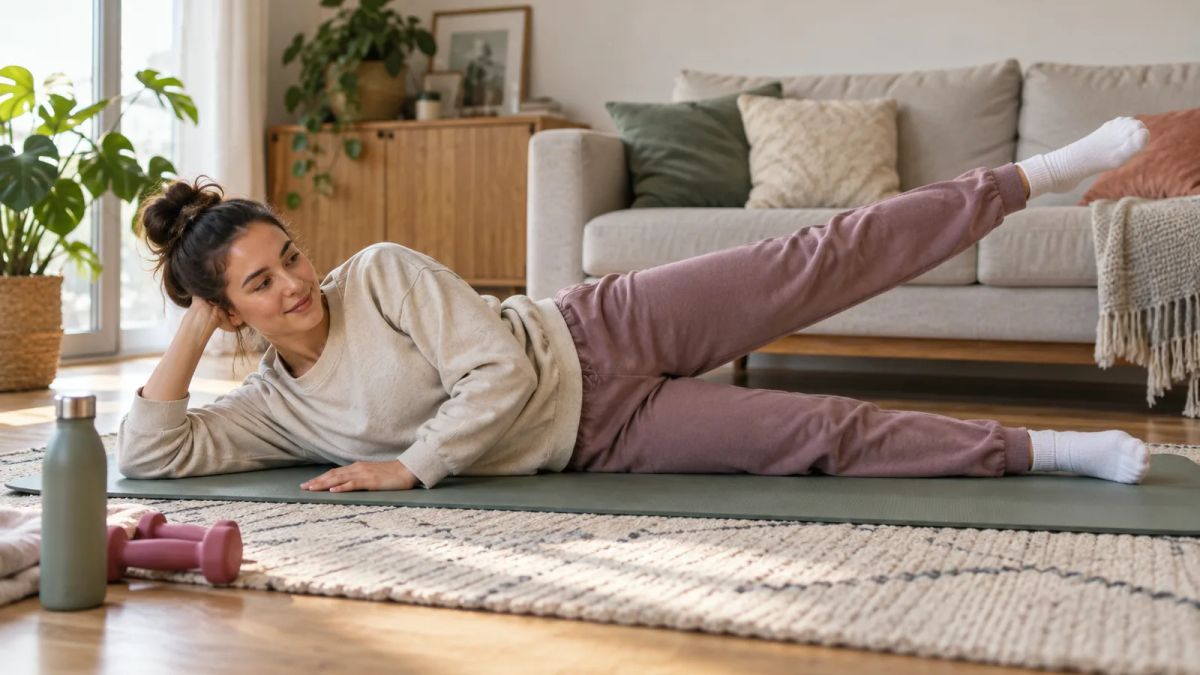
Here is a set of desk exercises you can do at work without changing your clothes, leaving your chair for most of them, or drawing much attention from the person across the desk. The routine below runs from your neck down to your calves, adds a couple of standing moves and a short walk, and takes about five minutes.
The reason to bother is simple. Sitting still for hours on end is hard on the body, and the fix is not a gym membership but small, frequent movement scattered through the day. You don't need to do the whole list at once. One or two moves an hour is the goal.
How to use this
Treat the routine as a menu, not a test. On a normal day, pick a few of these each time you get up for a drink or notice you've been hunched at the screen. Every stretch should feel like a mild, comfortable pull, never a sharp or pinching pain, and if a movement hurts you come out of it.
For the seated moves, the NHS suggests a solid, stable chair that does not have wheels, with your feet flat on the floor and your knees bent at about a right angle. If your office chair rolls, plant your feet firmly or wheel it against a wall first.
One caveat before you start. If you have a joint problem, a recent injury, or a condition that affects how you move, check with your GP or a physiotherapist so you know these suit you. That comes first, ahead of getting every rep right.
The routine: neck to calves, plus a walk
Do these slowly, breathing steadily. Where a move works one side at a time, do both.
1. Neck turns and a side stretch
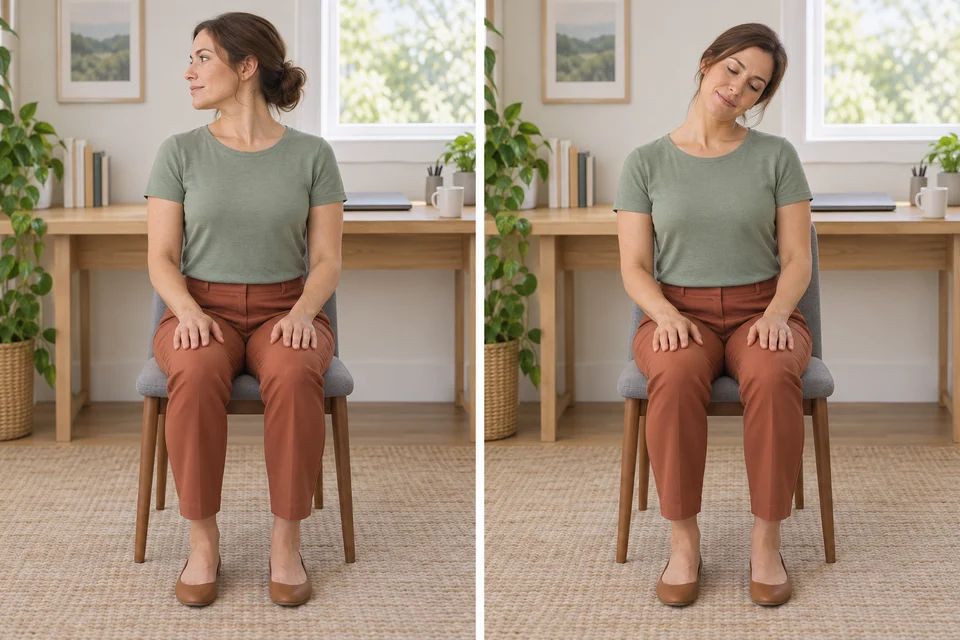
Sitting tall, turn your head slowly to look over one shoulder, hold for a few seconds, then the other way. Do three each side. Then drop one ear gently towards that shoulder until you feel a light stretch down the opposite side of your neck, and hold for around 15 seconds before swapping. The neck carries a lot of screen tension, so start here.
2. Shoulder rolls

Lift both shoulders towards your ears, draw them back, and let them fall in a slow circle. Roll backwards eight times, then forwards a few. Nothing to hold, this is loosening work for shoulders that creep up towards your ears as the day wears on.
3. Chest opener

Sit away from the back of the chair, pull your shoulders back and down, and extend your arms out to the side until you feel your chest open. Hold for around ten seconds and repeat a few times. Typing pulls everything forward, and this counters the slump.
4. Wrist and forearm stretch
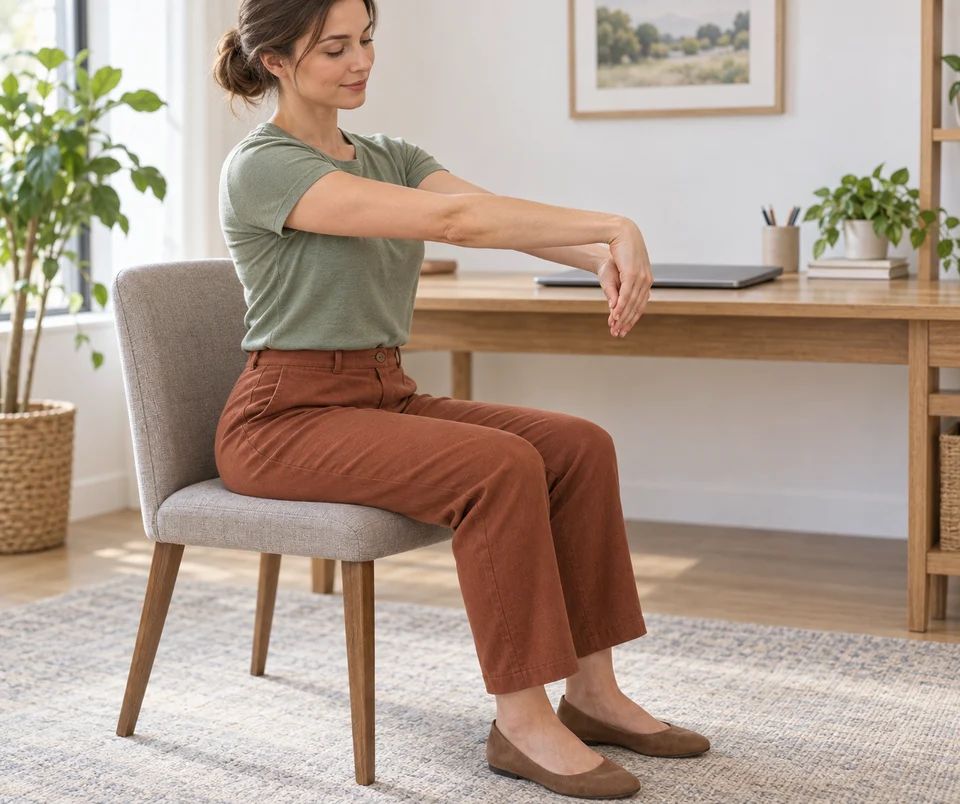
Extend one arm in front of you, palm up, and use the other hand to gently draw the fingers down and back towards you. Hold for around 15 seconds, then turn the palm down and repeat. Swap arms. Hours on a keyboard and mouse leave the forearms tight, and this gives them a break.
5. Seated spinal twist
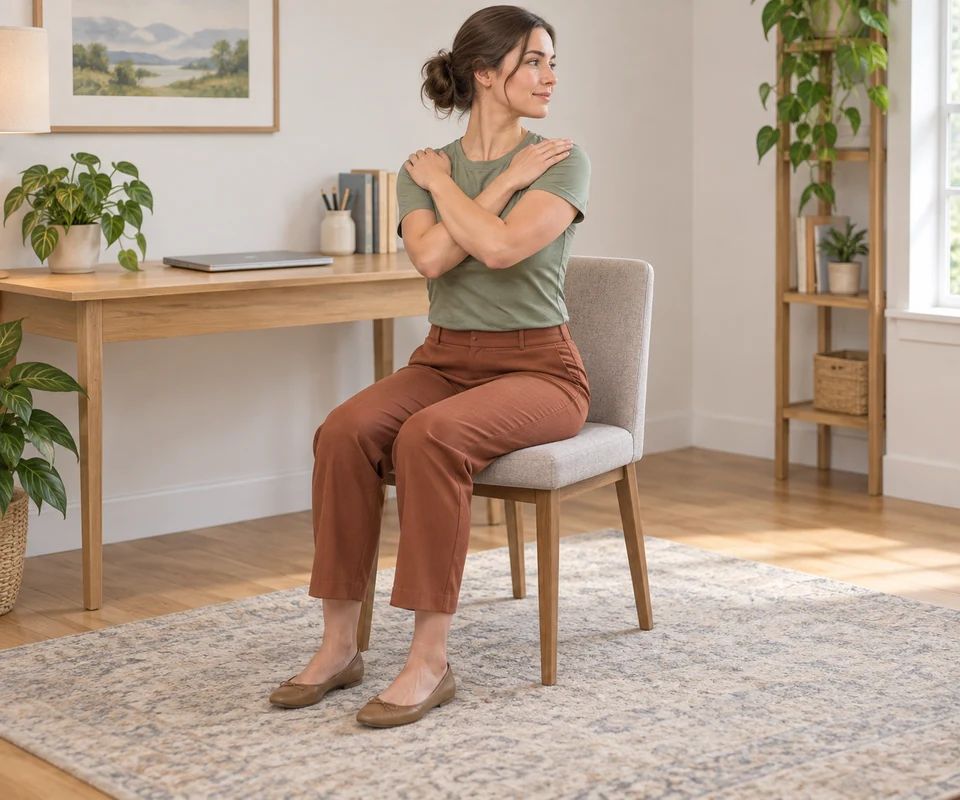
Cross your arms and rest your hands on opposite shoulders, then turn your upper body to one side as far as is comfortable without moving your hips. Hold for a few seconds and swing slowly to the other side. Do five each way. This wakes up a mid-back that stiffens from sitting square to a screen.
6. Hip marches
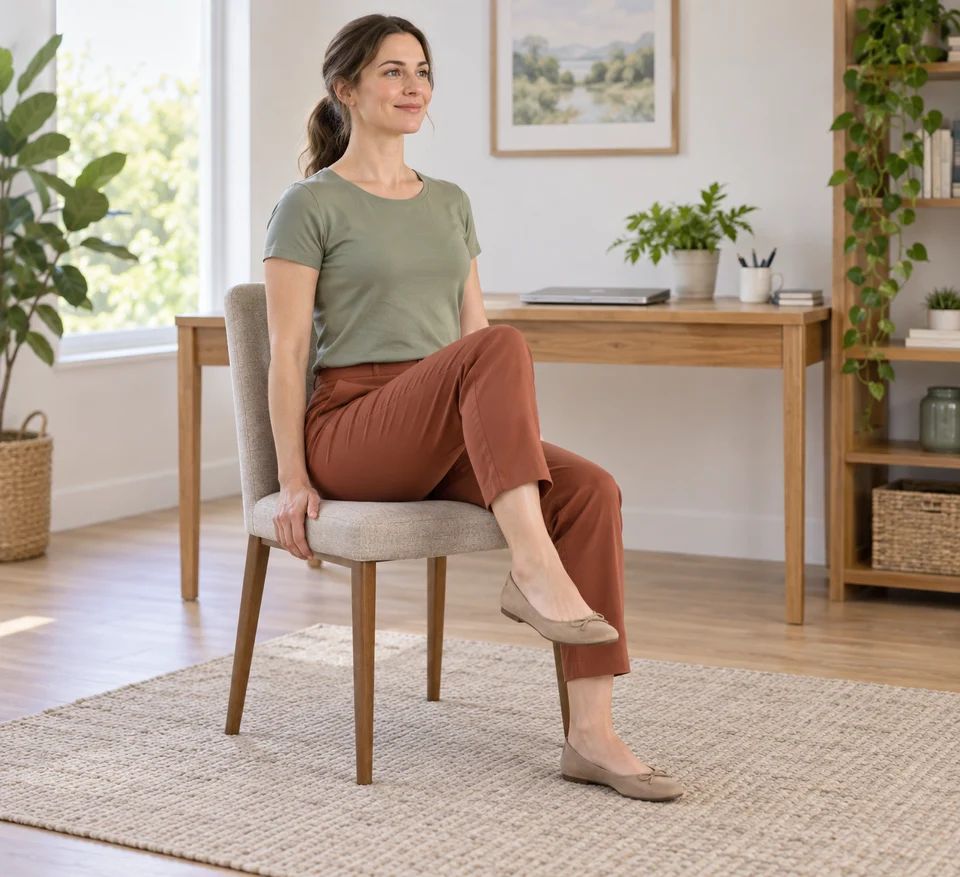
Sitting tall, lift one knee towards your chest as far as is comfortable, then place the foot down with control and lift the other. Do five to ten on each leg. Your hip flexors shorten while you sit, and a few marches remind them how to work.
7. Seated figure-four
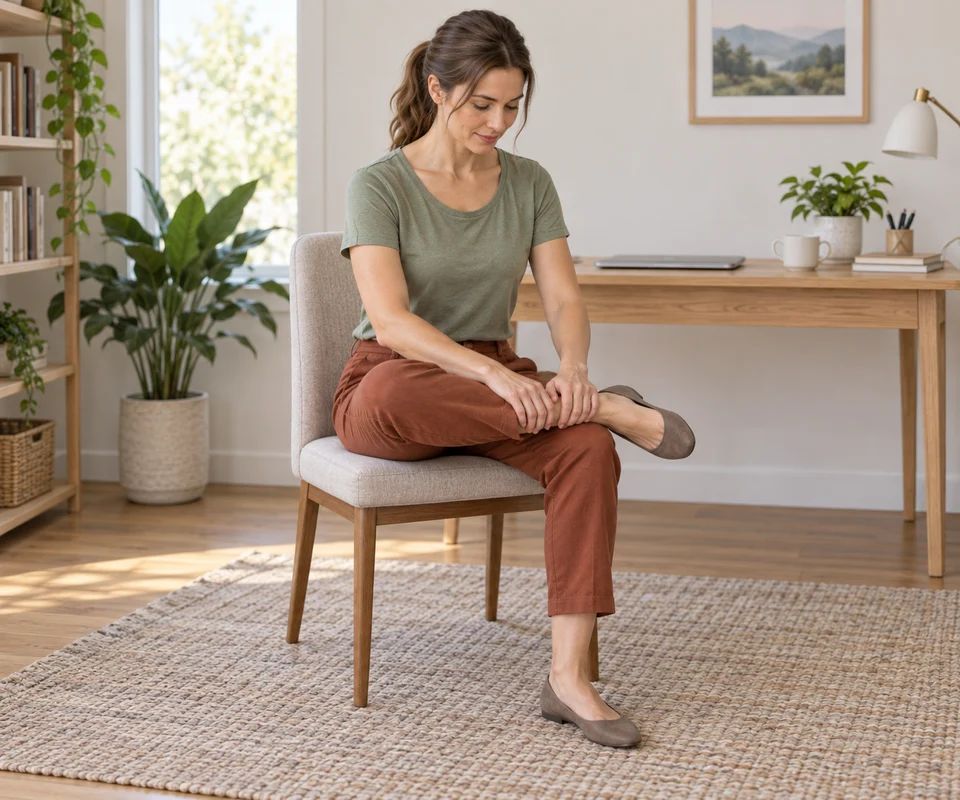
Rest one ankle across the opposite thigh so the bent knee opens outward, sit tall, then hinge forward gently from the hips until you feel a stretch deep in the hip and outer thigh. Hold for 20 to 30 seconds and swap. Tight hips are a big part of why standing up after a long meeting feels creaky.
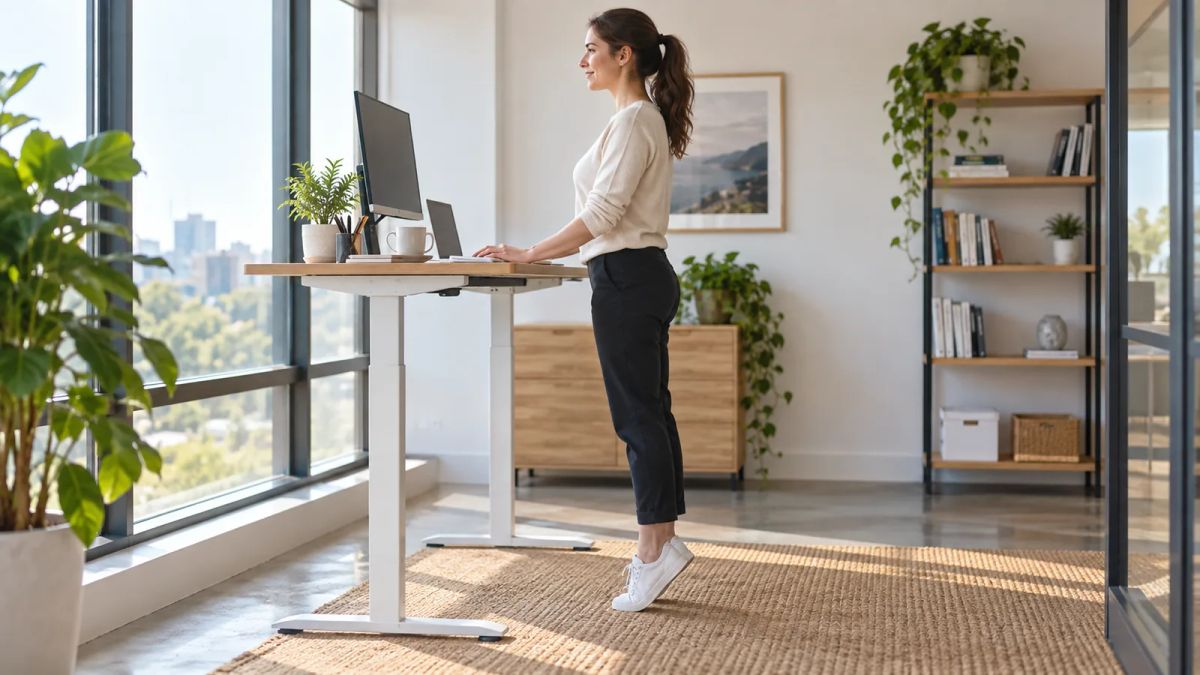
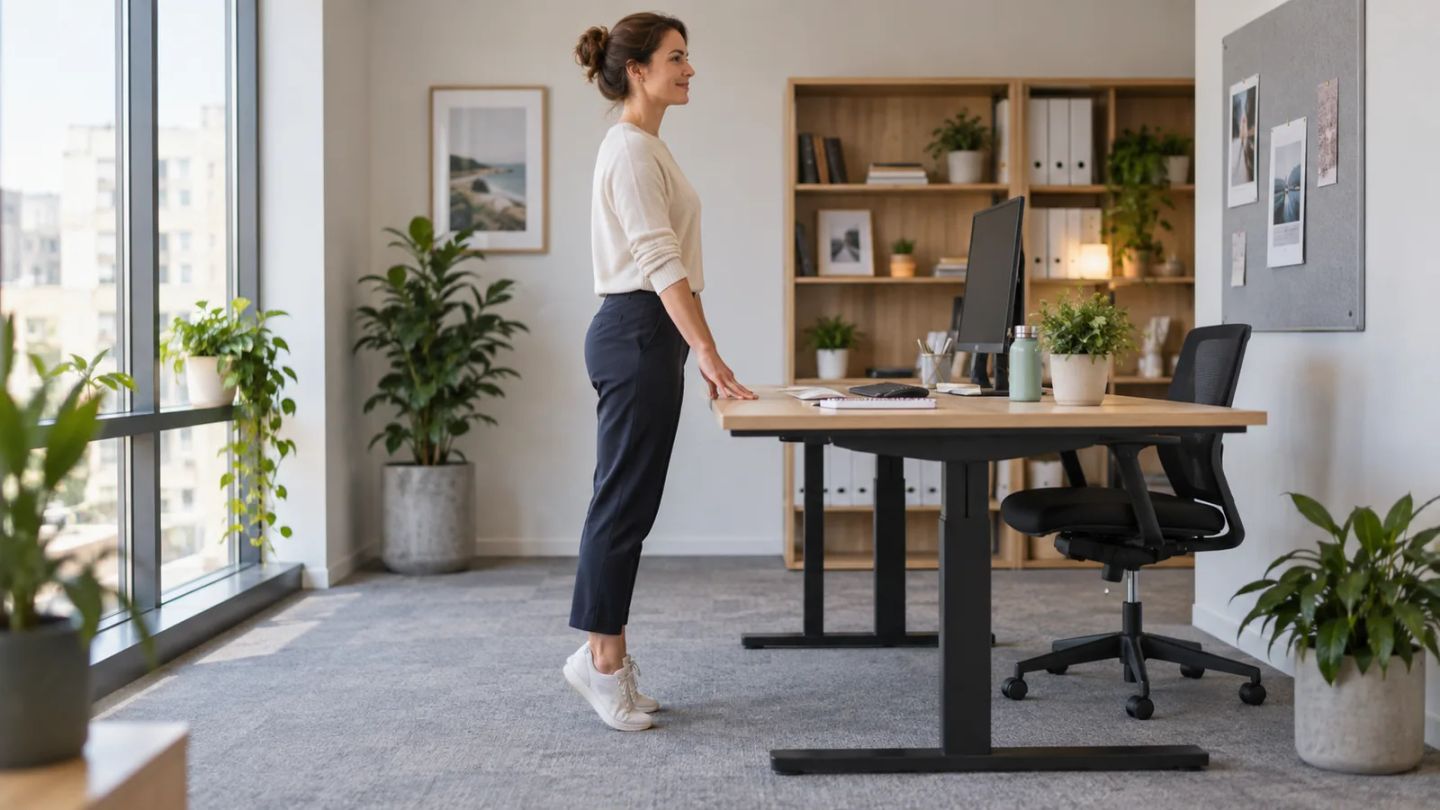
8. Stand up and do calf raises
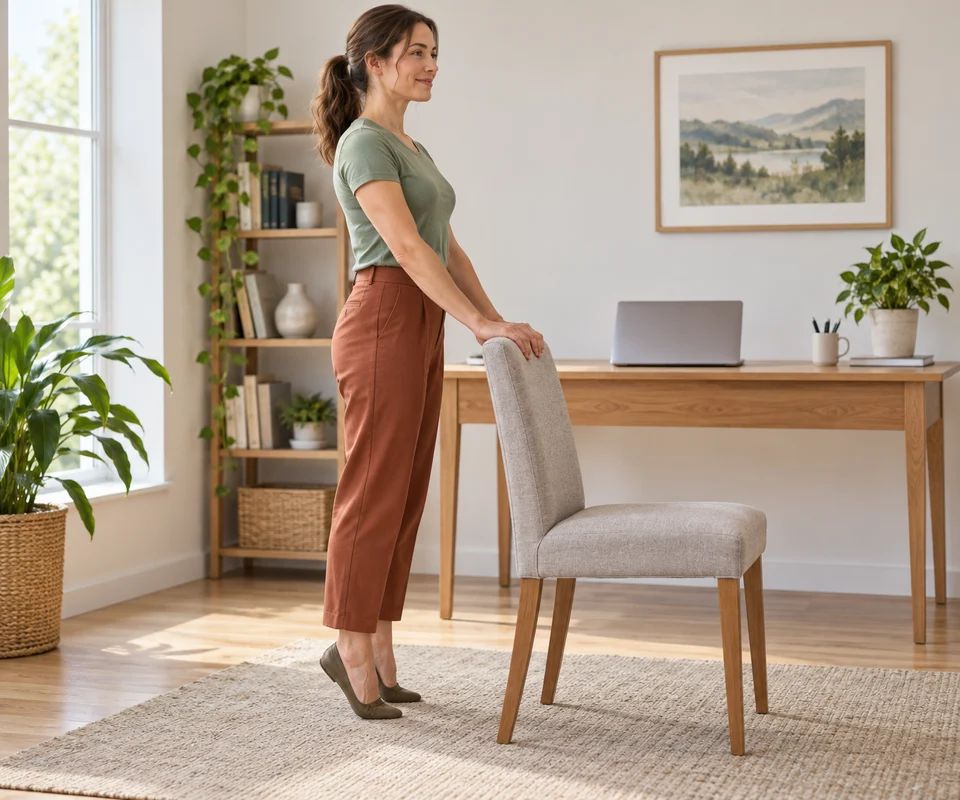
Stand behind your chair with a hand resting on it for balance. Rise onto the balls of your feet, hold for a second at the top, then lower slowly. Do 10 to 15. This gets the blood moving in your lower legs, which is exactly where sitting lets it pool.
9. A short walk

Finish by walking somewhere, anywhere. Fill your water bottle, take the long way to the printer, do a lap of the floor, or step outside for a minute. Two or three minutes on your feet does more for you than any single stretch on this list.
That's the full round, and you can do it in about five minutes. Most days you won't do all nine. Two or three moves plus a walk, a few times across the day, is the pattern that helps.
Why breaking up sitting is worth the effort
Long, unbroken stretches of sitting are the problem more than sitting itself. Harvard Health links prolonged sitting with higher risks of obesity, type 2 diabetes and heart disease, and points out that hours in a chair tighten the hip flexors and hamstrings and stiffen the joints. Its practical advice is blunt: set a timer to remind you to get up and move around every so often.
The interesting part is how little movement seems to shift the needle. In a controlled study of 60 older adults, breaking a long day of sitting with five minutes of light walking every 30 minutes lowered post-meal blood sugar and dropped systolic blood pressure by about 4 mmHg compared with sitting straight through. Standing breaks did nothing measurable. The walking made the difference, and being upright on its own did not.
Two honest caveats. That study used older adults in a lab over a single long day, so the exact numbers won't map onto everyone at every desk, and it measures short-term effects, not years of health. And the popular claim that movement breaks sharpen your focus is shakier than it sounds. A review of seven studies on breaking up sitting and thinking skills found mixed results, with only three showing a benefit, and the authors said firm conclusions can't be drawn yet. You might feel more awake after a walk, which is reason enough, but don't expect a guaranteed brain boost.
The bigger picture backs the small stuff. The World Health Organization advises adults to limit the time they spend being sedentary and reminds us that any amount of physical activity is better than none. Desk exercises won't replace the 150 minutes of weekly activity that guidance points to, but they chip away at the long sitting spells in between.
Building it into the workday
A stretch you mean to fit in somewhere tends to vanish. A stretch pinned to something that already happens tends to survive.
The American Heart Association suggests attaching a new action to a routine you already have, so it rides along with something automatic instead of asking you to remember. At a desk you're spoilt for cues. Every coffee refill, every trip to the loo, every meeting that ends, every hour that ticks over on your calendar can be the trigger for one or two moves.
Pick a cue that happens often and let the movement follow it. "When I fill my water bottle, I do calf raises and a walk back the long way" is the kind of plan that holds, because you were getting water anyway.
If you'd rather run on a clock, Harvard's timer idea works well. Here's a light hourly plan you can copy onto a sticky note or a repeating calendar reminder:
9am neck turns + shoulder rolls
10am stand, calf raises + a lap of the floor
11am wrist stretch + seated twist
12pm walk to lunch, take the stairs
2pm chest opener + hip marches
3pm stand, figure-four each side
4pm short walk, refill water
5pm neck + shoulders to unwind
You don't have to follow it to the minute. The point is to break up the sitting, not to run your day by alarm. If your work comes in deep blocks where stopping every hour would wreck your concentration, aim for the end of each task instead, and get up whenever you surface.
None of this asks you to sit less overall. It asks you to sit in shorter stretches. That distinction is the whole game.
A place to tick off the movement

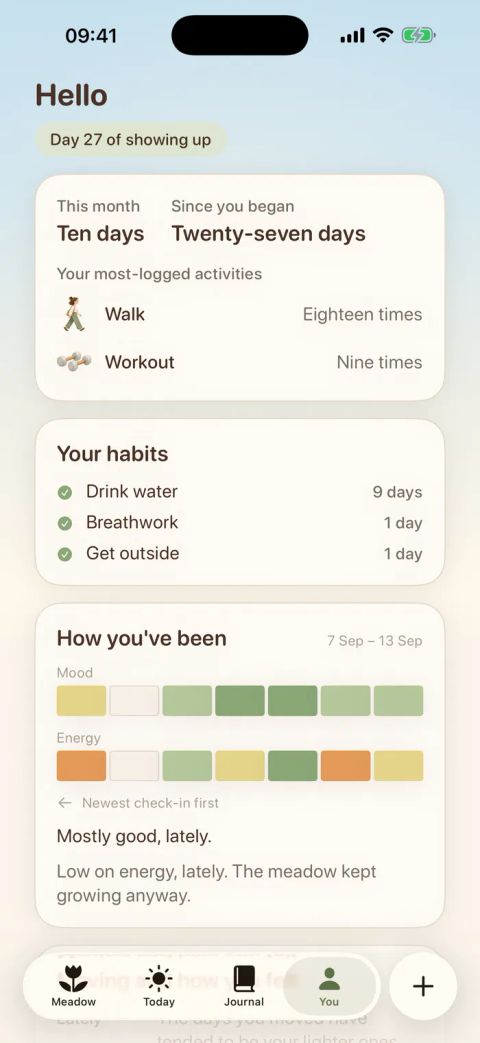
If a nudge on your phone helps the habit stick, Meadow gives the desk breaks somewhere to land. It's a gentle habit app for iPhone from Wildcard Wellness where you log the movement you enjoy with a timer, a lunchtime walk or a few minutes of stretching, and tick off small daily habits like getting up from your desk or drinking more water. You can note your mood and energy as the day goes, and every day you show up grows a wildflower in your own meadow. There are no streaks, so a head-down day with no breaks at all resets nothing you've built, and you pick it back up whenever you're ready.
On a heads-down day, and after you drift off it
Decide your smaller version before you need it. On a day so busy you can't spare five minutes, one thing still counts. Stand up, roll your shoulders back, and walk to the far end of the office and back. Thirty seconds on your feet keeps the thread going, and keeping the thread going is what turns this from a chore into something your body starts to expect.
And you will drift off it. Everyone does. A fortnight of back-to-back deadlines will bury the whole routine, and that's fine. Nothing is undone by the gap. The stiffness that creeps in after weeks of solid sitting is the result of staying still, not a mark against you, and the way back is the same as the way in. Tomorrow, on your first coffee refill, do the neck turns and one short walk. Start there, not with a heroic hour of catching up.
Common questions
Do desk exercises do anything? They won't transform your fitness, and they're no substitute for proper activity outside work. What they do is interrupt the long sitting spells that the evidence flags as the real issue, and short walking breaks in particular have measurable short-term effects on blood sugar and blood pressure. Think of them as damage control for a sedentary job, not a workout.
How often should I get up from my desk? There's no single magic number, but roughly once an hour is a sensible target and matches the pattern used in the research. If an hour feels too frequent for your workload, get up at the end of each task or meeting. Any break beats none.
Can I lose weight doing exercises at my desk? On their own, not meaningfully. Weight is shaped by many things, and desk moves burn very little. They're better understood as a way to sit less and feel less stiff. If weight is your goal, they're a small helper alongside broader changes, and it's worth talking to your GP about a plan that fits you.
Will colleagues think it's odd? Most of these are subtle enough that nobody will notice, and the walk and calf raises look like someone stretching their legs, which is normal. If a move feels too conspicuous, save it for a quieter moment or a room on your own.
For more ways to weave movement through an ordinary day, this pairs well with our guide to building an active lifestyle without the gym. If your back and shoulders are stiff first thing, a short morning stretch routine sets you up before you sit down, and for something more structured at your desk, chair yoga covers similar ground with a calmer, guided feel.
Right now, before you close this, do one thing. Stand up, roll your shoulders back three times, and walk to refill your water. That's the first break of the day, and the habit starts with it.
AUTHOR
Co-founder of Meadow.
Ash is co-founder of Meadow, a habit and movement tracking app that turns small acts of self-care into a growing wildflower meadow.
See how far you've come
Your habits, moods and little wins, all in one place
Meadow keeps track of the walks, the water and the good days, so you can look back and watch your effort add up.
Download Meadow