Wall Pilates is ordinary Pilates done with a wall as your partner, using it for support, feedback and a little resistance so the moves feel steadier and are easier to learn. Below is a followable beginner set, nine named moves in order, that you can do at home in fifteen to twenty minutes with nothing but a clear stretch of wall and a mat if you have one.
The wall earns its place. It shows you when your spine is stacked. It catches your balance, so you can think about the movement and not about staying upright, and it takes some load off your joints. That mix makes wall Pilates a kind way in if you're new to exercise, easing back after a break, or wary of getting down to the floor and up again.
This guide covers what wall Pilates is, who it suits, the nine-move plan with step-by-step cues and reps, what it can and cannot do for your body, how to stay safe, and how to turn it into something you keep doing.
What wall Pilates is
Pilates itself is a slow, controlled form of movement built around the core. Cleveland Clinic describes it as a low-impact, full-body workout and points out that the core is far more than your stomach, taking in "your sides, your mid to lower back, your buttocks and your hips". Wall Pilates keeps all of that and adds a flat vertical surface you can lean on, press against, or rest your legs up.
Two things change once the wall is involved.
It gives your body constant feedback, so a rounded shoulder or a tilted pelvis shows up the moment it touches the surface. And it shares the work, holding you steady through a squat or a stretch you might wobble through unsupported. Healthline, whose beginner guide was medically reviewed, sums up the appeal by calling wall Pilates low impact and suitable for small spaces, which is most of the reason it travels so well into a bedroom or a hallway.
You need almost nothing to start. A sturdy wall with no pictures or shelves in the swing of your arms, a bit of clear floor, and a mat or towel for the lying-down moves. Light hand weights of one or two pounds are optional and better left for later.
Who it suits, and when to check first
Cleveland Clinic calls Pilates customizable to fit you and your health goals, regardless of your age, sex, health status and fitness level, and the wall version leans into that. It suits people who sit at a desk all day and feel it in their neck and lower back, anyone rebuilding a little strength and balance, and beginners who want to learn the shapes of Pilates before trying a mat or reformer class.
One honest note before you begin. A wall makes the moves safer, not risk-free.
The same Cleveland Clinic guidance is clear that "it's always a good idea to talk with a healthcare provider before starting a new workout routine". That goes double if you're pregnant, recovering from injury or surgery, living with a heart condition, or dealing with back or joint trouble that flares. A quick word with your GP or a physiotherapist tells you which moves to favour and which to skip, and that beats pushing through something that doesn't feel right.
The plan: nine wall moves for beginners
Work through these in order. Move slowly and aim for mild effort, never strain. Keep your breath flowing. Don't hold it. Where a move has a left and a right, do both sides. Stop anything that brings sharp or pinching pain.
1. Posture reset
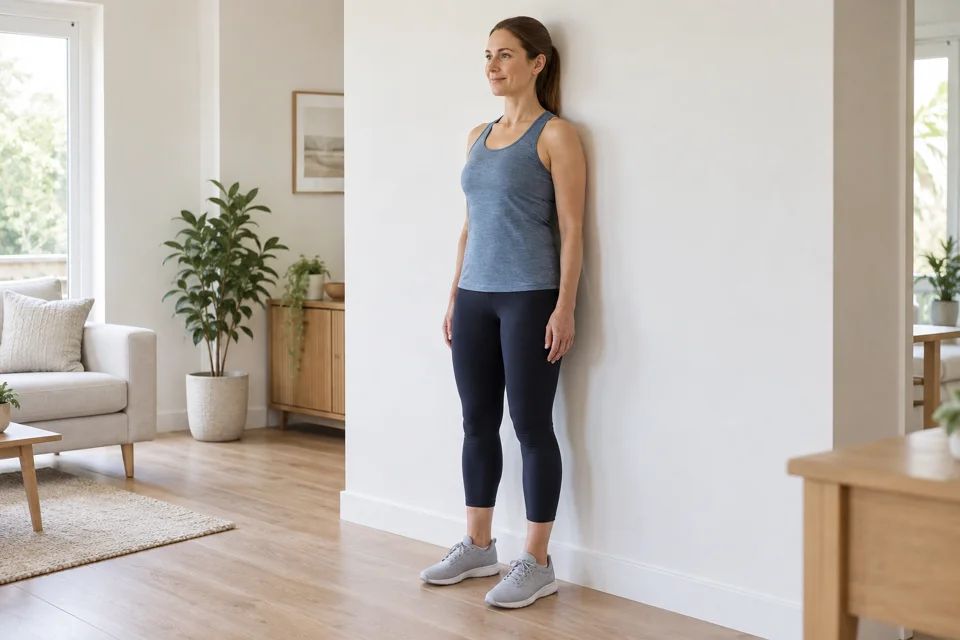
Stand with your back to the wall, heels a few inches out, and gently press your lower back, upper back and the back of your head towards it. Draw your navel in softly and widen your collarbones. Hold for five slow breaths, feeling the line the wall makes down your spine. This sets the alignment you will carry through the rest.
2. Wall roll-down
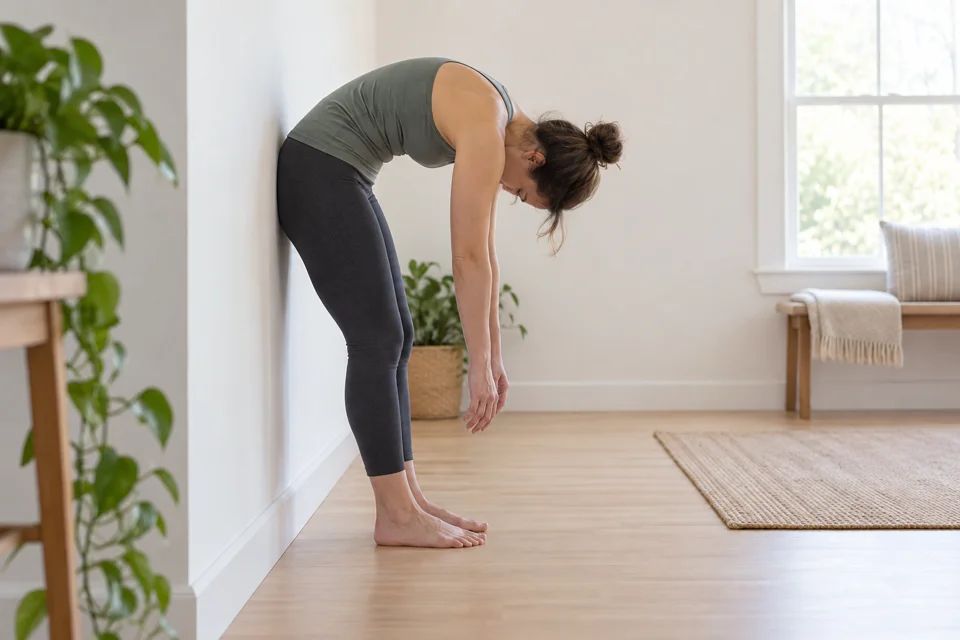
From that standing position, drop your chin to your chest and peel your spine away from the wall one section at a time, rolling down until your arms and head hang loose towards the floor. Pause for a breath, then stack back up slowly, bone by bone, until your head is last to arrive. Do four unhurried rounds. It is one of the gentlest ways to free up a stiff back.
3. Wall arm circles
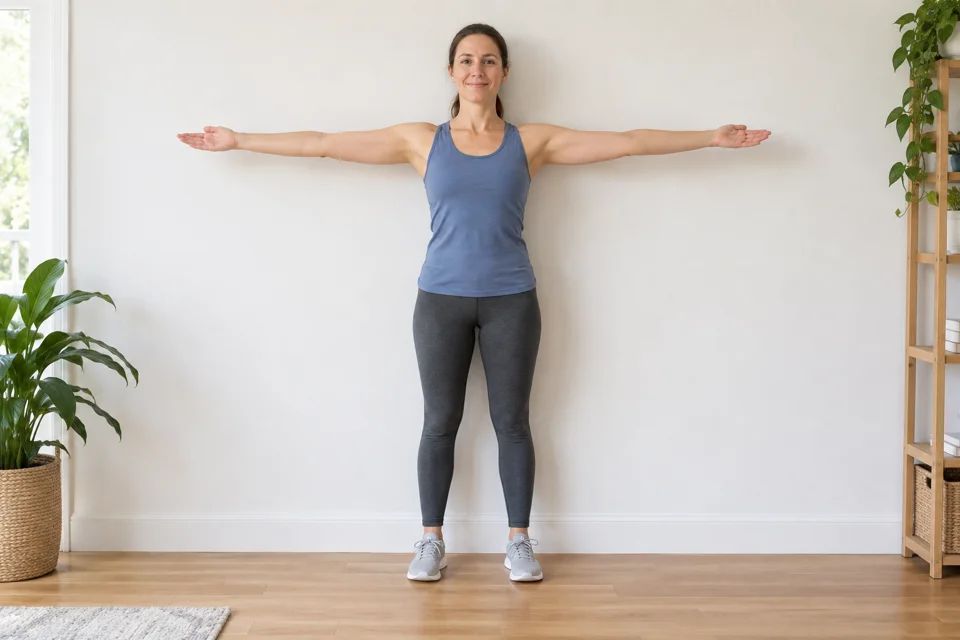
Standing tall against the wall, raise both arms in front of you, open them out wide, then float them down by your sides in a slow circle. Do eight forwards, then eight in reverse, keeping your shoulders down and away from your ears. This wakes up shoulders that have spent the day hunched over a screen.
4. Wall push-up
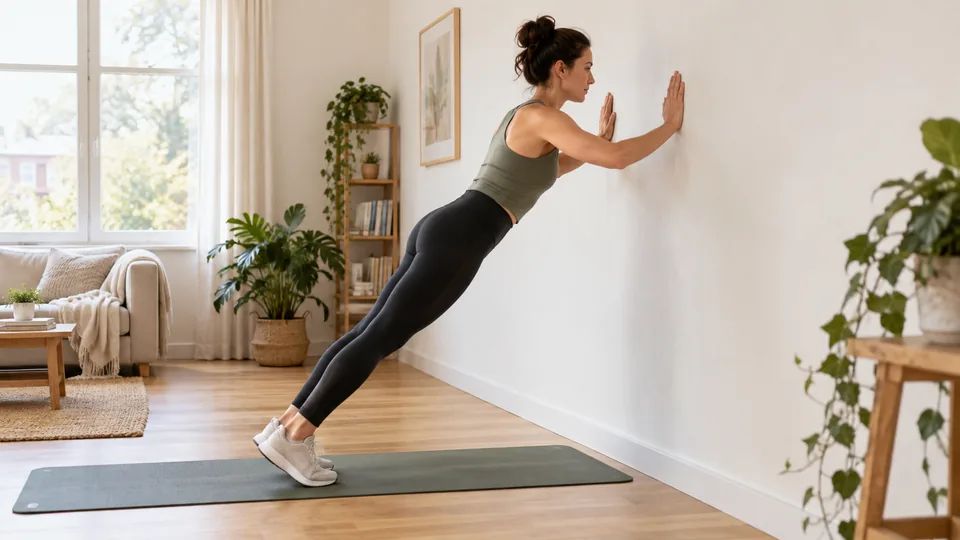
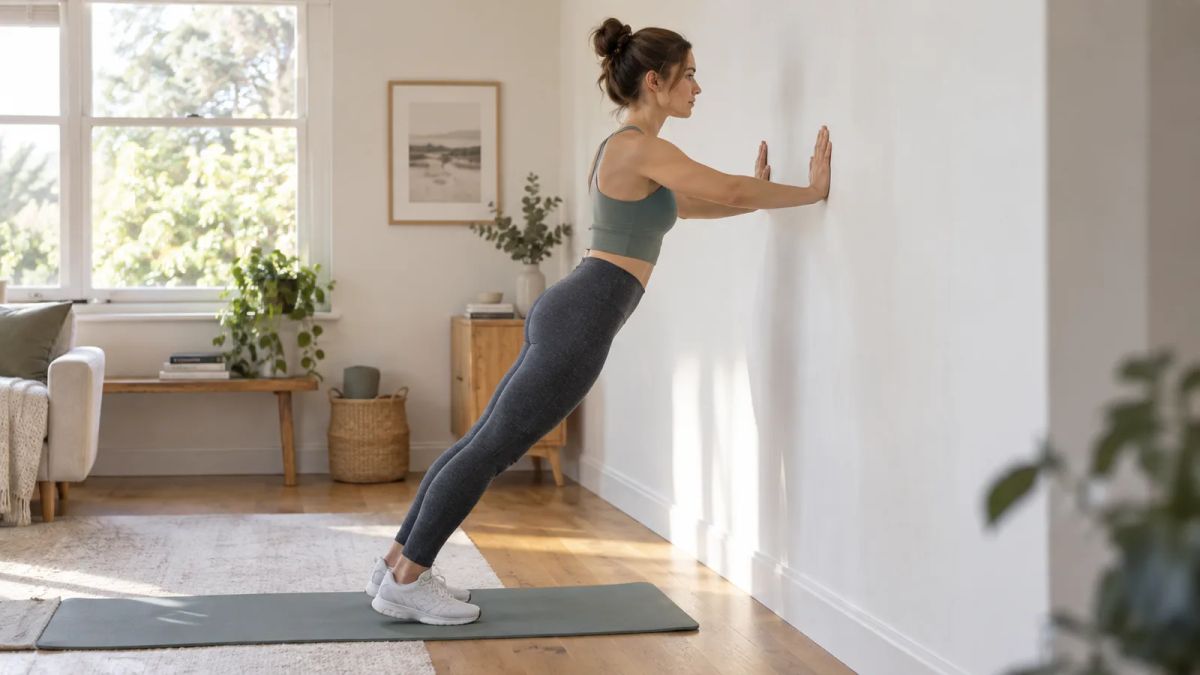
Turn to face the wall, feet hip-width and about two feet back, and place your palms on it at shoulder height. Keeping your body in one straight line from head to heels, bend your elbows to bring your chest towards the wall, then press back out. Do eight to ten, and step your feet further back later to make it harder. Your core holds you level throughout.
5. Wall sit
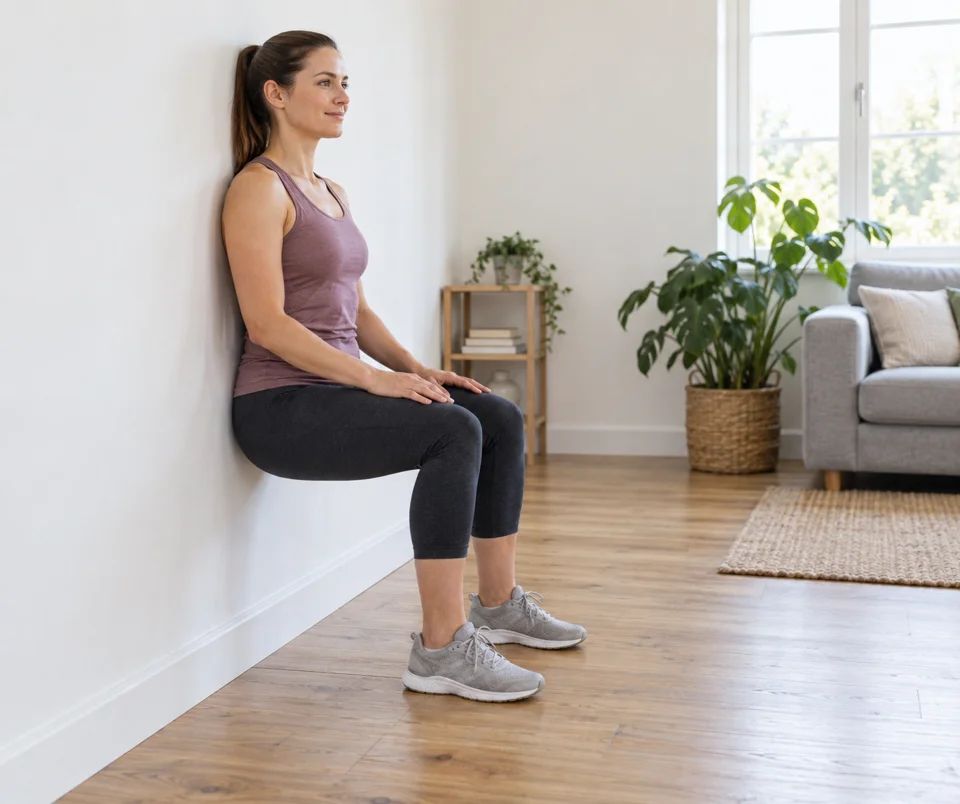
Back to the wall again, walk your feet forward and slide down until your knees bend towards a right angle, thighs working, knees stacked over your ankles. Hold for twenty to forty seconds and build up over the weeks. There's research behind this one, covered in the next section. Come up if your knees complain, and keep breathing steadily the whole time.
6. Wall marches
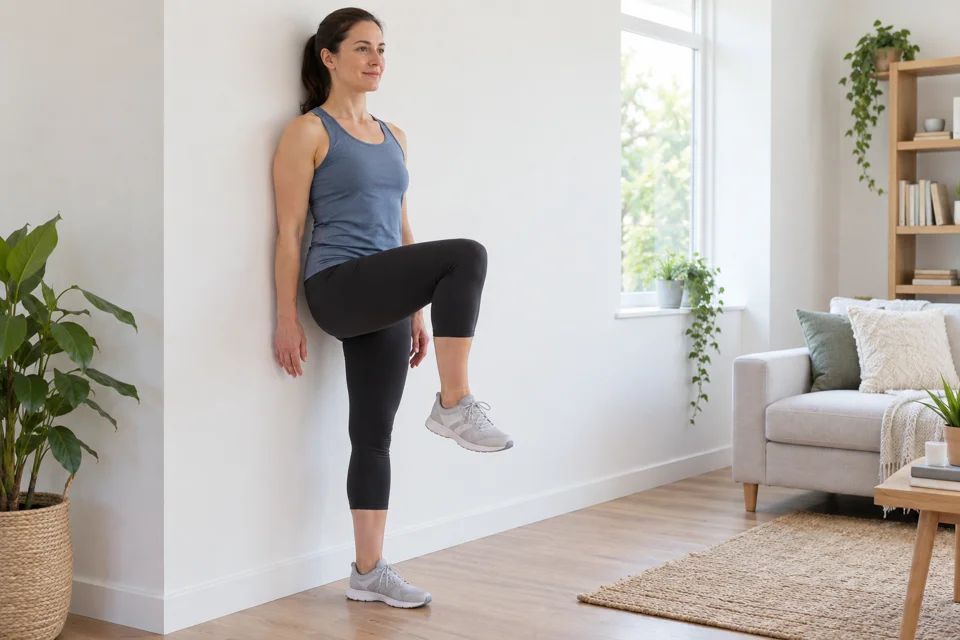
Stand with your back to the wall for balance and lift one knee towards hip height, lower it with control, then lift the other, as if marching on the spot in slow motion. Keep your spine long against the wall and your middle engaged so you do not rock side to side. Do eight to ten lifts on each leg. It builds core control and a little single-leg steadiness.
7. Wall bridge
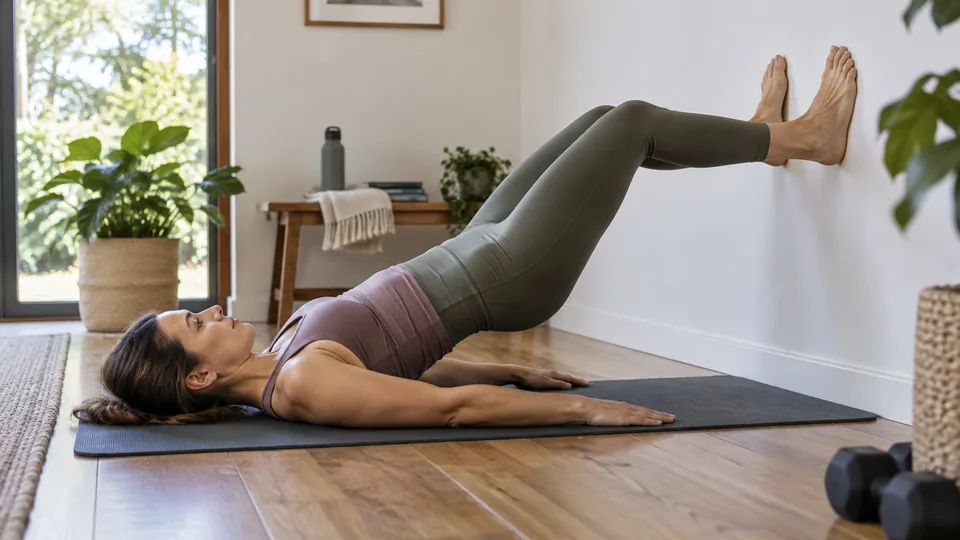
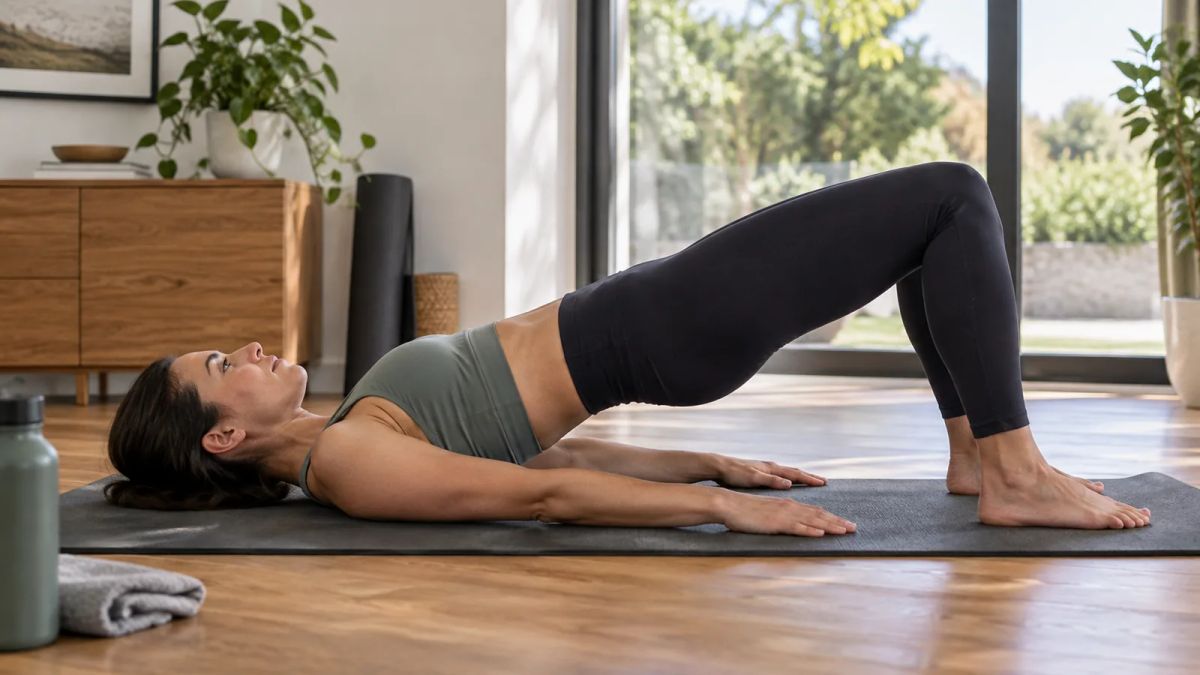
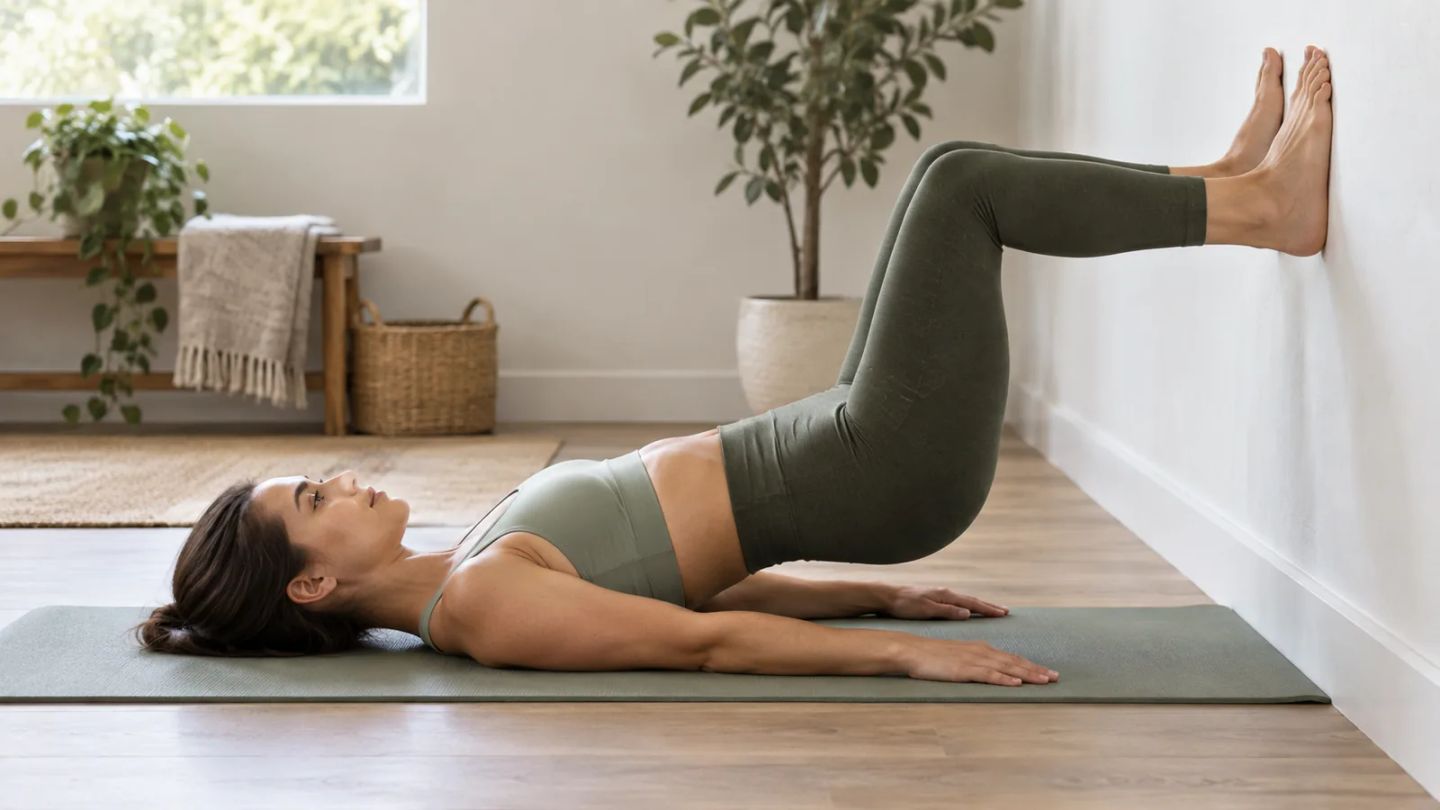
Lie on your back with your feet flat on the wall, knees bent at roughly a right angle, arms resting by your sides. Press through your feet and peel your hips off the floor one vertebra at a time until you make a gentle slope from knees to shoulders, then lower slowly. Do eight to ten. You should feel this in your glutes and the back of your thighs, not your lower back.
8. Legs up the wall
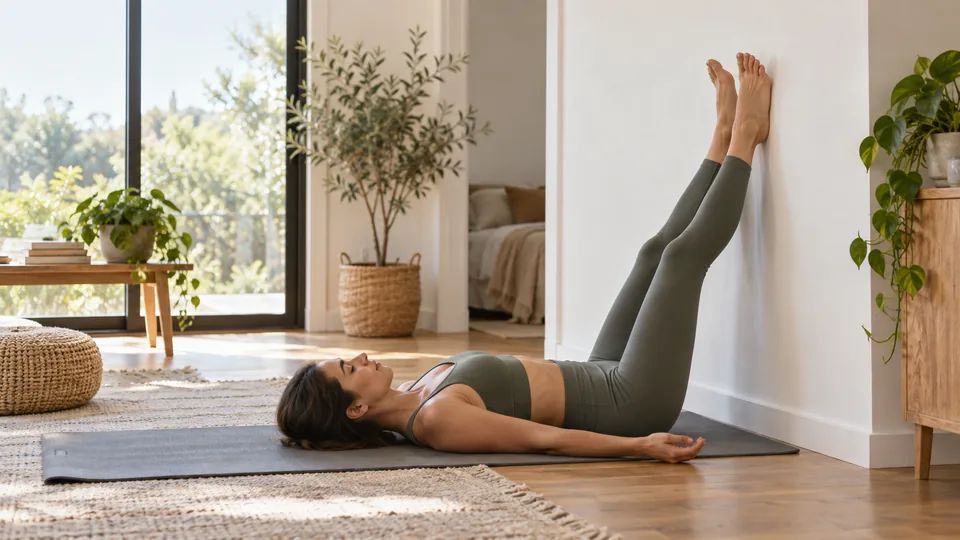
Sit side-on close to the wall, then swing your legs up it and lie back so your body makes an L, bottom near the skirting and legs resting up the surface. Let your arms fall open and breathe slowly for one to three minutes. It is a restful pose that eases tired legs and gives your nervous system a moment to settle.
9. Wall butterfly stretch
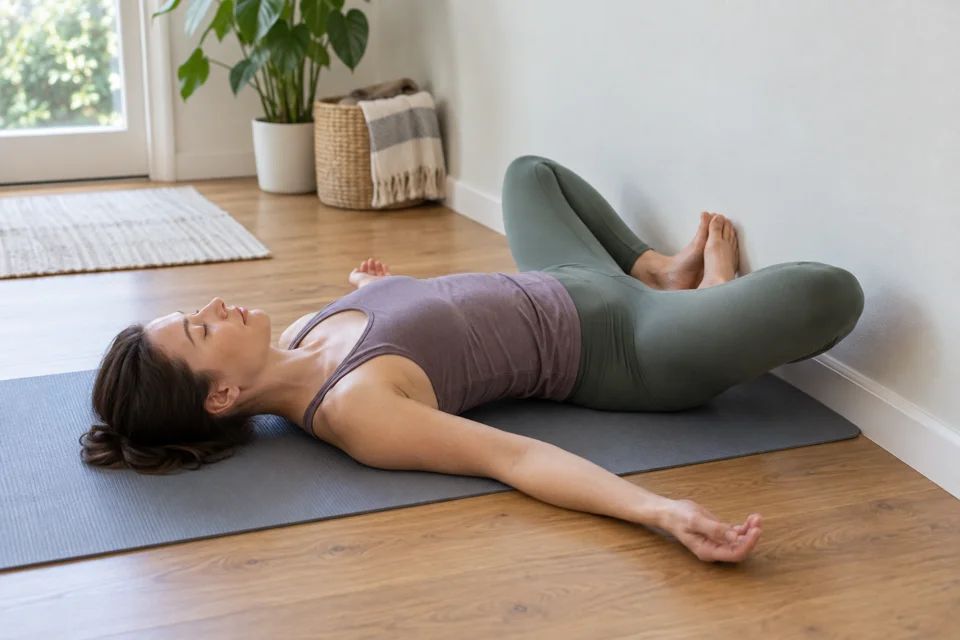
Staying on your back with legs up the wall, bring the soles of your feet together and let your knees open outwards, sliding your feet down towards your hips as far as is comfortable. Rest here for thirty seconds to a minute, breathing into your hips. This opens tight hips gently and makes a calm end to the set.
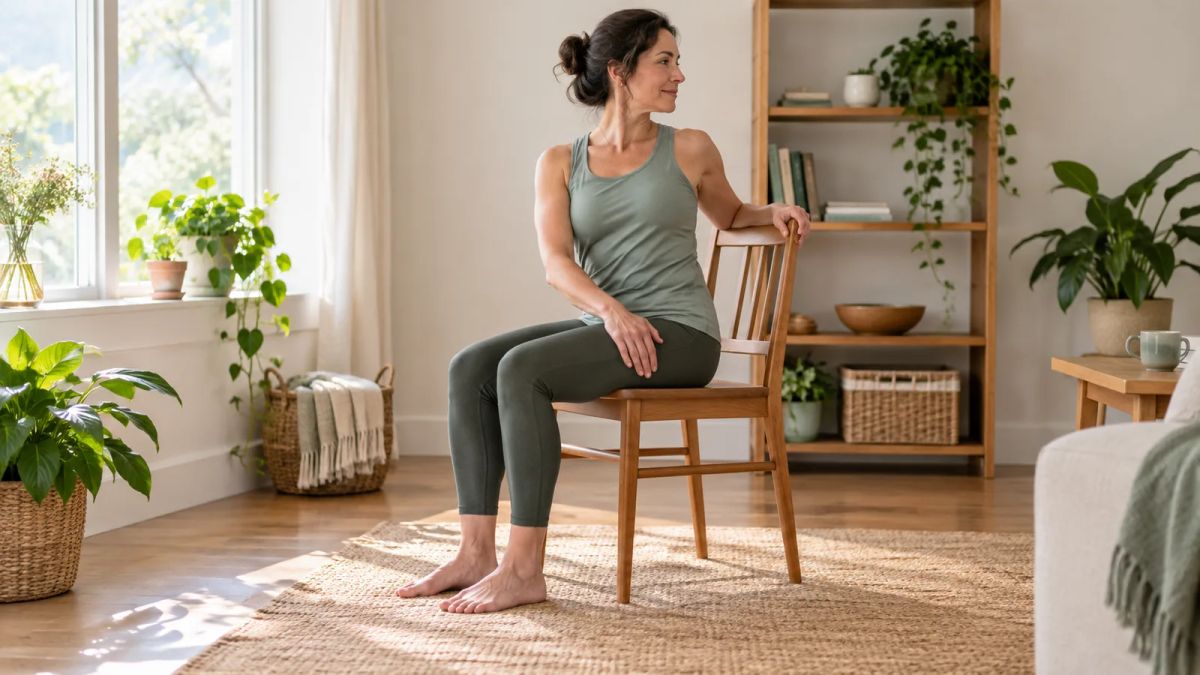
That is the whole sequence, standing work through to a restful finish, in fifteen to twenty minutes. If you would like more structure alongside it, our yoga for beginners guide and this chair yoga walkthrough cover similar low-impact ground, and the morning stretch routine is a shorter mobility option for busy days.
What wall Pilates can and cannot do
The fair pitch sits between the breathless promises and the shrug.
On the plus side, the core and posture benefits are well founded. Cleveland Clinic links a stronger core to easier good posture, and notes that Pilates helps lower back pain that stems from "misalignment and lack of core strength". Healthline adds that a wall practice can support posture, improve flexibility and tone muscles, and that pairing the moves with slow breathing offers a way to manage stress. For an approach you can do at home with no kit, that is a useful spread.
The evidence on back pain is encouraging and modest at the same time. A 2023 systematic review of eight randomised trials found that Pilates is not inferior to equivalently dosed exercises for improving core muscle strength in people with chronic low back pain, and can beat doing no exercise at all. The researchers rated the certainty of that evidence as very low, so read it as a fair reason to try, not a promise about your back.
The wall sit has its own small piece of science. A large 2023 meta-analysis reported by the British Heart Foundation found that isometric holds like the wall squat were associated with lower resting blood pressure over time. The BHF adds two sensible caveats worth repeating: keep breathing through the hold rather than clenching, and if you have a heart condition, ask your healthcare practitioner which exercise suits you before you begin.
Now the limits.
Wall Pilates on its own is not a weight-loss engine, and the "28-day transformation" framing that follows these workouts around online oversells what a few minutes a day can do. It builds control, steadiness and some strength, and it is a fine on-ramp, though bigger strength gains still come from progressive resistance work over time. Treat it as one part of a wider week. The NHS suggests adults aim for at least 150 minutes of moderate activity a week plus muscle-strengthening on two days, and a short daily wall set fits comfortably inside that.
How to make it a habit
Finding fifteen good minutes is the easy part. Doing them often enough to feel a difference is where most plans quietly fall apart, and that has little to do with willpower.
Attach the set to something you already do. The American Heart Association recommends tying a new action to a routine you already have, so it rides along with an automatic moment instead of asking for a fresh decision each day. "After I put the kettle on, I do my nine wall moves" gives the habit a fixed home, which holds better than a loose plan to fit it in somewhere.
Decide your smaller version now, before you need it. On a rushed or low day, the posture reset, one wall roll-down and a thirty-second wall sit still count. A short session keeps the thread going, and keeping the thread going is what turns this into something your body expects.
If you miss a day, or a week, nothing is undone. Pick the next day and do the posture reset again. Starting small after a gap is more reliable than trying to make up for lost time in one long session.
A small record helps you notice the practice becoming part of your week. Keep one on paper if you like. Write the move and its cue, then tick the days you show up.
Move: Wall Pilates set Cue: after I put the kettle on
Mon ☐ Tue ☐ Wed ☐ Thu ☐ Fri ☐ Sat ☐ Sun ☐
A filled week might look like this, with a couple of gaps and no drama about them.
Move: Wall Pilates set (15 min) Cue: after I put the kettle on
Mon ☑ Tue ☑ Wed ☐ Thu ☑ Fri ☐ Sat ☑ Sun ☑
If a paper grid is not your thing, our habit tracker guide covers other ways to keep score without turning it into a chore.
A gentle place to keep it going

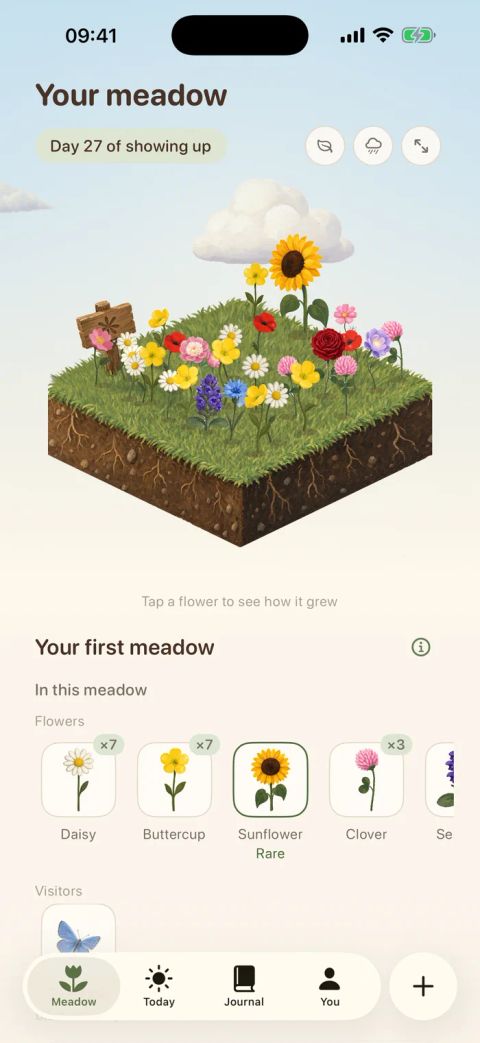
To make this easier to come back to, Meadow gives your wall Pilates a spot on your iPhone. It is a gentle app from Wildcard Wellness where you log the movement you enjoy along with small daily habits, and note your mood, energy and a daily win. Every day you show up grows a wildflower, and rare flowers and little animal visitors turn up over time. There are no streaks, so if you skip a day nothing resets and your flowers never wilt.
Tomorrow, pick your cue, the kettle or your first cup of tea, and do the posture reset, one wall roll-down and a short wall sit while it happens. That is enough to begin.
AUTHOR
Co-founder of Meadow.
Ash is co-founder of Meadow, a habit and movement tracking app that turns small acts of self-care into a growing wildflower meadow.
Little and often, with Meadow
Consistency, not intensity.
Meadow turns the movement you enjoy and the habits that help you feel good into a meadow of wildflowers. No streaks to break, and your flowers never wilt.
Download Meadow