An active lifestyle is one where movement runs through your ordinary day. You don't save it up for a gym session you may never reach. You build it by taking the walking, standing, carrying and stair-climbing you already do and doing a little more of it on purpose, in the gaps your week already has.
That is the whole idea, and it is good news for anyone who has quietly decided they are "not a gym person". A gym is one good way to be active, but it asks for a spare hour, a change of clothes and the will to leave the house on a dark evening, which is why so many memberships gather dust by February.
The movement woven through a day asks for none of that. This guide covers what an active lifestyle looks like when you build it this way, the honest state of the evidence for why it helps, where the extra movement hides in a desk job, a house full of children or a body that does not move as freely as it used to, and how to make any of it stick.
What an active lifestyle looks like
Picture two people who both weigh the same and neither of whom "exercises". One drives to a desk, sits most of the day, drives home and sits again. The other walks part of the way in, takes the stairs, stands on calls, carries the shopping in from the car and pushes a hoover round at the weekend. Over a week the second person has moved far more, without a single minute of anything called a workout.
Scientists have a name for that background movement: non-exercise activity thermogenesis, or NEAT. A review in the Journal of Exercise Nutrition & Biochemistry describes it as the energy you spend on everything that is not sleeping, eating or deliberate exercise, from standing and walking to cleaning, stair-climbing and fidgeting. It varies a lot from person to person. The same review points to research in which people with obesity sat on average about two hours a day longer than lean people, and puts the wider decline in NEAT down to cars, mechanised work and labour-saving gadgets at home.
An active lifestyle, then, is mostly a matter of putting some of that movement back. Not all at once, and not by becoming someone you are not.
Why everyday movement matters
The case for moving more is strong, and it is worth being straight about what the evidence does and does not say.
Start with the official targets, because they set the scale. The CDC puts the weekly aim at 150 minutes of moderate activity, or 75 minutes of vigorous activity, plus muscle-strengthening on two or more days. That sounds like a lot until you read the line the World Health Organization sets beside its own version of the same target: any amount of physical activity is better than none, and all physical activity counts. Walking, cycling, wheeling, active recreation and play all get named as the real thing.
Most of the world is under the bar, which is worth knowing before you measure yourself against it. The WHO's latest figures, published in June 2024, put 31% of adults, about 1.8 billion people, below the recommended level in 2022.
The reassuring part is that you do not have to bank those minutes in one go. The CDC is explicit that you can spread activity across the week and break it into smaller chunks, and that adults who sit less and move any amount gain some health benefit. Five minutes here and ten there add up to the same total as one long session.
Some of the return arrives the same day. The CDC lists better sleep and less short-term anxiety among the effects you can feel straight away, with the slower case covering heart disease and stroke, type 2 diabetes, several common cancers, hip fracture, and the loss of everyday function that creeps up with age. The short-term effects are the ones that keep people going, so it is worth noticing them.
There is also a growing body of research on the plain harm of sitting still for hours. Harvard Health, summarising several studies, reports that people who swapped 30 minutes a day of sitting for light activity had around a 17% lower risk of dying over a 10-year follow-up, and that those sitting roughly three hours a day were about a third less likely to die of cardiovascular disease than those sitting seven. These are observational findings, which means they show a link rather than proof that the movement caused the difference, but the direction is consistent across studies.
If you are returning to activity after a long gap, or you live with a health condition, a word with your GP before you push the intensity is sensible. The aim here is more ordinary movement, which is safe for almost everyone.
How many steps a day counts as active
People want a number, and the most useful recent one comes from a 2025 review in The Lancet Public Health. Researchers led by Melody Ding at the University of Sydney pooled 57 studies and settled on 7,000 steps a day as a sensible general target. Set against 2,000 steps, 7,000 was associated with a 47% lower risk of dying from any cause, a 38% lower risk of dementia and a 27% lower risk of type 2 diabetes.
Treat those figures as a direction, not a promise. They come from observational research, so people who walk more may differ in ways the studies cannot fully account for, and a step count says nothing about how hard you are working or about swimming and cycling. What the review does settle is that the old 10,000 is not a threshold you have to clear. Seven thousand is a good place to aim, more still seems to help up to around 12,000, and anything above where you are now is movement in the right direction. Our guide to how many steps a day works through the numbers in detail.
Where the movement hides
The trick is to find the movement your day already contains and take a little more of it. What that looks like depends on how your days are shaped, so here are three common situations.
If you have a desk job
A desk day is mostly a sitting problem, and a sedentary lifestyle is what builds up when nothing interrupts it. The fix is frequency. Break up the sitting often, in small ways, and the total climbs on its own.
- Stand up and walk about for a minute or two every hour, even to fill a glass of water or look out of a window.
- Take calls on your feet, and pace while you are on them.
- Use the stairs instead of the lift, at least for the first few floors.
- Walk over to a colleague's desk to ask a question.
- Get off the bus a stop early, or park at the far end of the car park, so a short walk bookends your day.
- Spend part of your lunch break walking, even ten minutes, which the NHS says counts as a brisk walk if you can still talk but not sing.
None of these needs a gym, a shower or a spare hour. They need a reminder and a week or two of repetition.
If you are at home with young children
Small children are a movement engine if you let them be one. The activity is there. It's invisible and exhausting, so it doesn't feel like it counts. It counts.
Walk the school or nursery run where you can. Get down on the floor and play with them. Put music on while you cook and move to it. Carry the shopping in over several trips. A pram or buggy walk is a proper walk, and doing it briskly turns a chore into the thing the guidelines are asking for. A pram walk done at a pace you can talk but not sing through is a brisk walk by the NHS definition, and it counts.
If your mobility is limited
Limited mobility changes the shape of an active lifestyle without ruling one out. The principle is the same, which is to move more often, and the movements are gentler and better supported.
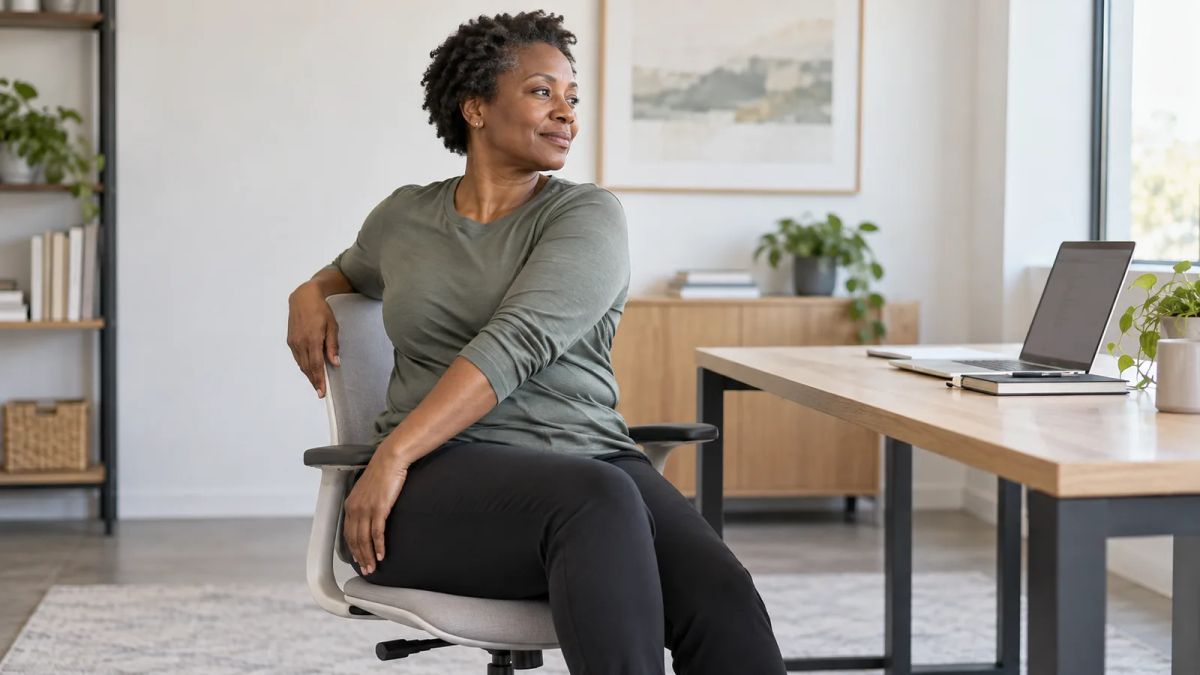
Stand up more often if you can, since standing itself uses more energy than sitting and breaks the long, unbroken hours the sitting research warns about. Take short, frequent walks with a stick, a frame or a wall to hand. Seated movement is a full option in its own right, and chair yoga gives you gentle strength and mobility work you can do from a stable chair. If you have a condition that affects how you move, ask a GP or physiotherapist what is safe for you before you change much, and let their answer set the pace.
Active travel: The quiet win
Getting from A to B is the easiest movement to hide in plain sight, because you have to do it anyway. The WHO specifically calls for making walking, cycling and other active transport part of everyday life, and swapping even one leg of a journey from a seat to your feet or a bike turns dead time into active time.
You do not have to walk or cycle the whole way. Cycle to the station and take the train. Walk the last half-mile. Do the school run on foot two mornings a week and drive the rest. A commute is a daily, repeating slot, which makes it one of the sturdiest anchors you have for movement that lasts.
How to make it stick
Knowing what to do is the easy half. The reason good intentions fade is that they float free of the day, so the way to keep everyday movement going is to pin each new action to something you already do without thinking.
James Clear calls this habit stacking, with a simple formula: "After [current habit], I will [new habit]." The current habit is the reminder. "After I put the kettle on, I will do a lap of the garden." "After I sit down for a call, I will stand up for it instead." Your existing routine does the remembering, which is the part willpower is worst at. Our guide to habit stacking walks through picking an anchor that holds.
Pick anchors you never miss, whatever the week throws at you, and keep the new action small enough to do on a bad day. Use the planner below to write one down. There is a blank version to fill in and a worked example underneath it.
My movement swap: ____________________
After I ____________________ (an anchor I never miss), I will ____________________ (a small movement).
Smaller version for hard days: ____________________
Here is one filled in:
My movement swap: Walk part of my commute.
After I get off the bus, I will get off one stop early and walk the rest.
Smaller version for hard days: Get off at my normal stop but take the stairs at the station.
If you want a menu to choose from, tick two or three of these to start, no more:
- ☐ Take the stairs instead of the lift
- ☐ Walk or pace during phone calls
- ☐ Get off a stop early, or park further away
- ☐ Stand up and move for a minute every hour
- ☐ Walk part of the school run
- ☐ Put music on and move while cooking
- ☐ Carry the shopping in over several trips
- ☐ A short walk after lunch or after dinner
Two more things are worth deciding in advance. The first is that smaller version for the days the full swap will not happen, because a shrunken version done beats a full version skipped every time. The second is your restart. Everyday movement isn't a streak you can ruin. Miss a day, or a week, and a single walk picks it back up. The gap is information about a busy week, not a verdict on you. For more on choosing and keeping habits like these, our guide to building healthy habits goes deeper, and the benefits of walking makes the case for the most useful movement of the lot.
Somewhere for everyday movement to live
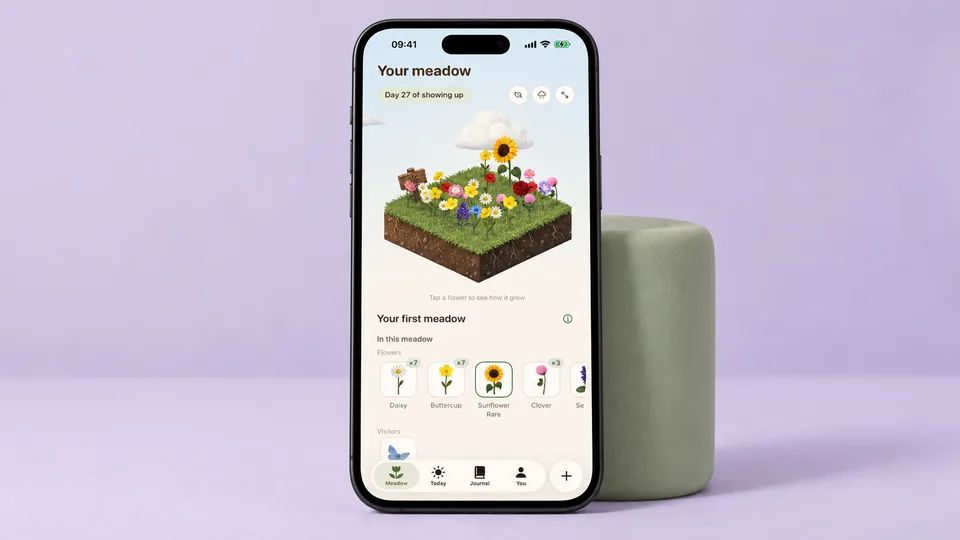
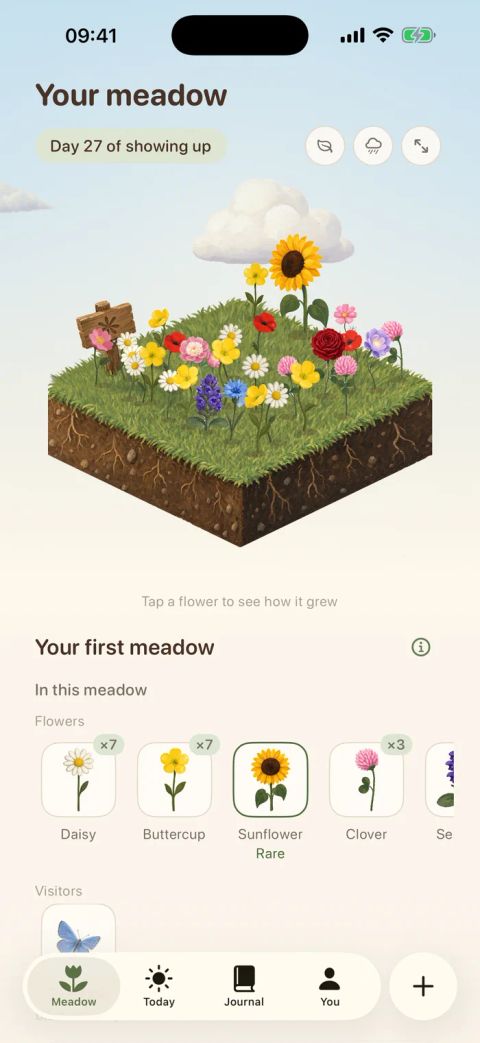
When everyday movement is the goal, Meadow gives it somewhere to live. It is a movement and habit app for iPhone from Wildcard Wellness, where you log the movement you enjoy with a timer, tick off small daily habits like drinking water or getting outside, and note your mood, energy and a daily win. Each day you move grows a wildflower in a meadow that is yours alone, and because it rewards consistency rather than a perfect week there are no streaks, so a missed day resets nothing and your flowers never wilt.
Frequently asked questions
Can you get fit without a gym?
For most everyday goals, yes. The health targets set by the WHO and CDC are written around total activity, not gym time, and walking, cycling, chores and active travel all count towards them. A gym helps with structured strength training and progression, but you can build an active life without ever joining one.
How much movement do I need?
The broad target is 150 minutes of moderate activity a week plus two strengthening days, but the more useful number is "more than yesterday". Any amount is better than none, and you can reach the total in small chunks spread across the week.
Does housework or walking the dog count?
It does. Chores, carrying, gardening and dog walks are exactly the non-exercise movement that makes up a large share of many people's daily activity. Doing them a little more briskly nudges them from light to moderate, which is where more of the health benefit sits.
What if I have an office job and sit all day?
Break up the sitting often. Standing and moving for a minute or two each hour, taking calls on your feet and using the stairs all chip away at the long unbroken hours that the sitting research links to worse outcomes. Frequency beats any single burst.
I keep starting and stopping. How do I stay consistent?
Attach each movement to an anchor you never miss, keep it small, and give it a smaller version for hard days. Treat a missed day as neutral, and pick it back up at the next anchor. Consistency comes from low friction and a forgiving restart.
One thing to do now
Pick one anchor in tomorrow's day and one small movement to follow it. Write the single line: "After I ______, I will ______." Make it something you cannot forget and cannot fail, like taking the stairs at the station or walking a lap while the kettle boils. One swap, tied to a moment you already keep, is an active lifestyle begun.
AUTHOR
Co-founder of Meadow.
Ash is co-founder of Meadow, a habit and movement tracking app that turns small acts of self-care into a growing wildflower meadow.
Little and often, with Meadow
Consistency, not intensity.
Meadow turns the movement you enjoy and the habits that help you feel good into a meadow of wildflowers. No streaks to break, and your flowers never wilt.
Download Meadow