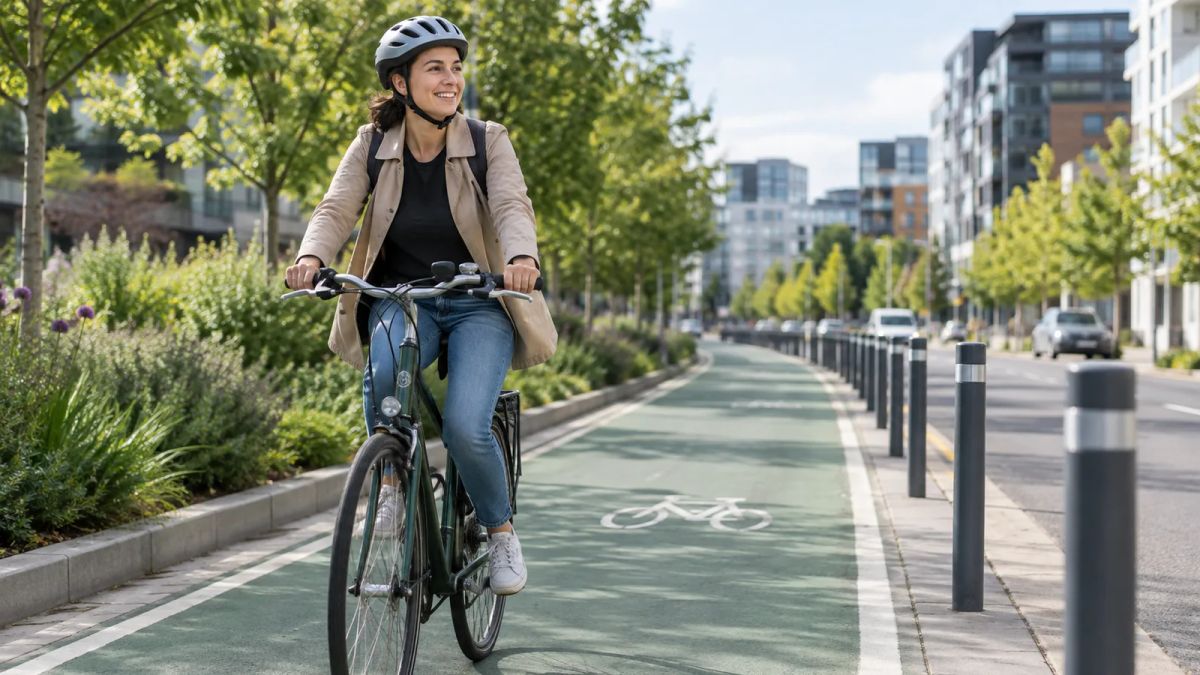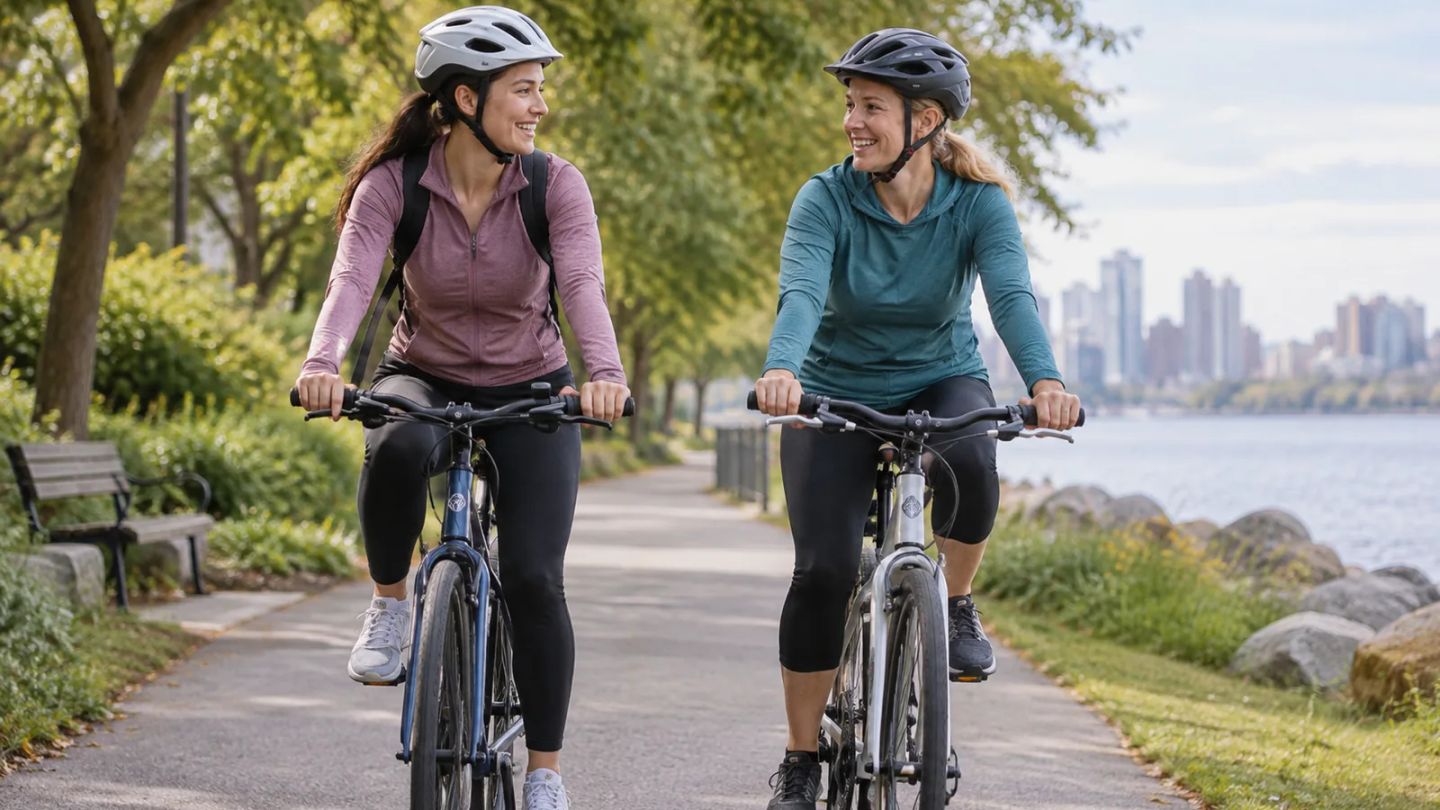
Cycling gives your heart and legs a proper workout while asking very little of your knees, which is a large part of why it suits so many women who can't or don't want to run. It fits around a school run or a commute, it holds up through the years when your hormones are changing, and the one job it won't do on its own is strengthen bone.
So this is the honest, women-specific version. What riding does for your heart and head, why the bone question needs a second kind of exercise alongside it, how a ride can shift across your menstrual cycle, in pregnancy and through menopause, how to make the saddle comfortable, how to feel safer on the road, and how to start. For the general picture beyond a women's lens, our guide to the benefits of cycling covers the rest.
Your heart, especially after 40
Before menopause, women as a group have a lower risk of coronary heart disease than men. Oestrogen is part of why. The British Heart Foundation explains that it helps control your cholesterol and slows fat building up in your arteries, and that as oestrogen falls around menopause, that protection fades and heart disease risk climbs. That is the point where a regular cardio habit earns its place.
Cycling is a straightforward way to get that cardio. Harvard Health describes riding a bike as good for your heart and muscles while putting minimal stress on your joints, and it builds the big muscles in your legs as you go. Three half-hour rides a week, or a ride to work and back, keeps your heart working without the pounding that turns a lot of women off running.
The BHF also notes that getting more active helps you keep to a healthy weight, ease anxiety and low mood, and improve your heart health. None of that is unique to women. The risk climbs in midlife, so a form of exercise you'll keep doing counts for a lot.
Kind to sore knees and hips
Here is the part that pulls in women who've been told to rest a cranky joint. Your weight sits on the saddle and the pedals instead of landing through your knees and hips step after step, so cycling is one of the few kinds of real cardio a sore knee will usually put up with.
That makes it a good option after an injury, through a flare of joint pain, or if high-impact exercise has never agreed with you. If you're weighing it against a daily walk, our piece on whether walking or biking is better for weight loss sets out how the two compare. The short version is that the best one is the one you'll do.
The bone catch worth knowing
Here is where cycling has a real gap, and it's one women should know about, because bone loss speeds up around menopause.
Cycling is non-weight-bearing. Your skeleton never takes the load of your body against the ground, and that load is the signal that tells bone to stay strong. A systematic review by Abrahin and colleagues found that cycling and swimming don't have positive effects on bone mineral density, with nine of ten studies linking heavy cycling to low bone density, and concluded that neither is a good choice for preventing osteoporosis on its own.
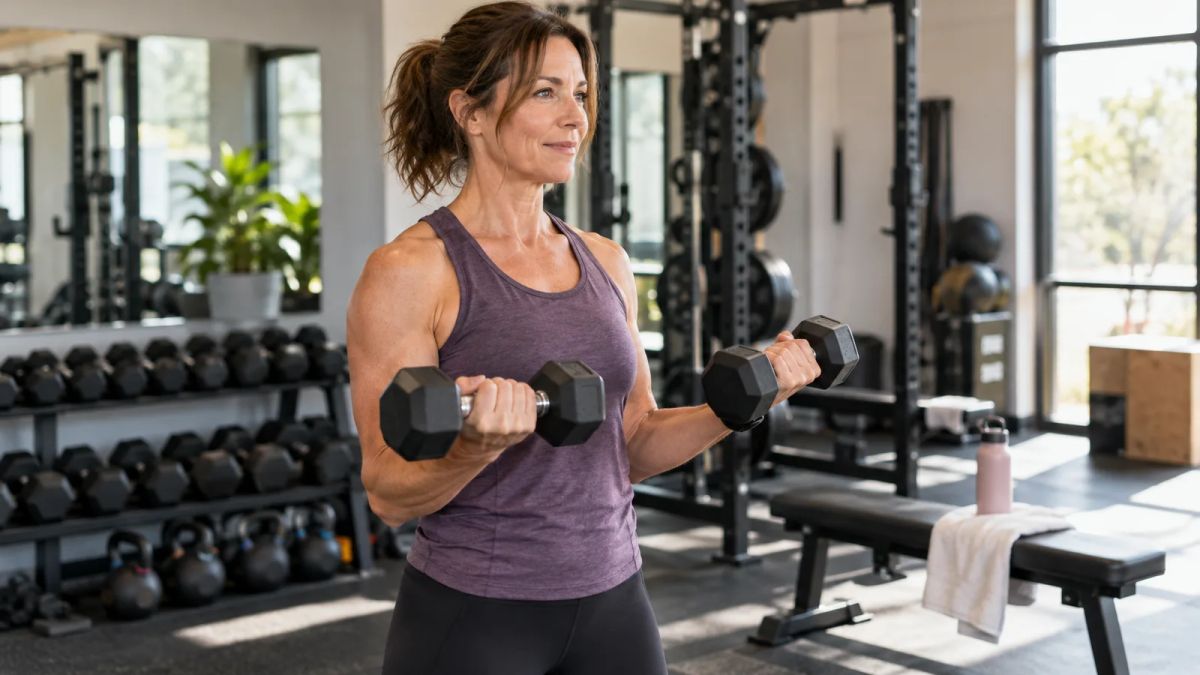
That's no reason to stop riding. It's a reason to put something weight-bearing beside it. The NHS advises focusing on weight-bearing exercise around menopause, the kind where your feet and legs carry your weight, like walking, running or dancing, plus resistance work such as lifting weights. Two short strength sessions a week, a brisk walk most days, or carrying the shopping upstairs all sit neatly beside your rides and cover the bone work cycling can't.
Mood, sleep and the mental side
A ride tends to take the edge off a rough day. The BHF lists reduced anxiety and low mood among the benefits of being more active, and says exercise can help with menopausal symptoms like broken sleep and mood swings.
Set your expectations fairly, though. A bike ride won't fix a hard week and it's no substitute for treatment when you're struggling. What it gives you is a small, repeatable thing that helps a bit. If low mood, anxiety or sleep problems hang around, talk to your GP alongside anything you do for yourself.
Riding across your menstrual cycle
Plenty of women notice their energy on the bike rise and dip across the month, and the research supports the idea that something is going on while stopping well short of a rulebook. A systematic review of menstrual cycle and performance found the effects inconclusive and highly individual, and its authors suggest tracking your own cycle instead of following a generic plan, because as they put it, "each female is different from another and does not respond similarly to training".
So the useful move is to notice your own pattern. If the days before your period leave you flat, that's a fine week for an easy spin instead of a hard push, and if you feel strong mid-cycle, use it. Jot down how each ride feels for a couple of months and you'll see your own shape, not a textbook's.
Period pain is a separate question, and here the evidence leans more clearly towards moving. A 2019 Cochrane review of exercise for period pain found that regular exercise may cut pain intensity by an amount big enough to notice, compared with doing nothing. The catch is that the evidence was low to very low certainty, mostly from small trials. Most asked women to exercise about three times a week for 45 to 60 minutes, spread across the month, using a mix from aerobic training and Zumba to yoga and stretching. A regular ride is one reasonable way to get that kind of movement in.
If period pain stops you getting on with your day, see your GP. It's worth ruling out a cause that needs treating.
Cycling while pregnant
Pregnancy doesn't automatically mean putting the bike away, but the balance question changes. The NHS lists cycling alongside horse riding and downhill skiing as activities with a risk of falling that should only be done with caution while you're pregnant. As your bump grows and your centre of gravity shifts, a wobble at a junction carries more risk.
A static bike takes the falling out of it. A 2014 comparison of pregnancy exercise guidelines from around the world found stationary cycling listed as a suggested activity in the guidance from Australia, Canada, Denmark and Spain. You get steady cardio while the saddle carries your weight.
Every pregnancy is different. Talk to your midwife or GP before you start or carry on riding, and check in again if anything changes. If you're unsure, the NHS advice is to ask your maternity team.
Cycling through perimenopause and menopause
Cycling fits this stage well. It's kind to joints that ache more than they used to, it gives you cardio at a time your heart needs the help, and you can ride at whatever pace the day allows. If perimenopause is the reason you're rethinking exercise, our guide to the best exercise for perimenopause sets out how to build a rounded week.
Carry the bone point with you here. Falling oestrogen speeds bone loss, so a woman who only ever cycles can end up short on the weight-bearing load her bones need. Ride for your heart and your head, and keep walking, dancing or a little strength work in the week too.
Getting the saddle right
Saddle pain is why a lot of women quit before cycling turns into a habit, and most of it comes down to fit, not toughness. Cycling UK's guide to saddle comfort for women has the useful detail.
Your weight should rest on your sit bones, the two bony points at the base of your pelvis, and not on the soft tissue in front. You can measure the gap between your sit bones by sitting on a piece of corrugated cardboard, marking the dents and measuring across, which gives you the saddle width to look for. A shorter saddle, or one with a central cut-out, takes pressure off the soft tissue. Set the height so that with your heel on the pedal your leg is straight at the bottom of the stroke, and try tilting the nose down a degree or two if you feel pressure at the front.
Numbness is worth taking seriously, because it's common and easy to shrug off. In a 2021 study in Sexual Medicine of 875 women who cycle, 44% reported genital numbness, and those who did had modestly higher odds of problems with sexual function. Riders with higher handlebars were less likely to report numbness, which the authors link to less pressure on the perineum. It was a one-off survey, so it can't prove cause and effect. Still, raising your bars a little is an easy thing to try.
Padded shorts help, worn without underwear so there are no seams against you, and a little chamois cream cuts friction on longer rides. Numbness or pain that doesn't settle once you've sorted the fit is worth taking to a bike shop with a proper fitter, or to your GP, so don't grit your teeth through it.
Here's a quick comfort check to run before you commit to a longer ride.
Comfortable on the bike
☐ Sit bones resting on the wide part of the saddle, not perched on the nose
☐ Saddle height set so your leg is nearly straight with your heel on the pedal
☐ Saddle nose level or tilted down a degree or two, no pressure at the front
☐ Handlebars high enough that you're not tipped forward onto the saddle nose
☐ Padded shorts on, nothing underneath
☐ No numbness after ten minutes. If there is, stop and adjust
Feeling safe and confident on the road
Worries about traffic are one reason far fewer women cycle than men, as Cycling UK points out. That worry is fair. The numbers still come down on the side of riding. A Dutch review by de Hartog and colleagues estimated that people who swapped short car trips for a bike gained around 3 to 14 months of life from the extra activity, against days or weeks lost to air pollution and accidents. That's roughly nine times more gained than lost.
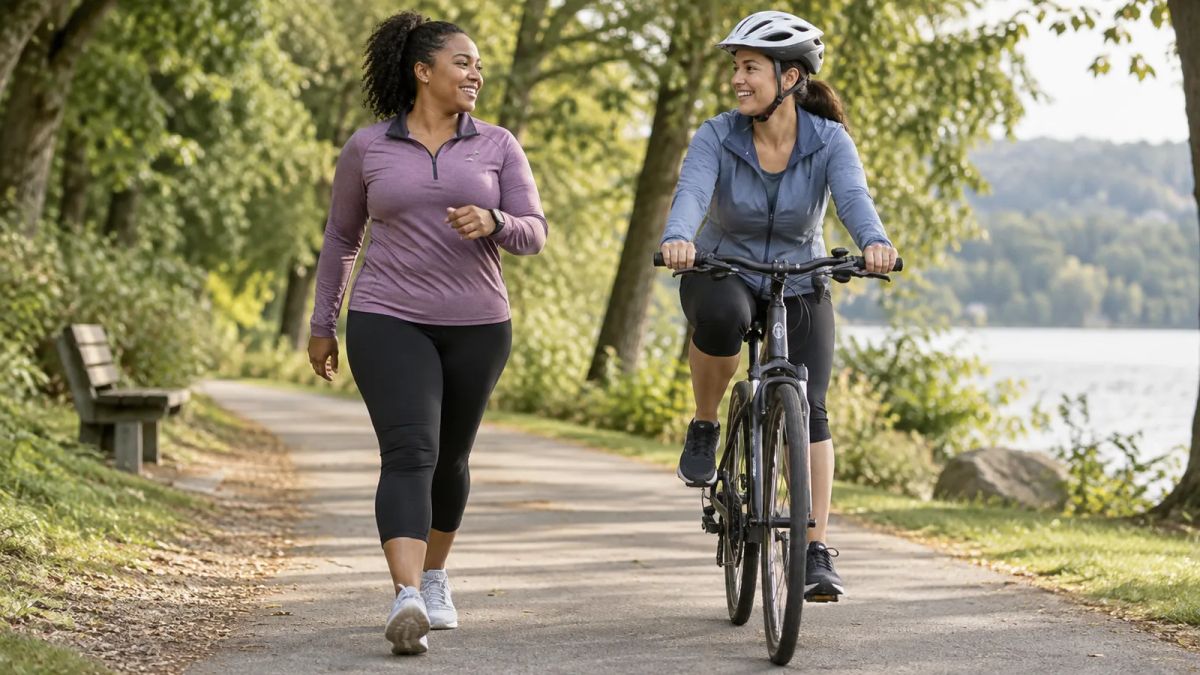
Confidence tends to build the way fitness does, a bit at a time. Start on routes you know, like a park path, a towpath or quiet back streets, at a time of day when they're calm. Ride with a friend if that helps. A local group ride or an adult cycle-skills session can make busier roads feel far less daunting once you're ready for them.
How much, and how to start
For the week as a whole, the CDC suggests at least 150 minutes of moderate activity or 75 minutes of vigorous activity, plus muscle-strengthening on two or more days. Riding on the flat counts as moderate, and pushing up hills counts as vigorous, judged by the talk test, where moderate is when you can talk but not sing. Those strengthening days are also doing your bones a favour, so keep them in.
Most new riders do too much on day one, ache for three days and quietly stop. Build up slowly instead.
- Week one: two or three easy rides of 10 to 15 minutes on flat, quiet ground, with the aim of getting comfortable on the bike.
- Week two: the same number of rides, and stretch one or two of them to 20 minutes.
- Week three: push your longest ride to 30 minutes, and try two days back to back to see how your legs recover.
- Week four: aim for three rides of around 30 minutes, one of them a little brisker.
If a week goes sideways, repeat it instead of forcing the next one.
To make the ride happen at all, tie it to something already fixed in your day. James Clear describes attaching a new action to an existing routine so the old habit becomes the cue, an approach he calls habit stacking. A short ride straight after the school drop-off asks less of your willpower than one you have to summon from nowhere.
See your rides bloom into something

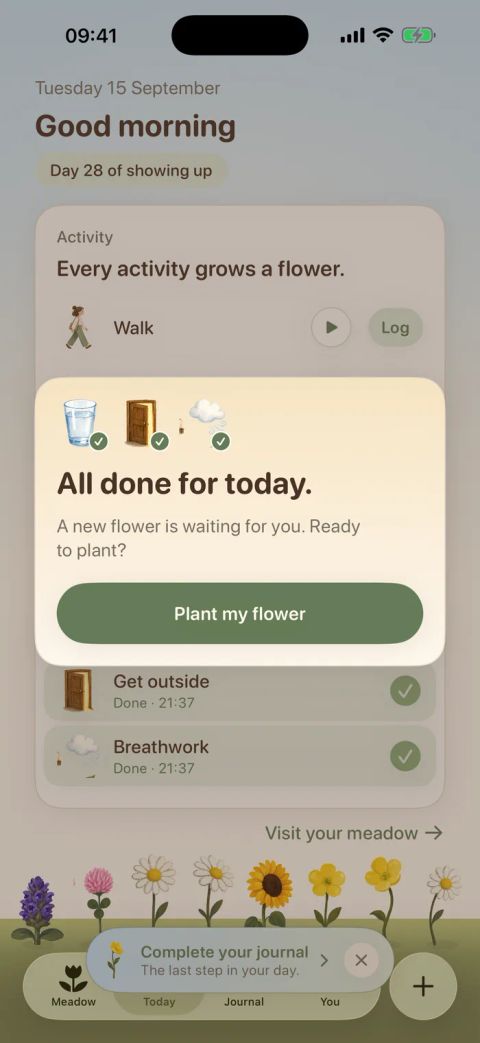
Watching the rides add up can be the thing that keeps you in the saddle, and Meadow keeps that record for you. It's a movement and habit app for iPhone from Wildcard Wellness where you log a ride with a timer, tick off small daily habits like a walk or a glass of water, and note your mood and energy, and a new wildflower blooms for each day you show up. Because it's built around showing up often, there are no streaks to protect, so a period week off the bike or a rained-off Saturday resets nothing you've grown.
For the days it doesn't happen
A gap counts for far less than you'd fear. The weather closes in, or a period leaves you wiped, and a week slips by. Take the next chance instead of trying to win back the lost rides in one heroic go.
On a stretched day, shrink the ride instead of dropping it. Ten minutes on an indoor bike, or a slow loop to the end of the road and back, keeps the habit alive on the days that would otherwise break it.
Common questions
Is cycling enough exercise for a woman on its own?
For your heart, lungs and legs, regular riding does a lot of the work, and it can carry you to the 150 minutes of moderate activity a week that health bodies suggest. The gap is bone. Because cycling is non-weight-bearing, it does little for bone density, and that becomes a bigger deal as oestrogen falls around menopause, so pair it with weight-bearing movement like walking, dancing or strength work.
Will cycling help me lose weight?
It can be one part of it, but riding alone rarely moves the scales the way people hope. Weight turns on far more than exercise, including how you eat, how you sleep, and any conditions or medication you're managing. Ride because it makes your week feel steadier and your legs stronger, and treat any change on the scales as a side effect.
Can cycling reduce belly fat?
It can help, as part of the bigger picture. Harvard Health notes that exercise can shrink your waist and reduce the deep visceral fat around your organs even when the scales don't move, while spot exercises like sit-ups firm the muscles without reaching that fat. That's relevant in midlife, because the same article explains that women tend to carry more visceral fat after menopause. You can't choose where you lose fat from, so treat regular rides as one piece alongside food, sleep and strength work.
Is 30 minutes of cycling a day enough?
For the aerobic side, it's a good target. Thirty minutes of moderate riding on five days makes the 150 minutes a week the CDC suggests. Add strength work on two days and something weight-bearing for your bones, and you've covered the main bases.
Does my saddle need to be a women's-specific one?
Not necessarily. What counts is that the saddle fits your sit bones and takes pressure off the soft tissue, and plenty of so-called unisex saddles do that well for women, while some women's saddles won't suit you. Measure your sit bones, try before you buy if a shop has a saddle library, and judge by how you feel after ten minutes in the saddle, not by the label.
I leak a little urine when I ride. Should I worry?
It's common. The NHS says urinary incontinence affects millions of people, that you shouldn't feel embarrassed raising it with a GP, and that pelvic floor exercises are one of the first things to try. A women's health physiotherapist can help with those too. It isn't something you have to put up with, and it needn't stop you riding in the meantime.
One thing to do today
Pump up the tyres, spend two minutes setting the saddle height so your leg is nearly straight with your heel on the pedal, and ride 10 minutes round quiet streets with no target. That's a cycling habit starting, and a comfortable one.
AUTHOR
Co-founder of Meadow.
Ash is co-founder of Meadow, a habit and movement tracking app that turns small acts of self-care into a growing wildflower meadow.
Every little bit counts
Five minutes counts. So does a dance in the kitchen.
Log the movement you enjoy and the small habits that help you feel good, and watch them bloom into something you can see.
Download Meadow