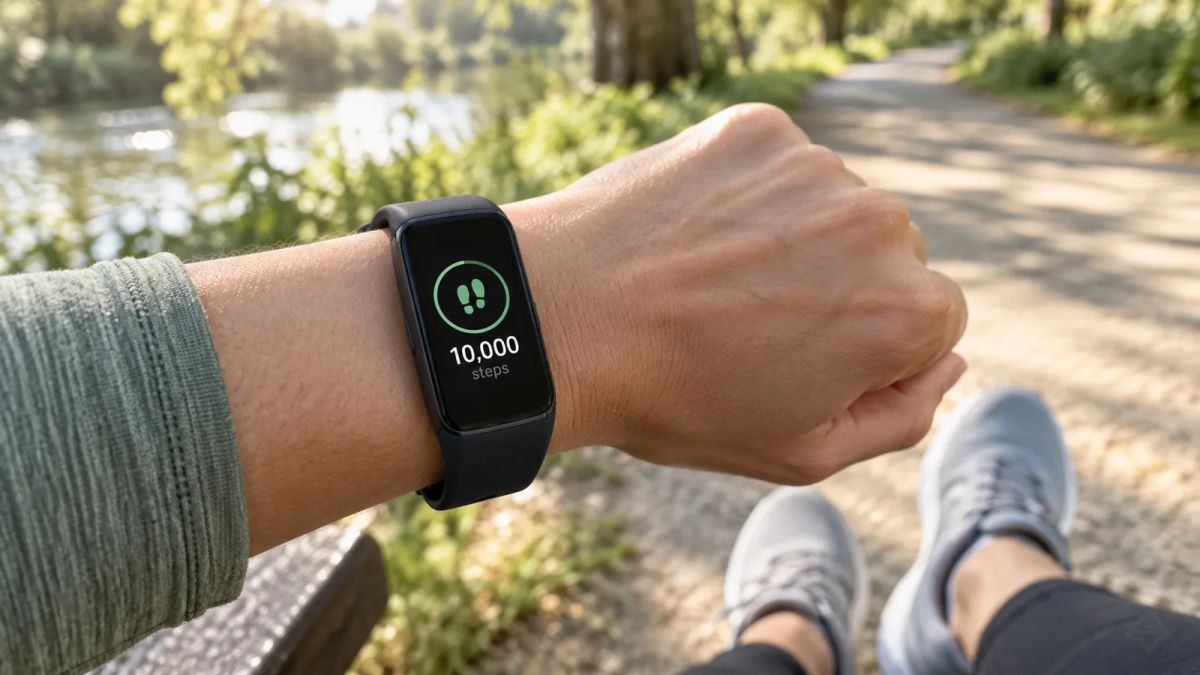
Ask how many steps a day you need for good health and the honest answer is that there is no single number your body requires. What the research keeps showing is more reassuring than any target: the health gains from walking start well below 10,000 steps, they climb fastest when a fairly inactive person begins doing a bit more, and they level off rather than rewarding you forever for a higher tally. A sensible daily figure is one built a step above what you already do, not one borrowed from a headline.
That reframes the whole question. Instead of hunting for a magic total, it helps to know roughly where the benefits appear, how they shift with age, and how to pick a number you can hit most days.
What the evidence says about steps and health
The most useful finding is how early the benefits begin. A large study summarised by Harvard Health found that people walking as few as 2,200 steps a day had lower odds of heart disease and early death than those who moved less. That is a long way short of 10,000, and it matters most for anyone starting from very little.
The gains build from there, then flatten. UCLA Health describes a cardiovascular sweet spot of roughly 2,800 to 7,100 steps a day, and notes that people managing around 8,000 steps were about half as likely to die during the studies as those at 4,000. Notice the shape of that. Doubling from very low to moderate does a lot, while pushing far beyond adds less and less.
A few caveats belong with any step number. Most of this evidence is observational, which means it can show that more steps went hand in hand with better health without proving the steps alone caused it. People who walk more tend to differ in other ways too. The numbers also come from groups, not from you, so treat them as a direction of travel rather than a personal prescription. The pattern they point to is steady and undramatic. More movement beats less, the biggest wins come early, and there is no cliff edge where a missed thousand steps undoes your health.
Other figures circulate and deserve the same care. A 2026 systematic review of structured lifestyle programmes found people averaging around 8,500 steps a day, but the authors were plain that this is "hypothesis-generating rather than prescriptive". Those programmes changed diet and activity together, so the walking figure cannot be lifted out and read as a dose.
How many steps a day by age
Here is where a flat 10,000 target stops making sense. Your age shapes where the benefits level off, and that changes what a good number looks like for you.
A meta-analysis led by Amanda Paluch, pulling together 15 international studies and nearly 50,000 people, mapped this out clearly. Reporting on the work, the UNC Gillings School of Global Public Health explains that for adults aged 60 and over, the risk of early death levelled off at around 6,000 to 8,000 steps a day. For adults under 60, it settled at roughly 8,000 to 10,000. More steps beyond those points did not add much for longevity.
The size of the effect is worth holding onto. Across the more active groups, EurekAlert's summary of the same study reports a 40 to 53 percent lower risk of death compared with the least active. That is a meaningful gap, and it opens up at step counts most people can reach.
So an older adult chasing 10,000 may be working hard for benefits that arrived a few thousand steps earlier, while a younger adult has a little more headroom before the returns flatten. Neither number is a pass mark. They are guides to where "enough for health" tends to sit, and both are lower or more flexible than the round figure everyone quotes.
Why 10,000 was never a health rule
The 10,000 target is sticky because it is memorable, not because a lab landed on it. It traces back to a 1960s marketing campaign for a Japanese step counter rather than to research, and the walkable evidence since then points to lower, age-dependent numbers. If you want the fuller story, we cover it in 10,000 steps a day.
The deeper problem with any fixed goal is that people differ. The CDC puts it plainly, noting that the amount of activity a person needs "varies greatly from person to person". A number that suits a fit 40-year-old may be out of reach for someone returning to activity, and unnecessary for someone in their seventies. That is an argument for a personal figure, not a universal one.
Steps, or minutes? What the guidelines measure
British health advice mostly sidesteps step counts and talks about time and effort instead. The NHS suggests adults aged 19 to 64 aim for at least 150 minutes of moderate activity a week, or 75 minutes of vigorous, plus strengthening on two or more days. Brisk walking counts as moderate, and a step counter cannot tell how hard you were working, which is why effort belongs in the picture alongside the tally.
That is not a rival system so much as the same idea in different units. Whether you count 7,000 steps or 30 brisk minutes, you are aiming at regular movement your body notices. Ten brisk minutes that barely dents a step total still counts.
If you are returning to activity after a long break, are pregnant, or have a health condition or any concerns, it is worth speaking to your GP before you build up. A general target cannot account for your particular situation, and a short conversation can set a starting point that fits you.
Setting a sensible number for you
The number that helps is the one you can repeat. Start from what you already do rather than a target off a screen. If your phone counts steps, look back at a normal week and find your rough average across a busy day and a quiet one.
Then set your aim a modest step above that baseline. Someone averaging 3,000 steps will get more from a realistic 4,500 than from an 8,000 goal abandoned by Wednesday. Someone already near 6,000 might edge towards 7,000 or 8,000, comfortably inside the healthy range for their age. The direction matters more than the roundness of the figure. For a fuller method of finding and nudging that baseline, we walk through it in how many steps a day should I walk.
Think about where the extra steps come from before you commit, because a target only sticks if it fits your real day. A loop of the block after lunch, one bus stop earlier, a walk to the postbox, pacing the kitchen while the kettle boils. Weather, safety after dark, caring duties, a body that aches and shift work all shape what is possible, so choose the version that survives an ordinary week. If your goal is losing weight rather than general health, the balance shifts towards diet and effort, which we cover in how many steps a day to lose weight.
Smaller on hard days, and starting again after a gap
Some days your target will be too much, and that is worth planning for. Keep a smaller version ready. If your aim is 6,000 and the day collapses, walk to the end of the road and back, or step outside for three minutes. A short walk logged as a short walk keeps the habit alive in a way a blank day does not.
Miss a day, or a week, and the walking still counts when you pick it up. There is no debt to repay by doubling your steps tomorrow. Take the next reasonable chance and carry on at whatever figure fits.
Meadow, without the streak

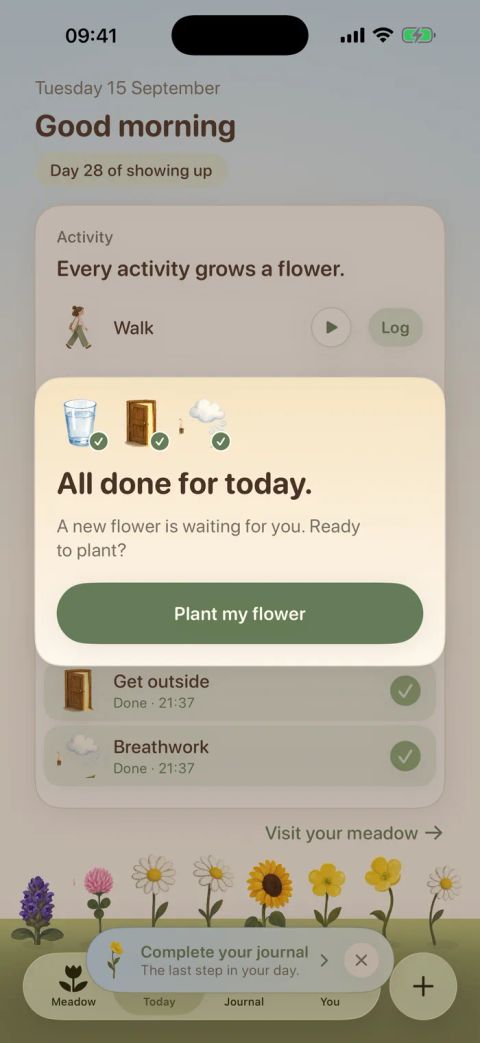
Marking each walk gives you something honest to look back on, which tends to help more than staring at one daily figure. A tick on a wall calendar does the job. Another app worth checking out is Meadow, because it is built for a habit measured over weeks rather than perfect days. It is a gentle habit tracker for iPhone from Wildcard Wellness. You log movement you enjoy, a walk, a dance, a little yoga, tick off small daily habits like drinking water or getting outside, and note your mood, a daily win and an affirmation. Every day you show up grows a wildflower, with rare flowers and little animal visitors turning up over time. There are no streaks, so a missed day resets nothing and your flowers never wilt. Meadow costs $39.99 a year or $9.99 a month after a seven-day free trial.
Common questions
Is 10,000 steps a day bad for you?
No. For most people 10,000 is a fine and healthy amount. The point is that it is not a required minimum, and the main health benefits appear well before it, so treating it as a pass or fail mark is misleading rather than harmful.
How many steps a day is considered active?
There is no official line, but research often treats the least active groups as those around 3,000 to 4,000 steps a day, with clear benefits appearing as people move into the 6,000 to 8,000 range. For general health, landing somewhere in that middle band most days is a reasonable read of "active".
Do steps have to be brisk to count?
Every step counts towards your total, and the Paluch analysis found step count mattered more than pace once the total was accounted for. That said, brisk minutes add value a raw count cannot see, which is why UK guidance leans on 150 minutes of moderate effort. A mix of gentle and brisk walking is fine.
Is walking enough on its own?
Walking does a lot, but the guidelines also ask for muscle-strengthening activity on two or more days a week. Steps and strength work cover different needs. If you want the wider case for a daily walk, see the benefits of walking.
For your first step this week, check your typical daily count, then set an aim a little above it that sits inside the healthy range for your age. That is a walking habit starting from your own week rather than a number off a screen.
Every little bit counts
Five minutes counts. So does a dance in the kitchen.
Log the movement you enjoy and the small habits that help you feel good, and watch them bloom into something you can see.
Join the Meadow waitlist