Building a healthy habit around a full life comes down to one small action, tied to something you already do, kept going after the days you miss. That is the whole method, and everything below fills it in. The harder part is choosing well and keeping the action small enough to survive a bad week, which is where most good intentions quietly come apart.
If you have started before with a long list and watched it fade by the third week, willpower was rarely the problem. A list of five new things asks for five new decisions every day, and a packed day has no room for that. One action tucked inside a routine you already keep asks almost nothing of you.
This guide covers what makes a habit stick, a menu of high-value habits worth your attention with the honest state of the evidence for each, how to begin one without rebuilding your life, what to do when it slips, and the smaller version and the restart that keep it alive.
What makes a habit stick
Three things do most of the work: a clear cue, a small action, and one habit at a time. The rest is detail.
A cue is the trigger that tells your brain the action is due. The most reliable cue is a routine you already run without thinking. James Clear calls this habit stacking, with a plain formula: "After [current habit], I will [new habit]." The American Heart Association gives the same advice on making habits stick, tying a new behaviour to an established one so the old routine becomes the reminder. Your existing day does the remembering for you.
Pick the anchor from the things you never miss, whatever the week throws at you. Filling the kettle. Sitting down at your desk. Picking up your keys. Giving a child their tea. "After I do X" holds up far better than "at 2pm" when your days tend to move around.
Then make the action small. Not small as a warm-up to something bigger, but small enough to do on your worst day. A glass of water. A five-minute walk. A single stretch before you sit down. A habit you can manage when you are tired, late and out of patience is a habit that survives, and you can always do more once the small version is steady.
Start with one. One is easier to remember, easier to fit around shift work or caring for someone, and easier to forgive when it slips. There is no scientific limit on how many habits a person can hold, and stacking more comes later, but a single action is the one you can keep honest while the rest of your life carries on unchanged. If you want the mechanics in more depth, we have a fuller piece on tiny habits.
A menu of habits worth your attention
Here are high-value habits across movement, food and drink, sleep, and mind, with the honest state of the evidence for each. You are choosing one to begin, not adopting the list.
Move a little, most days
The single most useful movement habit is the one you will repeat. Official guidance sets the target high: the CDC recommends 150 minutes of moderate activity a week plus two muscle-strengthening days, which is a real goal to build towards rather than a starting line. The line worth holding on to is the CDC's own: some activity is better than none, and any amount brings some benefit.
That is what makes a short walk after lunch such a good first habit. Lunch happens most days, so the anchor is sturdy, and a brisk few minutes still counts. Walking has a deep evidence base behind it for heart health, mood and weight, which we cover in the benefits of walking. If you are returning to exercise after a long gap or you live with a health condition, a word with your GP before you raise the intensity is sensible.
Eat one thing better
Trying to overhaul your whole diet at once is the surest way to keep none of it. Change one thing. Add a piece of fruit or a handful of vegetables to a meal you already eat.
The evidence here is strong on direction, careful on promises. The WHO advises at least 400g of fruit and vegetables a day to lower the risk of diet-related disease. Harvard's Nutrition Source points to a large cohort study in which people eating the most produce were around 30% less likely to have had a heart attack or stroke than those eating the least. That is an association from observational data, not a guarantee that one extra apple changes your odds, but the pattern is consistent enough to be worth building towards.
Water is the other easy win. The NHS suggests six to eight cups or glasses of fluid a day, and tea, coffee and lower-fat milk all count. A glass after you brush your teeth is a clean place to start, and we have a whole guide on drinking more water if that is your one.
Protect your sleep
Sleep is the habit that makes every other habit easier, and the one busy people cut first. The CDC recommends seven or more hours a night for adults. Duration matters, but the habit you can build is a consistent wind-down: a fixed-ish bedtime, screens set down a little earlier, the room dark and cool.
Anchor it the same way you would anything else. "After I put the kids to bed, I set my alarm and put my phone on the far side of the room." Small, repeatable, and pointed at the thing you control, which is the routine around sleep rather than sleep itself.
Steady your mind
A minute of slow breathing, a short walk without your phone, a line in a gratitude note. These are low-cost habits with a gentler evidence base, and it is worth being straight about that. The NCCIH's review of meditation and mindfulness finds they can help with stress and anxiety and work about as well as some standard therapies, while noting much of the research is preliminary and the long-term effects are less clear.
Treat these as small, pleasant additions rather than treatments. If you want something structured, breathwork gives you a few simple patterns to try after a fixed daily moment like sitting down at your desk.
How to start one without overhauling your life
Choose a single habit from the menu, name it precisely, and set up the easy version in advance.
Precision is what turns an intention into a habit. "Eat healthier" leaves you guessing. "One piece of fruit with my breakfast" gives you a clean yes or no and a fixed place to put it. Write your habit as a single sentence in the form below.
My habit: ____________________
After I ____________________ (your anchor), I will ____________________ (your small action).
Easy-version setup: ____________________ (what I prepare the night before)
Here is one filled in:
My habit: Drink a glass of water in the morning.
After I brush my teeth, I will drink the glass of water waiting by the sink.
Easy-version setup: Fill the glass and leave it by the toothbrush the night before.
That last line matters more than motivation, which comes and goes and tends to vanish on the days you needed it. A habit that leans on feeling keen is fragile. A habit that leans on a glass already poured, or shoes already by the door, is far harder to skip.
When it slips: troubleshooting
Most habits do not fail dramatically. They erode. Here are the common failure points and what to change.
- You keep forgetting. The cue is weak. Move the habit to a stronger anchor, one you never miss, and put a physical reminder in its path.
- You remember but skip it. The action is too big. Shrink it until the small version feels almost too easy, then let that count.
- It works for a week then fades. You added too many at once, or the anchor moves around. Drop back to one habit and pin it to a fixed daily moment.
- You dread it. Swap it. A walk you enjoy beats a workout you avoid. Movement you like is movement you repeat.
- Weekends break it. Give it a weekend-shaped version and a weekend anchor, because your Saturday routine is not your Tuesday one.
Two decisions made in advance will save more habits than any amount of resolve.
The first is your smaller version. Every habit needs an easier setting for the days the full one will not happen. If the plan is a ten-minute walk, the smaller version is once around the block. If it is a full glass of water, it is a few sips. Give it a name so your record stays truthful, and let it count. A smaller version done beats a full version skipped, every time.
The second is your restart. Habits rarely die from one missed day, they die from the story we tell ourselves about it. A well-known habit-formation study followed people repeating a daily action over twelve weeks and found that missing a single opportunity did not derail the process. The same work found habits took very different lengths of time to feel automatic from one person to the next, so there is no fixed number of days at which yours is guaranteed to click. Miss a day, keep your earlier marks, and pick the habit back up at the next anchor. The gap is information, not a verdict.
Track it so you can see it working
A small record does two things. It shows you what is happening rather than leaving you to guess, and it hands you a quiet moment of "done" each time you mark it. There is decent evidence for the effect: a meta-analysis of 138 studies found that prompting people to monitor progress towards a goal improved how often they reached it. Those studies covered many different goals, so this is a consistent direction rather than a promise about any one chart.
You can keep it on paper. One row per week, one box per day, marked with a tick.
Habit: A glass of water after I brush my teeth
Mon ☐ Tue ☐ Wed ☐ Thu ☐ Fri ☐ Sat ☐ Sun ☐
The format matters far less than the habit of keeping it. A wall calendar, a notebook by the kettle, or an app all do the same core job. Use the one you will look at again without having to remember to.
Meadow, without the streak
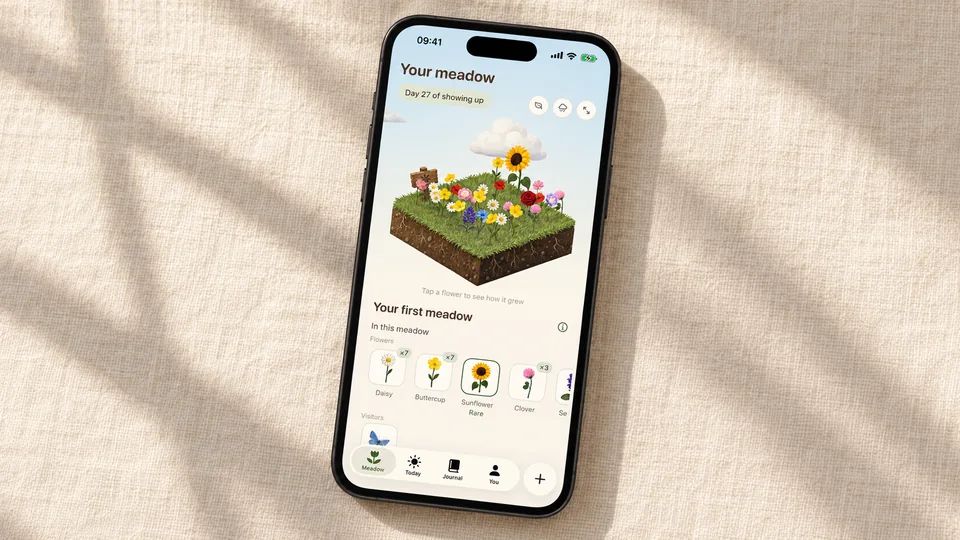
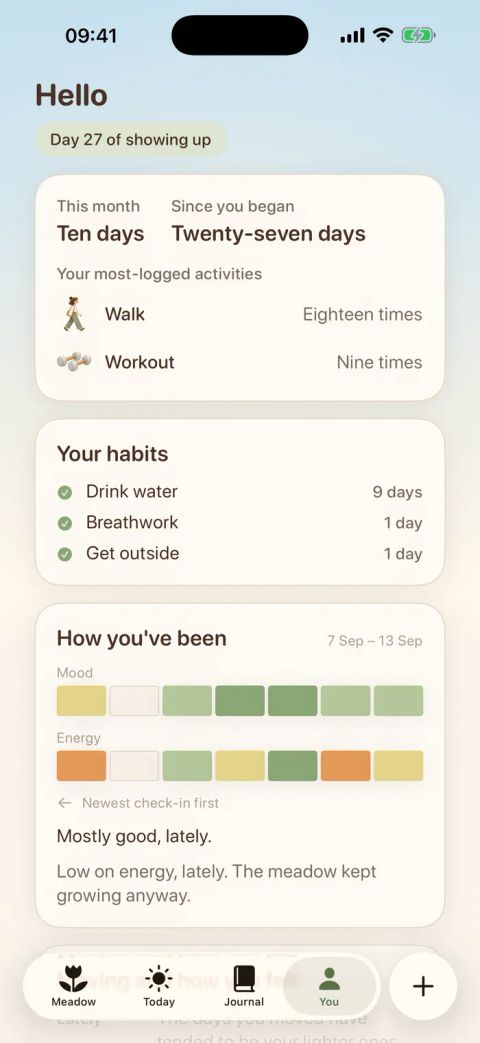
If your record lives better on your phone, another app worth checking out is Meadow, because it is built around picking a habit back up rather than punishing a gap. It is a gentle habit tracker for iPhone from Wildcard Wellness. You log movement you enjoy, a walk, a dance, a little yoga, alongside small daily habits like drinking water or getting outside, and you can note your mood, a daily win and an affirmation. Every day you show up grows a wildflower, with rarer flowers and small animal visitors appearing over time. There are no streaks, so a missed day resets nothing and your flowers never wilt. Meadow costs $39.99 a year or $9.99 a month after a seven-day free trial.
Frequently asked questions
How many habits should I start at once?
One. A single action is the one you can keep honest while the rest of your week runs as normal. Add the next only once the first feels automatic.
How long does it take to form a habit?
There is no reliable universal number. The research most often quoted found a wide range from person to person and habit to habit, so treat any single figure with suspicion and judge by whether the action is getting easier, not by a date on the calendar.
What if I miss a day?
Keep your earlier marks and restart at the next anchor. One missed day does not undo the habit, and the evidence suggests a single lapse does not derail formation. The risk is the story you tell yourself, not the gap itself.
What is the best time of day for a new habit?
Whenever your anchor is most reliable. Morning suits habits you can protect before the day fills up, but a sturdy after-lunch or after-work cue beats an ambitious morning one you keep skipping.
Which healthy habit should I pick first?
The one you will repeat. A small movement, food, water, sleep or breathing habit all pay off, so choose the one that fits your day with the least friction rather than the one that sounds most impressive.
One thing to do now
Write one sentence: the small habit you will add, and the everyday moment it will follow. "A glass of water after I brush my teeth." "A short walk after lunch." Then set up the easy version for tomorrow, the glass poured or the shoes by the door, so your first attempt is already waiting. That single line, anchored and ready, is the habit begun.
See how far you've come
Your habits, moods and little wins, all in one place
Meadow keeps track of the walks, the water and the good days, so you can look back and watch your effort add up.
Join the Meadow waitlist