Habit stacking is a way to build a new habit by attaching it to one you already do, using a plain formula: after I [current habit], I will [new habit]. The habit you already have becomes the reminder, so the new one doesn't lean on you remembering it or feeling motivated on the day.
The term comes from James Clear, who wrote Atomic Habits, and the idea underneath it comes from BJ Fogg's Tiny Habits work, where the same move is called anchoring. Clear credits Fogg directly: your old habit acts as an anchor that holds the new one in place.
Most advice about new habits tells you to dig up more discipline. Habit stacking takes a different route. It borrows a trigger you already own, so the awkward part, remembering to start, is handled before you begin.
What habit stacking is
The formula is one sentence: after [current habit], I will [new habit]. You can run it as "before" when that fits the day better, but "after" is the version most people use.
Clear's own example is "after I pour my morning cup of coffee, I will meditate for sixty seconds." The coffee is the anchor. The meditation is the new habit riding along behind it.
The word Clear keeps returning to is specific. A vague plan like "I'll meditate more" has no moment to live in, so it drifts to a later that never comes. "After I pour my coffee" points at an exact event, which is why he warns that "many people select cues that are too vague." His fix is blunt: name the precise action. After I close the door. After I brush my teeth. After I sit down at the table.
This sits close to the tiny habits method, and the two overlap on purpose. Tiny habits is mostly about shrinking the new behaviour until it's almost too small to skip, then celebrating it. Habit stacking is about the join, the routine you bolt the new action onto. In practice you often use both together: a small action, anchored to something solid.
Why anchoring to an old routine works
A habit you've done for years runs on its own. You don't decide to brush your teeth, you find yourself doing it the moment you walk into the bathroom. That automatic quality is the thing habit stacking borrows.
Research on how habits work explains why it holds. Wendy Wood and David Neal describe habits as responses that get triggered by the context cues that were present when you did the behaviour before: the place, the time of day, the action that came right ahead of it. Once a habit is set, the cue fires the response directly, without you having to want it or plan it.
An established routine, then, is a reliable cue you already own. When you stack a new habit behind it, you plug into a signal that turns up every day whether you're in the mood or not. No phone alarm, no spare scrap of motivation, because the old habit hands you the prompt for free.
This is also why an anchor beats a clock time. "At 8am" depends on you clocking the time and being free at that exact minute. "After I make my morning tea" happens whenever the tea happens, so it survives a day that starts late or runs sideways.
How to build your first stack
List the things you already do every day without fail. Not the things you mean to do, the ones that happen anyway: making coffee, letting the dog out, sitting down at your desk, brushing your teeth, putting the kettle on after work. Those are your candidate anchors.
Pick one and write a single line.
After I ________, I will ________.
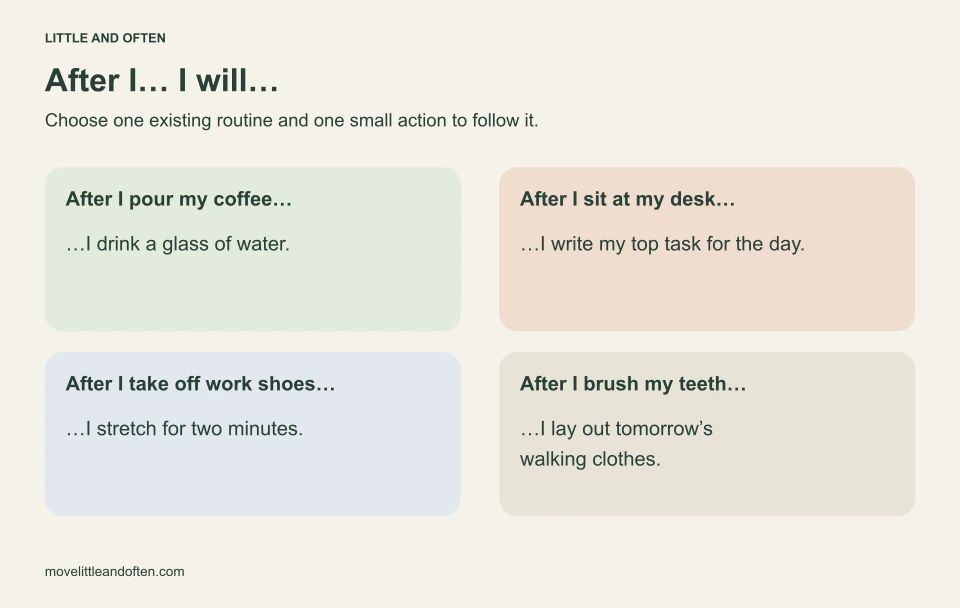
The first blank is the anchor. The second is the new habit, kept small enough that a rushed day can't crowd it out. Here are a few filled in across an ordinary day:
After I pour my morning coffee, I will drink one glass of water.
After I sit down at my desk, I will write my top task for the day.
After I take off my work shoes, I will do two minutes of stretching.
After I brush my teeth at night, I will lay out tomorrow's walking clothes.
Two things make an anchor hold. It has to happen every single day, and it needs a natural gap right after it for the new action to fit. Brushing your teeth works. "After I check my email" doesn't, because you check email twenty times a day and none of them is one clear moment.
The start of the day is full of ready-made anchors, which is why a morning routine is such fertile ground for stacking. You wake, you make a drink, you wash, you sit down, all in a fixed order you barely think about.
Once one stack runs by itself, you can chain another behind it. Clear calls the longer version a habit chain: after the first new habit, a second, then a third, each one cueing the next. A morning chain might read: after I pour my coffee, I drink a glass of water, then I take my vitamins, then I write my top task. Build it one link at a time, and only add the next when the one before it runs without thought. If keeping any single habit going is the sticking point, our guide to staying consistent digs into that.
On a hard day, shrink it
Decide now what the habit looks like on a day when you've got nothing left. If your stacked habit is two minutes of stretching, the bad-day version might be one stretch on the floor. If it's writing your top task, it might be one word. A tiny version keeps the join intact, and the join is what you're building: the link between the old cue and the new response strengthens only if you keep firing it.
If you miss, pick it up at the next cue
Missing a day isn't the failure it feels like. Data from a real-world habit study found that a single missed day had little effect on how automatic the behaviour eventually became. One gap doesn't break a stack. What breaks it is dropping the anchor and never coming back. The next time the cue rolls round, the coffee, the teeth, the kettle, do the new habit again. The cue is still there, waiting.
How habit stacking relates to implementation intentions
Habit stacking has a close cousin in psychology called an implementation intention, and it's worth knowing because the evidence behind it is strong.
An implementation intention is an if-then plan: if situation y arises, then I will perform behaviour z. You decide in advance exactly when and where you'll act, which is the same trick habit stacking uses, only stated as if-then instead of after-I.
The numbers are what make it worth borrowing. A meta-analysis by Peter Gollwitzer and Paschal Sheeran pooled 94 studies and found that forming these if-then plans had a medium-to-large effect on reaching goals, a Cohen's d of about 0.65. Fixing the precise moment you'll act, ahead of time, beats a general intention to get to it at some point.
Habit stacking is an implementation intention with the "if" set to an existing habit. In place of "if it's 8am" you use "after I pour my coffee", which gives you a cue already wired in rather than one you're still trying to notice. That's the small edge stacking has over a plain if-then plan: the trigger is a behaviour you never skip.
The American Heart Association gives the same advice in plainer words, suggesting you attach a new action to a routine you already have so it rides along on something automatic.
Common mistakes
- Stacking too much at once. The quickest way a stack collapses is loading four or five new habits onto one anchor on day one. Your attention splits, you forget half of them, and by Thursday the whole thing has quietly folded. Add one, let it settle, then add the next.
- Choosing a weak anchor. If the anchor only happens some days, or has no clear single moment, the new habit slips. "After I get home" is fuzzy, because getting home is a stretch of twenty minutes with no fixed point. "After I hang up my keys" is one action at one moment.
- Anchoring to something with no gap after it. If you rush straight from one thing into the next, there's no room for the new action to land. Pick a cue that ends in a natural pause.
- Making the new habit too big. A stack works when the new action is small enough to do on autopilot. "After I sit at my desk, I will do a full workout" won't hold for long. Keep the stacked habit light, and let it grow on its own on the days you've got more in you.
See the stack build up

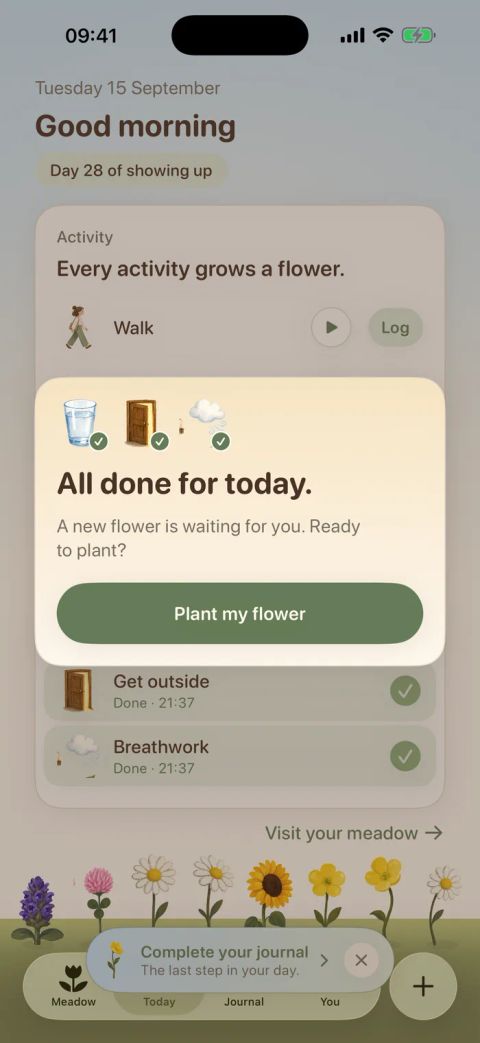
If you'd like the new habit somewhere you can see it, Meadow gives each stacked action a home on your phone. You tick off small daily habits as you do them, log a bit of movement, and note your mood and energy, and every day you show up grows a wildflower in a meadow that's yours alone. It's built for turning up over perfect weeks, so there are no streaks to break, and a missed day never wipes out what you've grown. A stacked habit you can barely feel yourself doing slowly turns into something you can watch fill in.
A few common questions
How many habits can I stack together? Start with one new habit on one anchor. Once it runs without effort, add a second behind it. There's no hard cap on a chain, but long chains are fragile, so grow them slowly.
What makes a good anchor? Something you already do every single day, at a specific moment, with a natural gap right after it. Brushing your teeth, making your first coffee, sitting down at your desk. Steer clear of anything that only happens now and then.
How long before the stacked habit feels automatic? There's no honest fixed number. A real-world study put the average nearer ten weeks, with a range running from about 18 days to well over 200, and simpler actions bedded in sooner. Judge yourself by whether you're still turning up at the cue, not by whether it has clicked yet.
Does one missed day ruin the stack? No. A single gap has little effect on how automatic the habit becomes. Come back to it at the very next cue and carry on.
Right now, pick one thing you already do every morning without fail and write a single line: after I [that habit], I will [one small new action]. Put it where the anchor happens, a note by the kettle or on the bathroom mirror, and run it tomorrow when the cue comes round.
AUTHOR
Co-founder of Meadow.
Ash is co-founder of Meadow, a habit and movement tracking app that turns small acts of self-care into a growing wildflower meadow.
Every little bit counts
Five minutes counts. So does a dance in the kitchen.
Log the movement you enjoy and the small habits that help you feel good, and watch them bloom into something you can see.
Download Meadow