A sedentary lifestyle means spending most of your waking hours sitting or lying down with very little movement, whether that's at a desk, in the car, or slumped on the sofa. The part that catches people out is that sitting time gets counted separately from exercise. You can run at six in the morning and still spend the rest of the day sedentary.
That's the awkward bit. Ticking the exercise box and sitting for ten hours are not opposites, and doing the first doesn't cancel the second.
This guide covers what counts as sedentary, the health risks the research links to it and where that research stops short of proof, the more cheerful finding that scattered movement offsets a good chunk of the damage, and a handful of ways to sit less that survive a normal working week.
What counts as sedentary
The technical definition is narrower than "not exercising". The Sedentary Behaviour Research Network defines sedentary behaviour as any waking behaviour that burns very little energy while you're sitting, reclining or lying down, formally 1.5 metabolic equivalents or below. In plain terms, that's most of what you do at a desk, on the sofa, in the driver's seat and scrolling your phone.
Standing still sits right on the edge of it. The moment you're up and pottering about, refilling a glass or wandering to a colleague's desk, you've stepped out of the sedentary zone and into light activity.
How much of the day does this add up to? The NHS reports that many UK adults spend more than seven hours a day sitting down across work, travel and leisure, and that people aged 65 and over are the most sedentary of all, often sitting or lying for ten hours or more. Cleveland Clinic puts the threshold for a sedentary lifestyle at roughly four to six hours of cumulative sitting or lying down a day. Most desk-based days clear that before lunch.
You can exercise and still be sedentary
Here's the distinction worth getting straight, because it's the one most articles skate over.
Physical inactivity and sedentary behaviour are two different things. Physical inactivity means not hitting the recommended amount of exercise. Sedentary behaviour is about how much of your day you spend sitting, and the two don't cancel out. A shop assistant on their feet all shift might do no formal exercise yet rack up very little sitting time. An office worker who cycles hard at the weekend might hit every activity target going and still sit through the entire working week.
The NHS is blunt about it: you can hit your weekly activity target but still be at risk of ill health if you spend the rest of the time sitting or lying down. The gym session is good for you. It doesn't buy back the eight hours in the chair either side of it.
How much movement it takes to properly offset a lot of sitting is a high bar. A meta-analysis led by Ulf Ekelund pooling data from more than a million people found that about 60 to 75 minutes of moderate activity a day seemed to eliminate the raised risk of death linked to long sitting. That's an hour of brisk walking or similar, every day, which is far more than most people manage. Below that, activity helps but doesn't wipe the slate clean.
The health risks, and what the research can and can't say
Sedentary time keeps turning up alongside some serious conditions. The World Health Organization notes that higher sedentary time is associated with increased mortality, cardiovascular disease, cancer and type 2 diabetes in adults. The NHS links prolonged sitting to heart disease, stroke, type 2 diabetes and weight gain. Cleveland Clinic adds a connection to depression and to certain cancers.
Read that list carefully, though, and hold onto the word "associated". Most of this evidence is observational. It watches large groups over years and notices that the people who sit most tend to fare worse, but people who sit for ten hours a day often differ from those who don't in dozens of other ways, from income to existing illness. That makes it hard to prove sitting itself is the cause of the harm, as opposed to a marker for something else. The link is consistent and the biological story is plausible, since idle muscles handle blood sugar and fats less well. It isn't the same as a proven cause.
So take the risks seriously without treating them as a verdict. If you have a health condition, or you've been inactive for a long stretch and want to change that, it's worth a word with your GP before you make big changes, so the plan suits you.
The more encouraging part: small movement does a lot
The flip side of all this is the part that should take the pressure off. You don't need an hour at the gym to interrupt a sedentary day. You need to stand up more often.
A small Columbia University study led by Keith Diaz tested different walking "doses" across an eight-hour sit. Five minutes of light walking every 30 minutes cut the post-meal blood sugar spike by 58% compared with sitting straight through, and every walking pattern they tried lowered blood pressure by 4 to 5 mmHg. It was a tiny study, so treat the exact numbers as a signal not a promise, but the direction is clear and it matches a wider body of work on breaking up sitting.
There's a name for all this incidental movement. Non-exercise activity thermogenesis, or NEAT, is the energy you burn through everything that isn't sleeping, eating or deliberate exercise, from walking to the kettle to fidgeting to carrying the shopping in. It varies enormously between people, by as much as 2,000 calories a day between two people of similar size, mostly down to how much they move about in ordinary life. A sedentary day is a low-NEAT day, and the fix isn't a workout, it's putting the small movements back in.
Daily steps are the easiest handle on this. If you want a fuller picture of what regular walking does and doesn't do, our guide to the benefits of walking lays out the evidence.
Practical ways to sit less
None of this needs a standing desk or a new routine. It needs a few triggers that get you out of the chair before you've been in it too long. Pick two or three of these to start.
- Break up the long sits. Every half hour or so, stand up and move for a few minutes, even if it's a lap of the room or the walk to fill a glass. This is the single habit with the most evidence behind it, and it's the one the Columbia walking study points straight at.
- Pin movement to things that already happen. The American Heart Association suggests attaching a new action to an existing routine so it rides along automatically. Stand every time the kettle boils, walk during phone calls, get up at the end of each meeting.
- Do standing-up things standing up. Take calls on your feet, read on your feet, fold the washing on your feet. None of it is exercise, and all of it is time out of the chair.
- Walk the short journeys. The trips you'd normally drive or scroll through, the corner shop, the school run, a message you could deliver in person, are the easiest movement to reclaim.
- Make the evening less of a marathon sit. The after-work stretch on the sofa is where the hours pile up. Stand for one episode, potter during the ad breaks, or take a short walk before you settle in.
If you want a menu of these short bursts, our piece on exercise snacks breaks them down, and for movement you can do without leaving your desk, the desk exercises at work routine covers seated and standing options for a busy day.
A gentle place to log the small stuff

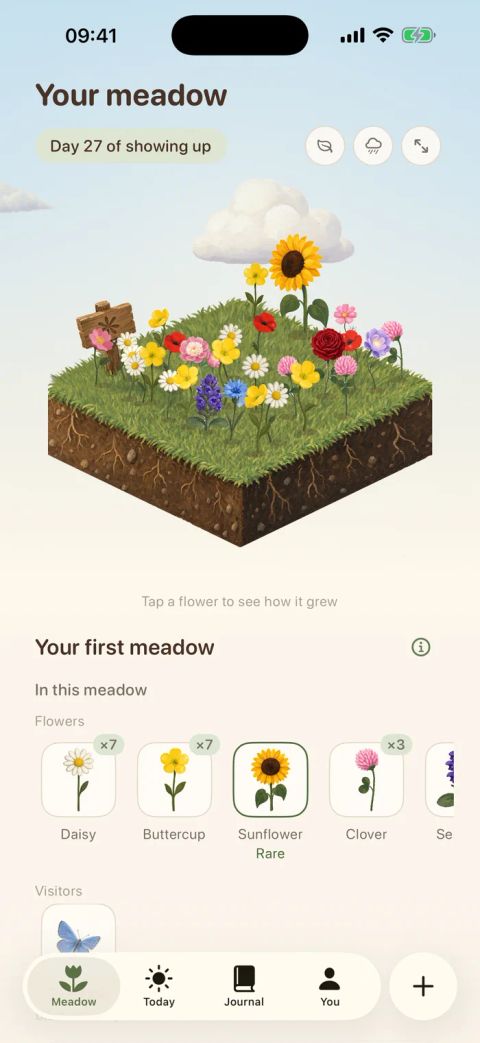
If a nudge on your phone helps you remember to get up, Meadow gives those small movements somewhere to land. It's a habit app for iPhone from Wildcard Wellness where you log the movement you enjoy with a timer, a five-minute walk or a lap around the house, and tick off small daily habits like standing up more or getting outside. Every day you show up grows a wildflower in your own meadow, and because there are no streaks, a day chained to your desk resets nothing you've built. You pick it back up the next morning.
On a flat-out day, and after you slip
Decide the smaller version before you need it. On a day so packed you can't picture standing up every half hour, do one thing: get up once an hour and walk to the far end of the room and back. That single loop keeps the pattern alive when the ideal version is off the table.
And there will be days, or whole weeks, when you sit through the lot. A run of deadlines, a bug you're nursing, bad weather that keeps you in. Nothing is undone by it. A sedentary spell is a spell, not a life sentence, and the way out is the same as the way in, one stand-up at a time. Tomorrow, when the kettle next boils, be on your feet for it.
Common questions
Is sitting "the new smoking"? That line gets thrown around a lot and it overstates things. The health risks of sitting are real and worth acting on, but the evidence linking sitting to harm is mostly observational and nowhere near as strong or as clearly causal as the evidence on smoking. Take it as a good reason to move more, not as cause for alarm.
How many hours of sitting a day is too much? There's no clean cut-off. Risk seems to climb the more you sit, with no single safe number, and roughly ten hours a day is where several studies flag rising cardiovascular risk. The useful goal isn't a magic figure, it's to sit less than you do now and break up the long stretches.
Does a standing desk fix a sedentary lifestyle? It helps a little by getting you out of a seated posture, but standing still is close to sedentary on the energy scale. The benefit comes from moving, not from swapping a sitting statue for a standing one, so use a standing desk as a prompt to shift about and take walking breaks.
I already exercise. Do I still need to worry about this? Somewhat, yes. A daily workout is good for you and helps offset sitting, but unless you're doing a solid hour of moderate activity a day, it doesn't fully cancel the risks of a mostly seated day. Keep the exercise and add the standing-up.
Can you reverse the effects of years of sitting? The research on movement is encouraging on this. Becoming more active is linked to better health at almost any age, and the everyday changes here start working the same week you start them. You don't need to make up for lost time, you need to move more from here on.
Right now, before you move to the next thing, stand up. Walk to the other side of the room, or fill a glass of water, and let that be the first break in the sit. The habit starts with getting out of the chair once.
AUTHOR
Co-founder of Meadow.
Ash is co-founder of Meadow, a habit and movement tracking app that turns small acts of self-care into a growing wildflower meadow.
Little and often, with Meadow
Consistency, not intensity.
Meadow turns the movement you enjoy and the habits that help you feel good into a meadow of wildflowers. No streaks to break, and your flowers never wilt.
Download Meadow