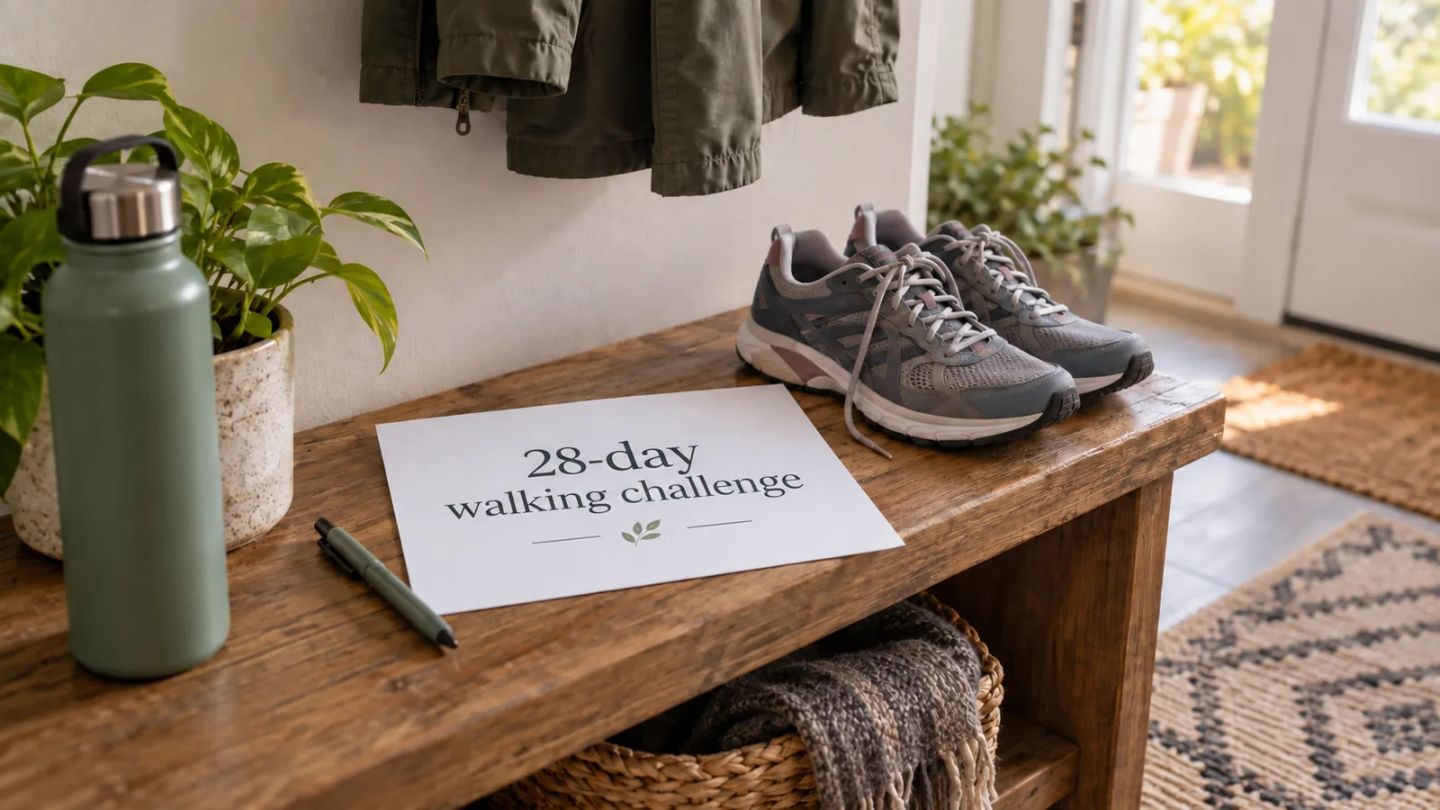
A 28-day walking challenge is a four-week plan where you walk a little each day and add a small amount of time as the weeks go on, so that a short stroll on day one grows into a comfortable, brisk walk by day 28. Below is the full plan, written out day by day, with a version you can make smaller on hard days and a plan for what happens once the four weeks are up.
Twenty-eight days is a useful length. It's long enough for walking to start feeling normal, and short enough that you can see the finish line from the start.
This won't promise weight loss or a fixed transformation. It's a followable structure for building a walking habit that survives real life.
Why 28 days works
A challenge puts a start date, an end date and a shape around something you keep meaning to do. That shape is most of the reason it works.
You're not committing to an hour on the treadmill. You're agreeing to a short walk today, then a slightly longer one next week, on a plan you can read at a glance. The point isn't to exhaust yourself into fitness by day 28. It's to still be walking in week five, once the habit has taken hold.
Walking earns its place here because it asks so little. It's gentle on the joints, needs no kit beyond shoes you already own, and suits most fitness levels. Harvard Health notes that regular walkers tend to take fewer sick days and that walking can ease joint pain rather than aggravate it, which is part of why it holds up as a daily habit.
Pick your starting point
The plan below comes in one shape with three settings. Choose the row that matches where you are now, and read the daily targets through that lens.
- Gentle start: you are returning to activity after a long gap, or you walk very little day to day. Take the lower time in each range and keep the pace easy.
- Steady start: you walk a bit already and want a structure to build on. Use the middle of each range.
- Brisk start: you are reasonably active and want the challenge to push you a little. Take the upper time and lean into the brisker sections.
You can move between settings as you go. Nobody is watching, and the plan bends to you.
If you are returning to exercise after a long break, are pregnant, or live with a heart, joint or breathing condition, check with your GP before you start. A general plan cannot account for your particular situation.
The 28-day plan, week by week
Open our free 28-Day Walking Plan and Tracker (PDF). Save or print the three-page pack: the four-week walking schedule plus trackers for all 28 days. No sign-up needed.
Each week has six walking days and one easier day. The easier day is built in. Rest is part of the training.
Week 1, days 1 to 7: turn up. The only goal this week is to walk every day at a comfortable pace, the kind where you can chat without effort. Aim for 10 to 15 minutes a day. On day 4 and day 7, keep it short and gentle, a five to ten minute amble to let the habit settle. Do not worry about speed or distance yet. Turning up is the whole job.
Week 2, days 8 to 14: add a little time. Walk 15 to 20 minutes on most days. Twice this week, pick up the pace for the middle few minutes until you are walking briskly, then ease back. The NHS describes a brisk walk as a pace where you can still talk but not sing. Keep one easy day, around ten minutes, when your legs want a break.
Week 3, days 15 to 21: bring in some effort. Walk 20 to 25 minutes most days. On two or three days, add short brisk intervals: two minutes brisk, two minutes easy, repeated across the walk. Add one longer walk at the weekend, 30 minutes or so, at whatever pace feels sustainable. Take one gentle recovery day of ten to fifteen minutes.
Week 4, days 22 to 28: settle into it. Walk 25 to 30 minutes most days, with a mix of brisk stretches and easy ones. Keep your longer weekend walk. By the end of this week, six walks of around 25 minutes lands you near 150 minutes, which is the weekly amount of moderate activity the CDC suggests for adults, alongside muscle-strengthening on two days. On your last day, walk your favourite route and notice how different day one would feel now.
That is the plan in full. Print it, screenshot it, or copy the tracker below so you can tick off each day.
A tracker you can use
Marking each walk gives you a record to look back on, and watching your own progress tends to make you more likely to keep a goal. A meta-analysis of 138 studies found that people who tracked their progress toward a goal were more likely to reach it. A wall calendar does this. So does the tracker below.
Here is a blank week. Fill in your target, then tick the day once the walk is done.
Week ____ Daily target: ____ minutes
Mon ☐ Tue ☐ Wed ☐ Thu ☐ Fri ☐ Sat ☐ Sun ☐
Longer walk this week: ____ Easy day: ____
And here is a filled example from week three:
Week 3 Daily target: 20 to 25 minutes, with 2-min brisk intervals
Mon ☑ Tue ☑ Wed ☐ Thu ☑ Fri ☑ Sat ☑ (30-min river loop) Sun ☐ (easy 12 min)
Longer walk this week: Saturday river loop Easy day: Sunday
You can track minutes, steps or distance, whichever you find easier to notice. If you prefer steps, a rough guide is that most people cover somewhere near 100 steps a minute at a brisk pace, so a 25-minute walk lands around 2,500 steps on top of your normal day.
Adapting the plan for hard days
Some days the full walk won't happen. Plan for those days.
Keep a smaller version ready. If the day's target is 25 minutes and you have five, walk for five. Walk to the end of the road and back. A short walk logged plainly as a short walk keeps the habit alive and keeps your record truthful about the day you had.
A challenge is a pattern you can return to.
If you miss a whole day, or three, the walking still counts when you pick it up again. There is no debt to repay and no need to double your minutes tomorrow to make up for it. Research on how habits form suggests that a single missed day does not undo the progress you have made. Take the next reasonable chance and carry on from where the plan sits, not from where you think you should be.
Room to miss a day and carry on
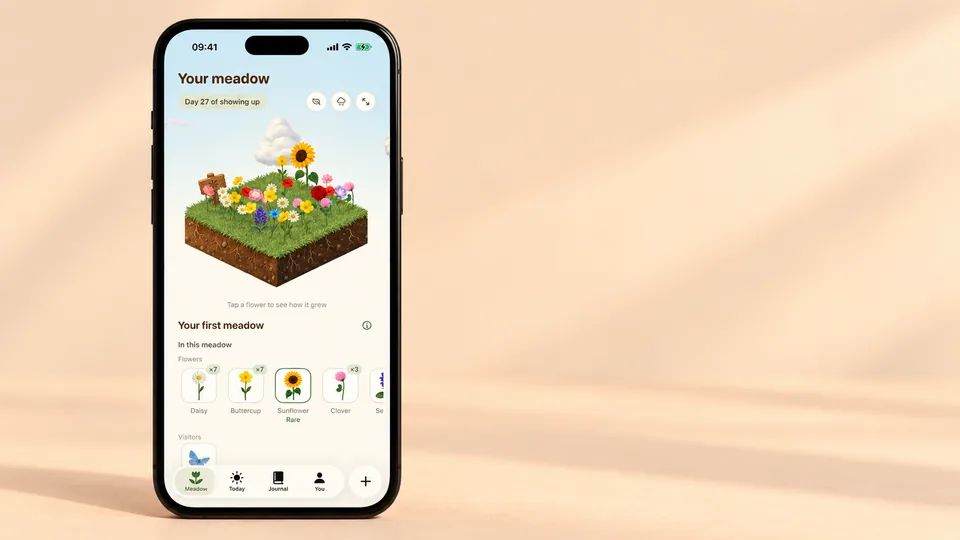
If you want something to track your walks that will not punish a missed day, the app you choose matters.
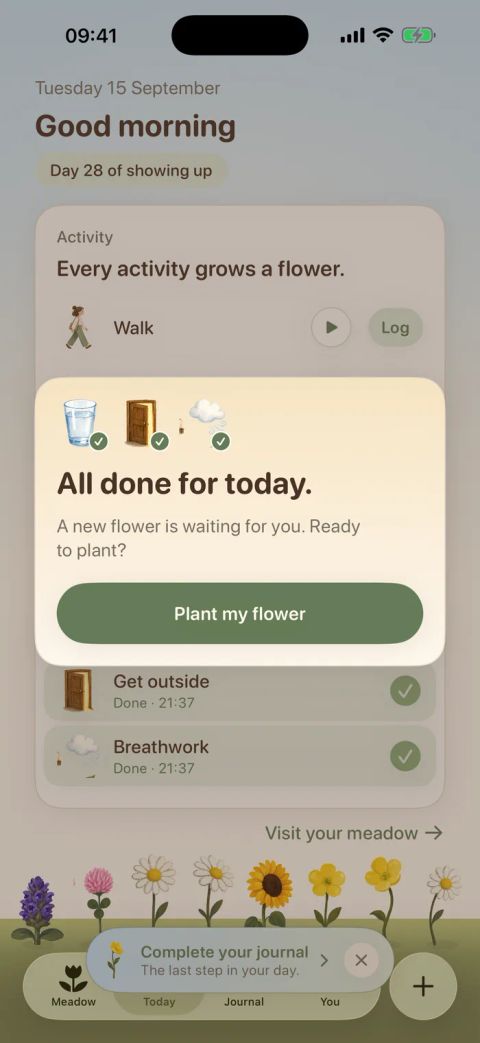
Meadow fits that brief, because it is built around returning rather than never missing. Made by Wildcard Wellness for iPhone, it lets you log each walk with a timer, tick off small daily habits, and note your mood, energy and a daily win, and every day you show up a new wildflower blooms in your own meadow. There are no streaks, so missing a day, or three, of the plan resets nothing and your flowers never wilt.
That gentleness fits a 28-day challenge, where the days you nearly skip are the ones that decide whether the habit sticks.
What to do after day 28
Treat the last day of the challenge as a checkpoint.
By now you have walked most days for a month, and your day-28 walk feels easier than day one did. The question is how to keep that without a numbered plan telling you what to do each morning. The honest answer is to make the walking a bit less structured and a bit more yours.
Hold to the weekly total and let the daily script go. Six walks of around 25 minutes, or four or five longer ones, keeps you near the 150 minutes a week that the American Heart Association and the CDC both point to. The AHA also suggests attaching a new habit to something you already do, so walk after the school run, after lunch, or before your evening meal, and it stops depending on willpower.
If you enjoyed the structure, you have options. Repeat the four weeks at a higher setting. Swap some walks for a hillier route, since even a gentle incline adds effort without adding time. Or roll straight into another challenge to keep the shape without the boredom.
For the bigger picture on how these plans are built and varied, our guide to the walking challenge covers the format in full, and if the weather or your schedule keeps you inside, the indoor walking challenge gives you a four-week plan you can do without leaving the house.
Common questions
Will a 28-day walking challenge help me lose weight?
It might contribute, but walking alone is not a weight-loss guarantee. Weight depends on the balance between what you eat and what you burn, and the CDC notes that the amount of activity needed varies a lot from person to person. A month of daily walking is more reliable as a way to build fitness, mood and a habit than as a diet. Our piece on walking for weight loss sets it in context.
How many steps a day should I aim for during the challenge?
There is no single right number. A large study of older women found benefits appearing from around 4,400 steps a day compared with very low activity, and a meta-analysis led by Amanda Paluch found the mortality benefit levelling off at roughly 6,000 to 8,000 steps for older adults and 8,000 to 10,000 for younger ones. During the challenge, go by walk time. Our guide to how many steps a day goes deeper.
Do I need rest days if I am only walking?
Walking is low-impact, so a rest day is more about keeping the habit sustainable than recovering from strain. The easy days in this plan let you stay consistent without burning out, which is what carries a habit past week four.
What if I can only walk for five minutes?
Then walk for five minutes and count it. A short walk done daily beats a long walk you keep putting off, and you can lengthen it as the weeks go on. Starting small is the plan working.
Is walking every day too much?
For most healthy adults, daily walking at a comfortable pace is fine and often helpful. If a joint or a niggle flares up, take an easy day or a genuine rest day, and speak to your GP if pain persists.
Your first step is small. Decide when and where tomorrow's walk will happen, set the day-one target at 10 to 15 minutes, and write it down where you will see it. One walk, at a time you have already chosen, is a 28-day challenge beginning.
AUTHOR
Co-founder of Meadow.
Ash is co-founder of Meadow, a habit and movement tracking app that turns small acts of self-care into a growing wildflower meadow.
Every little bit counts
Five minutes counts. So does a dance in the kitchen.
Log the movement you enjoy and the small habits that help you feel good, and watch them bloom into something you can see.
Download Meadow