Most people don't need 15,000 steps a day, and the evidence suggests the biggest health gains arrive well before you get anywhere near it. That doesn't make 15,000 pointless. It is a real target with a real origin, and for a certain kind of walker it fits nicely, so it helps to know where the figure came from, what it asks of your day, and who it suits before you decide to chase it.
This guide is honest about all of that, including the parts that rarely make the headline.
Where the 15,000 figure came from
Unlike the round 10,000 that started as a pedometer slogan, 15,000 has a study behind it, though a smaller and more specific one than most articles admit.
In 2017, researchers led by William Tigbe at the University of Warwick, working with the University of Glasgow, followed 111 healthy, non-smoking postal workers in Glasgow. As Futurity reports, participants wore an activPAL monitor on the thigh for a week while the team measured weight, blood pressure, blood samples and cardiovascular risk. Office-based staff tended to have larger waistlines and worse cholesterol profiles than the walking delivery staff. The line that travelled around the internet was this one: the levels associated with zero cardiovascular risk factors were walking more than 15,000 steps a day, roughly seven to eight miles, or about seven hours a day on your feet.
That is where the number was born.
It is worth sitting with what the study was and was not. It looked at a specific group of already-healthy adults with physically demanding jobs, and it found an association, not proof that 15,000 steps caused their better markers. People with active jobs differ in other ways too. The finding is interesting, but it was never a prescription for the general population, and treating it as one stretches it further than the researchers did.
Do you need that many?
For most outcomes that people care about, the answer is no, and a stack of larger studies points the same way.
The clearest pattern in the research is that the benefits of walking climb steeply from a low base and then flatten out. Harvard Health, summarising work by Dr I-Min Lee on nearly 17,000 older women, notes that mortality risk dropped as steps rose and then levelled off at around 7,500 a day. More steps beyond that didn't clearly buy more protection in that group.
A 2022 meta-analysis of 15 studies and about 50,000 people, summarised by the UNC Gillings School of Global Public Health, found the plateau depended on age. For adults aged 60 and over, the benefit for longevity settled at roughly 6,000 to 8,000 steps a day. For younger adults it settled higher, at about 8,000 to 10,000. In both cases, more steps than that added no further gain for longevity in the data.
More recent work pushes the practical figure lower still. A 2025 dose-response review in The Lancet Public Health, covered by EurekAlert, pooled 57 studies and more than 160,000 adults. At around 7,000 steps a day, compared with about 2,000, it recorded lower rates across a spread of outcomes, including a 47% lower risk of death from any cause, 25% for cardiovascular disease and 38% for dementia. The authors suggested 7,000 as a more realistic target than 10,000. They did note that for some conditions, such as heart disease, the benefit kept rising past 7,000, which is where a higher personal target can earn its place.
Not every analysis finds a clean ceiling, though. A 2023 meta-analysis in the European Journal of Preventive Cardiology pooled 17 studies and nearly 227,000 people, and, as EurekAlert reported, the risk of dying kept falling as steps rose, with no upper limit found up to 20,000 a day. Each extra 1,000 steps went with a 15% lower risk of death from any cause. The authors were open that data at the very top was thin and needs confirming in bigger groups. Like the rest of this research, it shows an association, not cause and effect.
So the broad shape holds. Going from very little to a moderate amount is where the returns are largest. Pushing from 10,000 to 15,000 still adds movement, and some data hints it may add a little more protection, but for the average person it sits in the flatter part of the curve.
10,000 or 15,000: which is better?
For most health outcomes, the gap between the two is smaller than the extra 5,000 steps suggests. A 2020 study in JAMA tracked 4,840 US adults aged 40 and over who wore step counters. Compared with people taking 4,000 steps a day, those taking 8,000 had about half the risk of dying during follow-up, and those taking 12,000 had roughly a 65% lower risk. The first extra 4,000 steps did the heavy lifting. The next 4,000 added something, but less.
That's the trade you're making with 15,000. The last 5,000 steps is around two to two and a half more miles and something like 40 extra minutes on your feet each day, for a return that's real but smaller than the one you got earlier on the curve. If you'd like the case for a lower number, our look at whether 7,000 steps a day is good sets it out.
Where 15,000 earns its keep is time out of the chair. If you sit at a desk all day, those extra miles eat into hours you'd otherwise spend sitting, and the Glasgow study linked long sedentary hours with bigger waistlines and worse blood fats.
Does pace count as much as the total?
Going by the research so far, less than you might expect. The same JAMA study found no significant link between step intensity and risk of death once total daily steps were taken into account. The 2022 meta-analysis summarised by UNC found no definitive link for walking speed either.
A brisk pace still has a practical upside. It gets you to 15,000 in less time, which on a busy day may be the difference between reaching it and giving up.
The time and effort reality
Fifteen thousand steps is a bigger daily commitment than the tidy phrase suggests, and it is fair to know that before you sign up.
For many adults, 15,000 steps works out at roughly six to seven and a half miles, depending on height and stride. At a normal walking pace, that is somewhere around two hours of walking, give or take, spread across the day. The postal workers in the Glasgow study logged theirs through a job that kept them upright for hours. Fitting the same total around a desk, a commute and family life is a different task entirely.
That gap is the honest heart of the matter. If your day already involves a lot of movement, 15,000 may arrive without much strain. If it doesn't, reaching it can mean carving out real time, and a target you dread rarely survives a busy month. Our guide to how many miles should you walk a day sets the distance side out if that framing suits you, and 10,000 steps a day covers the more common target and where it came from.
How many calories do 15,000 steps burn?
There's no single figure, because the energy you use walking depends mostly on your body weight and your pace. Harvard Health's calories-burned table is a sensible place to start. It puts 30 minutes of walking at 3.5 mph at about 107 calories for a 125-pound person, 133 at 155 pounds and 159 at 185 pounds. In UK terms, that's roughly 9, 11 and 13 stone.
Stretch that to the two or so hours that 15,000 steps takes many people, and a rough estimate lands near 430, 530 and 640 calories for those three weights. Walk faster and the numbers climb. The same table has 30 minutes at 4 mph using between 135 and 189 calories across those weights.
Treat all of this as a ballpark. Your stride, your route and your own body will all nudge the total up or down.
A bigger calorie burn doesn't turn into a predictable amount of weight lost, either. The CDC explains that weight loss comes from pairing activity with eating fewer calories, and that the activity people need varies a great deal. Our guide to how many steps a day to lose weight goes into that in more depth. If you're hoping to lose weight for a health reason, your GP can help you shape a plan that suits you.
Who might want 15,000
A high step target isn't for everyone, but it does suit some people well, and setting a number is a personal choice rather than a health rule.
You might want to aim high if you already move a lot and want a target that reflects it, if you have a physically active job that racks up steps anyway, if you are training for a long walk or a multi-day trek, or if walking is your main form of exercise and you enjoy the volume. Some people managing their weight also use a higher step count as part of a wider plan, though the CDC is clear that the activity needed varies a lot from person to person and depends on overall energy balance, not steps alone.
If you are returning to activity after a long break, are pregnant, are older, or live with a health condition, it is sensible to talk to your GP before setting a demanding target, since a general figure cannot account for your particular situation. A goal that suits a fit delivery worker may not suit your knees or your week.
How to build up to 15,000 safely
The fastest way to abandon a step goal is to leap at it from a standing start. Build the volume in stages instead, and let your body catch up to the number.
Build up like this:
- Find your baseline first. Track a normal week without changing anything, and take the daily average as your real starting point.
- Add around 1,000 to 2,000 steps a day and hold there for a week or two until it feels ordinary.
- Step up again by a similar amount only once the current level feels easy, not before.
- Keep at least one lighter day in the week so your feet, calves and joints get a break.
- Treat 15,000 as a ceiling you rise to over a couple of months, not a target for tomorrow.
The NHS advice to build up gradually applies here more than for any lower target, because the extra miles land on the same joints day after day. It also describes a brisk walk as a pace where you can talk but not sing, which is a useful way to add effort without adding hours.
Most of the volume comes from stitching walking into the day, not one long march. A loop after lunch, getting off a stop early, pacing during phone calls and a short stroll after dinner add up faster than they look. Our piece on the benefits of walking covers why even the moderate amounts are worth protecting.
Overtraining, aches and recovery
More isn't always better, and a high daily total brings a risk that lower targets do not: doing too much, too soon, on tired legs.
Walking is low impact, but 15,000 steps a day is still a lot of repetition through the same feet, shins and knees. If you ramp up quickly, the usual signs of overdoing it are worth watching for. Nagging foot, shin or knee pain that lingers, tiredness that doesn't lift after a normal night's sleep, and a walk that starts to feel like a chore are all signs to ease off. Don't push through them.
Recovery is part of the plan, not a failure of it. Rest days, decent shoes, and dropping your step count for a while after illness or injury before building back up all keep the habit sustainable. A lighter week that protects your knees beats a heroic fortnight that ends in a limp.
A tracker that allows a rest day

Chasing a big number gets harder when a single missed day feels like a broken streak, and that pressure is exactly what pushes people to walk on sore legs.
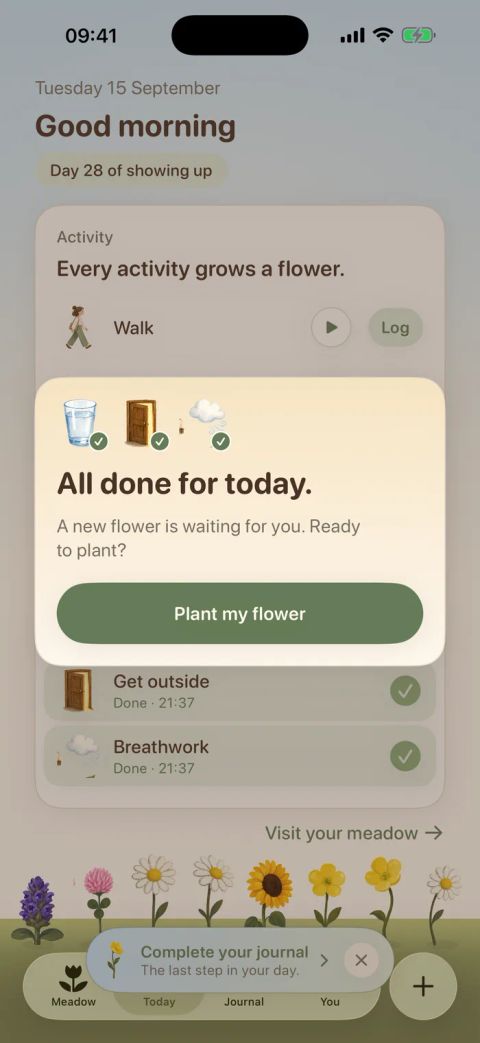
Meadow takes the opposite approach, treating a missed day gently rather than as a failure. It is a movement and habit app for iPhone from Wildcard Wellness, where you log the movement you enjoy with a timer, tick off small daily habits, and note your mood and energy, and each day you show up grows a wildflower in your own meadow. Find it at growyourmeadow.com. It is built for consistency, not perfect weeks, so a rest day your legs needed resets nothing and your flowers never wilt.
On hard days, and after a gap
Some days 15,000 won't happen, and planning for those days keeps the habit alive instead of snapping it.
Keep a smaller version ready. If the full total is out of reach, aim for a fraction of it, or step outside for ten minutes and call that the day's win. A short walk logged plainly as a short walk keeps you honest and keeps you moving.
If you miss a day, or a week, the walking still counts when you pick it up again. There's no debt to repay by doubling your steps tomorrow, and trying to is how sore knees start. Take the next reasonable chance, start a little below where you left off, and build back up.
Frequently asked questions
Is 15,000 steps a day too much?
For most people it is more than needed for the main health benefits, which tend to level off well below it. It is not harmful in itself if you build up to it sensibly, but ramping up fast raises the risk of overuse aches, so progress gradually and keep lighter days.
Is 15,000 steps a day considered very active?
Yes. On the step bands researchers have used for years, set out by Catrine Tudor-Locke and colleagues in a 2011 review, 12,500 steps or more a day counts as "highly active", the top band. At 15,000 you're comfortably inside it.
How long does 15,000 steps take?
Roughly two hours of walking for many adults, spread across the day and not done in one go. The exact time depends on your pace and stride.
How many miles is 15,000 steps?
For many adults it works out at around six to seven and a half miles, depending on height and stride length.
How many calories do 15,000 steps burn?
As a rough estimate, somewhere around 430 to 640 calories for two hours at 3.5 mph if you weigh between about 9 and 13 stone, based on Harvard Health's figures. Heavier people and faster walkers use more, lighter people and slower walkers less.
Will you lose weight walking 15,000 steps a day?
You might, but no step count guarantees it. Walking more can support weight management as part of a wider plan, and the CDC notes the amount of activity needed varies a lot between people and depends on your overall energy balance, including what you eat. If weight loss is a health goal for you, talk it through with your GP.
Which is better, 10,000 or 15,000 steps?
For most people, 10,000 already sits near where the biggest health gains level off, and 15,000 adds a smaller extra benefit for about 40 more minutes a day. If you already move a lot and enjoy the volume, 15,000 can be a fine personal target. If it leaves you dreading your day, a lower number you meet most weeks will do more for you than a big one you abandon.
Your first step this week is not 15,000. Track a normal week to find your real average, then decide whether adding 1,000 or 2,000 to that is a target you would keep, and let the bigger number wait until the smaller one feels easy.
AUTHOR
Co-founder of Meadow.
Ash is co-founder of Meadow, a habit and movement tracking app that turns small acts of self-care into a growing wildflower meadow.
Every little bit counts
Five minutes counts. So does a dance in the kitchen.
Log the movement you enjoy and the small habits that help you feel good, and watch them bloom into something you can see.
Download Meadow