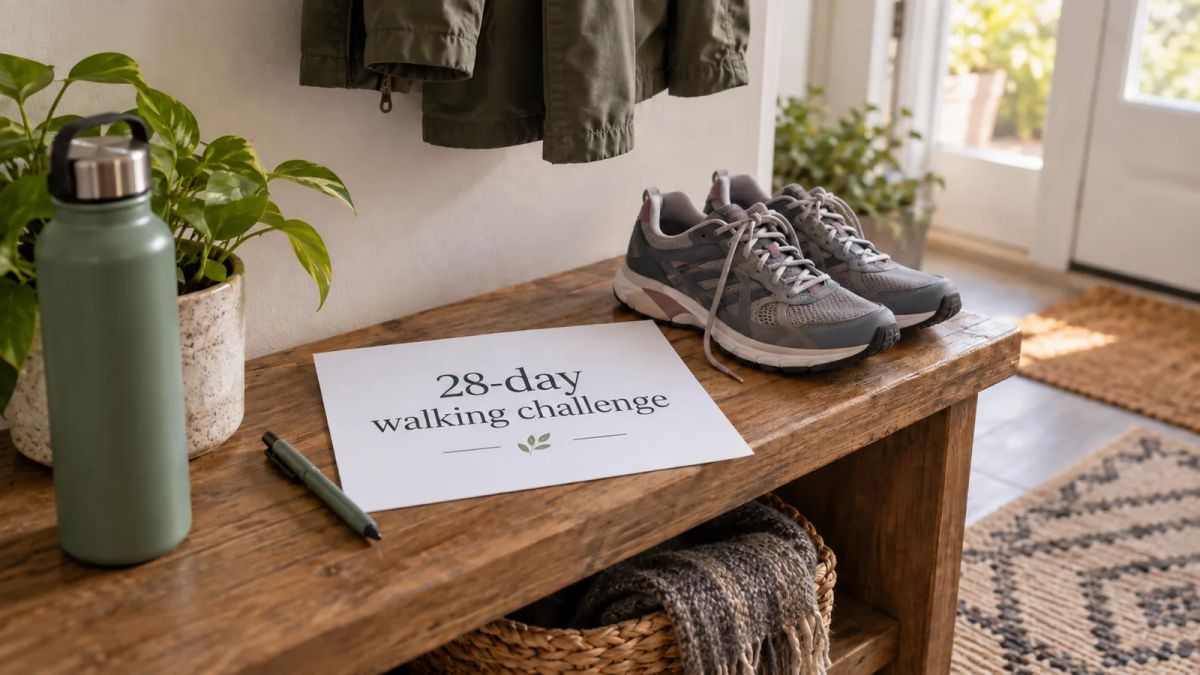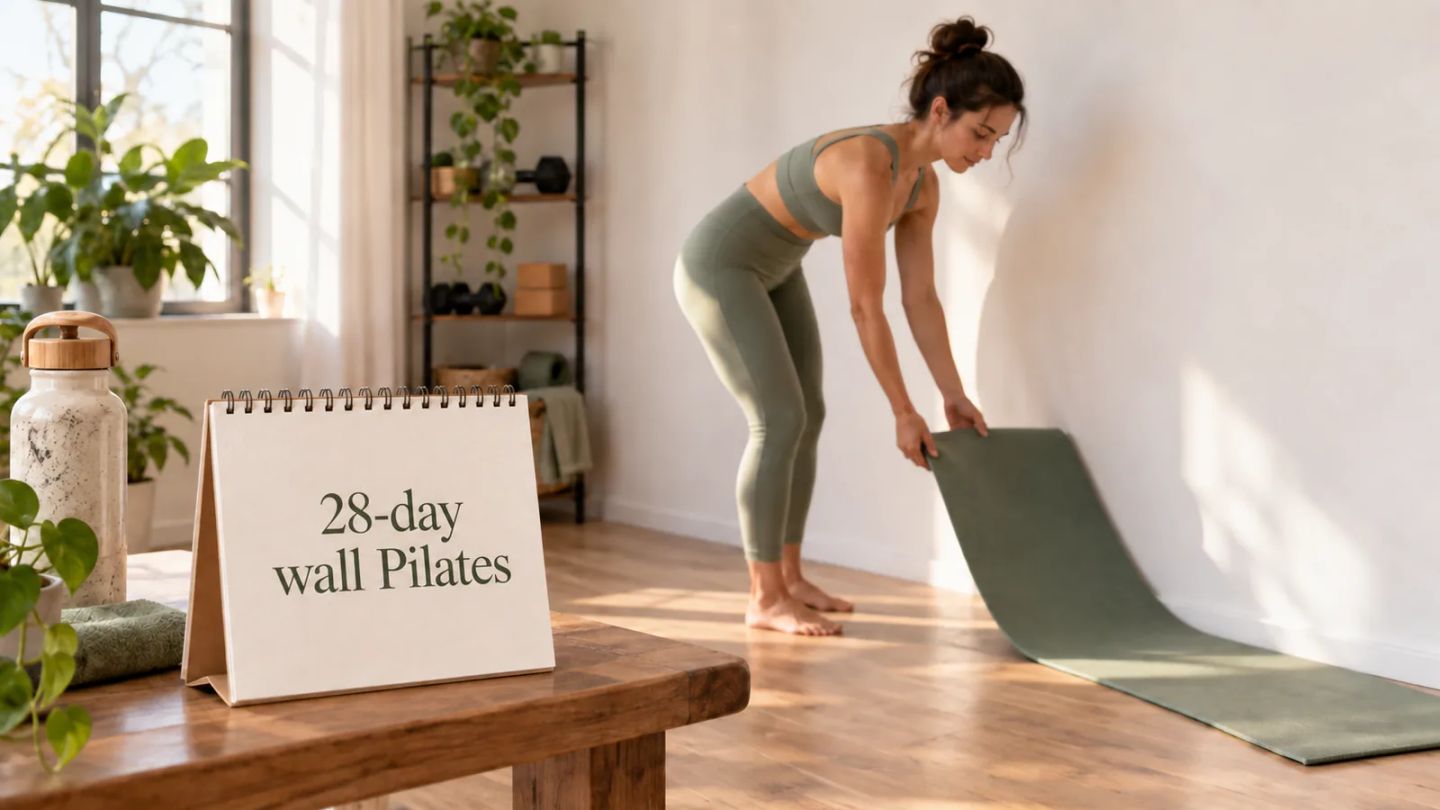
A 28-day wall Pilates challenge is a four-week plan where you do a short set of Pilates moves against a wall each day and add a little time and effort as the weeks go on, so a handful of simple shapes in week one becomes a flowing routine by day 28. One honest thing before you start: "wall Pilates" is a marketing name for ordinary mat Pilates done with a wall as a prop, not a separate discipline with science of its own.
The wall is a good prop, though. It steadies your balance, feeds back when your spine or hips drift out of line, and takes some load off your joints, which makes it a kind way in for beginners and anyone easing back after a break.
Below is the full four-week plan, with the moves, reps and rest days spelled out, a smaller version for hard days, and a plan for after day 28.
What four weeks can realistically do
Wall Pilates builds the things Pilates has always been good at. Cleveland Clinic describes Pilates as a low-impact, full-body workout focused on the core, and lists better posture, balance, flexibility and lower-back comfort among its likely benefits. Those gains are real, and they come from doing the moves over weeks, not from any 28-day clock.
Balance is where the evidence is strongest, especially with age. A 2023 systematic review pooled 20 randomised trials and 930 older adults and found Pilates improved balance, with the clearest gains in dynamic balance.
What a month won't do is flatten your stomach or melt away fat, whatever the before-and-after reels imply. The CDC is plain that most weight loss comes from eating fewer calories, while activity helps you keep it off, and no amount of ab work spot-reduces belly fat. Treat this plan as a way to move daily, build core control and steadier balance, and settle into a habit you keep past week four. That's plenty.
Before you start
You need almost nothing. A clear stretch of wall with no pictures or shelves in the swing of your arms, a bit of floor, and a mat or folded towel for the lying-down moves.
Pick an effort level and read every week's targets through it. If you're new to exercise or coming back after a long gap, take the lower reps and shorter holds. If you already move a fair amount, take the upper end and slow the moves down for more challenge. You can shift between the two as you go.
One safety note worth taking seriously. A wall makes the moves steadier, not risk-free. Cleveland Clinic advises you to check with a healthcare provider before starting any new routine, and Harvard Health repeats the point for Pilates specifically, noting it's low-impact and generally accessible but still worth clearing with your doctor first. That goes double if you're pregnant, recovering from injury or surgery, or living with a heart, back or joint condition. Move slowly, aim for mild effort, keep breathing, and stop anything that brings sharp or pinching pain.
The 28-day wall Pilates plan, week by week
Each week runs six practice days and one rest day. The rest day isn't a failure. It's built in, because muscles adapt between sessions and a schedule you can keep beats a punishing one you drop by day nine.
The four weeks climb in a clear shape. Week one teaches the moves. Week two adds reps and time. Week three adds strength and single-leg work. Week four links it all into a smoother flow. Follow the numbers or the blockquote, whichever you find easier to read at a glance.
Week 1, foundations (days 1 to 7)
Learn the shapes at a comfortable pace. Aim for 10 to 15 minutes and don't chase effort yet. Run through these in order on six of the seven days, and take one full rest day.
- Posture reset. Stand with your back to the wall, heels a few inches out, and press your lower back, upper back and head gently towards it. Draw your navel in and hold for five slow breaths.
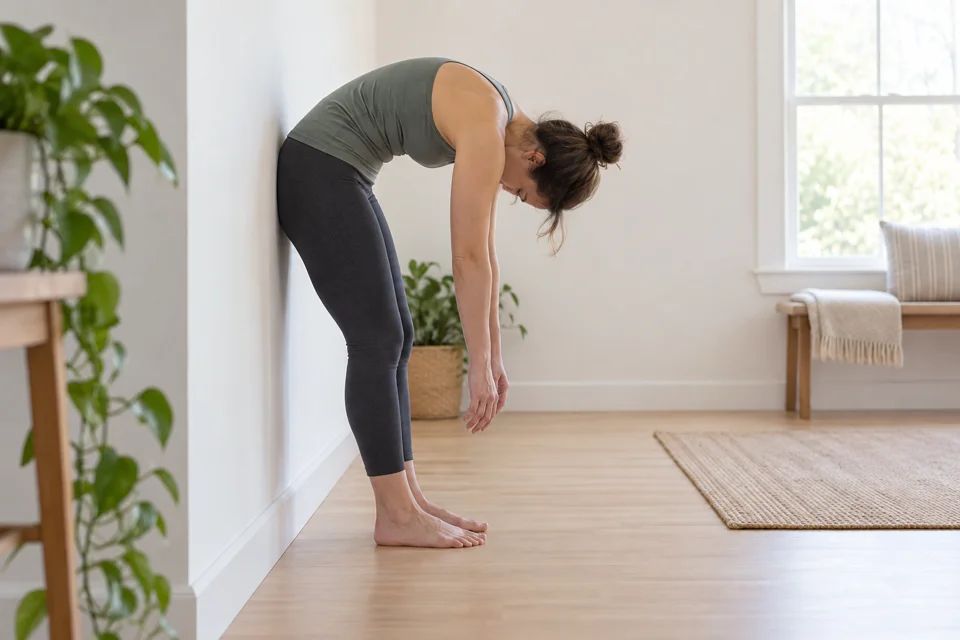
- Wall roll-down. Drop your chin and peel your spine away from the wall one section at a time, then stack back up slowly. Do four rounds.
- Wall arm circles. Standing tall against the wall, raise both arms in front, open them wide, and float them down in a slow circle. Do eight forwards and eight in reverse.
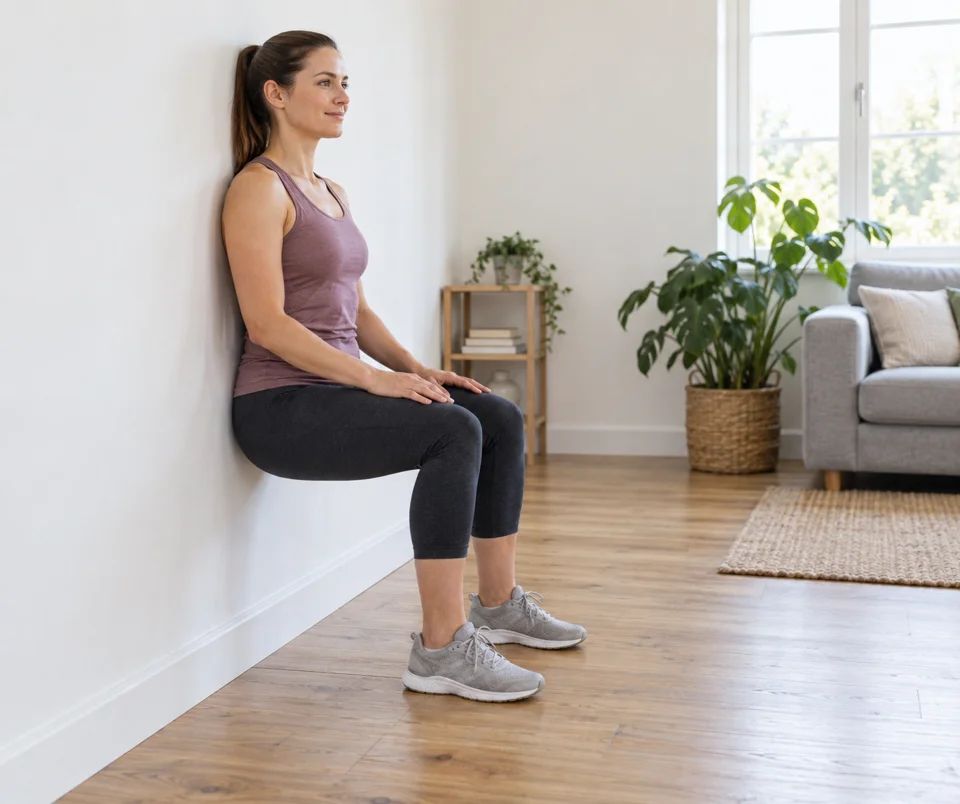
- Wall sit. Walk your feet out and slide down until your knees bend towards a right angle. Hold 20 seconds, breathing steadily.
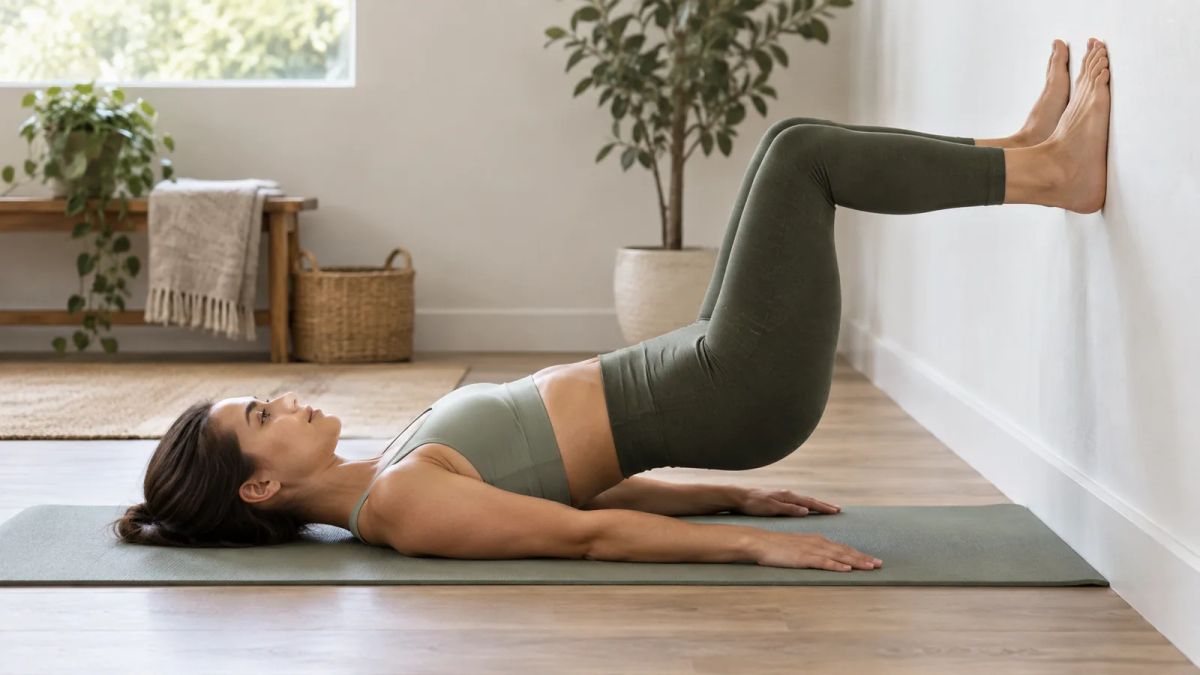
- Wall bridge. Lie on your back with your feet flat on the wall, knees bent, and peel your hips up one vertebra at a time, then lower. Do eight.
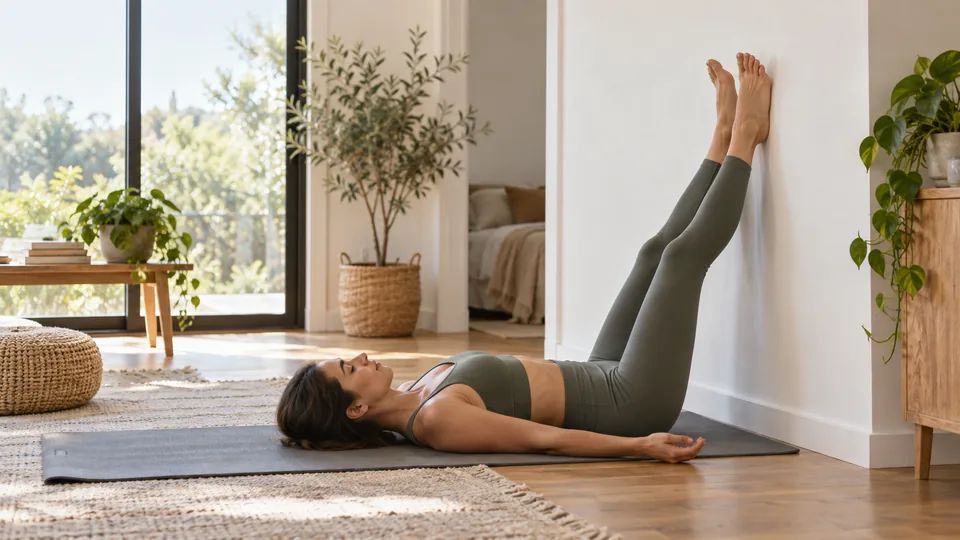
- Legs up the wall. Swing your legs up the wall and lie back for two minutes to finish.
Week 1, foundations. Six days of 10 to 15 minutes, one rest day.
Moves: posture reset, wall roll-down (x4), wall arm circles (8 each way), wall sit (20 sec), wall bridge (x8), legs up the wall (2 min).
Aim: learn the shapes, no strain.
Week 2, build (days 8 to 14)
The moves are familiar now, so add a little time and a new one. Aim for 15 to 20 minutes across six days, with one rest day.
- Posture reset. Five slow breaths, as before.
- Wall roll-down. Five rounds this week.
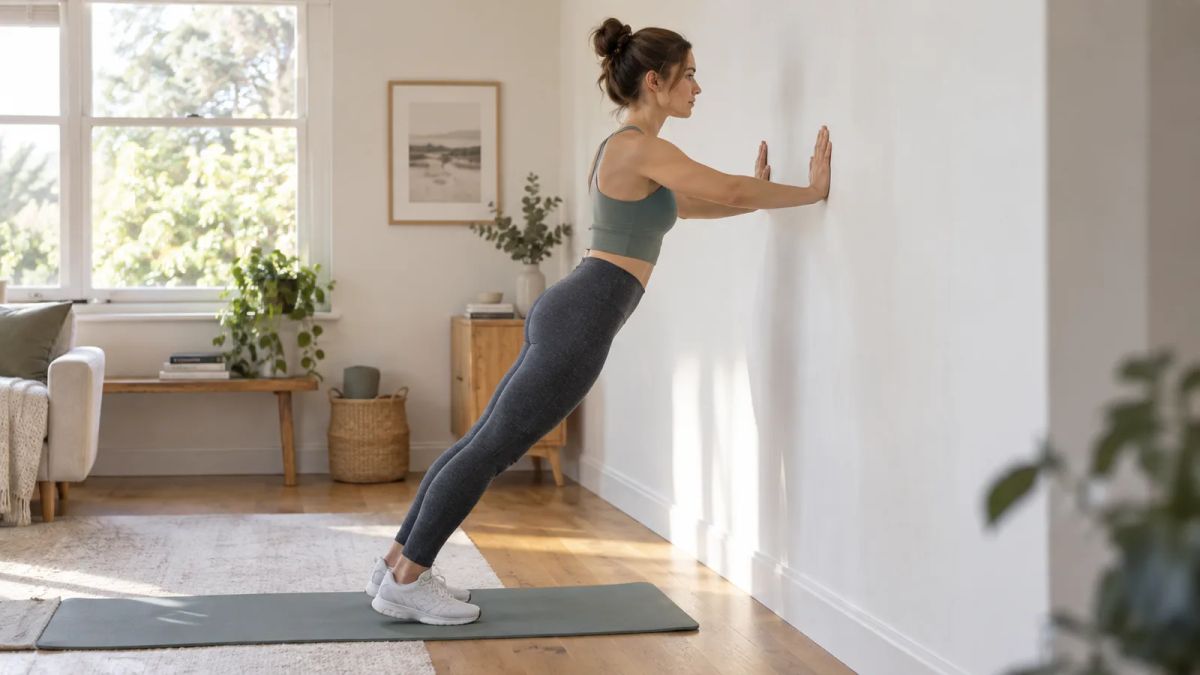
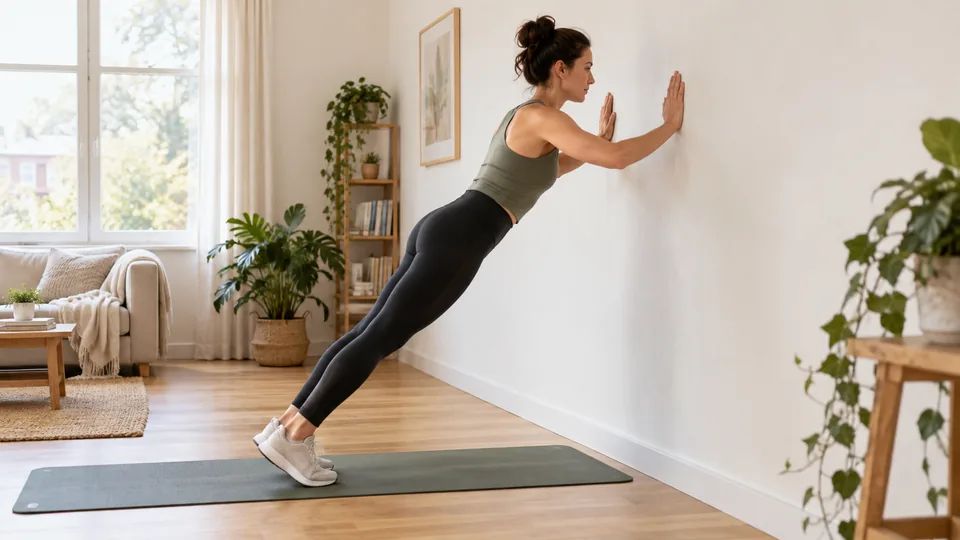
- Wall push-up. Face the wall, hands at shoulder height, feet a couple of feet back. Keep a straight line from head to heels and bend your elbows to bring your chest towards the wall. Do eight to ten.
- Wall sit. Hold 30 seconds.
- Wall marches. Back to the wall, lift one knee towards hip height and lower it with control, then the other. Do eight to ten each leg.
- Wall bridge. Ten to twelve reps.
- Legs up the wall. Two to three minutes to finish.
Week 2, build. Six days of 15 to 20 minutes, one rest day.
Moves: posture reset, wall roll-down (x5), wall push-up (8 to 10), wall sit (30 sec), wall marches (8 to 10 each leg), wall bridge (10 to 12), legs up the wall.
Aim: more reps, add the push-up and the marches.
Week 3, strength (days 15 to 21)
Longer holds, more reps and some single-leg work. Aim for 20 to 25 minutes across six days, with one rest day. If a move feels shaky on one leg, keep a fingertip on the wall and build from there.
- Wall roll-down. Five rounds to warm the spine.
- Wall push-up. Ten to twelve, feet stepped further back to make it harder.
- Wall sit. Hold 40 to 45 seconds. If that comes easily, lift one heel for a few seconds at a time.
- Single-leg wall bridge. From the bridge position, extend one leg and press up through the other foot. Do six to eight each side.
- Wall side leg lifts. Stand side-on with one hand on the wall and lift the outer leg to hip height with control. Do ten each side.
- Wall marches. Twelve each leg.
- Legs up the wall, then butterfly. Bring the soles of your feet together, let your knees open, and rest for a minute.
Week 3, strength. Six days of 20 to 25 minutes, one rest day.
Moves: wall roll-down (x5), wall push-up (10 to 12), wall sit (40 to 45 sec), single-leg wall bridge (6 to 8 each side), wall side leg lifts (10 each side), wall marches (12 each leg), legs up the wall and butterfly.
Aim: longer holds, single-leg control.
Week 4, flow (days 22 to 28)
Now link the moves into one continuous sequence, with smooth transitions and less pausing between them. Aim for 25 to 30 minutes across six days, with one rest day. Keep the reps from week three, but move from one shape to the next without stopping, so the whole set flows.
- Posture reset into wall roll-down. Two rounds to open the spine.
- Wall push-up, then straight into wall sit. Ten push-ups, then a 45-second hold.
- Wall marches, then single-leg wall bridge. Twelve marches each leg, flowing down to the floor for six to eight bridges each side.
- Wall side leg lifts. Ten each side, controlled and slow.
- Legs up the wall and butterfly. Two to three minutes to close.
On day 28, run your favourite version of the flow and notice how different the same moves feel from day one. That contrast is the point of the whole four weeks.
Week 4, flow. Six days of 25 to 30 minutes, one rest day.
Moves: the week-three repertoire linked into one continuous sequence, smooth transitions, minimal resting between shapes.
Aim: put it all together and feel the difference.
A tracker you can use
Open our free Your 28-day wall Pilates plan (PDF). Save or print it to use alongside this guide. No sign-up needed.
Marking each session gives you a record to look back on, and watching your own progress tends to keep you at it. A meta-analysis of 138 studies found that people who tracked their progress toward a goal were more likely to reach it. A wall calendar does this. So does the grid below.
Fill in the week and your session length, then tick each day once the set is done.
Week ____ Session: ____ minutes
Mon ☐ Tue ☐ Wed ☐ Thu ☐ Fri ☐ Sat ☐ Sun ☐
Rest day: ____
Here's a filled example from week three, with a rest day and one honest gap.
Week 3 Session: 20 to 25 minutes, single-leg work
Mon ☑ Tue ☑ Wed ☐ (rest) Thu ☑ Fri ☐ Sat ☑ Sun ☑
Rest day: Wednesday
When a day falls apart
Some days the full set won't happen. Plan for those before they arrive.
Decide your smaller version now. On a rushed or flat day, the posture reset, one wall roll-down and a 30-second wall sit still count. A short session keeps the thread going, and keeping the thread going is what turns 28 days into a habit.
If you miss a whole day, or three, nothing is undone. Research on how habits form suggests a single missed day does not derail the process. Pick the plan up from where it sits, not from where you think you should be, and carry on. There's no debt to repay and no need to double up tomorrow.
A kinder way to keep coming back

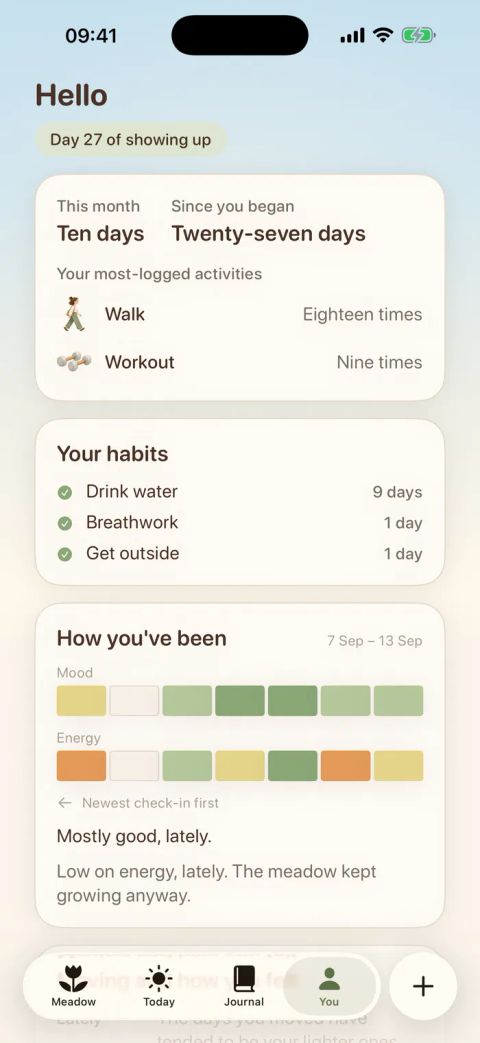
The daily-streak design of most challenge apps is where people fall off. Miss a day, break the chain, feel like you've failed, quit. Meadow is built the opposite way. It's a movement and habit app for iPhone from Wildcard Wellness where you log each wall Pilates session with a timer, tick off small daily habits, and note your mood, energy and a daily win. Every day you show up grows a wildflower in your own meadow, and there are no streaks, so skipping a day of the plan resets nothing and your flowers never wilt. For a challenge, where the days you nearly skip are the ones that decide whether it sticks, that forgiveness helps.
What to do after day 28
Treat the last day as a checkpoint, not a finish line.
By now the moves feel familiar and your day-28 flow is smoother than your first wobbly week. Two or three sessions a week is enough to hold the benefits, so let the daily script go and settle into a rhythm you can maintain.
Wall Pilates is low to moderate intensity, so it sits well alongside walking and some cardio for a fuller week. The NHS suggests adults aim for 150 minutes of moderate activity a week plus strengthening on two days, and a short wall set counts towards the strengthening side. To make it stick, the American Heart Association recommends tying a new action to a routine you already have, so "after I put the kettle on, I do my wall set" holds better than a loose plan to fit it in somewhere.
If you want to go deeper, our guide to wall Pilates exercises walks through each move with form cues, does wall Pilates work sorts the evidence from the hype, and the benefits of Pilates sets the whole practice in context.
Common questions
Is a 28-day wall Pilates challenge legit, or a fad?
The four-week format is a social media packaging, and the "wall Pilates" name is marketing for mat Pilates against a wall. The movement underneath is sound. A month of near-daily Pilates builds core control, balance and posture, as long as you keep it up afterwards.
Will it help me lose weight?
Not on its own. Weight change depends mainly on what you eat, and the CDC notes the activity needed varies a lot between people. Wall Pilates can be part of an active week that supports a healthy weight, but pairing it with walking and sensible eating does the heavy lifting.
How long should each session take?
Most plans keep daily sessions between 10 and 30 minutes, and this one climbs from about 10 minutes in week one to 30 by week four. If you have five minutes, do the smaller version and count it.
Is it safe to do wall Pilates every day?
For most healthy adults, a short daily set at gentle effort is fine, which is why this plan keeps six practice days and one rest day each week. If a joint or a niggle flares up, take an extra rest day, and speak to your GP if pain persists.
Do I need any equipment?
No. A clear wall, a bit of floor and a mat or towel are enough. Light one or two pound weights are optional and better saved for once the moves feel steady.
Your first step is small. Clear a stretch of wall, pick tomorrow's cue, and do the day-one set of six moves at an easy pace. One 12-minute session, at a time you've already chosen, is a 28-day challenge beginning.
AUTHOR
Co-founder of Meadow.
Ash is co-founder of Meadow, a habit and movement tracking app that turns small acts of self-care into a growing wildflower meadow.
See how far you've come
Your habits, moods and little wins, all in one place
Meadow keeps track of the walks, the water and the good days, so you can look back and watch your effort add up.
Download Meadow