Walking can help you lose weight, but the way it helps is by being a habit you keep for months, not a switch that decides the number on the scales. If you walk most days and pair it with changes to how you eat, walking earns its place in the weight picture. On its own, it moves the scales slowly, and what you eat carries most of the question.
So the goal worth chasing is not a walk that promises a certain loss by a certain date. It is a walking habit that survives an ordinary week, with expectations you can live with, so a good routine never starts to feel like a failure when your body does something a walk alone cannot fix.
This guide is about the habit and the expectations. If you are here for the step-count question specifically, our guide on how many steps a day to lose weight takes that apart in full. Here the focus is how often to walk, how briskly, how long for, why diet does the heavy lifting, and how to build a routine that holds.
What walking realistically does for weight
Walking burns energy, and it does other useful things while it is at it. Cleveland Clinic notes that consistent walking helps reduce visceral fat, the deep abdominal fat linked to poorer health, and helps preserve lean muscle while you lose weight, which matters because losing muscle alongside fat is a common downside of dieting.
There is decent evidence behind brisk walking too. Harvard's Nutrition Source describes a meta-analysis of 22 randomised controlled trials in which brisk walking for about three hours a week produced significant reductions in body weight, body mass index, waist circumference and fat mass in men and women with obesity under the age of 50. That is a real result, and it also shows the shape of a realistic effect: meaningful over months of consistent walking, not dramatic overnight.
The catch is that walking works best in company. Harvard Health reports on a study of more than 7,000 adults followed for about seven years, where greater adherence to a good diet and higher activity were each linked to less weight gain, but the biggest reduction in body fat, especially visceral fat, came when both improved together. Diet and movement pull in the same direction. Do both and they add up.
Why what you eat carries most of it
Walking cannot outrun the kitchen, and it helps to know that before you pin your hopes on the walk alone. The US Centers for Disease Control and Prevention puts it plainly: most weight loss comes from decreasing the calories you eat, while regular physical activity is how you keep the weight off once it has gone.
That division of labour is worth holding onto. It is easier to eat a few hundred calories than to walk them off, so the fastest lever for losing weight tends to be food, and the strongest role for walking is protecting your health during the loss and holding the line afterwards. The CDC also stresses that the amount of activity a person needs varies a great deal from one body to the next, so there is no single dose that works for everyone.
None of this makes the walk optional. Cleveland Clinic sums up the balance well with the line that you cannot out-exercise poor nutrition, which frames walking as the partner to eating changes rather than a replacement for them. Weight also answers to sleep, stress, medication, hormones and life stage, so treat everything here as general information rather than advice for your particular situation.
How much, how often, how brisk
A common health baseline is at least 150 minutes of moderate activity a week, and brisk walking counts, so a handful of brisk walks gets you most of the way there. When weight is the goal, more tends to be asked of you. Cleveland Clinic suggests aiming beyond that, closer to 300 minutes a week, which works out at around an hour on five days, to see a meaningful effect on weight. Build towards that rather than starting there, because a number that suits a keen week and none of the ordinary ones is the fastest way to quit.
Pace matters as much as time. The NHS describes a walk as brisk when you can still talk but not sing the words to a song, which is usually around three miles an hour. That test beats any speed on a screen because it adjusts to how you feel on the day, and a brisk twenty minutes does more than a slow thirty.
Duration can be broken up without losing much. Two shorter walks fit a working day more easily than one long one, and they still count towards your week. If you are starting from very little, Harvard's Nutrition Source suggests easing in by adding 1,000 to 2,000 steps a day to what you already do, then building from there.
Build a walking habit you can keep
Any effect on your weight or your health lives in the repeating, not in one heroic session. A walk you can manage most days beats a daily march you abandon by the second week, so the first job is to make the walk small enough to survive a bad day.
Watch a few normal days first. Notice where a short walk could slot in without a fight, then attach it to something already fixed in your day, so an existing routine does the remembering rather than your willpower. After the school drop, before lunch, the first ten minutes of your break. The anchor is what carries the habit through a busy week.
Keep a record, because marking each walk helps far more than weighing yourself every morning and reading too much into the wobble. James Clear describes habit tracking as creating a visual cue, being motivating to see the progress, and feeling satisfying to record in the moment. A tick on a wall calendar does all three. So does an app.
His other rule earns its keep on the days it falls apart: never miss twice. As Clear puts it, missing once is an accident, and missing twice is the start of a new habit. One skipped walk changes nothing. The move that matters is taking the next one rather than trying to make up the distance you lost.
Here is a plan you can fill in and stick on the fridge. Start with the blank version:
Walk: _______ When: after I _______ How long: ___ minutes Pace: brisk enough to talk but not sing
Mon ☐ Tue ☐ Wed ☐ Thu ☐ Fri ☐ Sat ☐ Sun ☐
A filled example might read:
Walk: round the park When: after I drop the kids at school How long: 15 minutes Pace: brisk enough to talk but not sing
Mon ☐ Tue ☐ Wed ☐ Thu ☐ Fri ☐ Sat ☐ Sun ☐
Give yourself a smaller version for hard days, and decide it now so you are not negotiating with yourself when you are tired. A five-minute walk round the block, or walking on the spot during a phone call, keeps the habit alive on a day the full walk was never going to happen. Log the short walk as the short walk, so your record stays honest about what you did.
Meadow, without the streak

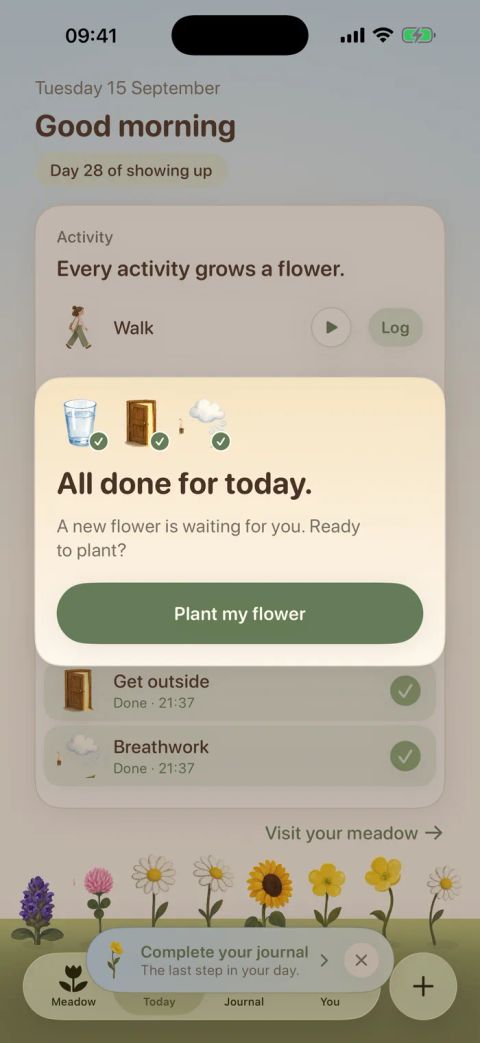
Another app worth checking out is Meadow, because it tracks a walk the way a habit tracker should when weight is the backdrop, which is gently. It is a habit tracker for iPhone made by Wildcard Wellness, where you tick off movement you enjoy, note your mood and a daily win, and watch a wildflower grow for each day you show up. There are no streaks, so a missed day resets nothing and your flowers never wilt, which fits a plan built for months rather than one you defend day to day. Meadow is $39.99 a year or $9.99 a month after a seven-day free trial.
That soft framing matters here. A tracker that punishes a missed day quietly teaches you that one gap is a failure, when the whole point of a weight-focused habit is the walk you take tomorrow.
When to talk to your GP
If you have not been active for a while, or you have a health condition or any concerns, speak to your GP before you build up, because a general plan cannot account for your particular situation. A GP can also point you towards the right support if your weight is affecting your health, which reaches well beyond walking. The NHS keeps a healthy weight section covering diet, activity and support services, and diet is where most of the weight question sits.
Common questions
How much do I need to walk to lose weight?
There is no single amount that works for everyone, and the CDC is clear that activity needs vary a lot between people. As a starting point, the 150 minutes a week of moderate activity the NHS recommends is a good health baseline, and Cleveland Clinic suggests building towards around 300 minutes a week if weight loss is the aim, paired with changes to how you eat.
Can I lose weight by walking without changing my diet?
Sometimes a little, usually slowly. The CDC notes that most weight loss comes from eating fewer calories, so walking tends to work best as a partner to diet changes rather than a substitute, and it is easier to eat calories than to walk them off.
Is walking better than running for weight loss?
Both burn energy, and the better one is the one you keep doing. Walking is kinder on the joints and easier to repeat for most people, which is part of why brisk walking shows up so well in the research over months of consistency.
How long before I see results?
Health improvements like steadier energy and better mood can arrive within a couple of weeks, while any change in weight tends to be gradual and depends heavily on the rest of your routine. Judge the habit by whether you kept it, not by the scales in week one.
Does the walk have to be brisk?
Brisker walking gives you more return for the same time, using the NHS talk-but-not-sing test, but any walking beats none. Start where you are and let the pace build on its own.
Pick one slot for a short walk tomorrow, decide when and where, and treat turning up as the whole of the goal. That is a walking habit starting, with no number on the scales attached to it.
If you want to go further, our guides on the wider benefits of walking, building routines through tiny habits, and how many steps a day to lose weight each pick up a thread of this one.
Every little bit counts
Five minutes counts. So does a dance in the kitchen.
Log the movement you enjoy and the small habits that help you feel good, and watch them bloom into something you can see.
Join the Meadow waitlist