The four laws of behaviour change are James Clear's rules for building a good habit: make it obvious, make it attractive, make it easy, and make it satisfying. Flip each one and you get his method for dropping a bad habit, where you make it invisible, unattractive, difficult and unsatisfying. Clear set them out in Atomic Habits, and the reason they caught on is simple. They give you four separate places to push instead of one blunt lever called willpower.
The laws are not a fifth thing to memorise on top of the habit loop. They sit directly on it.
That distinction is the whole trick, so it's worth getting straight before you try to use any of them.
Where the four laws come from
Every habit runs on a short loop: a cue, a craving, a response and a reward. The cue is the trigger, the craving is the wanting it stirs up, the response is the thing you do, and the reward is what you get for doing it. We pull that loop apart in our guide to the habit loop, which is the mechanism underneath all of this.
Clear took the four parts of that loop and turned each one into a question you can act on. The cue is where make it obvious lives. The craving is make it attractive. The response is make it easy. The reward is make it satisfying. So the laws are not a rival theory of how habits work. They're four handles fixed to the four parts of one machine, which is why you can grab whichever one is giving you trouble and leave the rest alone.
Build a good habit, one law at a time
You do not have to work all four at once. Most habits fail at one point, so find the weak link and start there.
Make it obvious
A habit needs a trigger you'll notice without thinking. The most reliable one is something you already do every day, so you bolt the new action onto it. Clear calls this habit stacking and gives it a formula: "After [CURRENT HABIT], I will [NEW HABIT]." He's firm that the cue has to be exact. "When I close my laptop for lunch, I will do ten push-ups next to my desk" beats a vague "when I take a break", because a loose cue has no moment to live in and drifts to a later that never comes.
The second half of this law is your surroundings. Leave the thing you want to do in plain sight. The water glass by the kettle. The trainers by the door. You're making the cue impossible to walk past.
Make it attractive
We do things we look forward to and skip things we dread, so the second law is about tilting the habit towards the first camp. Clear's main tactic here is temptation bundling, where you pair a habit you want to build with something you already enjoy. Only listen to the podcast you love while you're out walking. Only watch the show you're hooked on while you're on the exercise bike. The treat and the habit arrive together, so wanting one pulls you into the other.
Make it easy
Most habits die at the starting line, because getting going takes more effort than we have on a flat day. So you strip the friction out and shrink the first move down to something you could manage in a couple of minutes. Not a workout but one stretch on the mat. Not a full tidy but clearing one surface. A tiny opening move clears the bar even on your worst day, and it tends to grow on its own once you've started. Our guide to tiny habits goes into this properly, because it's the law most people get wrong by aiming too big.
Make it satisfying
The first three laws get you to do the habit once. The fourth is what makes your brain want to do it again. A reward has to land while you're still paying attention, or the loop never learns that the effort paid off. Some habits carry their own quick payoff, like the calm after a few slow breaths. Many don't, so you add a small one you can feel now, and the easiest is a mark that says done. A meta-analysis of 138 studies found that prompting people to keep an eye on their progress towards a goal improved how often they reached it, so ticking a box is a real help and not busywork.
Break a bad habit with the same four laws, flipped
To drop a habit you don't want, Clear runs the laws backwards. Make it invisible, unattractive, difficult and unsatisfying.
Making it invisible means pulling the cue out of your world. If the biscuits are on the counter you'll eat them, so they go on a high shelf or off the shopping list. If the phone drags your evening away, it charges in another room. You're not fighting the urge. You're removing the thing that starts it.
Making it unattractive means changing how you frame the payoff, reminding yourself what the habit costs you rather than what it hands you in the moment.
Making it difficult is the reverse of make it easy. You add friction so the behaviour takes a few more steps. Log out of the app so it asks for a password. Unplug the television after each use. None of this makes the habit impossible, and it doesn't have to. It only has to buy a pause long enough for the autopilot to hand the decision back to you.
Making it unsatisfying means adding a small cost to the slip, like telling someone you'll report in, so there's a downside your brain can feel. Our full guide to breaking a bad habit walks through the swaps and the slips in more depth, but the shape is the mirror image of building one.
Run one habit through all four
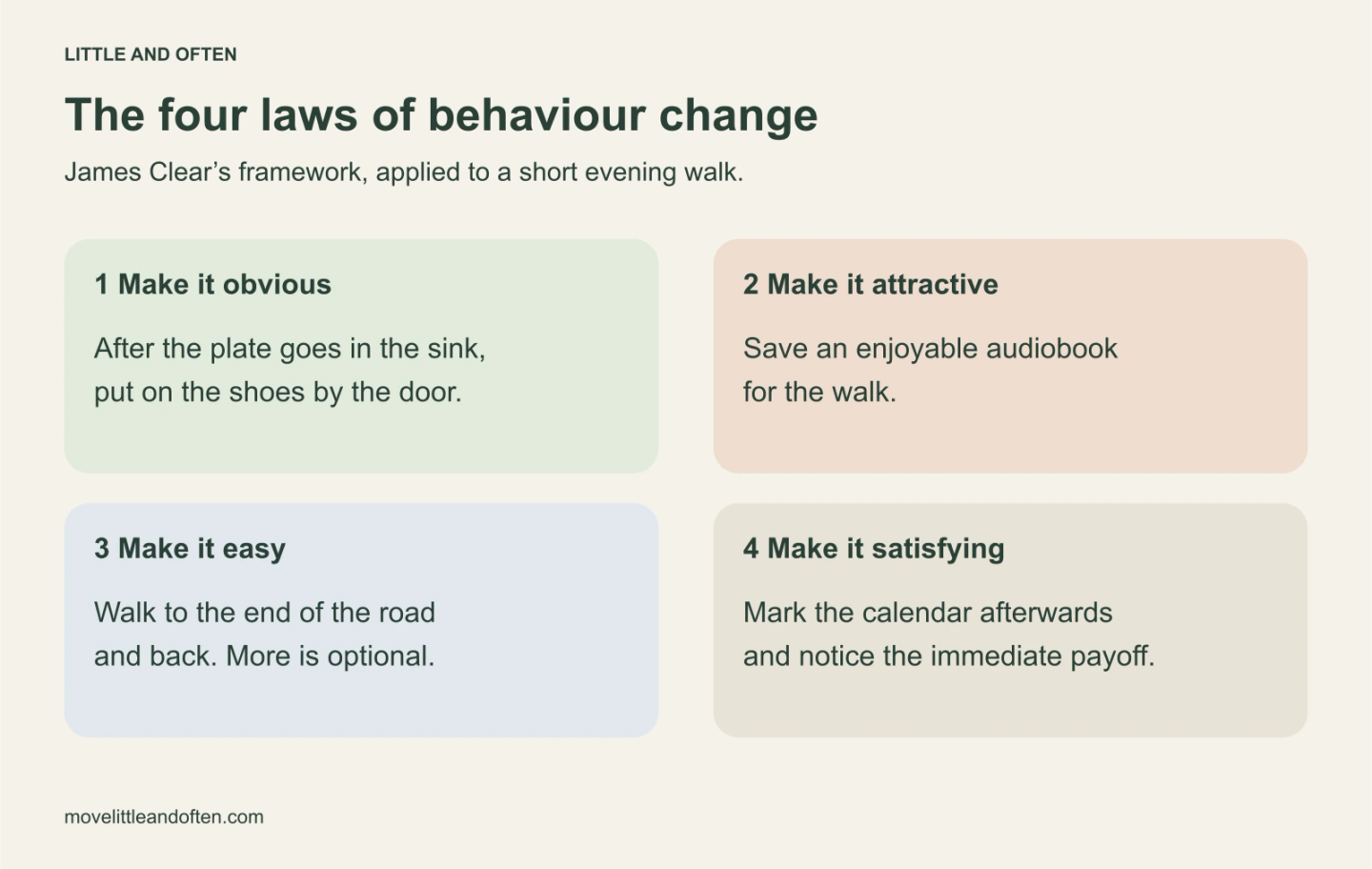
The laws click into place once you push a single habit through every one of them. Here's a blank template to fill in.
Habit: __________
Make it obvious (the cue it follows, and where): __________
Make it attractive (a want you'll pair it with): __________
Make it easy (the smallest honest version): __________
Make it satisfying (the payoff you'll notice straight after): __________
Filled in for a short evening walk, it might read like this.
Habit: a short walk after dinner
Make it obvious: after I put my plate in the sink, I lace up the shoes I've left by the back door
Make it attractive: I only let myself play the audiobook I'm hooked on while I'm walking
Make it easy: the walk is to the end of the road and back, about five minutes, and anything longer is a bonus
Make it satisfying: I tick the day off on the calendar by the door and notice how much clearer my head feels
Four short lines, and a habit that was floating around as a good intention now has a cue, a pull, a size and a payoff. If it slips later, you'll usually be able to point at the line that's gone soft.
What holds up, and what's popular but thin
The four laws are a well-organised synthesis by a practitioner, not a scientific theory that's been tested as a whole. That's worth saying plainly, because the framework is often passed around as though it were settled science. It's better thought of as a clear map, and some parts of the map rest on firmer ground than others.
Make it easy and make it obvious line up well with decades of habit research. Wendy Wood and David Neal, whose work sits at the centre of the field, describe habits as learned associations between a context and a response, so reshaping your surroundings and cutting friction work on the actual lever rather than on your resolve.
Make it satisfying has decent support too, since monitoring progress is one of the better-studied moves in the whole area.
Make it attractive is the law to hold more loosely. Temptation bundling has one well-known trial behind it. Katherine Milkman and colleagues gave gym-goers audiobooks they could only hear at the gym, and the keenest group visited 51% more often at first. The catch is in the same paper: "treatment effects declined over time (particularly following Thanksgiving)." So the tactic can give you a genuine early push, and you shouldn't count on it holding a habit together by itself.
One honest note runs across all of it. There's no fixed number of days after which a habit is done. In the best-known real-world study, people took a median of 66 days to reach their peak of automatic behaviour, but the range ran from 18 days to a predicted 254, depending on the person and the habit. Judge yourself by whether you're still turning up, not by a deadline you invented.
How to use this without overthinking it
Pick one habit and one law, the law where it keeps breaking. If you forget to do the thing, work on make it obvious. If you can't get started, work on make it easy. Fixing the weak point does more than half-doing all four.
Decide now what the habit looks like on a day when even the small version feels like too much, because that bad-day version is what keeps the thread unbroken. If the plan is a five-minute walk, the hard-day version is stepping out the front door and back. If it's one page of a book, it's opening the book on the right page and reading a line.
When you miss, and you will, treat it as one skipped rep and nothing more. The same study that gave us the 66-day median found that a single missed day had little impact on the habit forming, so one gap doesn't undo the weeks behind it. Most of the harm comes from the story afterwards, the sense of having blown it that turns one skipped evening into a fortnight of nothing. Keep your earlier marks, forgive the gap, and start again at the next chance.
Make the reward one you can see
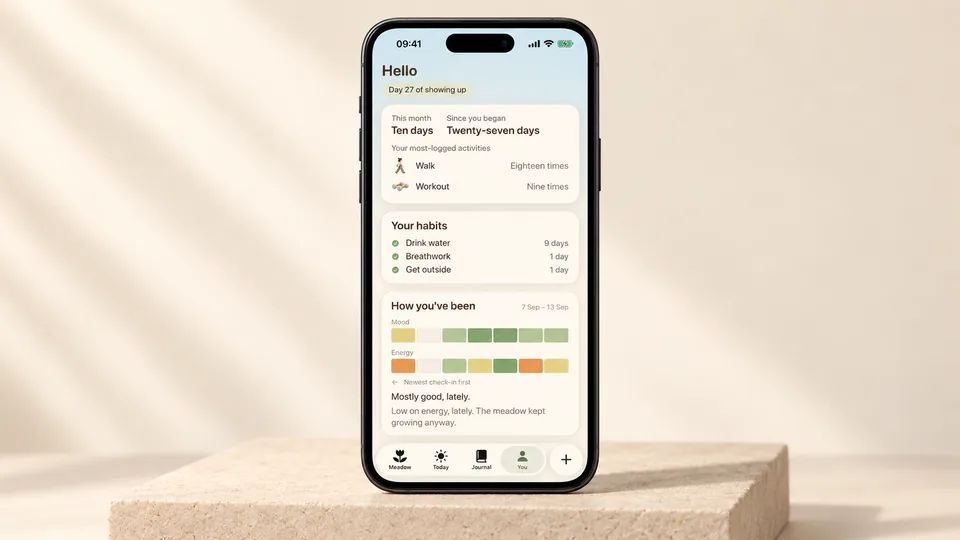
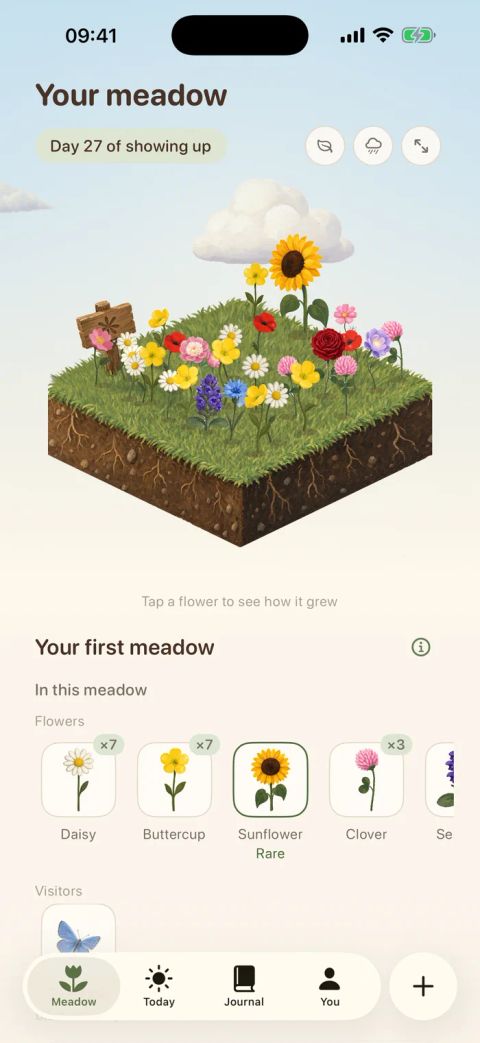
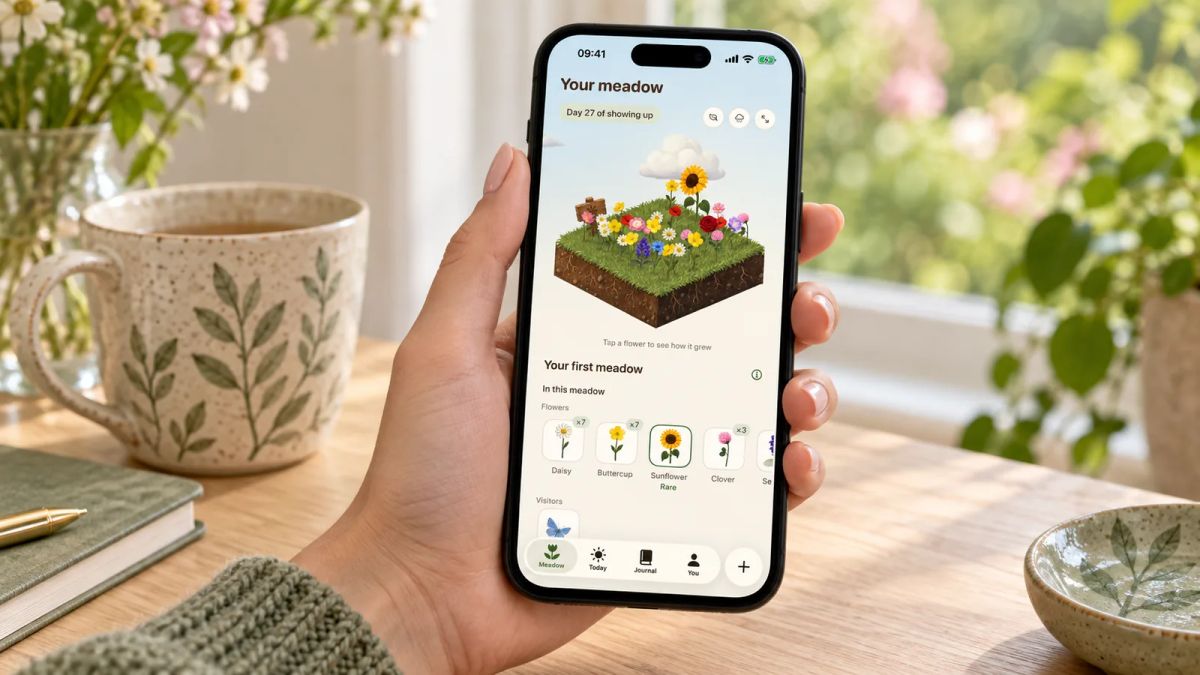
The fourth law is the one a phone can help with, because a satisfying payoff is easier to feel when you can watch it build. Meadow turns each day you show up into a wildflower. It's a gentle movement and habit app for iPhone from Wildcard Wellness, where you tick off a small daily habit, log a walk or a few minutes of yoga, and note your mood, energy and a daily win. Each time you turn up, a new flower blooms in your own meadow, so the reward for the habit is something you can see grow. There are no streaks, so a missed day resets nothing you've built, which fits a habit you're still teaching yourself to keep.
Frequently asked questions
What are the four laws of behaviour change?
They're James Clear's four rules for building a habit, from Atomic Habits: make it obvious, make it attractive, make it easy, and make it satisfying. Each one maps to a stage of the habit loop, so the cue, the craving, the response and the reward each get a rule you can act on.
How do you break a bad habit with them?
You invert every law. Make it invisible by removing the cue, make it unattractive by facing what it costs you, make it difficult by adding friction, and make it unsatisfying by attaching a small cost to the slip. The same four levers work in reverse.
Are the four laws scientifically proven?
The framework as a whole is a practitioner's synthesis, not a single tested theory. The pieces underneath it have research behind them to different degrees, with cue and friction work on firmer footing than temptation bundling, which rests on one trial whose effect faded over time.
Do I have to use all four at once?
No. Most habits break at one point, so it's more useful to find that weak link and work the matching law than to set up all four and lose track.
How is this different from the habit loop?
The habit loop is the mechanism, the cue, craving, response and reward that runs whether you plan it or not. The four laws are the instructions for steering that mechanism on purpose, one rule per part.
One thing to do today
Take one habit you're trying to build and run it through the four-line template above, filling a cue, a pairing, a small first move and a payoff you'll feel. Don't try to change your behaviour today. Get the four lines written down, because a habit with all four laws answered is far more likely to survive the week than a good intention with none of them.
AUTHOR
Co-founder of Meadow.
Ash is co-founder of Meadow, a habit and movement tracking app that turns small acts of self-care into a growing wildflower meadow.
Little and often, with Meadow
Consistency, not intensity.
Meadow turns the movement you enjoy and the habits that help you feel good into a meadow of wildflowers. No streaks to break, and your flowers never wilt.
Download Meadow