The 2 minute rule says to shrink a new habit down until it takes about two minutes, so the starting is too small to dread. That is the version James Clear made popular in Atomic Habits, and it is the one most people mean. There is an older rule with the same name, though, from David Allen's Getting Things Done, and the two get muddled all the time.
This guide covers both, keeps them straight, and is honest about what the rule can and cannot do on its own.
Two rules that share a name
James Clear's two-minute rule is about starting a habit. You take whatever you want to build and cut it to a version you can finish in roughly two minutes. "Read more" becomes read one page. "Do yoga" becomes roll out the mat. Clear's own line is that "when you start a new habit, it should take less than two minutes to do". He calls the small version a gateway habit, the doorway that leads into the bigger behaviour.
David Allen's two-minute rule is about clearing small tasks, and it came first. In Allen's version, any action you can finish in under two minutes gets done the moment it turns up. His reasoning is that parking a tiny job and coming back to look at it again later costs you more time than the job itself. Answer the one-line email now. Rinse the mug now. Book the appointment now instead of adding it to a list you'll re-read five times.
One rule helps you begin a habit. The other stops small jobs from stacking up. Clear credits Allen's rule and aimed his own version at habit-building instead of admin, which is why they sound alike. Keep them apart and both earn their place. Blur them and you end up trying to "power through" a full workout in two minutes, then feeling like a failure when you can't.
Most of this guide is about Clear's habit version, because that is the one people search for when they want to change something. Allen's gets its own section near the end.
Why two minutes is enough to start
For most habits, the hard part is getting going. Putting on your running shoes takes a fraction of the effort of the run, yet the shoes are where the resistance sits, because starting is the moment you have to overcome your own inertia.
Clear's point is that the first two minutes should be easy, even if what comes after them is hard. Make the entry point almost weightless and you stop needing a burst of willpower to cross it. Once the shoes are on, the walk often follows on its own. Once the page is open, you tend to read a second. Something already moving is easier to keep moving, and that is most of the trick.
There is a second reason it helps, and it is quieter. A big habit needs two things you can't rely on: a clear stretch of time and the energy to fill it. A two-minute version needs neither, so there is no day too rushed or too flat to fit it in. On your worst evening you can still open the notebook and write one sentence, and the thread stays unbroken.
The size looks almost pointless, and it is meant to. You are not trying to get fit or well-read in one sitting. You are making the start so light that it stops being a decision you have to win every single day.
There is an identity angle too. Clear argues that what you do now reflects who you currently believe you are, and that small repeated actions are how you prove a new identity to yourself. Each time you do the two-minute version, you cast a small vote for being the kind of person who reads, or moves, or writes. Two minutes done today builds that self-image far better than twenty minutes you keep meaning to do.
How to use the habit version
The method is short. The care goes into being specific.
- Name the habit you want. The real one, full size. Run three times a week. Read every night. Stretch each morning.
- Scale it down to a two-minute doorway. Ask what the first two minutes of that habit look like, then make that the whole target. Clear's own examples work well here: reading becomes read one page, running becomes lace up your shoes, studying becomes open your notes.
- Tie it to a fixed moment in your day. "After I make my morning coffee" holds up better than "in the morning", because a vague habit has no moment to live in and drifts to a later that never comes. This is the same move as habit stacking, and the two work well together.
- Do only the two minutes and let that count as a win. If more follows, good, but the target was two minutes and you hit it.
The rule people break is the fourth one. They quietly promote the two-minute version to a twenty-minute one after a good week, and the first hard day sends them back to nothing. Keep the official target at two minutes and treat everything above it as a bonus you didn't owe.
This overlaps with tiny habits, BJ Fogg's method, but they are not the same tool. Fogg builds a full recipe: an anchor you already do, a tiny behaviour, and a celebration straight after to wire it in. Clear's two-minute rule is narrower. It is one move, scaling the action down, and it says nothing about celebrating. If you want the fuller system with an anchor and a reward, read the tiny habits guide. If you want the single lever that gets you off the sofa tonight, the two-minute rule is it.
Fill in your own two-minute version
Here is a worksheet you can copy. Three lines and you have a plan.
The habit I want: ________
Its two-minute version: ________
I'll start it after: ________
Some filled examples across an ordinary day:
The habit I want: read more · Two-minute version: read one page · Start it after: getting into bed
The habit I want: move every day · Two-minute version: put my walking shoes on and step outside · Start it after: the lunchtime kettle
The habit I want: stretch in the mornings · Two-minute version: one hip stretch on the mat · Start it after: brushing my teeth
The habit I want: tidy as I go · Two-minute version: clear one surface · Start it after: dinner
Notice the start cue is an event, not a clock time. "After the lunchtime kettle" survives a day that slips by an hour, where "at 1pm" does not. Pick a moment that already happens without fail and leaves a natural gap right after it.
If you can, pick a morning cue. A 2024 systematic review from the University of South Australia, which pooled habit studies covering more than 2,600 people, found that habits tended to form more readily when people did them in the morning and when they enjoyed the behaviour. A two-minute version of something you like, tucked into the start of the day, has both on its side.
Start with one line, not four. One habit tied to one cue is easy to keep honest, and you can add another once the first runs by itself.
When to let the habit grow
Two minutes is where you start. It isn't meant to be where you stay forever.
Clear's phrase for the order of play is standardise before you optimise. A habit has to exist before it can be improved. In an interview about the rule, he adds that people stall because they fixate on the perfect version and don't let themselves show up in a small way. So the first job is turning up. The second job, much later, is making the session longer.
A sensible sign that it's time to grow is when the two-minute version happens without you thinking about it, and you often carry on past it anyway. Then nudge the target, a page becomes a chapter or the shoes-on walk becomes ten minutes round the block. Grow it in small steps and keep the two-minute version in your back pocket for rough days. If a bigger target starts getting skipped, drop back to the last size that stuck and keep the habit alive through the busy patch.
David Allen's version: do it now
Allen's rule is worth using on its own terms, and it fits a different problem. When a small task appears and you can finish it in under two minutes where you're standing, do it right then instead of writing it down.
It clears the mental clutter of a dozen tiny open loops. The quick reply, the form that needs a signature, the dish in the sink. Each one is a small thing, but a pile of small things you're carrying around is heavy, and the tracking costs more than the doing.
The catch is that it works best once you are already reviewing your commitments. Dropped into a normal day with no system behind it, "do every two-minute task now" can turn into constant interruption, where you never finish the deep work because you keep breaking off for admin. Todoist's guide to the rule makes the same point about context switching and suggests blocking focus time for big work, then saving two-minute jobs for when you're processing your inbox or new to-dos. Use it at those moments, not as a licence to answer every ping the second it arrives.
Where the two-minute rule stops working
The rule is a way in, not the whole habit, and it is fair to say so plainly.
Two minutes of reading will not make you well-read. Lacing your shoes is not a training plan. The rule's job is to get you started reliably, and at some point the habit has to grow into something that does the real work. The two-minute version keeps the door open on bad days. It is not the room.
It also does nothing about the pull of the old behaviour. If your evenings default to a screen, "read one page" still has to win against a habit that is already automatic, and that takes more than a small target. The wider mechanics of cue, routine and reward are worth understanding here, and our guide to the habit loop walks through them.
And it will not give you a tidy timeline. In the best-known real-world study of habit formation, people took an average of 66 days to reach their peak of automaticity, but the range ran from 18 days to a predicted 254. A review by the same research group notes that simple actions, like drinking a glass of water, settled in faster than more demanding ones, like 50 sit-ups. The University of South Australia review landed in the same place. As ScienceDaily reports, the median was roughly two months, but the range ran from 4 days to 335. So there is no date by which two minutes "should" have clicked. Judge yourself by whether you are still turning up, which is exactly what we cover in how long it takes to build a habit.
The version for a very bad day
Decide now, while you're thinking clearly, what the habit looks like on a day when even two minutes feels like a mountain. If the habit is one page, the bad-day version might be opening the book on the right page and leaving it by the bed. If it is a step outside, it might be opening the front door and breathing the cold air for ten seconds. It sounds almost silly, and that is the point. It keeps the thread unbroken when the alternative is dropping the whole thing.
If you miss a day
One missed day is not the failure it feels like. In that same 66-day study, a single missed day had little effect on how automatic the behaviour went on to become. What does the damage is the story afterwards, the "I've blown it now" that turns one skipped page into a fortnight of none. Do the two-minute version at the very next chance and carry on. Clear has a name for this too, never miss twice, and it pairs neatly with a habit this small.
Watch a small start add up
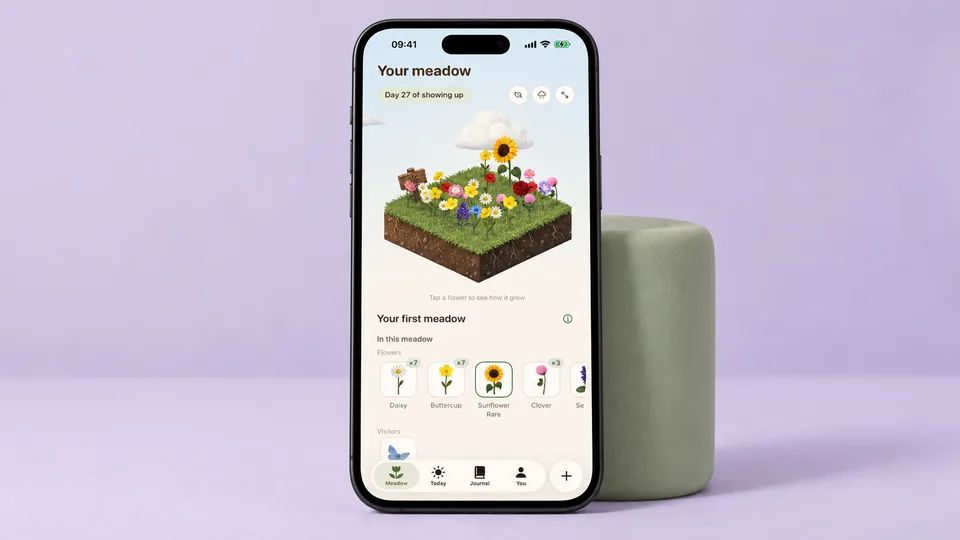
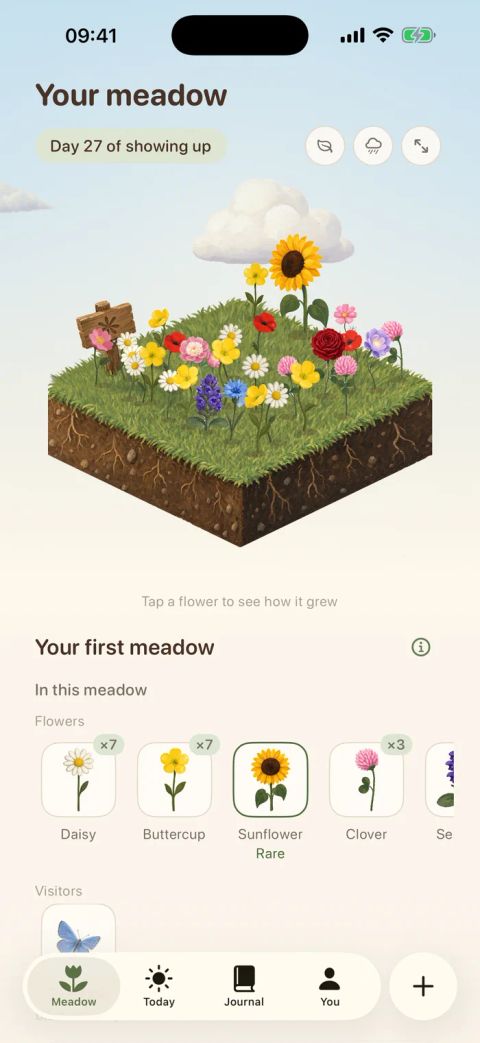
A two-minute habit pairs well with somewhere to mark it, because a small daily tick gives you that hit of "done" and, over weeks, shows you the pattern you have been quietly building. Meadow leans on the same idea the two-minute rule does, that turning up beats the size of the effort. It is a movement and habit app for iPhone from Wildcard Wellness where you tick off small daily habits, log a little movement with a timer, and note your mood and a daily win. Every day you show up grows a wildflower in your meadow, so two minutes you can barely feel yourself doing becomes something you can see. There are no streaks, so a missed day resets nothing and your flowers never wilt.
Common questions
What is David Allen's 2-minute rule? It's a productivity rule from Getting Things Done. If a task will take less than two minutes, do it as soon as it comes up, because tracking it and coming back to it later takes longer than doing it.
What are the downsides of the 2 minute rule? The habit version can stall at two minutes if you never let it grow, and it won't break an old habit on its own. The do-it-now version can splinter your day into interruptions if you apply it during focused work. Both are fixable, as the sections above show.
Is the 2 minute rule good for ADHD? It depends which version, and it varies from person to person. In ADDitude, ADHD coach Linda Walker argues that Allen's drop-everything version often backfires for adults with ADHD, because remembering to return to the original task and switching between tasks are the hard parts. Her alternative is a catch-all list you work through at a set time. Whether a tiny starting step helps you is something to test gently for yourself, and our guide to building habits with ADHD has more ideas. If ADHD, or a struggle to start things, is getting in the way of daily life, talk to your GP.
What is the 3-3-3 rule for productivity? It's a separate idea, usually credited to the author Oliver Burkeman. As Sahil Bloom describes it, you give three hours to your most important work, do three shorter tasks you've been avoiding, and fit in three maintenance jobs. The two-minute rule can help with the middle three, since opening a dreaded task for two minutes is often enough to get it moving.
Is the two-minute rule the same as tiny habits? They are close cousins. The two-minute rule is one move, shrinking the action so starting is easy. Fogg's tiny habits method wraps that in a full recipe with an anchor and a celebration. Use the rule when you want a quick lever, the method when you want the whole system.
What if two minutes turns into an hour? That is the rule working. The two minutes was only ever the entry point, and if momentum carries you further, take it. Keep the official target at two minutes so a rushed day still ends with a win.
Does it work for breaking a bad habit? Not directly. It is built for starting good behaviours. For those you are better off adding friction to the old habit, the reverse move the habit loop guide gets into.
Can I use it on a task I keep putting off? Yes. Todoist's guide suggests breaking a big, daunting project into a two-minute first step to get past the stuck feeling. Commit to two minutes of the dreaded task, open the document and write the first line, or pull out the first pile of paperwork. You're allowed to stop after two minutes, and often you won't want to.
Which two-minute rule should I use? Both, for different jobs. Clear's starts a habit you keep putting off. Allen's clears the small tasks cluttering your head.
Pick one habit right now and write its two-minute version in a single line: the habit you want, the two-minute doorway into it, and the everyday moment you'll start it after. Something like "read more, one page, after I get into bed." That line is the whole plan, and it is small enough to begin tonight.
AUTHOR
Co-founder of Meadow.
Ash is co-founder of Meadow, a habit and movement tracking app that turns small acts of self-care into a growing wildflower meadow.
Little and often, with Meadow
Consistency, not intensity.
Meadow turns the movement you enjoy and the habits that help you feel good into a meadow of wildflowers. No streaks to break, and your flowers never wilt.
Download Meadow