If you want one number for how long it takes to build a habit, the honest answer is that no dependable one exists. A new action becomes automatic somewhere between a couple of weeks and most of a year, and where you land depends on the habit you picked, on you, and on how much of normal life gets in the way. That range sounds unhelpful next to a tidy figure, and it is far more use to you, because the tidy figures were never built to hold up.
What decides whether a habit takes hold is not the calendar. It is how small you make the action, how reliably you tie it to something you already do, how little friction stands in the way, and whether you keep going after the days you miss. Get those right and the number of days mostly sorts itself out.
A habit is an action your brain has learned to run with barely any thought. The aim is to move a behaviour from something you decide to do each time into something that happens on its own when the moment arrives, and getting there is less about willpower than about setting the thing up so it survives a tired, ordinary day.
Why "21 days" is a myth
The "21 days to form a habit" line has been repeated so often that it feels like settled fact. No habit study sits behind it.
It came from a plastic surgeon. In his 1960 book Psycho-Cybernetics, Maxwell Maltz noticed that his patients seemed to take about three weeks to get used to a change like a new face or a missing limb, and he wrote that "it requires a minimum of about 21 days for an old mental image to dissolve", as James Clear has traced. Over years of retelling, the word "minimum" fell away, the surgery context vanished, and a loose observation about adjusting to change hardened into a promise about building habits that it was never making. Twenty-one days is a comforting idea and a poor guide.
What the research found
The more careful figure people reach for is 66 days, and that one does come from real work. It usually gets quoted in a way that drops the part that matters most.
It comes from a habit-formation study run by Phillippa Lally and colleagues, covered by the British Psychological Society. Volunteers each chose a daily action, repeated it, and rated how automatic it felt over about twelve weeks. The average time to reach maximum automaticity was 66 days, but the spread was enormous, running from 18 days to a predicted 254 depending on the person and the action. Roughly half the group had not settled into a habit at all by the time the study ended. A light action like drinking a glass of water bedded in far sooner than a demanding one, and the people who took on an exercise habit needed around one and a half times as long as those adding a new food or drink.
A 2024 systematic review pulled the wider evidence together. Reviewing twenty studies and 2,601 people across behaviours like activity, diet, flossing and drinking water, the authors reported median times to form a habit of roughly 59 to 66 days, average times stretching to between 106 and 154 days, and individual times ranging from as few as 4 days to as many as 335. Same conclusion, drawn from a much bigger pool: there is no shared finishing line everyone crosses.
So if you take one thing from all these numbers, let it be the width of the range rather than the midpoint. Treating 66 days as your target sets you up to feel behind when nothing has gone wrong. This is the opposite problem to breaking an established habit, where you are overwriting a routine that already has a groove worn into it. Here you are starting on an open patch of the day, which is the easier job of the two, though it still takes longer than three weeks.
What speeds it up
The timeline is not fixed, and a handful of choices reliably pull it shorter. None of them is willpower.
Keep the action small. The single most helpful move is to shrink the habit until it is almost too small to skip. Not "go for a walk" but "put my shoes on and step out the front door". Not "twenty minutes of yoga" but "one stretch on the mat". This is the heart of BJ Fogg's work on behaviour design at Stanford, which holds that making a behaviour easier is a more reliable route than trying to summon more motivation, because motivation rises and falls while a two-minute action stays doable. The test is whether you could manage it on your worst day of the month. If not, it is still too big. On days when you have more in you the action stretches by itself, so keep the official target tiny and let any growth arrive on its own. Our guide to tiny habits goes deeper on the method.
Tie it to a consistent cue. A small action still needs a home in your day, or it drifts to "later" and quietly never happens. The most dependable home is an existing routine you already do without thinking. The American Heart Association recommends fixing a new behaviour to an established one, so the new action rides along on a moment that already turns up every day. After I switch the kettle on, I do one stretch. An anchor like "after my morning tea" holds up better than "at 8am", because your clock might shift by an hour while the tea rarely gets missed. Start with one habit tied to one cue rather than a stack of them.
Lower the friction. Every extra step between you and the action is a chance to not bother. Put the shoes by the door, the glass on the side by the kettle, the book on the pillow. The less setup the moment demands, the more likely the habit survives a hectic morning, and small changes to where things sit do a share of the work that gritting your teeth cannot keep up.
Make sure it pays you back. A habit sticks faster when the action feels good rather than like a chore. The 2024 review found that how much people enjoyed a behaviour helped it become automatic, and that habits practised in the morning and ones people had chosen for themselves tended to form more strongly. Pick a version you can stand, do it early where you can, and notice the small good feeling when it is done rather than rushing past it.
Treat a missed day as nothing much. You will miss a day, then perhaps a run of them, and the habit will seem to vanish. That is ordinary. In the Lally study, missing a single chance to do the new behaviour had little effect on the habit that was forming. One gap does not undo the weeks behind it. The real damage comes from the story people tell afterwards, the "I've blown it now" that turns one skipped day into a fortnight of not bothering.
The smaller version, and getting back on after a gap
Every habit needs a setting for the days when even the small version feels like too much. Decide it now, while you are thinking clearly, so you are not negotiating with yourself at ten at night.
If your habit is one stretch, the bad-day version might be sitting on the mat for ten seconds. If it is a step outside, it might be opening the door and breathing the cold air for a moment. This sounds almost too small to count, and that is why it works. It keeps the thread unbroken when the alternative is dropping the whole thing.
To restart after a longer gap, go back to your cue and shrink the action right down for the first few days. The point is not to make up lost ground, which cannot be done anyway. It is to get the loop running again, and a tiny version does that far better than an ambitious one you abandon by Wednesday.
How long to expect, by type of habit
What you can expect depends on what you are asking of yourself. These are rough guides drawn from the research above, not promises, and your own timing may sit anywhere along the range.
Simple, low-effort habits (a glass of water with lunch, one daily stretch, a vitamin with breakfast): often start to feel smoother within a few weeks, because the action is easy and the cue is clear.
Medium habits with a bit of setup (a short daily walk, ten minutes of tidying, a few pages of reading): usually a couple of months of steady repetition before they run on their own.
Bigger, multi-step habits (a proper exercise routine, cooking from scratch most nights, an evening wind-down with several parts): commonly several months, and the exercise-style ones tend to take the longest of all.
The lesson across all three is patience with the calendar and care with the setup. You cannot make a habit form faster by wanting it more, and keeping the action small, the cue steady and the friction low makes it far more likely to form.
Keep a record somewhere you will see it
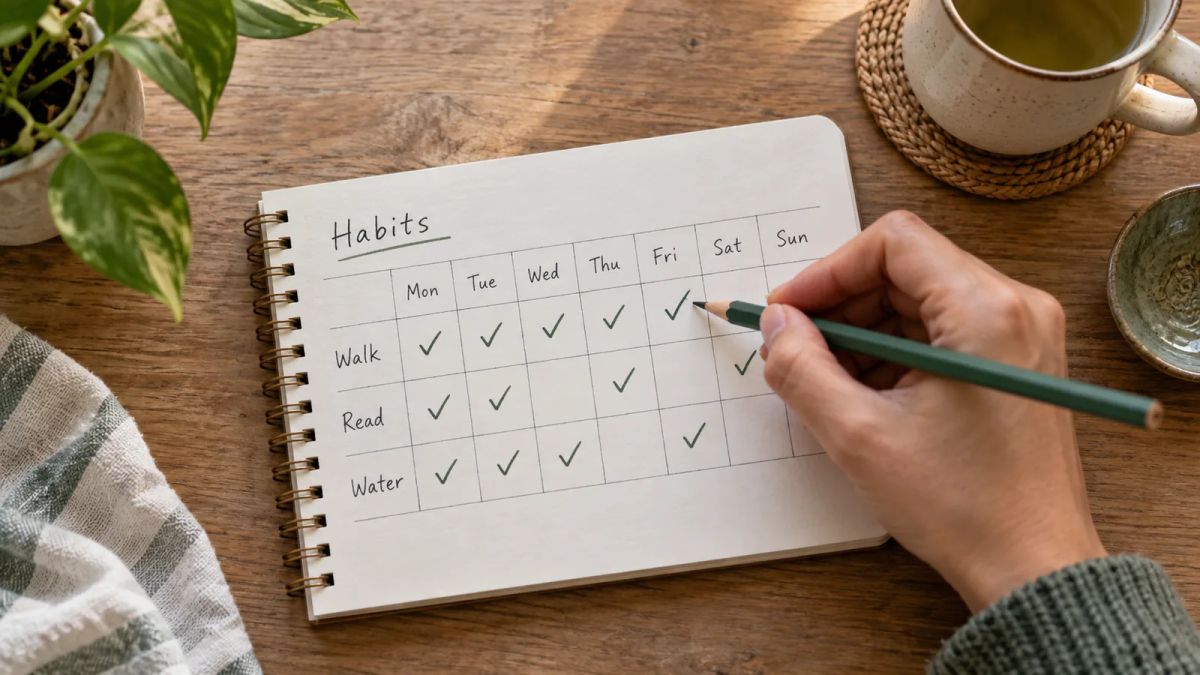
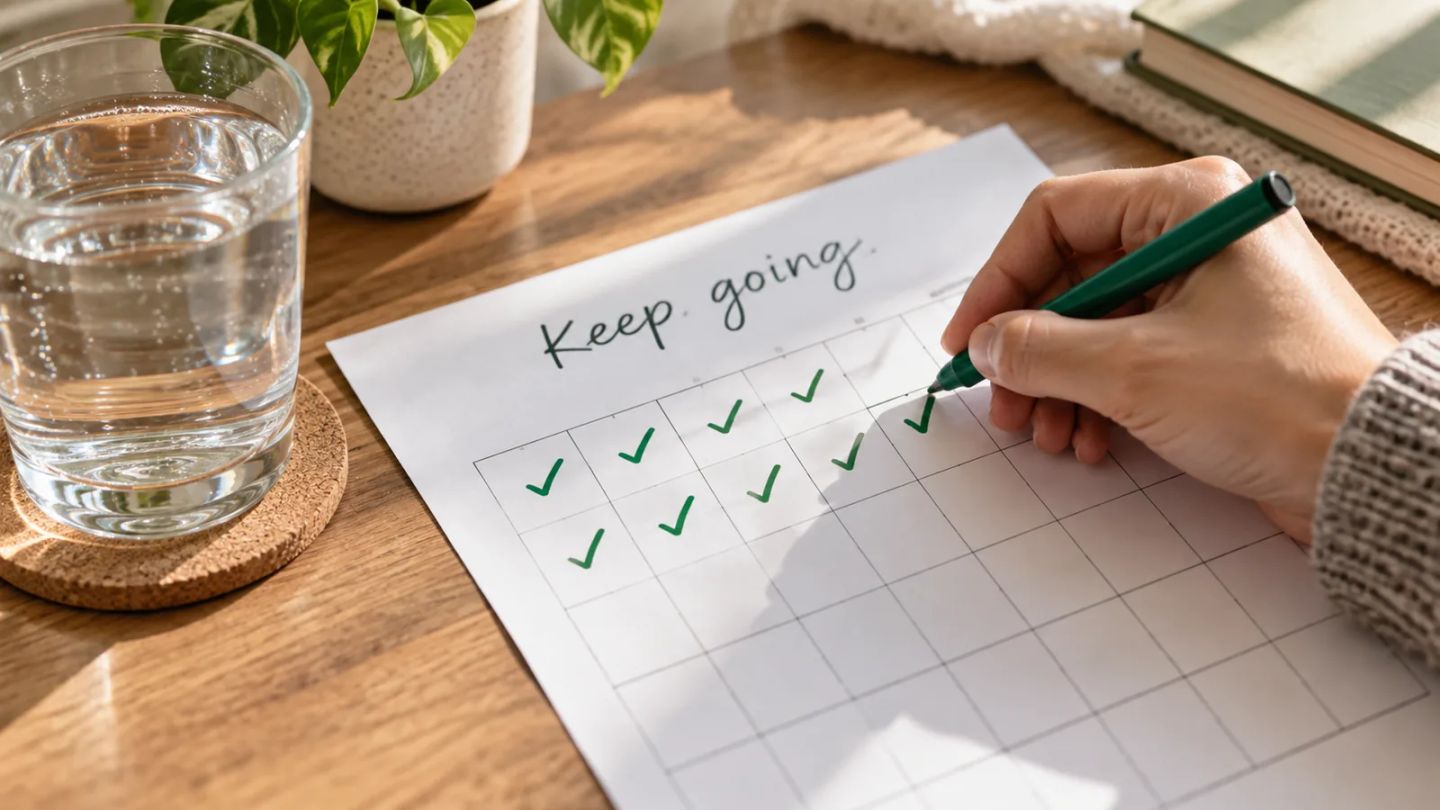
Watching your own progress helps more than it sounds like it should. A meta-analysis of 138 studies found that prompting people to monitor how they were doing towards a goal improved how often they reached it. Those goals varied a great deal, so a tick cannot promise to settle any one habit, and noticing whether you did the thing tends to help rather than feeling like a chore. A mark also gives you a small moment of "done" each day, and over weeks it shows the pattern you have been building.
Any format works, and the best one is the one you will look at. Write your plan on a single line before you start, blank first:
Habit: __________ Cue (after I…): __________ Bad-day version: __________
Mon ☐ Tue ☐ Wed ☐ Thu ☐ Fri ☐ Sat ☐ Sun ☐
And a worked example:
Habit: One glass of water Cue (after I…): switch the kettle on Bad-day version: one sip
Mon ☑ Tue ☑ Wed ☐ Thu ☑ Fri ☑ Sat ☐ Sun ☑
Keep it by the kettle, on the fridge or in a notebook you open daily. A phone habit tracker does the same job if you would rather tick a screen. The point is a home for the habit, not a perfect run of ticks.
Meadow, without the streak
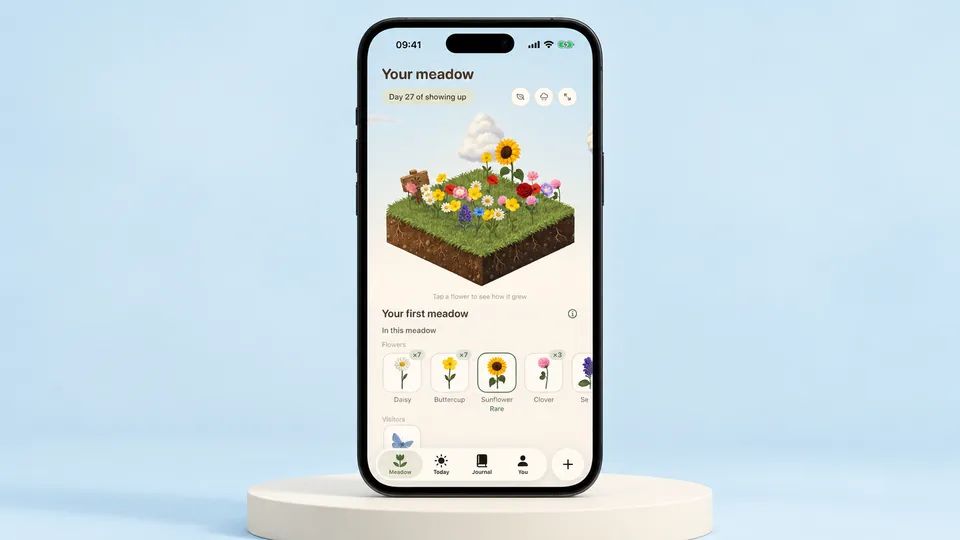
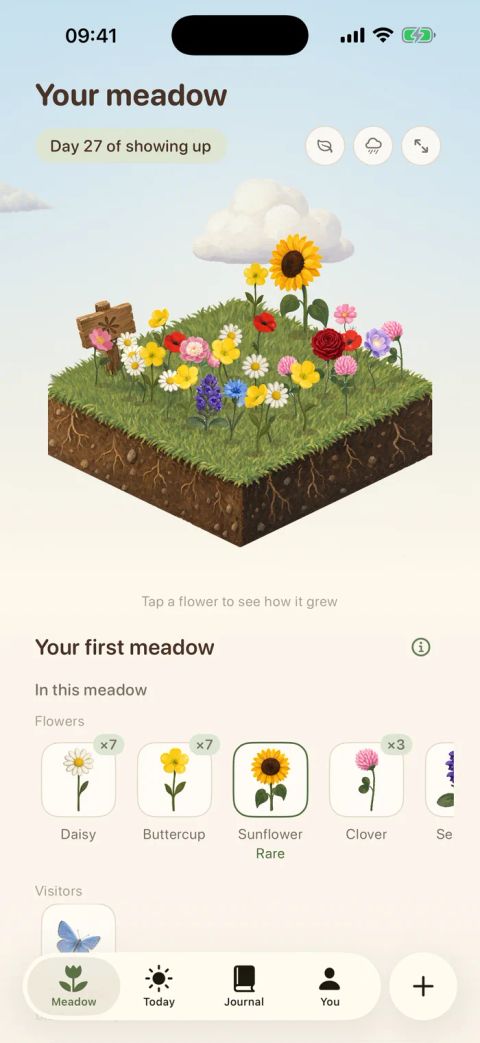
Another app worth checking out is Meadow, because its whole design leans into the pick-it-back-up thinking that a forming habit needs. It is a gentle habit tracker for iPhone, made by Wildcard Wellness. You tick off a small daily habit, log movement you enjoy like a walk or a little yoga, and note your mood, a daily win and a small affirmation. Every day you show up grows a wildflower, and rare flowers and little animal visitors turn up over time. There are no streaks, so a missed day resets nothing and your flowers never wilt, which matters when the research says one gap barely dents a habit anyway. It costs $39.99 a year or $9.99 a month after a seven-day free trial.
Common questions
Does it take 21 days to build a habit? No, not as a rule. The 21-day figure came from a plastic surgeon's notes on patients adjusting to surgery, not from any study of habits, and even then it was offered as a rough minimum. Some very light habits do settle in around that time, and plenty take two months or more, so treat 21 days as a myth rather than a target.
Where does the 66-day figure come from, and is it reliable? It is the average from Lally and colleagues' habit-formation study. It is a real result, but it sits on top of a range from about 18 days to well over 200, and a later review of twenty studies found individual times from 4 to 335 days. Use it to set your expectations at "a couple of months, give or take a lot", not as a deadline.
What if I miss a day, or several? A single missed day had little effect on habit formation in the research, so one slip is not the setback it feels like. A longer gap is a pause, not a verdict. Go back to your cue, shrink the action right down for a few days, and keep whatever record you were keeping rather than tearing it up.
How can I make a habit form faster? Make the action small enough to do on a bad day, attach it to something you already do daily, remove the friction around it, and pick a version you can stand doing. You cannot force the timeline, and those four moves reliably tilt it in your favour.
Is building a habit easier than breaking one? Usually, yes, because building starts on an open slot in your day while breaking means overwriting a routine your brain already runs on cue. The tools overlap a great deal, and our guide to how long it takes to break a habit covers the differences.
Right now, write one line naming the smallest version of your habit and the everyday moment it will follow, in the shape "after I do X, I will do Y". Keep the action small, tie it to a cue that happens daily, and measure yourself by whether you are still turning up rather than by any number of days. That single sentence is the plan, and it is small enough to start today.
Little and often, with Meadow
Consistency, not intensity.
Meadow turns the movement you enjoy and the habits that help you feel good into a meadow of wildflowers. No streaks to break, and your flowers never wilt.
Join the Meadow waitlist