Never miss twice is a rule for keeping a habit alive when life gets in the way: if you skip a day, make sure you don't skip the next one too. Miss once and it's a blip. Miss twice in a row and you've started to teach yourself the opposite habit, the one where you don't turn up.
The rule comes from James Clear's Atomic Habits, and it's the antidote to the all-or-nothing thinking that ends most good intentions early. This is a guide to what it means, why one missed day does far less damage than it feels like it does, and how to come back the next day without trying to make up for lost time.
What the rule says
Clear sets it out in a single line: "Missing once is an accident. Missing twice is the start of a new habit."
The first half is the permission. You will miss days. A meeting overruns, a child is up in the night, you're ill, you forget. None of that means you've failed at the habit, because a habit isn't a perfect record. It's a thing you do often.
The second half is the warning. The danger isn't the one skipped day. It's the second one, because two in a row starts to feel normal, and normal is exactly how habits form. So the target moves from "never miss" to something you can hit on a bad week: get back on the next day, every time. If you want the wider framework this sits inside, our Atomic Habits summary walks through the whole system.
One missed day does less than you fear
The reason the rule works is that a single gap barely touches a forming habit. It only feels catastrophic.
When Phillippa Lally's team at University College London followed 96 people building a new daily habit over 12 weeks, they looked closely at what happened when someone missed a day. As the British Psychological Society reported, "a single missed day had little impact on later automaticity gains, either early in the study or later on." One skipped day did not knock people off the path to a habit that ran on its own.
The same study is worth holding onto for a second reason. Time to reach an automatic habit ranged from 18 days to a projected 254, with wide variation between people. There's no fixed deadline you can fall behind, and no magic number of days after which you're safe. So a missed Tuesday isn't a broken schedule, because there was never a rigid schedule to break.
What derails people is rarely the miss itself. It's the story they tell afterwards, the one that says a single slip proves they were never going to manage it, so they may as well stop.
Why the rule protects you
Never miss twice does two useful things at once.
It takes the sting out of an ordinary bad day. When your whole plan hinges on an unbroken run, one empty box reads as total failure, and total failure invites you to give up completely. Dieting and addiction researchers have a blunt name for that spiral, the "what the hell" effect: you slipped once, so what the hell, the day's ruined, might as well abandon the lot. A rule that expects the occasional miss defuses that thought before it lands. One gap is part of the plan, not the end of it.
It also protects your momentum by keeping the run short. You're never more than a day from being back on track, which means you rarely build up the kind of long absence that's hard to return from. The habit stays warm.
There's a quieter benefit too, and it's about how you treat yourself after a slip. In a study by Michael Wohl and colleagues, students who forgave themselves for procrastinating before one exam went on to procrastinate less before the next. Psychology Today summarised the mechanism plainly: "self-forgiveness reduces procrastination by reducing negative emotions." Beating yourself up over a missed day keeps the guilt attached to the task, and guilt makes you want to avoid it. Letting the miss go makes tomorrow easier to face. Being kind about Monday is part of how you show up on Tuesday.
How to come back: the smaller version
The mistake people make on the comeback day is trying to pay off the debt. You missed a run, so now you'll do a double. You skipped two workouts, so today's has to be extra long. That's a fast route back to feeling defeated, because you've made the return harder than the original habit.
Do the opposite. Make the comeback almost too easy to skip.
- Shrink it right down. If the habit is a 30-minute walk, the comeback version is a walk to the end of the road. If it's ten minutes of yoga, it's rolling out the mat and doing one stretch. The point of the return day is to show up, not to perform.
- Anchor it to something you already do. The American Heart Association suggests attaching a new behaviour to an existing routine, so "after I make my morning coffee" gives the comeback a fixed moment instead of leaving it to drift.
- Forget the day you missed. There's nothing to make up. The only job is today, and the smaller version of today counts in full.
- Decide the rule now, while it's easy. Sitting in the guilt of a missed day is a bad time to make a clear-headed choice, so make it in advance: one miss means I go again tomorrow, no drama.
Here's a small comeback plan you can fill in for a habit you're building. Write the tiny version down before you need it, so it's ready on the day you don't feel like it.
My habit: ______________________
My comeback version (2 minutes or less): ______________________
When I'll do it: after ______________________
The rule: one miss is fine, I'm back the next day
Filled in, it might read like this.
My habit: a 20-minute evening walk
My comeback version (2 minutes or less): walk to the postbox and back
When I'll do it: after I clear the dinner plates
The rule: one miss is fine, I'm back the next day
Keep it where you'll see it. On a normal day you do the full habit. On a flat day you do the tiny version. Either way the streak of showing up, in the sense that counts, stays intact.
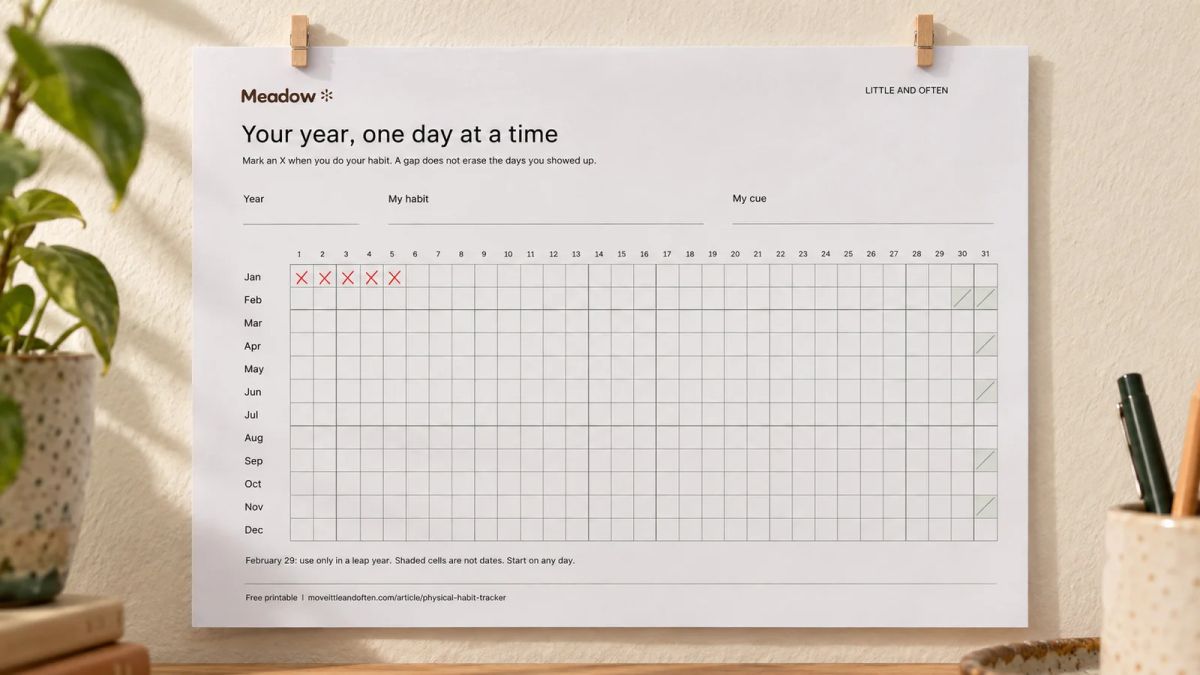
Open our free Habit restart plan (PDF). Choose a manageable comeback action, a reliable cue and a next opportunity. Use the review space to adjust after a break without catching up. Save or print it; no sign-up needed.
How it differs from a streak
Never miss twice looks like a cousin of the classic streak, but it flips the emphasis. A streak rewards the unbroken run and punishes the break, which works right up until the break, then often takes your motivation with it. Never miss twice assumes the break and cares only about the recovery. Our guide to the don't break the chain method covers the streak approach in full, including where its sharp edge tends to cut.
If you're the sort of person a broken streak sends into a spiral, the never-miss-twice framing is the safer one to build on. It gives you the pull of consistency with a built-in way back. For more on making that resilience part of a routine, see how to be consistent.
A place where a missed day costs nothing

Some tools are built around the exact idea behind this rule. Meadow is one of them, a gentle movement and habit app for iPhone from Wildcard Wellness.
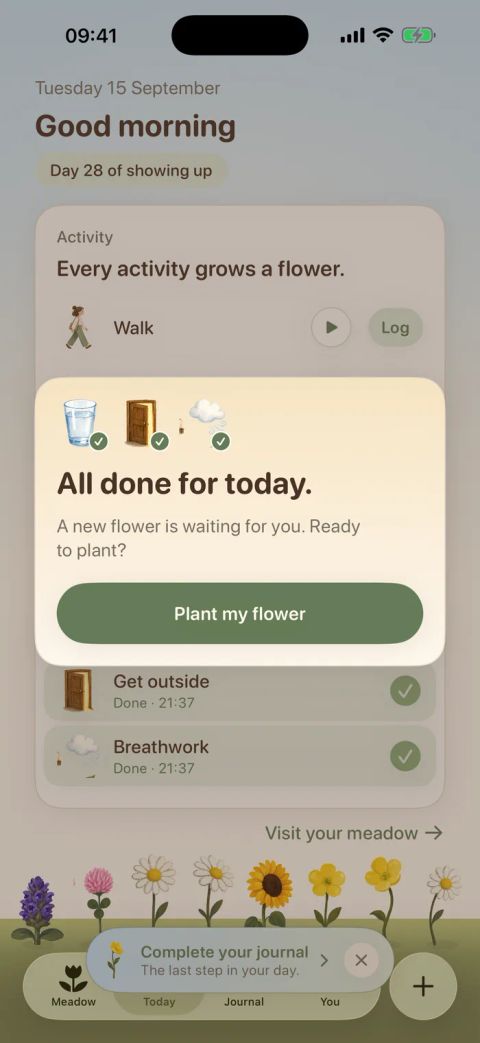
You log a walk or a few minutes of yoga, tick off a small daily habit, and note your mood and energy, and each day you show up a new wildflower blooms in a meadow that's yours alone. You can watch it fill in over the weeks, so there's real progress to see. What there isn't is a streak to break. Miss a day, a week or a month and nothing resets, and your flowers never wilt, so coming back the next day is the whole design rather than a rule you have to remember.
Frequently asked questions
What is the never miss twice rule?
It's a habit-keeping rule from James Clear's Atomic Habits: if you miss a day of a habit, make sure you don't miss the next one as well. One miss is treated as a normal slip, and two misses in a row is the thing to avoid, because that's where a new, unwanted pattern starts.
Where does never miss twice come from?
James Clear popularised it in Atomic Habits, with the line "Missing once is an accident. Missing twice is the start of a new habit." The idea builds on habit-formation research showing that a single missed day does little to derail a forming habit.
Does missing one day of a habit ruin it?
No. In Phillippa Lally's habit-formation study, a single missed day had little effect on how automatic the behaviour eventually became. Far more damage comes from deciding to abandon the habit after that one miss.
How do I get back on track after missing a day?
Do a smaller version the very next day. If the habit is a long walk, take a short one. Anchor it to something you already do, don't try to make up for the day you lost, and treat the miss as finished business.
Is never miss twice better than keeping a streak?
For many people, yes, because it removes the all-or-nothing trap. A streak can motivate you until it breaks and then talk you into quitting, while never miss twice expects the odd gap and focuses your effort on the comeback.
One thing to do today
Pick the habit you're building and write its comeback version now, before you ever need it: the two-minute, walk-to-the-postbox, one-stretch version you'll do on the day you don't feel like the real thing. Decide, in the same breath, that one miss means you're back tomorrow. That single sentence, written down while you're calm, is what keeps a missed day from turning into a missed week.
AUTHOR
Co-founder of Meadow.
Ash is co-founder of Meadow, a habit and movement tracking app that turns small acts of self-care into a growing wildflower meadow.
Every little bit counts
Five minutes counts. So does a dance in the kitchen.
Log the movement you enjoy and the small habits that help you feel good, and watch them bloom into something you can see.
Download Meadow