Tiny habits are new behaviours shrunk so small they take under a minute, then bolted onto something you already do every day. The method works because a tiny action asks almost nothing of you, so you can do it on a rushed morning or a flat evening, and it is the showing up, again and again, that turns a one-off into a habit.
The approach comes from BJ Fogg, a behaviour scientist at Stanford who coached thousands of people through it before writing the book Tiny Habits. His central point is blunt. Most habits fail not because you lack willpower but because you chose a version built for your best days, and your best days are not most days.
Shrink the action until it is almost too small to skip, tie it to a routine you already have, and let it grow on its own once the showing up feels normal. That is the whole idea. The rest of this guide is how to do it well, including the parts most articles gloss over: how to scale up, what to do when it stops working, and the truth about how long it takes.
What the tiny habits method is
Fogg builds each habit as a short recipe with three parts: after I [anchor], I will [tiny behaviour], then I celebrate.
The anchor is a routine you already run without thinking, like making your morning tea or brushing your teeth. It is the reminder, which means you are not relying on a phone alert or a spare bit of motivation to prompt you.
The tiny behaviour is the new habit cut down to its smallest honest version. Not twenty minutes of yoga but one stretch on the mat. Not a run but lacing up your trainers and stepping out of the door. Fogg's own example is two press-ups after he uses the bathroom.
The celebration is the step most people leave out, and Fogg argues it is the one that fixes the habit in place. Straight after the tiny behaviour, you do something that gives you a flicker of good feeling: a quiet "well done", a small fist-pump, a smile in the mirror. His shorthand is that emotions create habits, and that a hit of positive emotion right after the action tells your brain the behaviour is worth doing again.
James Clear, who wrote Atomic Habits, describes almost the same anchoring move and calls it habit stacking, with the formula "after [current habit], I will [new habit]". He makes one thing plain: be specific. "After I brush my teeth" beats "sometime in the morning", because a vague habit has no moment to live in and drifts to a later that never comes.
Why starting tiny works
A big habit needs two things you cannot count on: energy and a clear stretch of time. A tiny habit needs neither. When the action is one glass of water rather than "drink more water all day", there is no version of your day too busy or too tired to fit it in.
The small size does something to your head, too. The main reason we put a habit off is the effort of getting going, and a one-minute action removes most of that. Once your trainers are on, a short walk often follows without any extra push. Even on the days it does not, you have kept the habit alive, and the unbroken thread is what you are protecting.
There is a fair objection here: a single stretch or one glass of water looks too small to matter. It is meant to. You are not trying to get fit or hydrated in one session. You are making the starting so light that it stops being a decision you have to win every day.
The behaviour model behind it, in plain terms
Fogg sums up all behaviour in a short equation he calls B=MAP: a Behaviour happens when Motivation, Ability and a Prompt land at the same moment.
Picture three dials. Motivation is how much you want to do the thing. Ability is how easy the thing is. The Prompt is the nudge that says do it now. If any one of the three is missing, the behaviour does not happen, no matter how strong the other two are.
Motivation is the dial you cannot trust. It runs high when you are fresh and inspired and low when you are knackered, which is most evenings. So the tiny habits method stops leaning on it and turns up the other two instead. Make the action so easy that ability stays high even on a rough day, and let the anchor hand you a reliable prompt. Willpower stops being the thing holding the habit together.
Worked examples you can copy
Here is the recipe as a fill-in-the-blank template. Complete one line and you have a plan.
After I ________, I will ________, then I ________.
The first blank is your anchor, the second is the tiny behaviour, the third is your celebration. Some filled examples across an ordinary day:
After I pour my morning coffee, I will drink one glass of water, then I say "good start".
After I sit down at my desk, I will write one line in my journal, then I smile.
After I put the kids' shoes on, I will do one shoulder roll, then I tell myself "nice".
After I brush my teeth at night, I will lay out tomorrow's walking shoes, then I say "ready".
Each anchor is a fixed event, not a clock time. "After my morning tea" holds up better than "at 8am", because your day may slip by an hour but the tea rarely gets skipped. Pick an anchor that happens every single day and leaves a natural gap right after it for the new action.
Start with one recipe, not a stack of them. A single behaviour tied to a single cue is easy to remember and easy to keep honest. You can add another once the first runs by itself, and there is no prize for setting up five at once and losing track of them all by Thursday. If you want more starting points, our round-up of healthy habits is full of small actions that fit this template.
How to scale up without breaking it
The tiny version is the floor, not the ceiling. On days when you have more in you, the action stretches on its own. One stretch becomes a few. One glass of water becomes reaching for it through the morning. The step outside becomes a lap of the block, then a loop of the park. You are allowing the growth, not forcing it, and it tends to turn up once the starting takes no effort.
The trap is locking in the bigger version too soon. The moment you decide success now means the twenty-minute session, you have rebuilt the wall you knocked down, and the first hard day sends you back to nothing. Keep the official target tiny and treat everything above it as a bonus. That way a rushed day still ends with the box ticked and the habit survives to the next one.
When a tiny habit will not stick
Fogg's rule when a habit fails is to fix the design, not to blame yourself. Work through three checks, in this order.
- Make the behaviour smaller. If one stretch feels like too much on a bad day, the honest size is smaller than one stretch. Drop it to sitting on the mat for ten seconds. If you keep skipping it, it is still too big.
- Find a better anchor. A cue that only happens some days, or one with no room after it, will let the habit slide. Move it behind something rock solid, like the kettle going on or your head hitting the pillow.
- Strengthen the celebration. A flat "done" does less than a real moment of feeling good. Make the celebration bigger or more sincere until doing the habit carries a small glow.
The bad-day version
Decide now, while you are thinking clearly, what the habit looks like on a day when even the small version feels like too much. If your habit is one stretch, the bad-day version might be lying on the mat for ten seconds. If it is a step outside, it might be opening the front door and breathing the cold air. This sounds almost silly, and that is the point. It keeps the thread unbroken when the alternative is dropping the lot.
Restarting after you miss
Missing a day is not the failure it feels like. Data on real-world habit formation found that a single missed day had little impact on how automatic the behaviour eventually became. One gap does not undo the weeks behind it. What does the damage is the story people tell afterwards, the "I've blown it now" that turns one skipped session into a fortnight of nothing. This is the same trap that keeps bad habits in place, running in reverse. Keep your earlier marks, forgive the gap, and pick it up at the very next chance.
How long until it feels automatic
No one can give you an honest fixed number, and anyone quoting "21 days" is repeating a myth that traces back to a plastic surgeon's observation, not a study of habits. The best-known research puts the average nearer ten weeks, and it comes with a warning that the average hides a huge spread.
In that study people took a median of 66 days to reach their peak of automaticity, but the range ran from 18 days to a predicted 254. A simple action like drinking a glass of water settled in far sooner than a more demanding one. There is no single deadline you are failing to meet, so judge yourself by whether you are still turning up, not by whether it has clicked yet. If the timeline itself is on your mind, we go deeper in how long it takes to build a habit.
Keep a simple record
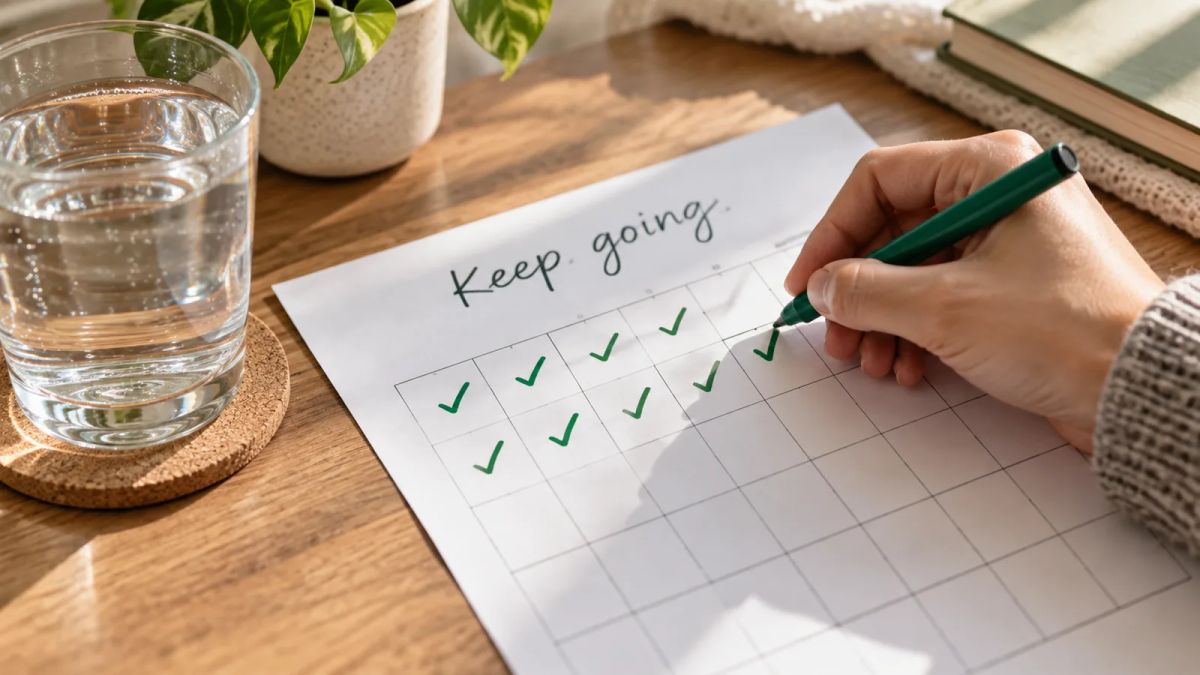
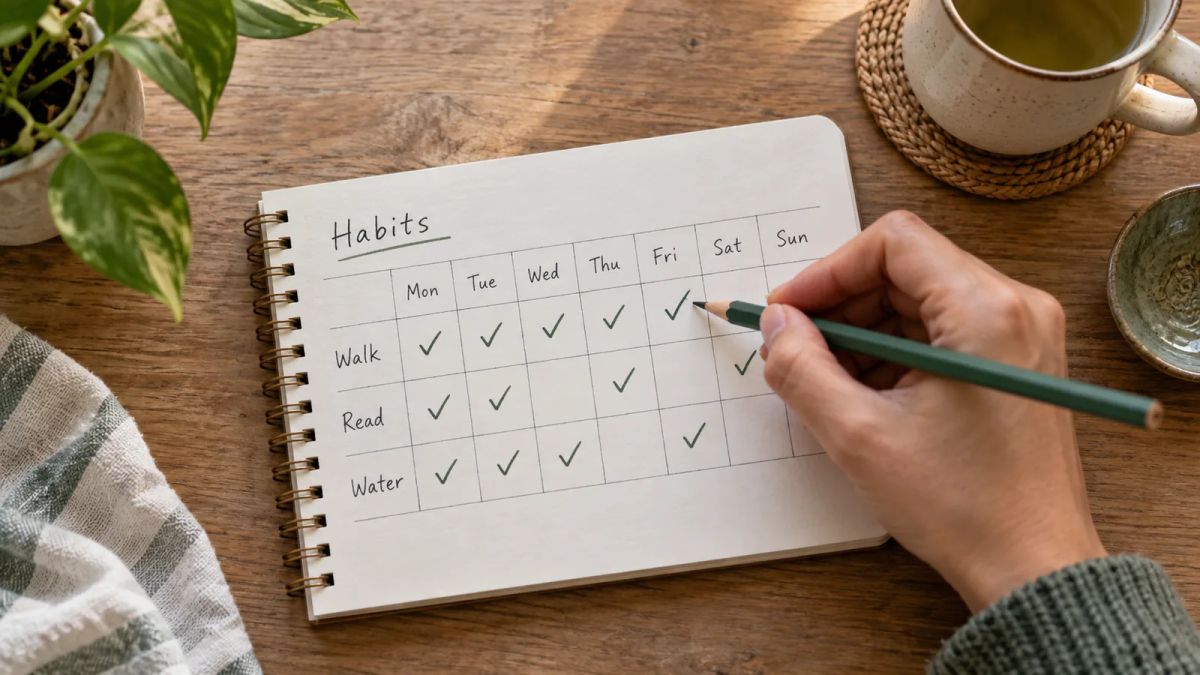
A tiny habit and a small daily mark go well together. The mark gives you a moment of "done", and over time it shows you the pattern you have been building. A meta-analysis of 138 studies found that prompting people to monitor their progress towards a goal improved how often they reached it, so a tick is a real help rather than busywork. The American Heart Association makes the same practical point about attaching a new action to an existing routine so it rides along on something you already do.
Use whatever you will look at again: a tick on the wall calendar by the kettle, a line in a notebook, a note on your phone. If a paper method suits you, our guide to using a habit tracker walks through it. The best format is the one that sits where the action happens.
Meadow, without the streak
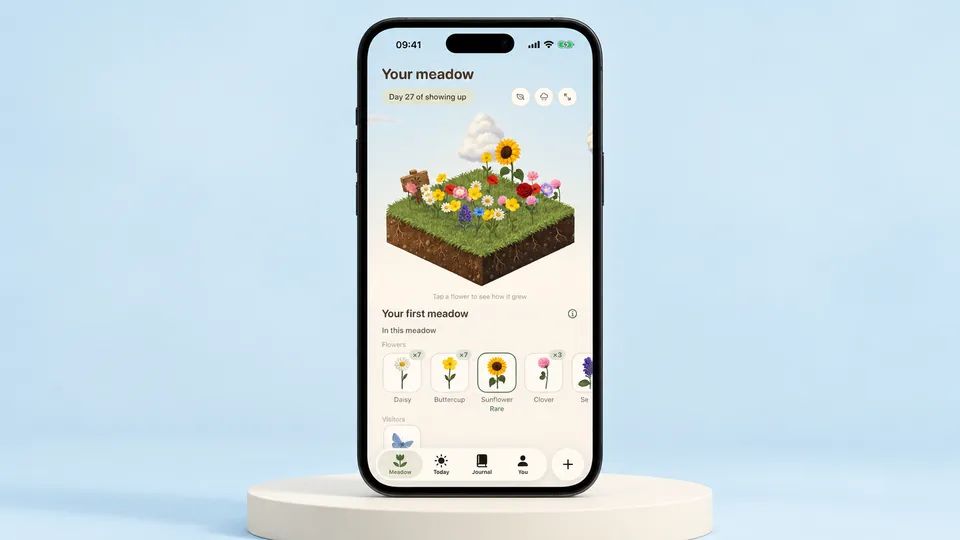
Another app worth checking out is Meadow, because it fits the tiny-habits idea rather than fighting it. Meadow is a gentle habit tracker for iPhone, made by Wildcard Wellness. You log movement you enjoy, like a walk, a dance or a little yoga, tick off small daily habits such as drinking water or getting outside, and note your mood, a daily win and a daily affirmation. Every day you show up grows a wildflower, and over time rare flowers and little animal visitors turn up in your patch. There are no streaks, so miss a day and nothing resets and your flowers never wilt, which suits the pick-it-back-up approach far better than a counter that punishes a gap. Meadow costs $39.99 a year or $9.99 a month after a seven-day free trial.
A few common questions
Do I need the celebration bit? It feels awkward at first, and it is easy to skip, but Fogg treats it as the engine of the whole method. The good feeling straight after the action is what tells your brain to repeat it, so give it a real go before you drop it.
How many tiny habits should I start with? One. Get it running on its own, then add a second. Trying to install several at once splits your attention and usually ends with none of them sticking.
How do I know if my habit is too big? Ask whether you could do it on your worst day of the month, the one with a migraine or a night feed or a double shift behind you. If the answer is no, shrink it further until the answer is yes.
Does a slip-up mean starting over? No. The habit is the pattern over weeks, not a spotless run. Keep the record you have, do the next rep, and carry on.
Right now, write one recipe in a single line: after an everyday moment you already have, one tiny action, then a small celebration. Something like "after my morning tea, one stretch, then I say well done". That sentence is the whole plan, and it is small enough to start today.
See how far you've come
Your habits, moods and little wins, all in one place
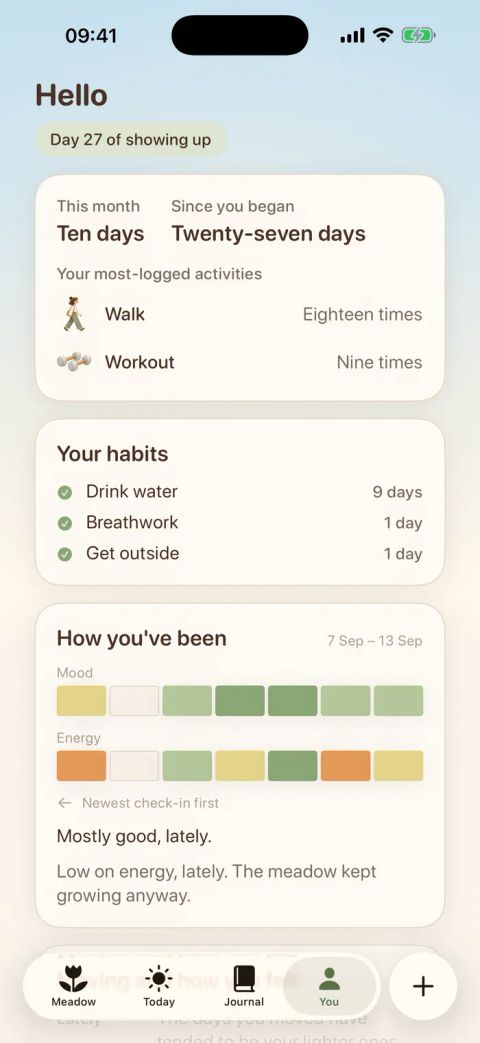
Meadow keeps track of the walks, the water and the good days, so you can look back and watch your effort add up.
Join the Meadow waitlist