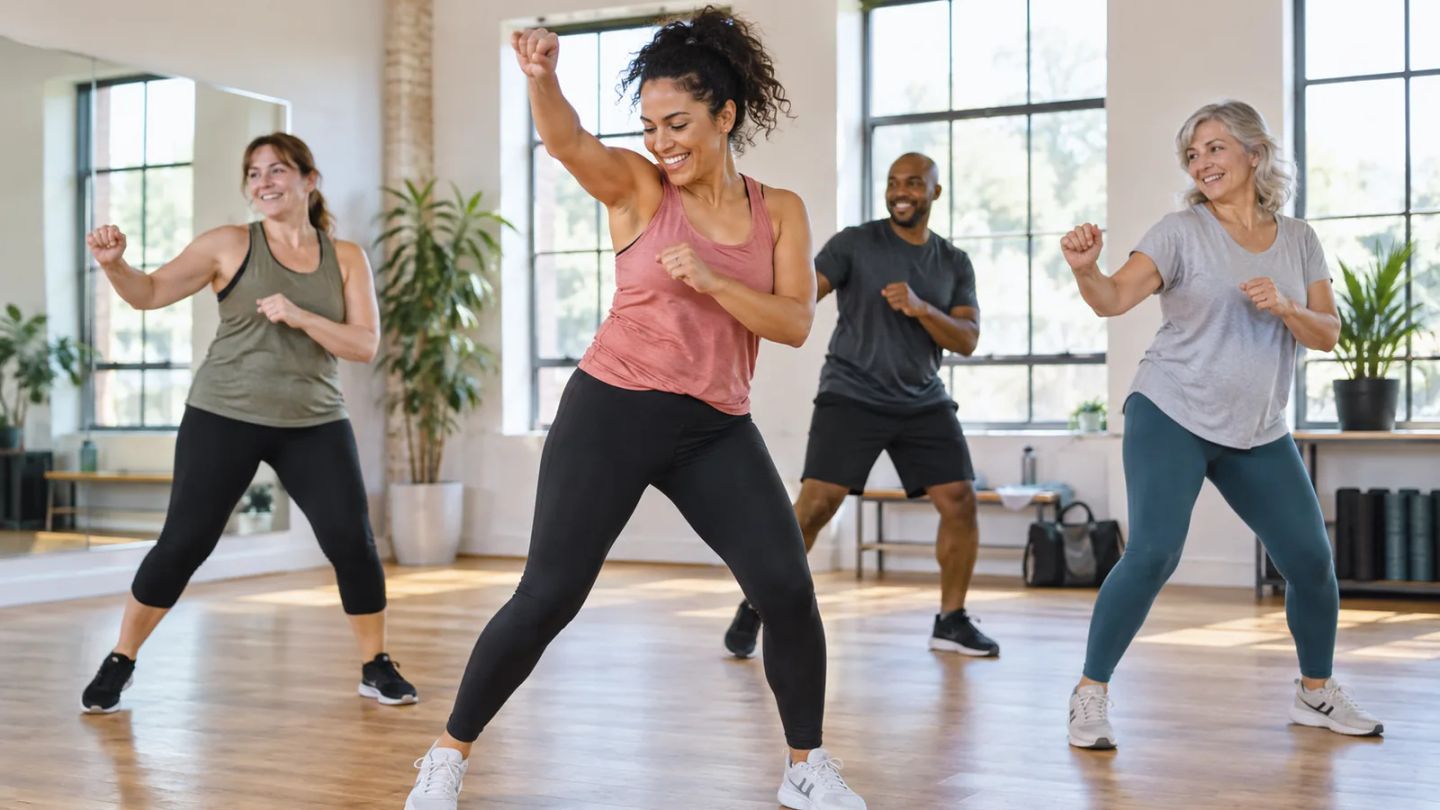
Dancing round your living room is real exercise. Put on four or five songs, keep moving until they finish, and you have done a cardio workout that needs no kit, no class and nobody watching.
That is the whole appeal. It is also why dance is one of the easier workouts to keep up, because a thing you look forward to gets done more often than a thing you dread.
This guide covers why dancing counts as proper cardio, the styles worth trying at home, how to start with no equipment or experience, a session you can copy tonight, who it suits and what it cannot do on its own, and how to keep it going once the novelty wears off.
Why dancing counts as real cardio
Move your arms and legs to music for long enough and your heart rate climbs, which is the point of cardio. Cleveland Clinic describes regular cardio exercise as lowering your resting blood pressure and heart rate, releasing endorphins along with serotonin and dopamine, helping you fall asleep faster, and possibly lowering your risk of dementia. Dancing gets you there the same way a brisk walk or a bike ride does, by keeping you moving.
Dance has its own evidence behind it. Harvard Health links regular dancing with lower blood pressure, stronger muscles and bones, better aerobic capacity and a healthier balance of good to bad cholesterol. You carry your own body weight through your feet as you move, so it loads your bones in a way that cycling and swimming do not, which helps with bone density as the years go on.
The mood side is where dance earns its place. Harvard points to a 2024 review in the journal Sports Medicine of 27 earlier studies, which found that dance eased anxiety and improved depression symptoms about as well as other structured exercise. That same review of 1,392 people found no clear gap between dance and other exercise on depression or anxiety scores, but it did see early signs that dance beat plain exercise on motivation, memory and social connection. The authors rated the quality of the studies as low to moderate, so read it as a strong hint rather than a closed case.
Learning the steps does something extra. Harvard notes that picking up dance movements seems to do more for memory and problem-solving than walking does, because your brain has to track the beat, the sequence and your own limbs at once. Balance and coordination tend to sharpen for the same reason.
Styles to try in your living room
You do not need to pick a lane, but knowing the main flavours helps you find one you enjoy.
Latin dance cardio, the kind made famous by Zumba, strings together salsa, merengue and reggaeton moves over upbeat music. Harvard's Nutrition Source puts it in the moderate aerobic zone, rising higher when you add jumps or faster tracks, and links it with better aerobic fitness, a lower waist measurement and steadier bone density. There is a gentler version, Zumba Gold, built for older adults and anyone easing in.
Hip-hop dance workouts lean on bounces, grooves and attitude, and they suit you if you would rather feel like you are at a party than in a class. Dance cardio, the format most online instructors teach, choreographs simple repeated moves to pop songs so you can follow along without any dance background.
Then there is the one with no name and no rules: freestyle in your kitchen. Put on the music you already love and move however the song pulls you. It burns the same energy as a video would, and you never have to rewind because you missed a count.
How to start with no equipment or experience
Clear a space about two metres square so you can step out in any direction without catching the coffee table. Dance barefoot on carpet or in supportive trainers on a hard floor, keep water within reach, and either follow a free video or line up a playlist and go.
If you have never done this, start small and slow. March on the spot, add a step to each side, then a grapevine, and let the moves get bigger as you warm up. Nobody is marking your technique, so a step that is roughly on the beat is a win. Keep your feet closer to the floor and skip the jumps if your knees or hips are sensitive, and the whole thing stays low-impact.
The one habit worth building early is not stopping. Walk on the spot between songs instead of flopping onto the sofa, and your heart rate stays up where the cardio benefit lives.
A session you can copy tonight
Open our free printable: Your living-room dance session (PDF). Save or print it to use alongside this guide. No sign-up needed.
A good dance workout has the same shape as any other: an easy warm-up, a middle where you push, and a wind-down that lets your heart rate settle. Songs make natural blocks, so build the session around a playlist and let the tracks do the timekeeping.
Here is a 25-minute plan you can follow as is. Swap in your own songs, and shorten it to two or three tracks on a day when that is all you have.
A 25-minute living-room dance session
Warm-up, about 3 minutes: march on the spot, roll your shoulders, step slowly side to side
Song 1, easy: step-touch and sway, find the beat, loosen up
Song 2, building: add your arms, take bigger steps, cover more floor
Song 3, push: pick up the pace, add a knee lift or a gentle bounce
Song 4, push: keep it going, freestyle through the chorus
Song 5, ease down: choose something slower and keep your steps small
Cool-down, about 4 minutes: walk on the spot, then stretch your calves, thighs and shoulders while you catch your breath
Do that four or five times a week and you are close to the weekly activity target most health bodies set. The CDC recommends adults get 150 minutes of moderate activity or 75 minutes of vigorous activity across the week, plus muscle-strengthening work on two or more days. A dance session where you can talk but not comfortably sing sits in that moderate zone, so three or four of them cover most of the aerobic side on their own.
Who it suits, and what it cannot do on its own
Dance workouts suit people who find the gym boring, who have no equipment and no space for any, and who are more likely to keep up something that feels like fun. They scale to almost any age and fitness level, from a full-tilt hip-hop class to the gentler Zumba Gold format, and staying grounded keeps them kind to the joints. If you would rather have that low-impact quality by design, our guide to a low-impact workout sets out the options side by side.
Be fair about the limits, too. Dancing burns energy, and people do reach for it to lose weight, but body weight turns on far more than one workout, including how you eat, how you sleep, your medication and health conditions outside your control. Dance because it lifts your week and gets you moving, and treat any change on the scales as a bonus.
Dance also does more for your bones and balance than for raw strength. It loads the legs and core, but it will not build muscle the way lifting or resistance work does, which is why the guidance pairs any cardio with strengthening on two days. A couple of short sessions of squats, press-ups or carrying the shopping upstairs sit neatly beside your dancing. If you have been inactive for a while or you live with a health condition, have a word with your GP before you throw yourself into anything high-energy, because a general target cannot account for your situation.
Let a dance count towards your day
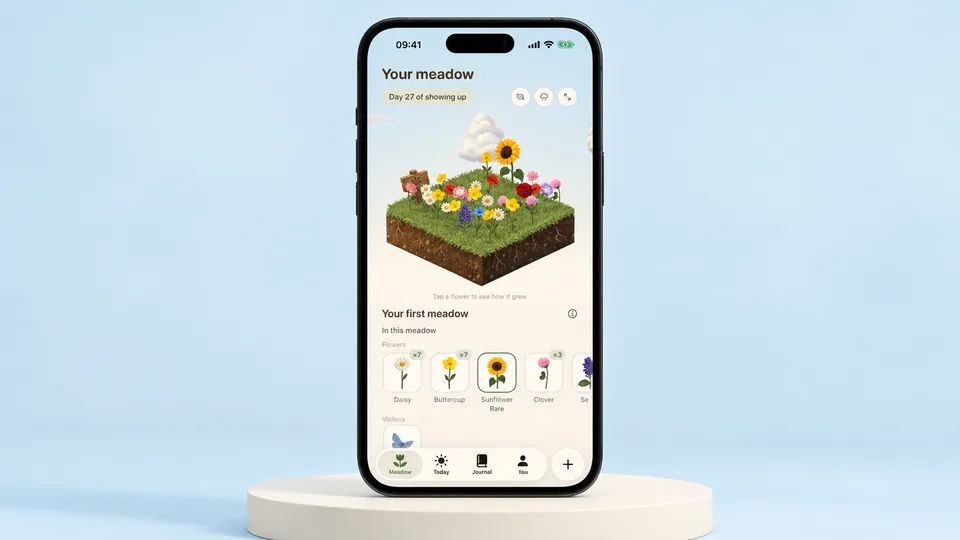
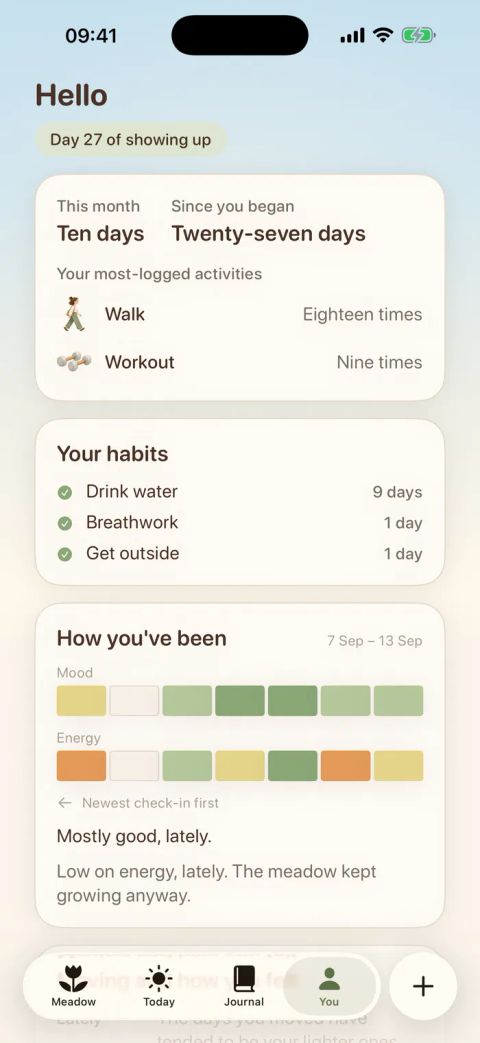
The days you dance are worth keeping track of, and watching them add up can be the thing that gets you off the sofa on a flat evening. Meadow lets you log a dance the way you would a walk, with a timer, so those 25 minutes in the kitchen become part of your record. It is a movement and habit app for iPhone from Wildcard Wellness where a new wildflower blooms for each day you move, and you can tick off small daily habits and note your mood and energy alongside it. It counts consistency over perfect weeks, so there are no streaks to protect and a night you skip resets nothing you have grown.
Keeping it going
The first week or two run on novelty, and then real life turns up. The trick is to make dancing small enough that a bad day cannot cancel it. On a stretched evening, do not aim for the full session. Put on one song and dance through it, start to finish, and let that count. A single track keeps the habit alive far better than an all-or-nothing plan that collapses the moment you are tired.
Tie it to something already fixed in your day, so it runs on a cue instead of willpower. The song that goes on while the kettle boils, or the three tracks after you get home before you sit down, ask less of you than a workout you have to summon from nowhere. If your enthusiasm keeps fading around the two-week mark, our piece on exercise motivation digs into why that happens and what to do about it.
Miss a few days and nothing is lost. Come back to one easy song and pick up where you left off, because getting going again is the entire skill.
Common questions
Is a dance workout enough exercise on its own?
For a lot of people, most weeks, regular dancing carries the aerobic side well. It can get you to the 150 minutes of moderate activity health bodies suggest, and it supports mood, balance and bone density along the way. The gap is dedicated strength work, which dance helps with but does not fully cover, so the advice adds strengthening on two days a week. Beyond that, variety helps, and something like cycling on other days gives your knees a rest while keeping the cardio up.
Can you lose weight with dance workouts?
Dancing burns energy and can be part of losing weight, but it will not do it alone, and no honest guide will promise a number. What you eat, how you sleep and your own body all pull on the result. Aim for a habit you enjoy enough to repeat, and let weight follow from the bigger picture rather than from one activity.
How long should a dance workout be?
Anywhere from one song to about 45 minutes works, depending on the day. Twenty to 30 minutes, four or five times a week, is a comfortable target that adds up to the weekly guidelines. Shorter still counts, and a rushed 10 minutes beats a planned hour that never happens.
Do I need to be any good at dancing?
No. Following a beat and keeping moving is all the cardio asks of you, and the fitness benefits do not care whether your timing is sharp. Alone in your living room there is no audience and no wrong move, which is exactly why it is a forgiving place to start.
Is dance cardio hard on your knees?
It can be low-impact or high-impact, and you get to choose. Keep your feet close to the floor, skip the jumps, and land softly, and a dance session is one of the gentler forms of cardio. Add leaps and fast direction changes and it becomes more demanding, so build up to those once your legs are used to the movement.
One thing to do today
Put on one song you love and dance through it, from the first beat to the last, no plan and no target. That is a dance habit starting, with none of the pressure a workout usually brings.
AUTHOR
Co-founder of Meadow.
Ash is co-founder of Meadow, a habit and movement tracking app that turns small acts of self-care into a growing wildflower meadow.
See how far you've come
Your habits, moods and little wins, all in one place
Meadow keeps track of the walks, the water and the good days, so you can look back and watch your effort add up.
Download Meadow