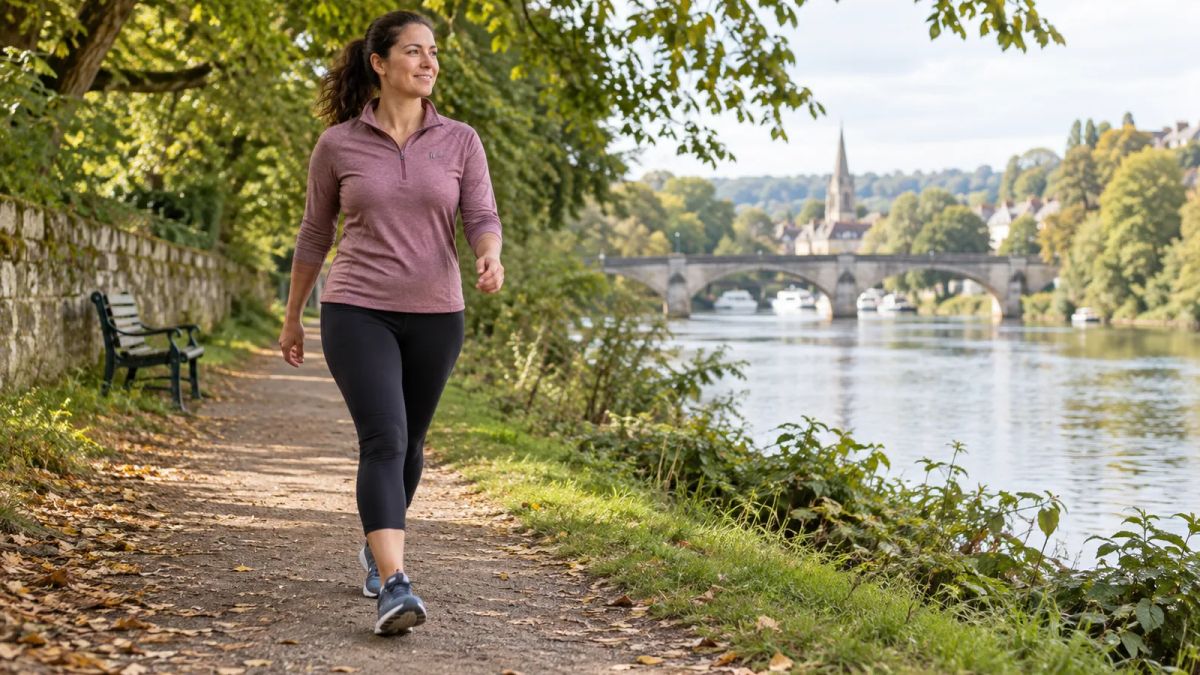
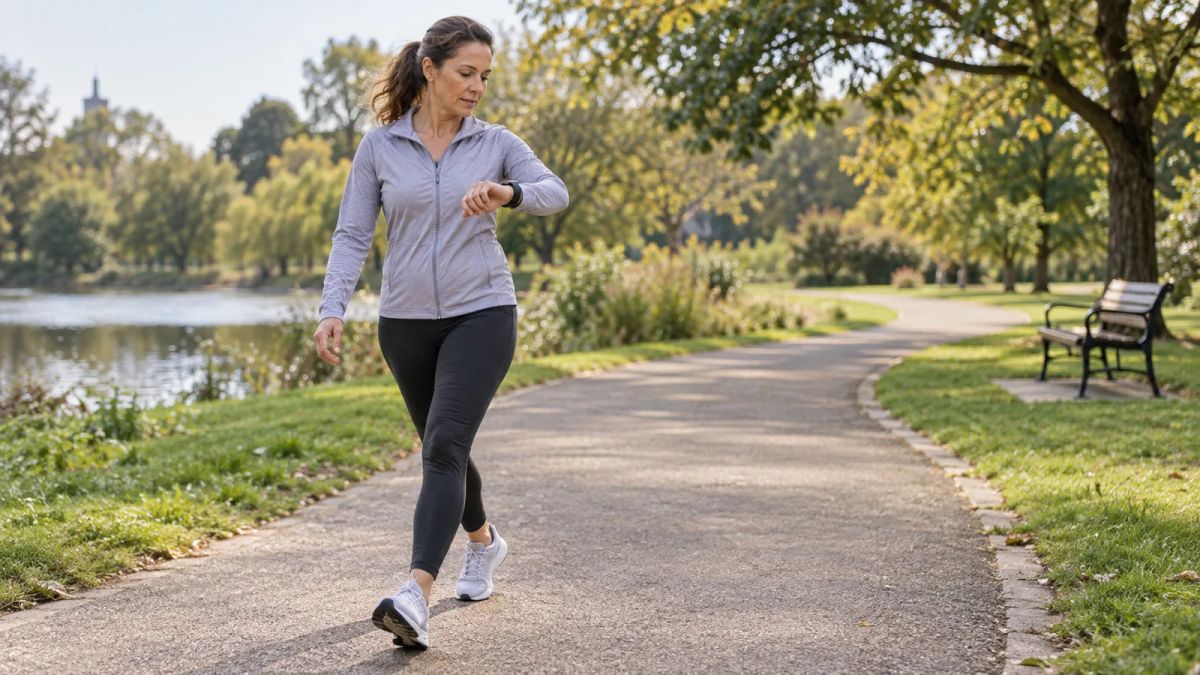
Biking burns more calories in the same half hour, and walking asks less of your joints, your budget and your nerve on a busy road. Neither of those facts decides the number on the scales. What decides it is the activity you'll still be doing in three months and what you eat alongside it, and on both of those counts the winner is personal.
This guide compares the two on the things people weigh up: calories per session, wear on the joints, cost, how easy each is to start, and what the longer research shows. For the habit side of walking, our guide to walking for weight loss goes deeper, and if the step count is your real question, how many steps a day to lose weight takes that apart.
What the calorie numbers show
Per minute, cycling wins, and it isn't close. Harvard Health's figures for a 155-pound (about 70kg) person over 30 minutes put walking at 3.5 mph at 133 calories and a brisk 4 mph walk at 175. Cycling at a moderate 12 to 13.9 mph burns 288 over the same half hour, and a harder 14 to 15.9 mph puts that at 360. Lighter or heavier bodies land above and below those numbers.
So if you have 30 minutes and want the bigger burn from them, the bike does more of the work. Cycling drives the largest muscles in your legs against constant resistance, and because the bike carries your weight you can hold a hard effort for longer than most people can hold a fast walk.
The picture flips when you measure by distance instead of time. A mile on foot burns more than a mile on the bike, because the mile on foot takes three or four times as long. If your day is counted in miles covered, not minutes spent, walking closes the gap.
Treat every one of these numbers as an estimate. The American Council on Exercise explains that the MET values behind calorie charts "do not estimate the energy cost of physical activity in individuals in ways that account for differences in body mass, adiposity, age, sex, efficiency of movement", so your true burn may sit some way off the chart.
You can't out-ride or out-walk your plate
The calorie tables leave one thing out. Most weight loss comes from eating fewer calories, not from burning more. The US Centers for Disease Control and Prevention puts it plainly: most weight loss happens from decreasing the calories you take in, while regular activity is how you keep the weight off once it's gone. The CDC also notes the amount of activity a person needs varies a great deal from one body to the next.
That's worth sitting with before you pick a side. An extra biscuit undoes a decent chunk of either workout in about a minute of eating, so whichever you choose, the food side of the sum does the heavy lifting. Walking or cycling earns its place by protecting your health, your muscle and your mood while you lose, and by holding the line afterwards.
What the two do to your joints and body
Both are gentle next to running. Walking and cycling are lower impact than pounding activities like running or skipping, which is part of why people stay with them.
Walking is weight-bearing, and that counts in its favour. Carrying your own weight loads your bones and helps keep them strong, which the bike, holding you up on the saddle, does not. If bone health is on your mind, the walk gives you something the ride can't, and it's one of the quieter benefits of walking that rarely makes the calorie tables.
Cycling's own edge is that it spares the joints in your legs from impact. If your knees or hips complain when you walk far, the bike lets you work hard with your feet never hitting the ground. The trade-off sits higher up. Long spells folded over the handlebars can nag at your lower back and neck, where a walk tends to leave them alone.
Cost and how easily you can start
Walking wins on both. You already own the kit, the route starts at your front door, and you can go this minute. That low bar is not a small thing when the goal is doing something most days for months.
A bike costs money up front, and it wants somewhere safe to ride and somewhere dry to live. None of that rules cycling out, but it adds friction between you and the first session, and friction is where good intentions leak away. A bike parked behind the lawnmower tends to stay there.
What the longer research shows
Regular cycling tracks with a longer, healthier life. A review pooling studies of more than half a million people found that around 100 minutes of cycling a week was associated with a 17% lower risk of dying over the follow-up, with the gains flattening at higher volumes. In the UK Biobank study of 263,540 adults inside that review, commuting by bike was associated with a 41% lower risk of death across five years, next to people who drove or took the bus.
Those are strong associations, and it helps to be clear about what they are. They're observational. People who cycle to work differ from people who don't in ways beyond the cycling, so the studies show a link, not proof that the bike caused it.
The same review is honest about weight, and so should we be. Across the prospective studies it looked at, cycling was tied to a change in weight or BMI of under a kilogram. Movement of any kind is a modest lever on the scales next to what you eat, which loops back to the plate.
So which suits whom
Pick by your body, your budget and your day, not by the calorie chart alone.
- Choose walking if money is tight, if your bones or balance are a concern, if you want something you can start today, or if you like movement you can fold into ordinary errands.
- Choose cycling if your knees dislike the pounding of a long walk, if you're short on time and want more burn from each session, or if you enjoy the ride enough to keep showing up.
- Choose both if you can. Alternating gives your joints a break, keeps things interesting, and makes a rained-off ride easy to swap for a walk.
The part that decides it: the one you'll keep
Strip away the numbers and the honest answer is dull and a bit freeing. The better exercise for your weight is the one you'll still be doing when the novelty wears off. A daily walk you enjoy beats a hard ride you dread and skip, and the reverse holds too.
So make the choice easy to repeat. Attach it to something already fixed in your day, keep the first version small enough to survive a tired evening, and decide now what the shrunk-down version looks like on a bad day. Ten minutes round the block, or one loop of the estate on the bike, keeps the habit alive on a day the full session was never going to happen.
Keeping a simple record helps more than weighing yourself every morning. James Clear describes a habit tracker as a visual cue that's motivating to watch build and satisfying to fill in, and his one rule for the wobble is never miss twice. One skipped day is an accident, two is the start of a new habit. Here's a plan you can fill in and stick on the fridge, starting with the blank version:
Move: _______ (walk or ride) When: after I _______ How long: ___ minutes Small-day version: _______
Mon ☐ Tue ☐ Wed ☐ Thu ☐ Fri ☐ Sat ☐ Sun ☐
A filled example might read:
Move: cycle the canal path When: after I finish work How long: 25 minutes Small-day version: 10 minutes on the turbo
Mon ☐ Tue ☐ Wed ☐ Thu ☐ Fri ☐ Sat ☐ Sun ☐
A place to log the movement you pick

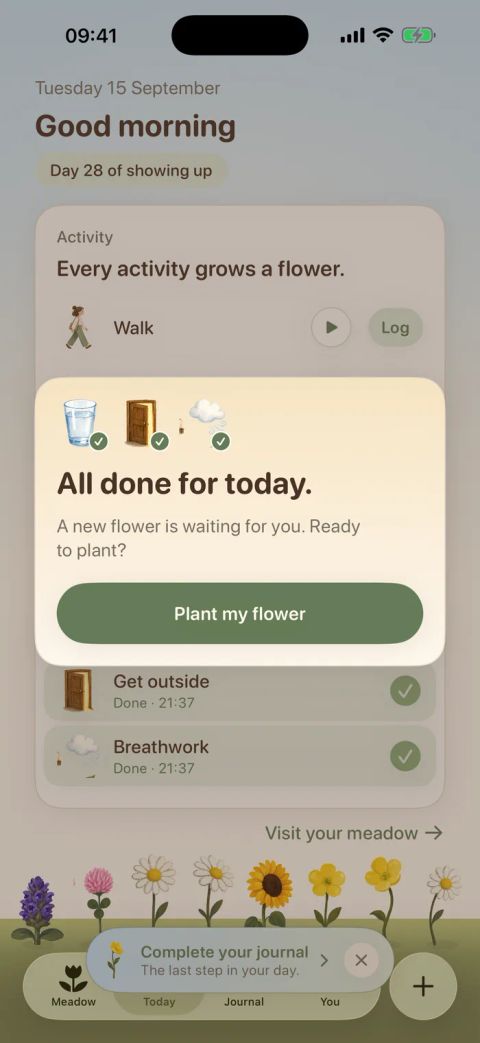
Some weeks go to plan and some don't, and Meadow is built for the second kind. It's a movement and habit app for iPhone from Wildcard Wellness where you log the exercise you enjoy, a walk or a ride, tick off small daily habits, and note your mood and energy. Each day you show up, a wildflower blooms in a meadow that's yours alone. There are no streaks, so a week the bike stayed in the shed resets nothing you've grown, which fits a plan built around months instead of one you defend day to day.
Before you start
If you've been inactive for a while, are carrying a health condition, or are pregnant, have a word with your GP before you build up, especially if you're going harder on the bike. The NHS notes a walk is brisk when you can still talk but not sing, and that talk test travels well to the bike too. Weight also answers to sleep, stress, medication and life stage, so treat all of this as general information and not advice for your own situation.
FAQ
Will I lose weight faster on a bike than walking?
Not on its own. The bike burns more calories per half hour, so a set amount of exercise time can build a bigger deficit, but the CDC is clear that most weight loss comes from eating less, and cycling's tie to actual weight change in studies is under a kilogram. Faster loss comes from the food side, with either activity supporting it.
Is cycling or walking better for bad knees?
Cycling usually feels kinder, because your feet never take the impact of each step. If long walks leave your knees sore, a bike or a stationary bike lets you work hard without the pounding. If a folded-forward position bothers your back, a more upright setup or a walk may suit you better.
How long should I walk or ride to lose weight?
A common health baseline is 150 minutes of moderate activity a week, and both brisk walking and steady cycling count towards it. For weight, build gradually towards more than that, but build towards it rather than starting there, because a routine that only fits a keen week is the quickest one to drop.
Can I do both?
Yes, and many people find that easiest to stay with. Riding some days and walking others rests your joints, adds variety, and means bad weather or a flat tyre never ends the week's movement.
AUTHOR
Co-founder of Meadow.
Ash is co-founder of Meadow, a habit and movement tracking app that turns small acts of self-care into a growing wildflower meadow.
Every little bit counts
Five minutes counts. So does a dance in the kitchen.
Log the movement you enjoy and the small habits that help you feel good, and watch them bloom into something you can see.
Download Meadow