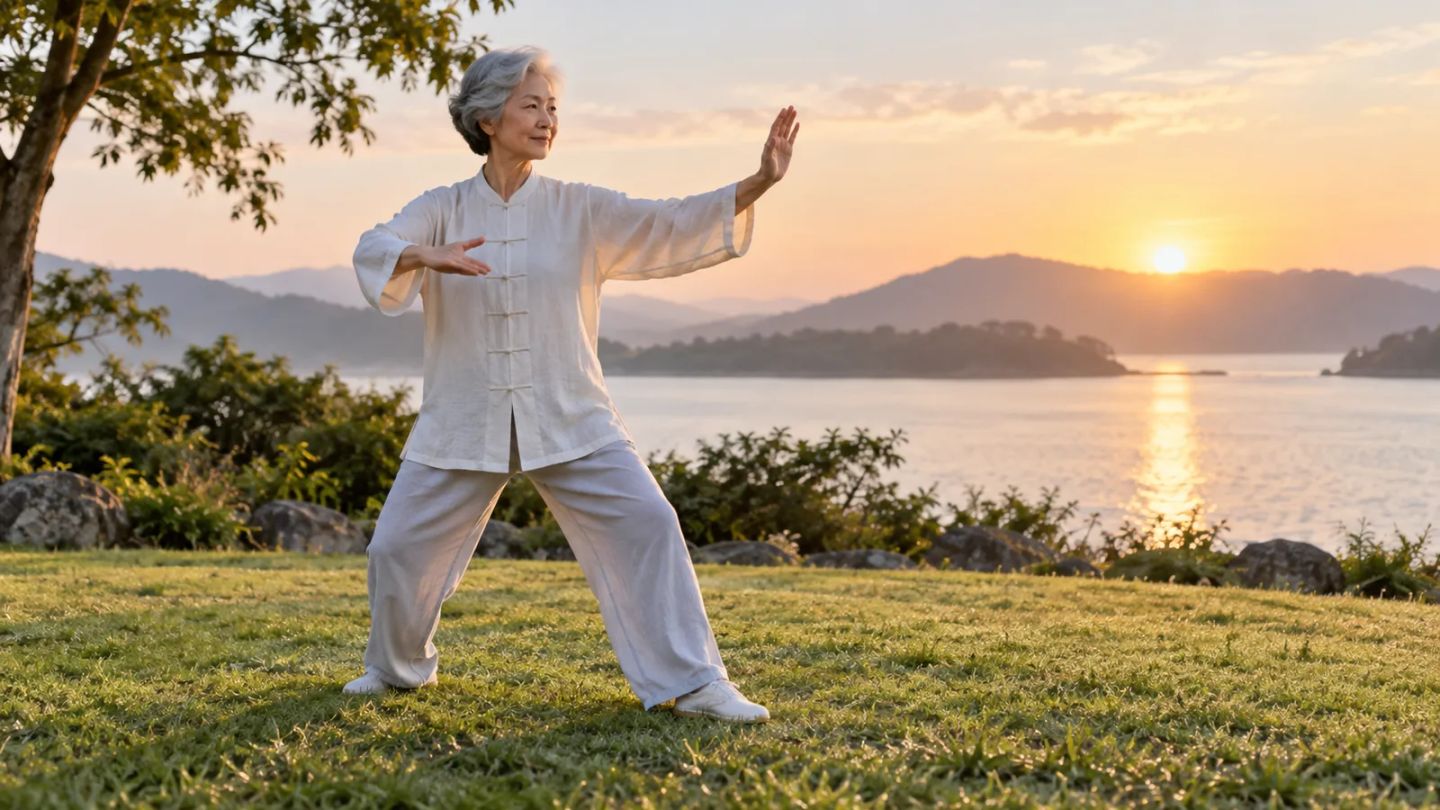
A morning tai chi routine is a short, slow sequence of standing movements you do soon after waking, breathing with each one. You don't need a class, a uniform or any equipment, and ten minutes beside a kitchen counter is a real start.
Tai chi comes from a Chinese martial art, but the version most people practise today is slow, low-impact and calm. Harvard Health calls it "meditation in motion". You shift your weight from foot to foot, move your arms in soft curves, and keep your knees a little bent while you breathe steadily. Nothing jerks or bounces. That is the whole appeal on a stiff, foggy morning.
This guide is a standing flow you can do on the spot. It's different from tai chi walking, where you carry the same principles into a walk around the block. Here you stay in one place and move through a handful of beginner shapes.
What the evidence shows
Tai chi has more research behind it than most gentle exercise, though the findings come with honest caveats. Here is where the evidence is strongest and where it's thinner.
Balance and falls are the clearest case. A systematic review of 24 randomised controlled trials in older adults found tai chi reduced the risk of falling (a relative risk of 0.76), and improved balance measures like the timed up-and-go test and single-leg standing. The authors note the effect grows with practice, with two to three sessions a week helping more than one, and they flag variation between the studies. The US National Center for Complementary and Integrative Health (NCCIH) is more cautious, describing "low-certainty evidence" that tai chi may cut the rate of falls by about 19 per cent.
Blood pressure is a promising signal, not a promise. A 2024 randomised trial in JAMA Network Open followed 342 adults with prehypertension for a year. Those doing tai chi lowered their office systolic blood pressure by about 2.4 mm Hg more than a group doing aerobic exercise like jogging and cycling. That is a modest, meaningful difference in one well-run study, and it doesn't replace anything your GP has prescribed.
Stress and mood tend to improve too. NCCIH reports tai chi has helped psychological well-being in people with cardiovascular disease, and Cleveland Clinic points to a twelve-week study where anxiety levels dropped in stressed but healthy people. The slow breathing and the need to pay attention to your body seem to do some of the work.
Then there are the everyday wins that are harder to pin to a single trial. Tai chi can build lower and upper-body strength, and it can improve flexibility. Harvard Health hedges these with "according to some studies" and "growing evidence", which is the right level of confidence. It's gentle movement with a decent track record, not a cure.
One line worth keeping in view: NCCIH says plainly that you shouldn't use tai chi to put off seeing a health professional about a medical problem.
Why mornings suit it
You wake up stiff. Tai chi asks for slow, warming movement rather than a cold sprint, so it meets a stiff body where it is. A few minutes of weight shifts and arm circles loosen the ankles, hips and shoulders before the day loads them up.
There's a practical reason too. A habit that hangs off something you already do every morning is easier to keep. The American Heart Association's advice for making habits stick is to attach the new action to an existing routine, like the moment the kettle goes on. Morning tai chi has a built-in cue and a quiet window before messages start arriving.
It also sets a tone. Starting the day with ten calm minutes, breathing on purpose, is a different opening from reaching straight for your phone.
Before you start
Read this bit even if you're keen to skip ahead.
- Clear a space about the length of your body, on a non-slip floor, near a wall or a sturdy chair you can touch for balance.
- Wear loose clothes and flat shoes, or go barefoot if the floor is warm and dry.
- Keep your knees soft, never locked, and never force a movement into pain. A little effort is fine, sharp pain is a stop sign.
- Practise on a fairly empty stomach if you can, and have water nearby.
A note on health conditions. Tai chi is low-impact and has a good safety record, and both Cleveland Clinic and NCCIH still suggest checking with your GP before starting a new routine if you have a heart condition, joint problems, balance issues, are pregnant, or take medication that can make you dizzy. If standing balance is a worry, you can do much of this holding a counter, or look at seated options first.
A gentle ten-minute morning flow
Open our free A gentle morning tai chi flow (PDF). Save or print it to use alongside this guide. No sign-up needed.
Move through these slowly, letting your breath set the pace. Aim for roughly a minute or two on each. If a movement feels awkward, do less of it and come back another day.
1. Settle and breathe
Stand with your feet about hip-width apart, knees softly bent, arms hanging. Let your shoulders drop. Take five slow breaths, in through the nose, out through the mouth, feeling your feet on the floor. This is the warm-up, and it counts.
2. Rocking
Sway your weight gently forward onto the balls of your feet as you breathe in, then back towards your heels as you breathe out. Keep it small and smooth. Do this eight or ten times to wake up your ankles and your sense of balance.
3. Opening and gathering
Breathe in and float both arms out and up to about shoulder height, palms turning up as if gathering air. Breathe out and let your hands sink back down in front of you, palms turning down, knees bending a touch. Repeat six times. This is the loosening for your shoulders.

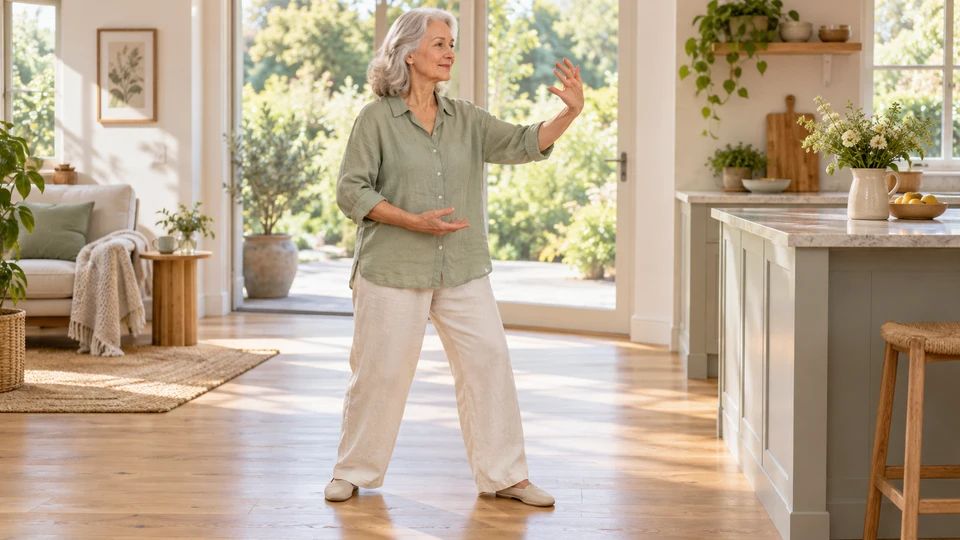
4. Cloud hands
Shift your weight onto your right foot and let your hands drift across your body to the right, one high near your face, one low near your waist, as though smoothing a pane of glass. Shift onto your left foot and let the hands float across to the left, swapping which is high and which is low. Keep breathing, slow and even. Flow side to side eight times.
5. Gentle weight shifts
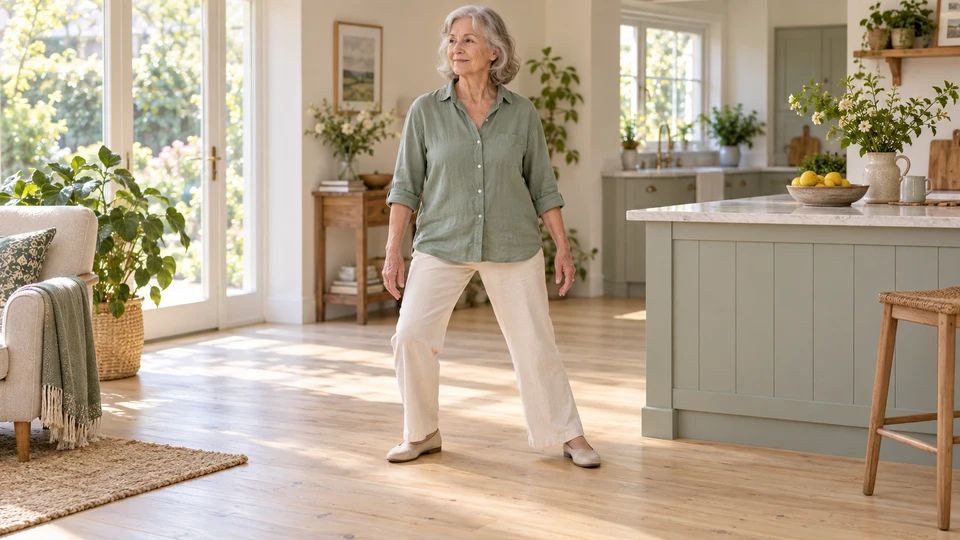
Step your feet a little wider. Bend the right knee and sink your weight to the right, keeping your torso tall, then sink to the left. Your arms can rest low and follow the motion. This one builds the steadiness the balance research is pointing at. Do it eight times, slowly.
6. Floating palms
Back to hip-width. Breathe in and let both palms float up the front of your body to chest height, then breathe out and press them softly down again, as if lowering something onto a shelf. Six unhurried rounds. Let this feel meditative.
7. Close
Bring your feet together, rest both hands lightly over your lower belly, and take five slow breaths. Notice how you feel compared with when you started. That's the whole flow.
Throughout, the breath is the engine. As a general rule you breathe in as you gather or rise, and breathe out as you sink or press. If the breathing and the movement fall out of step, let the breath lead and the arms catch up. Slowness is the point, so move slower than feels natural.
Keep the breathing going with an app

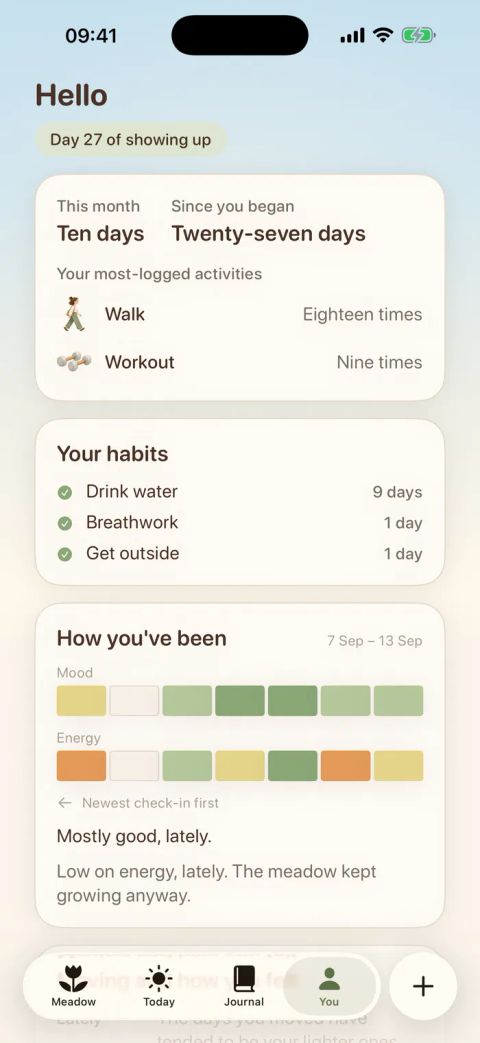
Some mornings you'll want a nudge to slow down before you even stand up. Meadow has a built-in breathwork feature, so you can settle your breathing alongside a wildflower meadow you've grown through your own daily practice. You can also log the few minutes of tai chi you did, tick off small habits like getting outside, and note your mood and energy. There are no streaks, so a morning you skip resets nothing you've built. You can find it at growyourmeadow.com.
On the mornings it doesn't happen
Some days you'll wake late, or your back will complain, or the flow above will feel like too much. Have a smaller version ready. Two minutes of the settle-and-breathe and a round of cloud hands still counts, and it keeps the thread going.
If you miss a day, or a week, don't try to make it up. Research on how habits form found that a single missed day doesn't break the pattern you're building, and there's wide variation in how long a routine takes to feel automatic. So there's no streak to protect and no clock to beat. You start again tomorrow, exactly where you left off.
For a slower entry, you might build the standing flow into a broader morning routine, or borrow shapes from mobility exercises for seniors if balance is your main aim. If you'd rather move while you walk, tai chi walking carries the same slow, breathing quality into a stroll.
Common questions
How long before I notice anything?
Calm and looser shoulders often come from the first session, because that's the breathing and the movement doing their immediate work. The balance and blood-pressure findings above came from months of regular practice, so treat those as the long game.
How many mornings a week?
The falls review found two to three sessions a week helped more than a single weekly class, and benefit rose with frequency. Aim for most mornings if you can, but three is a solid start.
Do I need to learn a full traditional form?
No. The flow here borrows a few beginner shapes. A full form takes longer to learn and is worth exploring later if you enjoy it, but you don't need one to get moving.
Is ten minutes enough?
For a beginner, yes. You can grow it to fifteen or twenty minutes as it settles into your morning, but a short, consistent flow beats a long one you dread.
What if I can't balance well standing?
Hold a counter or a sturdy chair for the weight shifts and cloud hands, or start with seated movement and build up. Steadiness is something the practice grows, so give it time.
Tomorrow morning, before you pick up your phone, stand up, soften your knees, and take five slow breaths with your feet on the floor. That's the routine started.
AUTHOR
Co-founder of Meadow.
Ash is co-founder of Meadow, a habit and movement tracking app that turns small acts of self-care into a growing wildflower meadow.
See how far you've come
Your habits, moods and little wins, all in one place
Meadow keeps track of the walks, the water and the good days, so you can look back and watch your effort add up.
Download Meadow