Tight hips are one of the most common complaints among women who sit for a living, and a few minutes of gentle stretching can loosen them so ordinary movement feels easier. What follows is an ordered routine of eight hip stretches that you can do on a mat or the edge of the bed in about ten minutes, with clear notes for pregnancy and the months after birth.
Your hips carry a lot. They take your weight when you stand, fold when you sit, and swing your legs through every step. When the muscles around them shorten and stiffen, standing tall and getting up off the floor start to feel like more effort than they should.
There are reasons the hips deserve attention in a woman's week. Long hours at a desk shorten the muscles at the front of the hip, pregnancy loosens the pelvis in ways that change how the joints feel, and the everyday jobs of lifting, carrying and bending ask a lot of a stiff hip. A short, regular stretch keeps all of that comfortable.
The routine below runs from the front of the hip through the inner thigh and outer hip to a gentle twist, so each stretch sets up the next.
Why hip flexibility is worth your time
Most tight hips are made by sitting. Cleveland Clinic points out that nearly one in four American adults sit for more than eight hours a day, and hips can become too tight when you're inactive, which leads to stiffer, more limited movement.
The mechanism is straightforward. A physiotherapist at the Hospital for Special Surgery explains that prolonged sitting puts your hip flexors in a compressed position, causing them to shorten and tighten up. Spend most of the day folded at ninety degrees and the muscles at the front of your hip slowly learn that shorter length, so standing tall and walking with an open stride begins to feel like work.
It bites harder as the years go by. A biomechanics study of healthy adults found that older adults lacked sufficient hip extension range of motion to walk with a stride as open as younger adults, with available hip extension dropping by around 30% across the ages measured. Hip extension is the backward reach of the leg that gives a walk its length, so losing it shortens your step without you noticing.
Pregnancy changes the picture too. Cleveland Clinic explains that the hormone relaxin loosens the muscles, joints and ligaments of your pelvis to make labour and delivery easier, which is welcome for birth but can leave you feeling looser or less stable in the meantime. That looseness doesn't vanish the day the baby arrives, which is why the stretches here come with pregnancy and postnatal notes, not a one-size-fits-all instruction.
The reassuring part is that stiffness responds to being used. Cleveland Clinic notes that when you strengthen and stretch these areas, everyday activities like walking, standing or climbing stairs can become more manageable. A few minutes a day is a small deposit into how your hips feel.
Stretch within your range, and check first if you need to
Every stretch here should feel like a mild pull or an honest effort, never a sharp, pinching or radiating pain. The NHS gives the same steer for flexibility work, to move as far as is comfortable and build the repetitions up slowly over time. Range comes with patience, not with forcing.
Warm the body a little before you sink into a deep hold. Harvard Health warns that stretching muscles before they are warmed up can hurt them, so a short walk or the gentler stretches first is a sensible way in.
Pregnancy asks for extra care. Because relaxin makes the joints more mobile, Cleveland Clinic notes it can also make you more susceptible to injuries and sprains, so ease into each stretch, avoid bouncing, and stop anything that pulls uncomfortably at the pelvis or pubic bone. That looseness lingers after birth, with relaxin levels taking up to a year to settle, so keep early postnatal stretching gentle, not ambitious.
If you're pregnant or recently gave birth, have a hip or pelvic problem, a recent injury, arthritis, or any condition that affects how you move, check with your GP, midwife or a physiotherapist before you start. Cleveland Clinic gives a useful line for telling normal from not: some dull soreness at first is expected, but contact a healthcare provider for sharp pain, or pain that lasts more than a few hours.
The routine: eight gentle hip stretches
Work through these in order. Breathe slowly, let each stretch settle rather than straining for depth, and where a move is one side at a time, do both. The held stretches sit well at around 20 to 30 seconds, or about five to eight slow breaths as Cleveland Clinic frames it. Repeat the ones that need it two to three times a side.
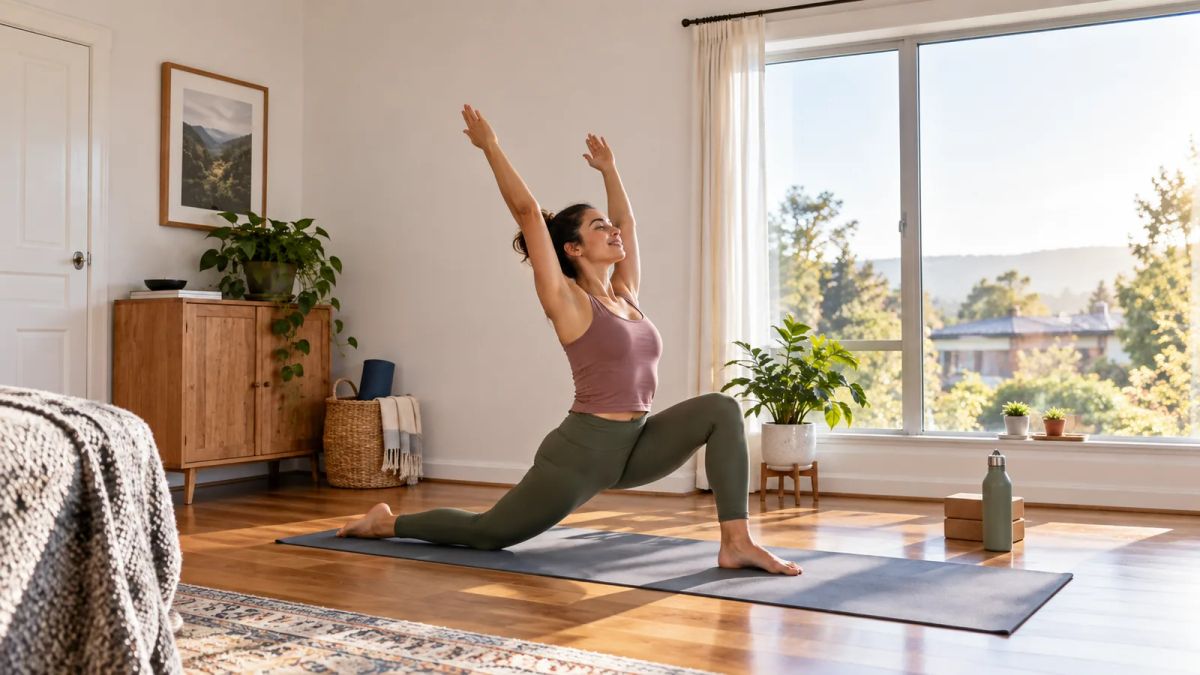
1. Kneeling hip flexor stretch
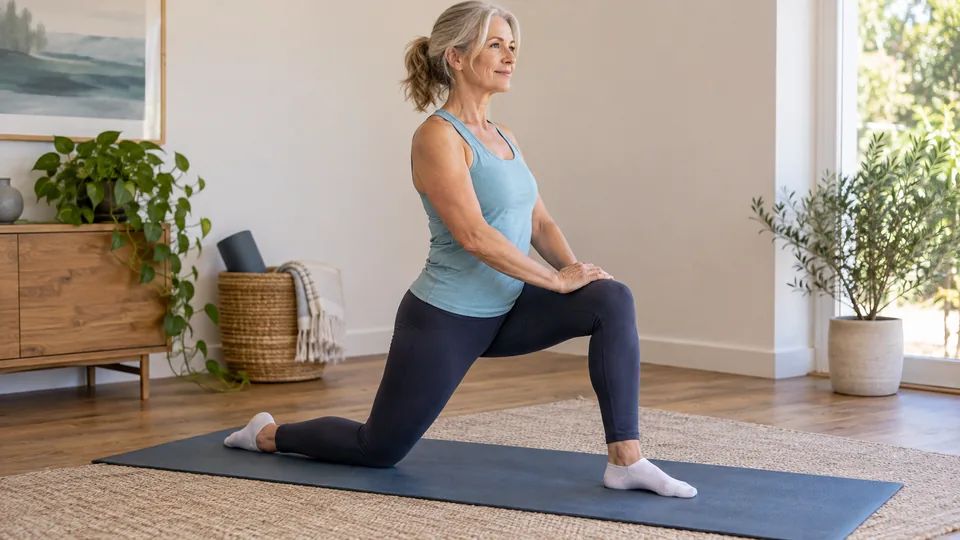
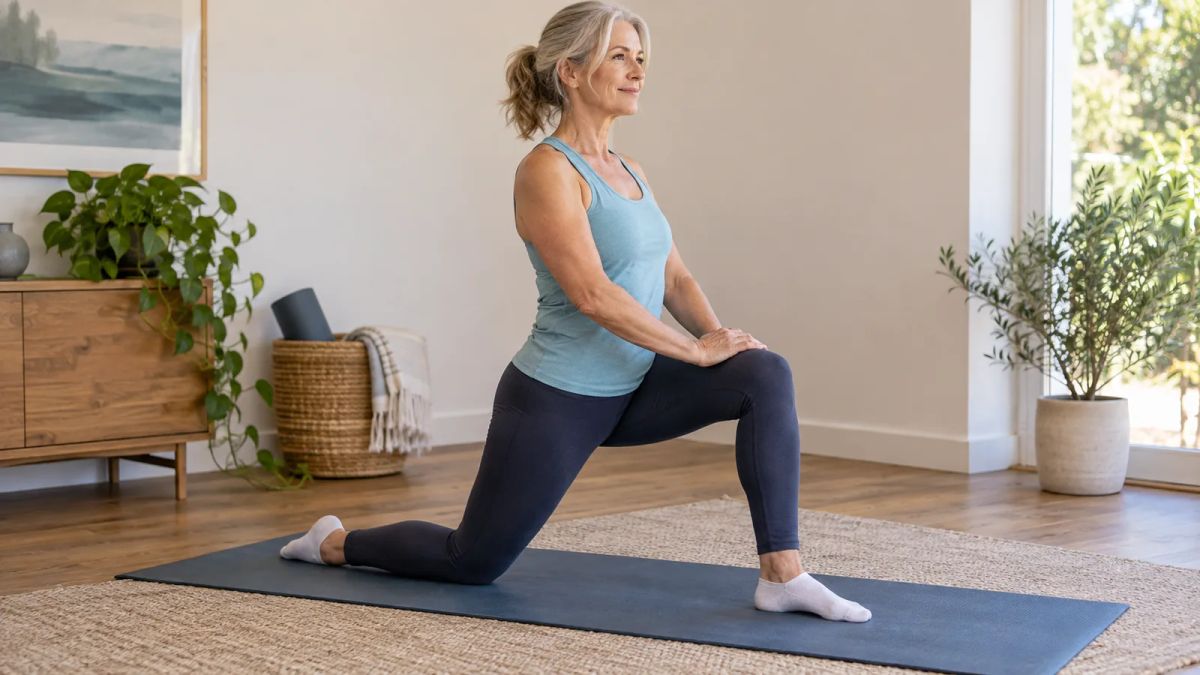
Kneel on one knee with the other foot planted in front, both bent to about ninety degrees, using a cushion under the down knee if the floor is hard. Tuck your pelvis under slightly, then ease your weight gently forward until you feel a stretch down the front of the kneeling hip. Keep your chest tall. Hold for around 30 seconds, and aim for two to three rounds each side. This targets the hip flexors that a chair keeps short, and the same 30-second hold repeated a few times per side is what the Hospital for Special Surgery physiotherapist uses for the front of the hip.
2. Butterfly stretch
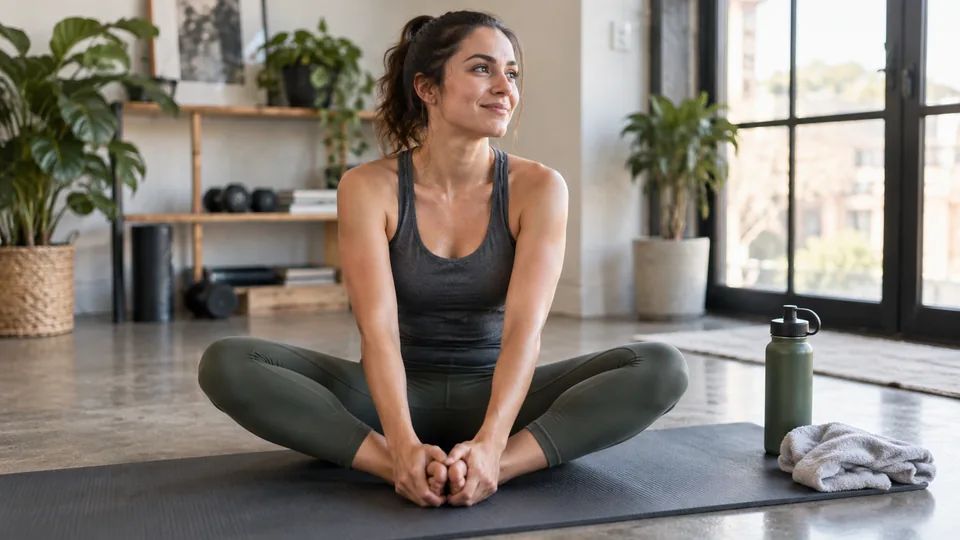
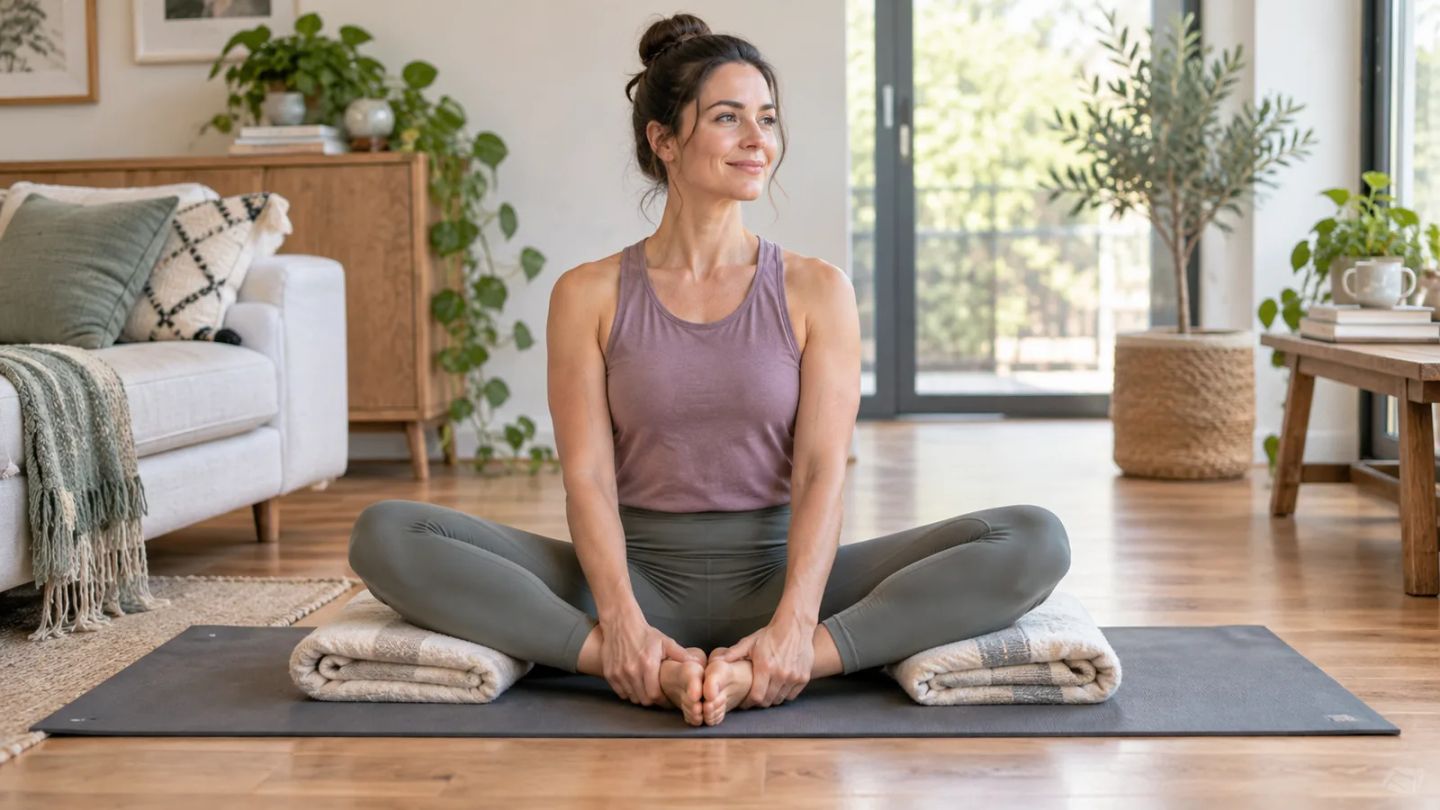
Sit tall with the soles of your feet together and your knees dropping out to the sides. Hold your ankles, lengthen your spine, and if you want more, hinge forward gently from the hips instead of rounding your back. Hold for 20 to 30 seconds. This opens the inner thighs and groin, an area that carries a lot of tension and often feels tight in pregnancy as the pelvis widens.
3. Lying figure-four
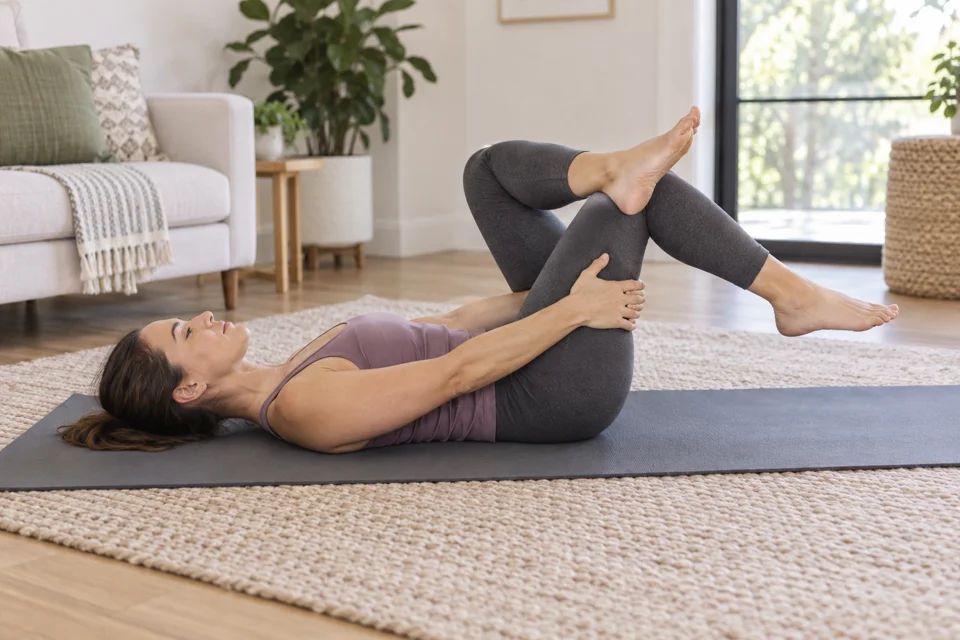
Lie on your back with both knees bent, cross one ankle over the opposite thigh so the bent knee opens outward, then reach through and draw the supporting thigh towards your chest until you feel a stretch deep in the crossed hip and glute. Hold for 20 to 30 seconds, then swap. If lying flat is uncomfortable in later pregnancy, do the same shape seated on a stable chair and hinge forward instead. This one reaches the outer hip and the deep muscles a desk chair keeps quiet.
4. Child's pose with wide knees
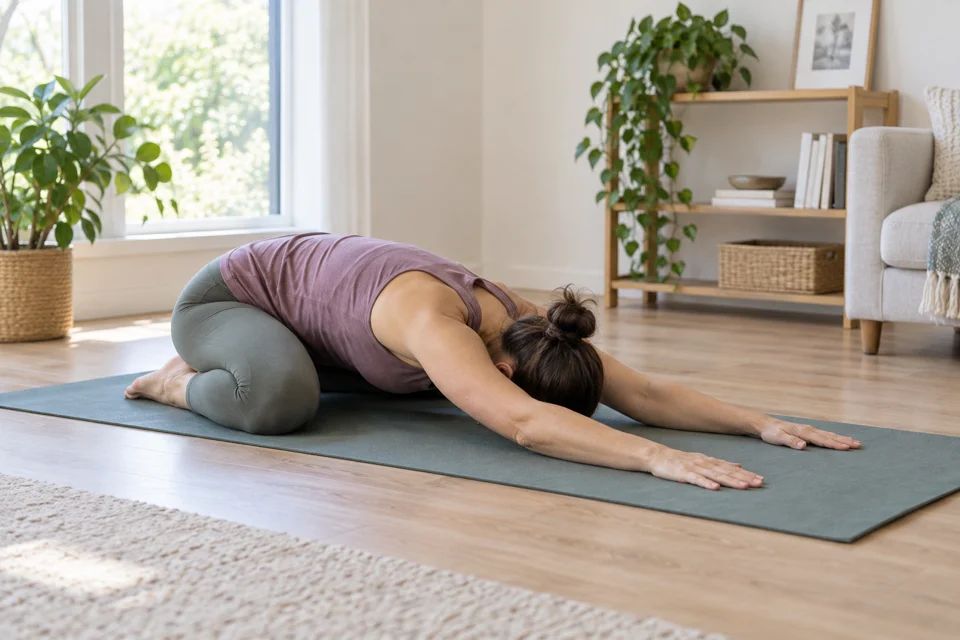
From all fours, take your knees a little wider than your hips, sit your hips back towards your heels, and walk your hands forward as your chest sinks between your thighs. Rest your forehead down and breathe into your lower back. Hold for 30 seconds to a minute. This is a calm opener for the hips and lower back, and the wide knees make room for the belly, which many women find works well in pregnancy.
5. Lying spinal twist

Still on your back, hug both knees in, then let them drop slowly to one side while you turn your head the other way, keeping both shoulders on the floor. Rest in the twist for 20 to 30 seconds, then bring the knees through centre and drop them to the other side. Keep it easy and let gravity do the work. This eases the outer hip and the lower back together, which often stiffen as a pair.
6. Pigeon pose
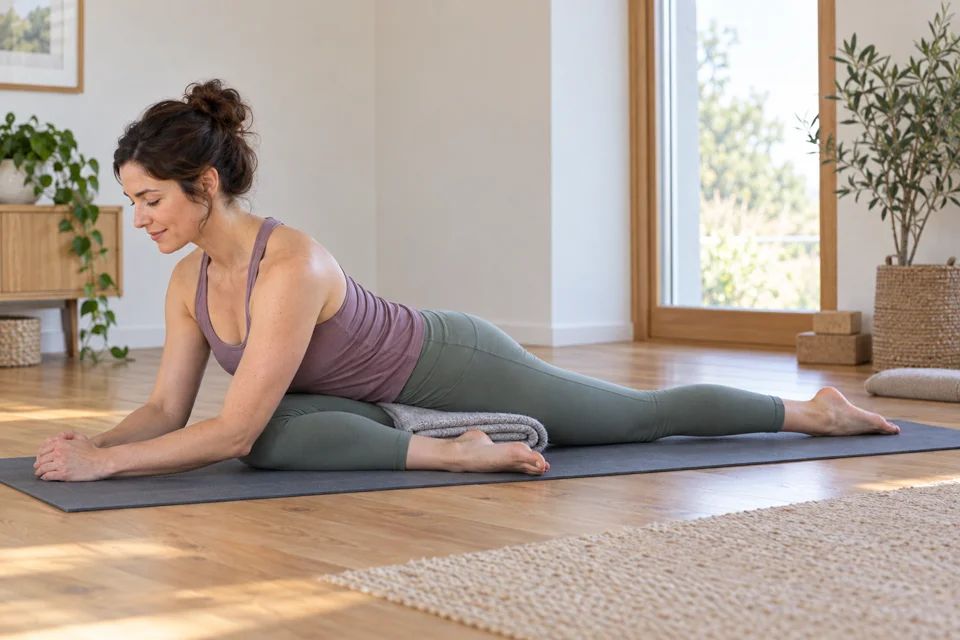
From all fours, slide one knee forward towards the same-side wrist and let the shin angle across, then stretch the other leg straight out behind you and lower your hips towards the floor. Come down onto your forearms if that feels right, and hold for 30 seconds to a minute before swapping. Pigeon is the deepest outer-hip opener here, so ease into it, and if it's too much for the knee or hip, the lying figure-four gives a similar stretch with less to set up.
7. Single knee-to-chest
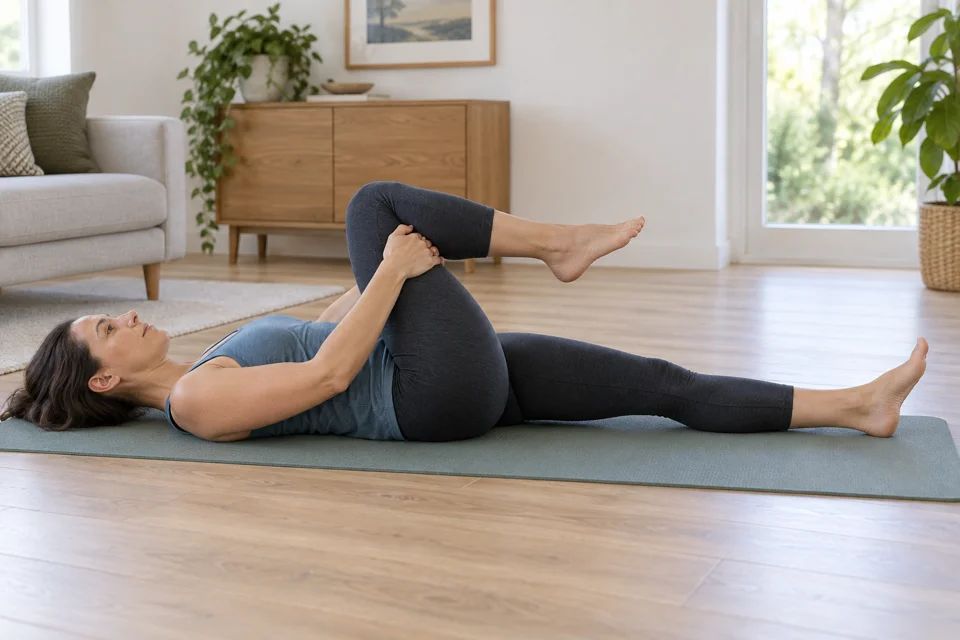
Lie on your back with both legs long, then draw one knee in towards your chest and hold it there with both hands, keeping the other leg relaxed on the floor. Hold for 20 to 30 seconds each side. This is a gentle release for the back of the hip and the lower spine, and an easy one to reach for on a stiff morning.
8. Seated wide-leg fold
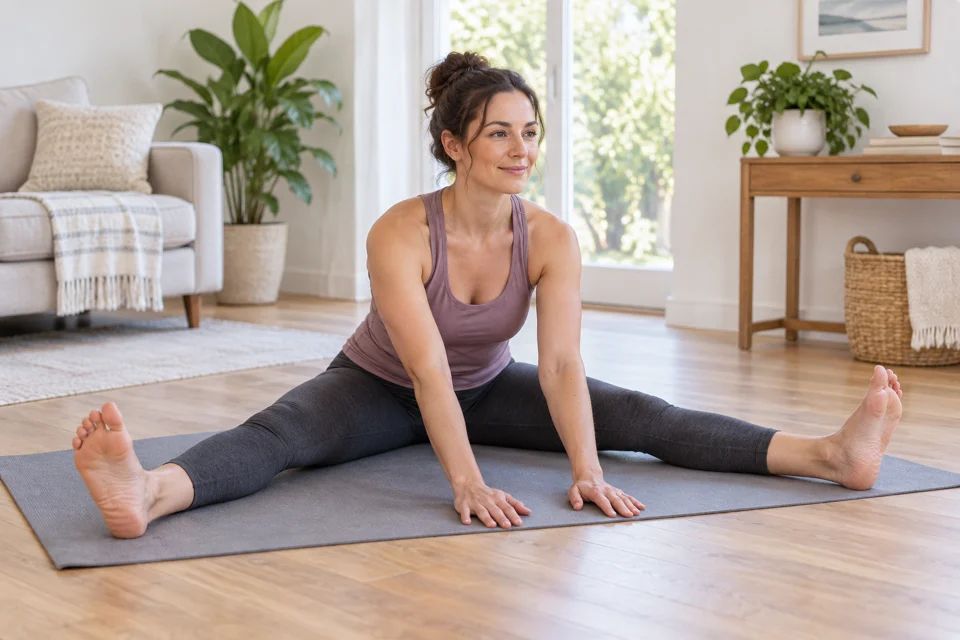
Sit tall on the floor with your legs open into a comfortable V, toes pointing up. Keep your back long and hinge forward from the hips only as far as feels like a mild stretch through the inner thighs and hips. There is no need to reach your toes. Hold for 20 to 30 seconds. This finishes the routine by opening the inner hip through a wider angle.
That's the full sequence, in roughly ten minutes. Take the deeper holds twice through if a hip feels especially tight, and skip anything that doesn't sit right on the day.
What hip stretching can and cannot do
Done regularly, this kind of routine can help you move through daily life with less stiffness and a little more range. That's the everyday benefit, and it's worth having.
The gains are real but modest and slow. A small controlled trial of young adults with tight hamstrings found that four weeks of static stretching, three days a week, improved hip flexion range of motion by around five degrees, a measurable change though a gentle one. Harvard Health is clear on the timescale too, noting that becoming more flexible takes weeks to months of regular work and that you have to keep it up to hold the gains. A single session leaves you looser for a while, but lasting change is an accumulation.
There are limits to be straight about. Stretching is not a treatment for an injury or condition, and it will not fix a hip that has been painful, catching or giving way for a while. That is one to have looked at, not stretched through. Pelvic girdle pain in pregnancy, the deep ache around the pelvis and pubic bone that some women get, is a case for a physiotherapist, not a deeper stretch, since forcing range can make it worse.
Building it into your day
A stretch you mean to fit in somewhere tends to evaporate. One pinned to a moment that already happens tends to stick.
The American Heart Association suggests tying a new action to a routine you already have, so it rides along with something automatic instead of asking for a fresh decision each day. Attach the hips to a cue that never gets skipped. "After I put the kettle on, I do my hip flexor stretch and a butterfly" is the kind of plan that holds, because the trigger is built in. Evenings work well too, since a stiff, sat-down day is exactly when the hips want opening.
There is a neat overlap with other gentle movement, so you can fold this in instead of adding a chore. It sits comfortably alongside a morning stretch routine, and the seated, supported approach of chair yoga covers a lot of the same hip ground with less to get down to the floor for. If you want to build strength and control as well as length, the more dynamic hip mobility exercises routine is the natural next step once these stretches feel easy.
On a hard day, and after a missed one
Decide your smaller version before you need it. On a stiff, rushed or low day, one kneeling hip flexor stretch per side and a single figure-four still count. A couple of minutes keeps the thread going, and keeping the thread going is what turns this into something your hips expect, not something you have to talk yourself into.
If you miss a day, or a fortnight, nothing is undone. Stiffness after a gap is the result of staying still, not a mark against you, and the fix is the same as ever. Pick the next day and do the gentler stretches again. Starting small after a break beats trying to make up for it in one long, ambitious session.
Keep the stretch in view
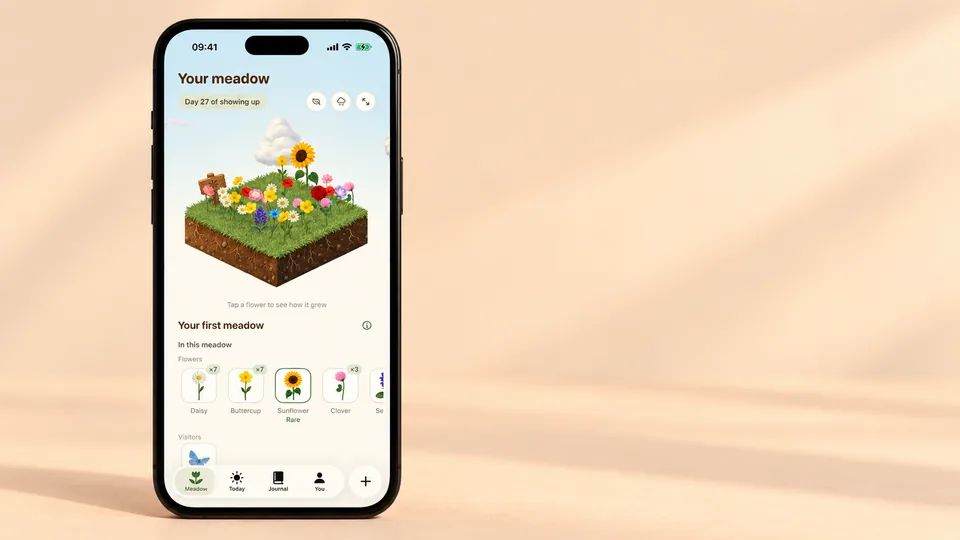
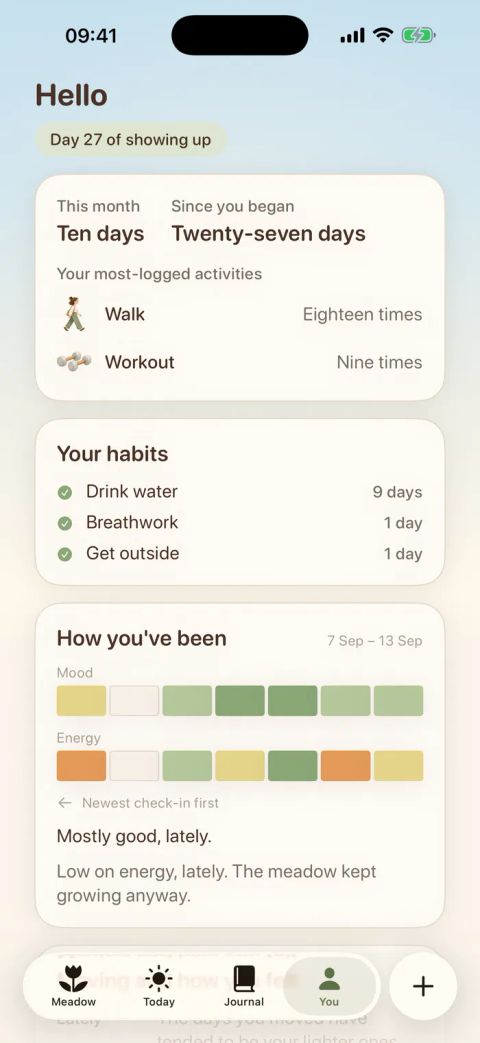
If it helps to see the practice building, Meadow keeps a quiet record of the movement you do. It is a habit app for iPhone where you log a stretch or a walk, tick off small daily habits, and note your mood, a daily win and an affirmation. Each day you show up grows a wildflower, and rare flowers and little animal visitors arrive as your meadow fills. There are no streaks, so a day you miss the butterfly stretch resets nothing and your flowers never wilt. You can find it at Meadow.
Today, pick your cue, the kettle or the end of the working day, and do the kneeling hip flexor stretch and a butterfly while it happens. That's enough to begin.
AUTHOR
Co-founder of Meadow.
Ash is co-founder of Meadow, a habit and movement tracking app that turns small acts of self-care into a growing wildflower meadow.
See how far you've come
Your habits, moods and little wins, all in one place
Meadow keeps track of the walks, the water and the good days, so you can look back and watch your effort add up.
Download Meadow