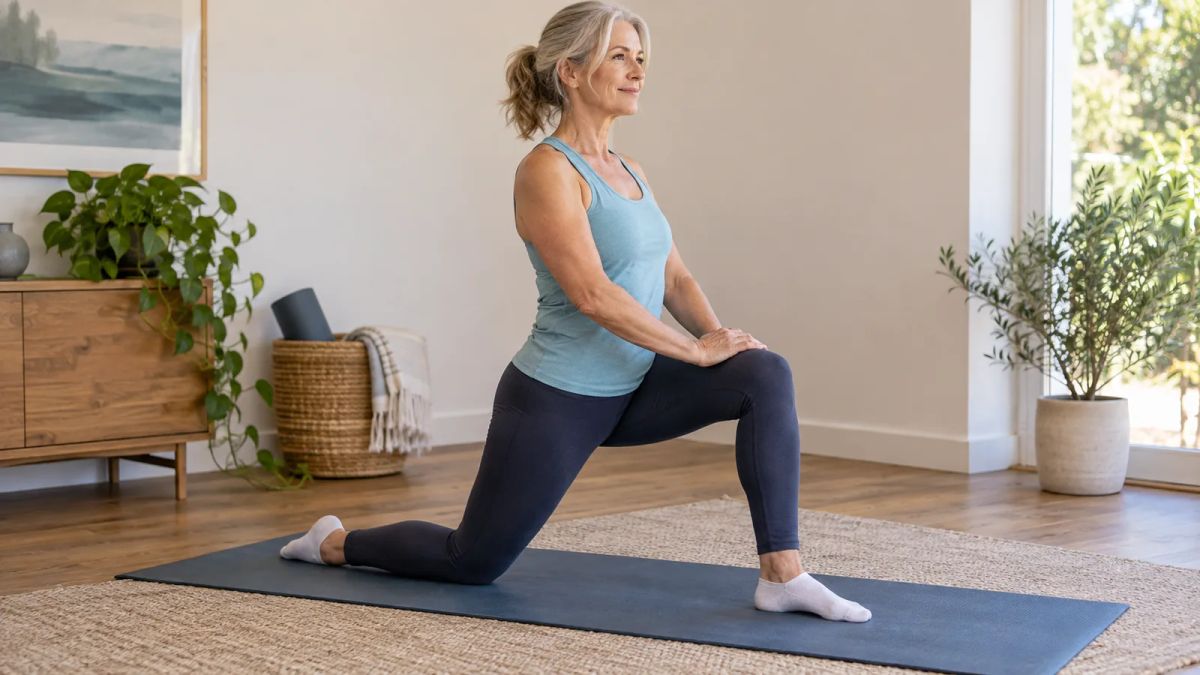
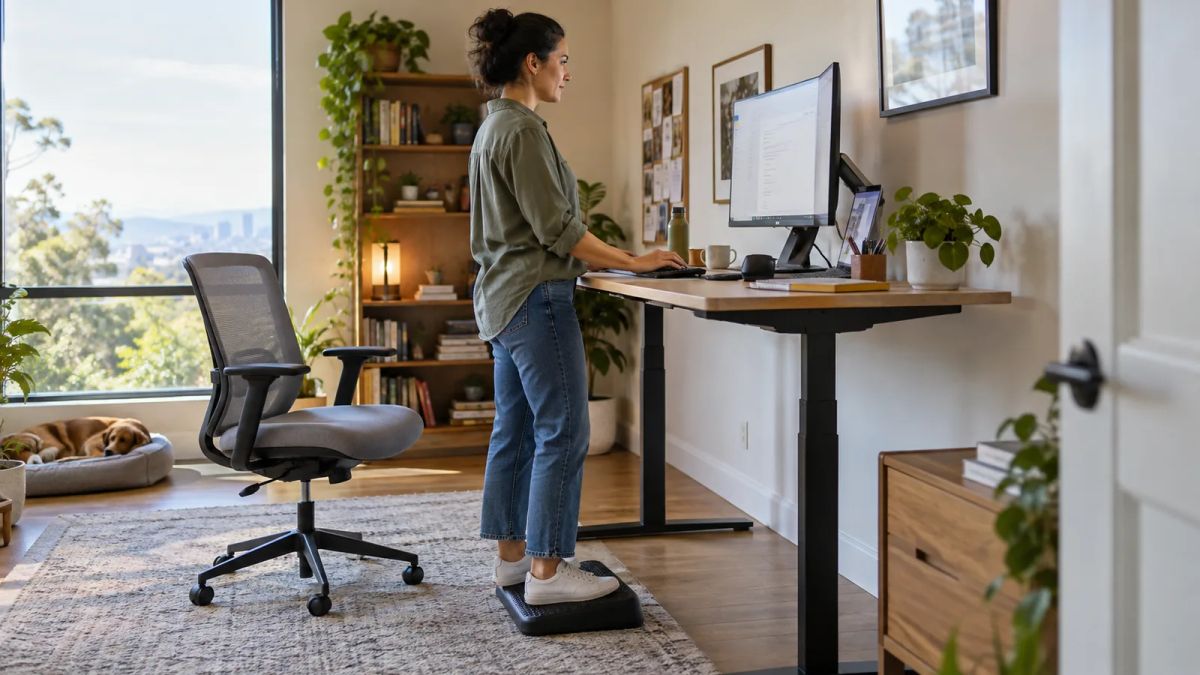
A day at a desk leaves the front of your hips short, your chest rounded forward, and your glutes and upper back stretched long and switched off. A handful of targeted stretches walks each of those back the other way. Below is a numbered routine of seven stretches you can do at or beside your desk in about eight minutes, working through the exact areas a long sit tightens and slackens.
You don't need a mat or a change of clothes. Most of these happen in or right next to your chair, and the two that don't only ask for a doorway. Do the whole set each evening to shake off the slump, or scatter them across the afternoon and drop one in each time you get up.
Loosening what stiffened is half the job. The other half is getting up more often, and there's a short section on that below.
What a day of sitting does to your body
Sit for hours and some muscles spend the whole time squashed short while their opposites sit stretched long and idle. Do that most days and your body starts treating the short length as normal, so the stiffness follows you out of the chair.
The clearest example is your hip flexors, the muscles running from your lower spine and pelvis to the top of your thigh. Harvard Health explains that during prolonged sitting these muscles tighten and shorten, and because they attach to the pelvis and lower back, that tightness can restrict how your pelvis rotates and feed into lower back pain. A physical therapist writing for the Hospital for Special Surgery puts the mechanism plainly: sitting holds the hip flexors in a compressed position, causing them to shorten and tighten up.
Everything on the front of you tends to close down like this. Lean toward a screen all day and your chest and the front of your shoulders shorten, while the muscles across your upper back lengthen and tire out trying to hold you upright. A sports medicine clinic lists the same pattern across the body: the glutes stretch while you sit, the hamstrings tighten without regular movement, and the neck takes extra tension from the head drifting forward toward the monitor.
The routine below hits each of those spots in turn.
Before you start
Every stretch here should feel like a mild, comfortable pull and nothing more. If you feel a sharp or pinching pain, ease off and come out of it. The NHS gives the same steer in its flexibility advice, telling you to move only as far as is comfortable and build up slowly.
For the seated moves, use a solid chair. If yours has wheels, plant your feet firmly or roll it against a wall so it can't shoot out from under you.
If you have a hip or back problem, a recent injury, or a condition that affects how you move, check with your GP or a physiotherapist before you start, so you know these suit you. That comes ahead of getting every rep right.
The routine: seven stretches to undo a day of sitting
Work through these slowly, breathing steadily, and hold each stretch for roughly 20 to 30 seconds unless a step says otherwise. Where a move works one side at a time, do both.
1. Kneeling hip flexor stretch
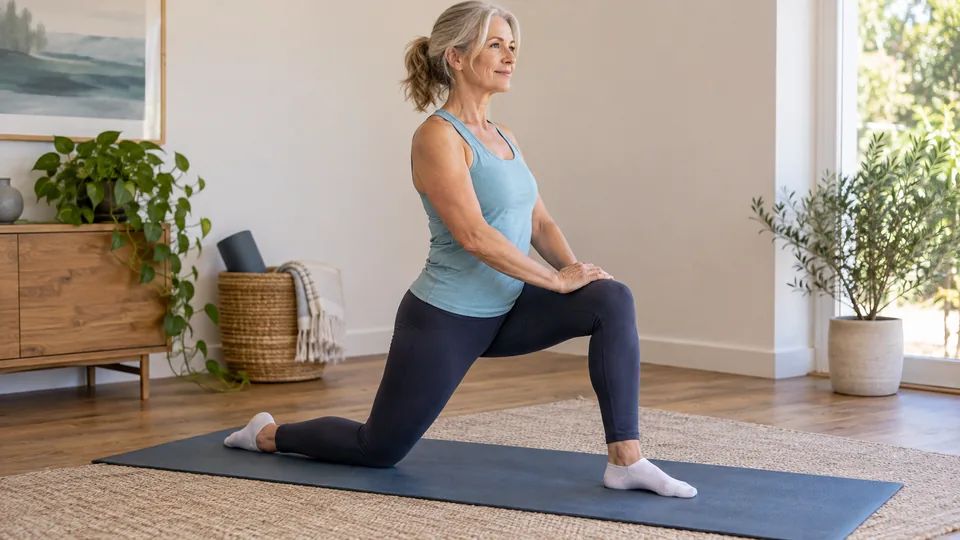
This one undoes the shortening that hours of sitting build into the front of your hips. Kneel on one knee with the other foot flat in front, knee bent at about a right angle, and rest your hands on the front thigh. Keep your torso tall and tuck your tailbone under slightly, then press your hips forward until you feel a stretch across the front of the kneeling leg's hip. Hold, then swap sides. Harvard suggests a combined total of about 60 seconds per side. No floor space? Stand and step one foot well back into a shallow lunge instead, keeping the back leg straight and torso upright.
2. Doorway chest opener
Sitting closes the chest, so this one prises it back open. Stand in a doorway, bend one arm to a right angle and rest the forearm against the frame at about shoulder height, then step gently through until you feel a stretch across the front of your chest and shoulder. Keep it mild and swap sides. If there's no doorway handy, clasp your hands behind your lower back, straighten your arms, and draw your shoulder blades together to lift the chest.
3. Seated spinal twist

Your upper back stiffens from sitting square to a screen all day, and a twist wakes it up. Sit tall with feet flat, place one hand on the opposite knee and the other behind you, and turn your upper body to look over your back shoulder, growing tall as you go. Turn only as far as is comfortable, hold, then unwind slowly and twist the other way.
4. Seated figure-four glute stretch
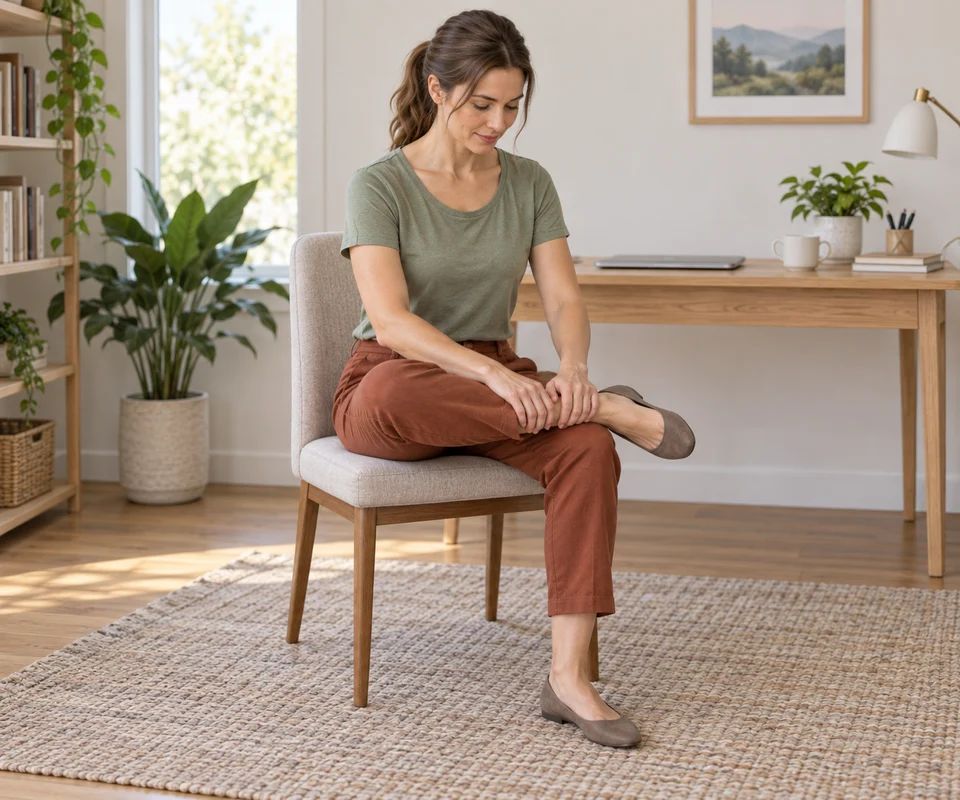
Your glutes sit stretched and idle all day, and this reminds them they exist. Rest one ankle across the opposite thigh so the bent knee opens outward, sit tall, then hinge forward gently from the hips until you feel a stretch deep in the hip and backside. Keep your back long instead of rounding it over. Hold and swap. This is a big part of why standing up after a long meeting feels creaky.
5. Seated hamstring stretch
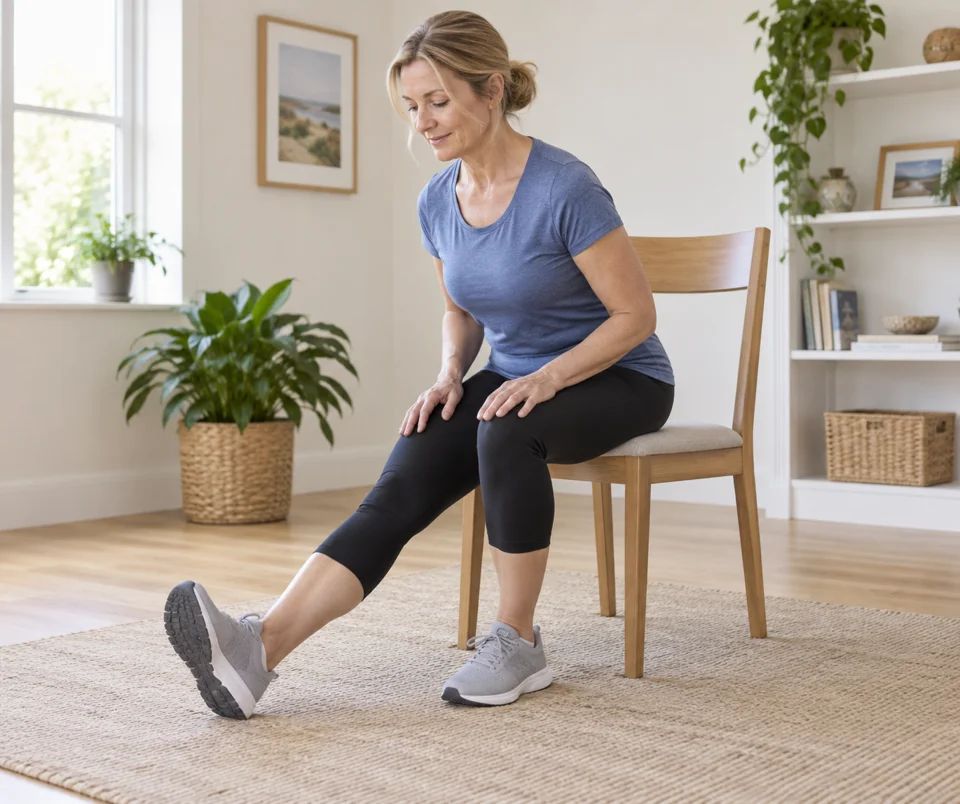
Hamstrings shorten from a day bent at ninety degrees, so give them some length back. Stay seated, straighten one leg out with the heel on the floor and toes pointing up, keep the other foot flat, then hinge forward from the hips with your chest leading until you feel a pull up the back of the straight leg. Move from the hips, not by curling your spine, and don't force it. Hold and swap.
6. Neck release and side stretch
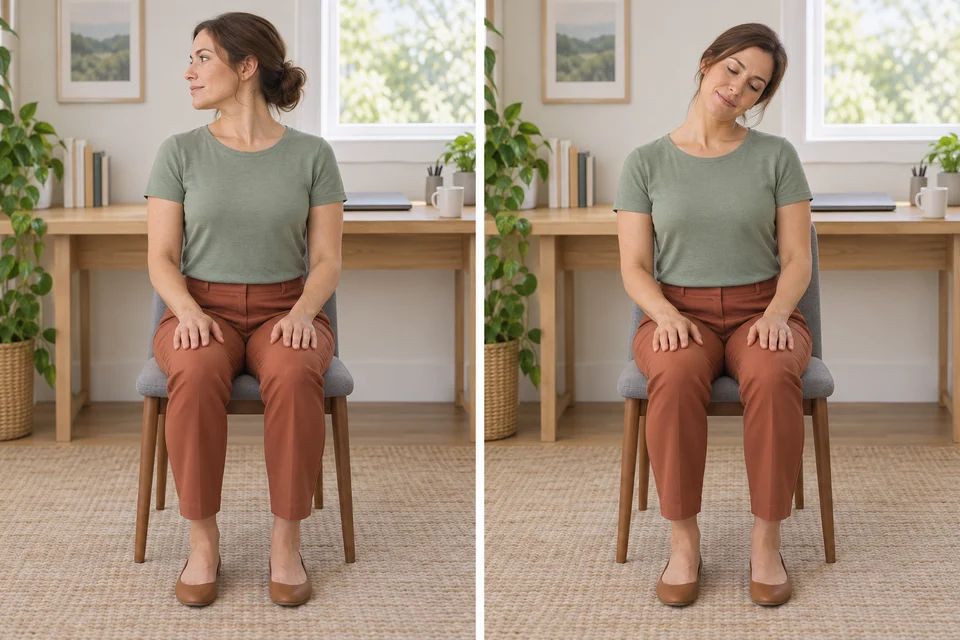
The neck carries the tension of a head that spends all day tilted toward the screen. Sitting tall, turn your head slowly to look over one shoulder, hold a moment, then the other way. Then drop one ear gently toward that shoulder until you feel a light stretch down the opposite side of your neck, and hold for around 15 seconds before swapping.
7. Standing back extension
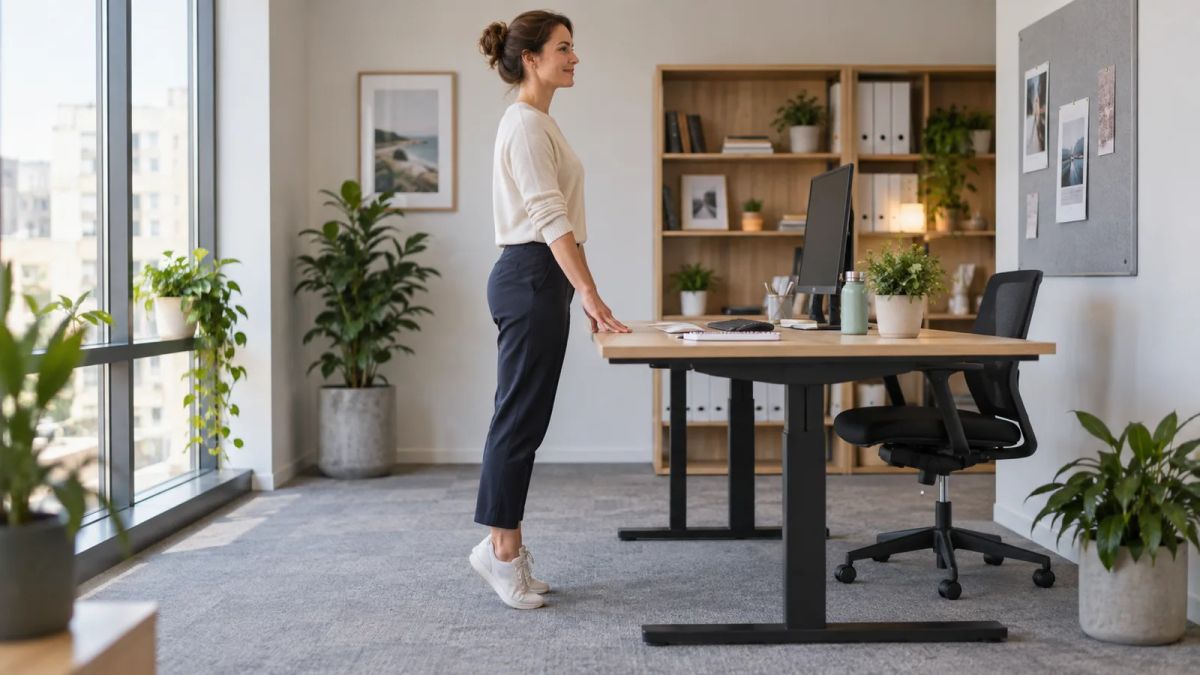
Finish by reversing the forward slump the whole day builds in. Stand up, place your hands on your lower back with fingers pointing down, and lean gently backward, opening your chest toward the ceiling. Keep it small and controlled, hold for a few seconds, and repeat two or three times. It feels like a proper exhale after hours hunched over a keyboard.
That's the full round in about eight minutes. Most days you won't do all seven in one go, and you don't have to. Two or three of these, a couple of times across the day, keeps the worst of the stiffness at bay.
Stretching helps, but getting up does more
Here's the honest limit of any stretch routine. A long day of sitting holds those muscles short for hours, and a few minutes of stretching can only give back so much of what that took. The deeper fix is to not let everything tighten so far in the first place, which means leaving the chair more often.
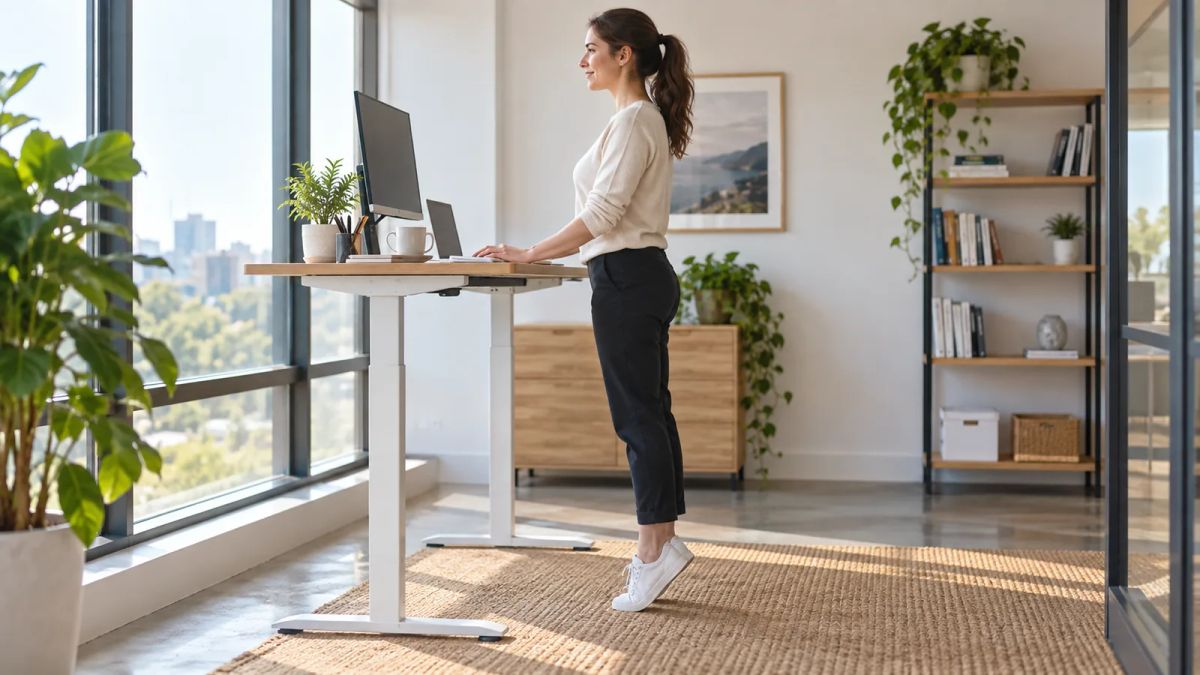
The physical therapist at the Hospital for Special Surgery recommends changing position every 30 to 45 minutes to keep tightness from setting in. This is where stretching and standing up meet. Every time you get up to refill a glass or take a call on your feet, the hip flexors lengthen, the glutes switch on, and nothing locks short.
It's worth doing even if you already exercise. The NHS points out that you can hit your weekly activity target and still face raised risks from heart disease, type 2 diabetes and weight gain if you spend the rest of the day sitting. The CDC frames the goal as move more and sit less, alongside the standard 150 minutes of moderate activity a week, and stresses that any amount of movement brings some benefit. You don't need a plan, only a reason to stand up more than you do now.
Make it a habit that survives a busy week
A stretch you mean to fit in somewhere tends to vanish. A stretch pinned to something that already happens tends to survive.
The American Heart Association suggests attaching a new action to a routine you already have, so it rides along with something automatic instead of asking you to remember. At a desk you're spoilt for cues. Pick one that happens most days, the afternoon coffee, logging off, the end of a meeting, and let a stretch or two follow it. "When I shut the laptop, I do the kneeling hip stretch and the chest opener" is the kind of plan that holds, because the cue was going to happen anyway.
If you want more ideas for weaving movement through the workday itself, our guide to desk exercises at work covers the small movement breaks that break up the sitting. And if you'd rather loosen up before the day begins, a short morning stretch routine works the same areas before you ever sit down.
Somewhere to mark the reset

If a nudge on your phone helps the habit stick, Meadow gives your end-of-day stretch somewhere to land. It's a gentle habit app for iPhone from Wildcard Wellness where you log the movement you enjoy with a timer, a few minutes of stretching or a lunchtime walk, and tick off small daily habits like getting up from your desk or drinking more water. You can note your mood and energy as the day winds down, and every day you show up grows a wildflower in your own meadow. There are no streaks, so a head-down day where you never left the chair resets nothing you've built, and you pick it back up whenever you're ready.
On a rushed day, and after you skip it
Decide your smaller version before you need it. On a day so packed you can't spare eight minutes, one thing still counts. Stand up, do the standing back extension, and roll your shoulders back three times. Thirty seconds on your feet keeps the thread going, and keeping the thread going is what turns this from a chore into something your body starts to expect.
And you will skip it. A fortnight of back-to-back deadlines will bury the whole routine, and that's fine. Nothing is undone by the gap. The stiffness that creeps in after weeks of solid sitting comes from staying still, not from any failure on your part, and the way back is the same as the way in. Tomorrow, when you shut the laptop, do the hip flexor stretch and the chest opener. Start there, not with a marathon session to make up for lost time.
Common questions
Will stretching fix tight hip flexors from sitting? Stretching gives back range and eases the pull you feel after a long sit, and doing it regularly helps. It isn't a one-off cure. Because a full day holds those muscles short for hours, the lasting fix pairs stretching with getting up often and strengthening the glutes and core that sitting leaves lazy. If tightness or pain lingers, see a physiotherapist.
How long should I hold each stretch? Around 20 to 30 seconds a side is a sensible default, and physios often suggest repeating a stretch two or three times. Ease in slowly instead of bouncing.
How often should I get up from my desk? There's no magic number, but roughly every 30 to 45 minutes is a reasonable target and matches common physio advice. If that's too frequent for the way your work flows, stand at the end of each task or meeting. Any break beats sitting straight through.
Can stretching fix my posture? It helps by loosening the tight muscles that pull you into a slump, especially across the chest and hips. On its own it won't hold you upright, because posture also depends on the back and core muscles that a day of sitting leaves under-used. Stretch the tight bits, strengthen the weak bits, and move more, and the slump has less to work with.
Right now, before you close this, do one thing. Stand up, place your hands on your lower back, and lean gently back to open your chest. That's the first undo of the day, and the habit starts with it.
AUTHOR
Co-founder of Meadow.
Ash is co-founder of Meadow, a habit and movement tracking app that turns small acts of self-care into a growing wildflower meadow.
Little and often, with Meadow
Consistency, not intensity.
Meadow turns the movement you enjoy and the habits that help you feel good into a meadow of wildflowers. No streaks to break, and your flowers never wilt.
Download Meadow