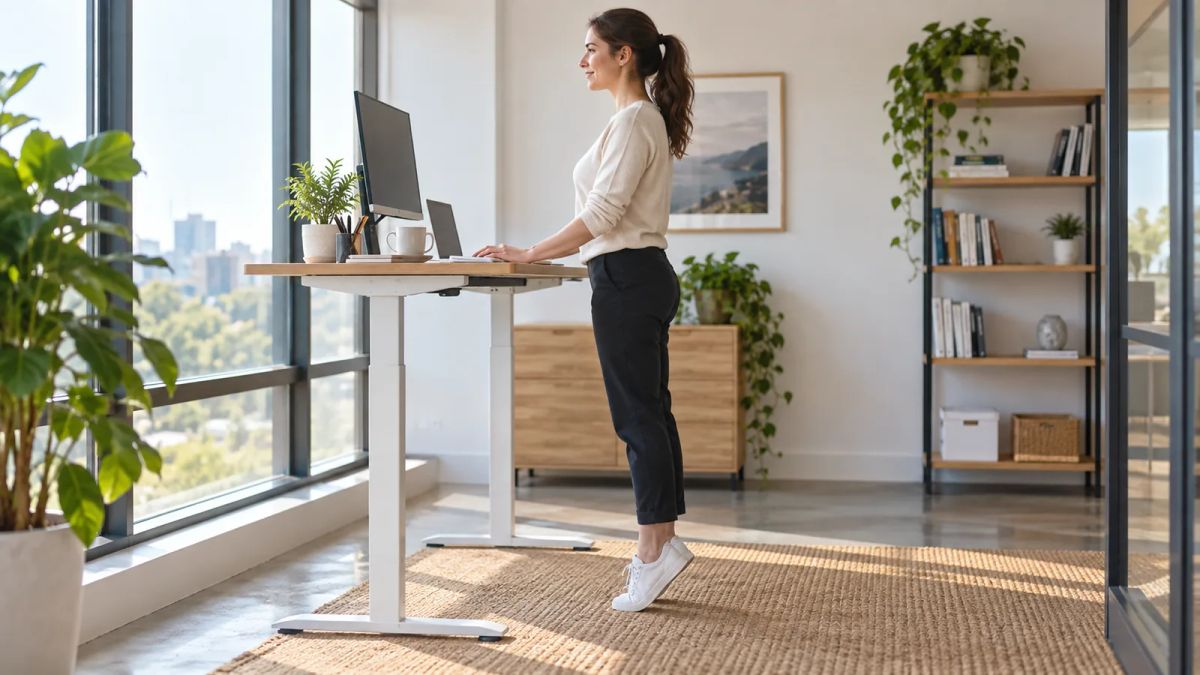
Standing all day isn't the upgrade it's sold as. You've swapped one fixed position for another, and your body still spends hours holding still.
The honest answer is that standing beats sitting by a small margin, and standing for hours brings its own aches and risks. What helps is movement. A short walk, a few stretches, a shift from sitting to standing and back again through the day.
If you bought a standing desk hoping it would undo a day at a screen, read this before you commit to eight hours on your feet.
What standing does for you
Standing burns a little more energy than sitting. That's about the size of it.
In a Harvard Health piece, one researcher clocked study subjects at roughly 80 calories an hour sitting and about 88 standing. A 2018 meta-analysis of 46 studies put the average gap at 0.15 calories a minute. Stand instead of sit for six hours and a 65kg person spends around 54 extra calories a day, which the authors reckon works out to about 2.5kg of body fat over a year if nothing else changes. Real, but small. Roughly a carrot's worth across an afternoon.
The steadier gains show up elsewhere. Breaking up long sits with time on your feet is linked by Cleveland Clinic to better circulation, steadier blood sugar and less of the lower-back stiffness that sets in when you don't move for hours. Some people also find they focus a bit better standing.
Standing has a place, then. It isn't exercise, though, and it was never going to stand in for a walk. Harvard's own figures put a gentle walk at about 210 calories an hour, more than double what standing gives you. That's the number to hold onto whenever a desk promises to sort out your health for you.
Where standing all day goes wrong
Go straight from sitting all day to standing all day and your legs, feet and lower back will let you know. Harvard flags exactly this: a sudden switch to full-time standing can bring on back, leg or foot pain.
There's a circulation cost too. Stand still for long stretches and blood tends to pool in your leg veins, which over time is associated with varicose veins. This is why shop workers, hairdressers and chefs report them so often. Standing without moving also loads your knees, hips and the small muscles of your feet, so aching arches and a stiff lower back by mid-afternoon are common once the novelty wears off.
The most striking finding comes from a 12-year Canadian study of more than 7,300 workers. People whose jobs kept them mostly on their feet developed heart disease at roughly twice the rate of those who mostly sat, 6.6% against 2.8%, even after the researchers accounted for age, health and other habits. Prolonged standing, in other words, is no free pass. It carries a risk of its own.
None of this means standing is bad for you. It means a whole day of it, without moving, trades one set of problems for another.
The trouble is the stillness, not the chair
Sitting and standing share the same flaw. Both keep you in one shape for hours while your muscles switch off and your circulation slows.
Your body runs on the small movements you make all day without thinking about them. Scientists call this NEAT, or non-exercise activity thermogenesis: the energy you spend walking to the kettle, taking the stairs, fidgeting, carrying the shopping. A review in the journal literature notes that NEAT can vary between two people of the same weight by up to 2,000 calories a day, and that walking lifts your metabolic rate by 100 to 200% above rest, while standing lifts it only 10 to 20%. The gap between standing and moving is far bigger than the gap between sitting and standing.
That's the real lever. Not the height of your desk, but how often you break away from it. Every trip to the kettle, every set of stairs and every short walk pushes blood around, wakes your muscles up and adds to the total that keeps you well. A day made of small movements beats a day frozen at any height.
Build a sit, stand and move rhythm
You don't need a rigid timer that pulls you out of every task. You need a loose habit of changing position and getting up often. Here's a simple way to structure it.
- Sit for focused work that needs fine control, like writing or detailed reading. Sitting is better for these anyway.
- Stand for calls, reading on screen, or tasks where you're thinking more than typing. Aim for spells of 30 to 60 minutes rather than the whole afternoon.
- Move every 30 minutes or so, even for one minute. Walk to fill your water glass, take a call on your feet, or do a lap of the office.
- Take one proper walk in the day. A ten-minute loop at lunch does more for you than any amount of standing still.
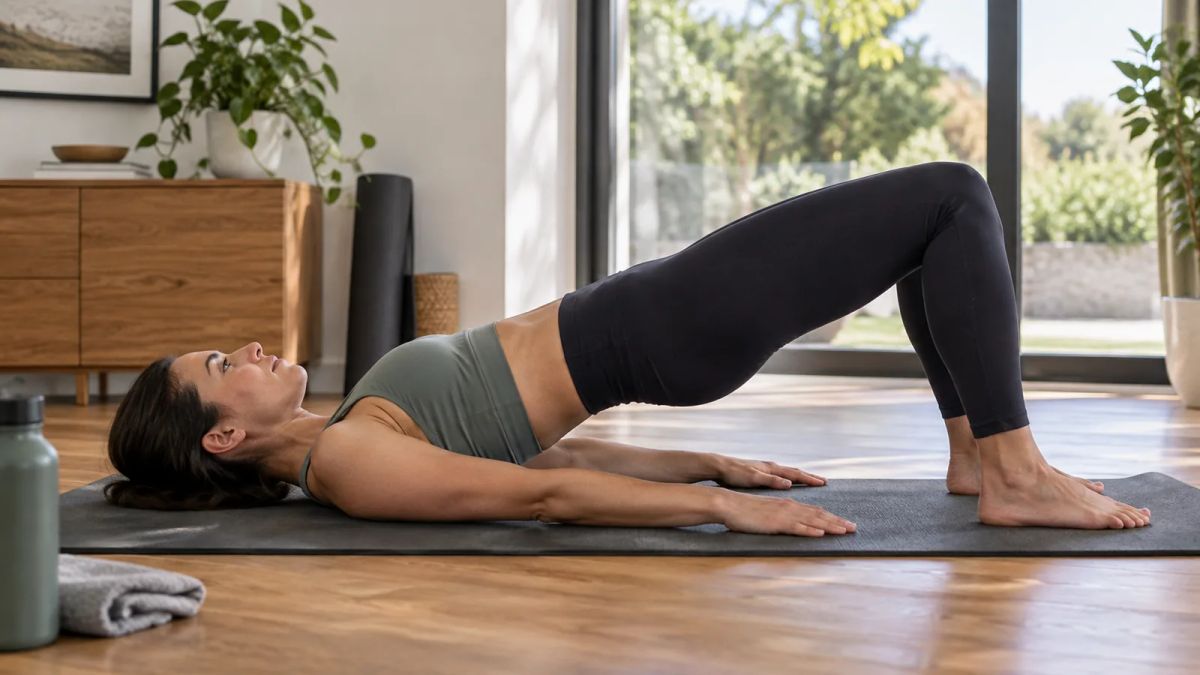
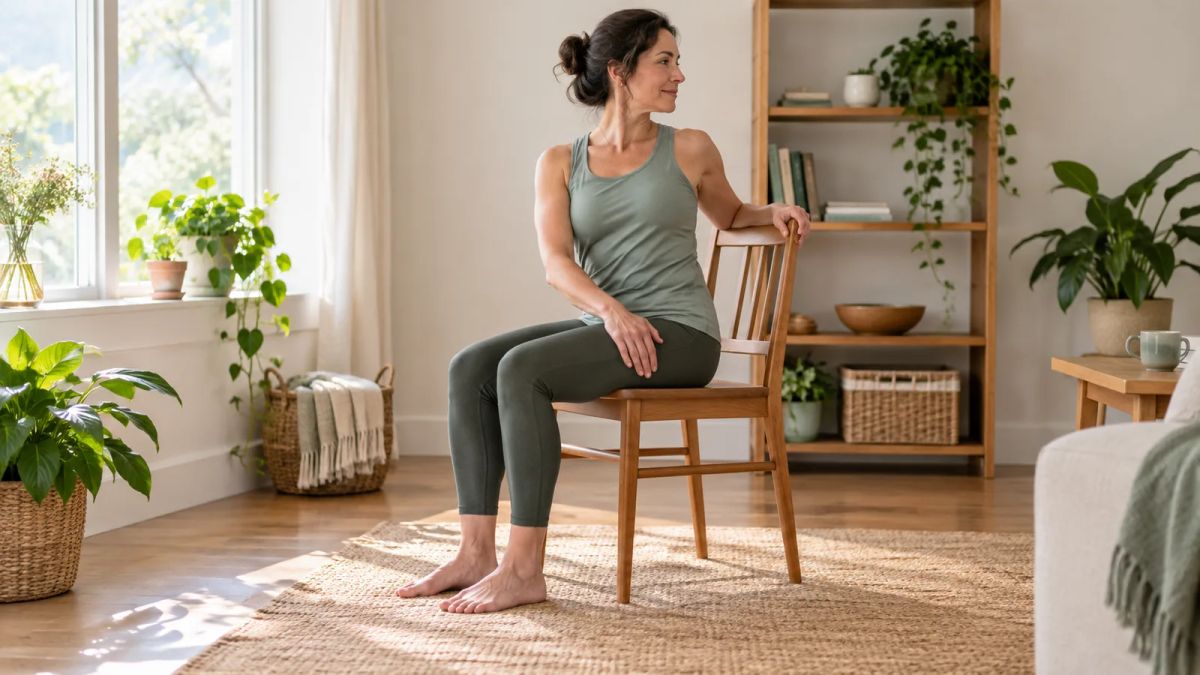
- Fit in a few desk exercises at work and some stretches for sitting all day to keep your hips, neck and shoulders from seizing up.
If it helps to see it laid out, here's a sample working day built around movement instead of one fixed pose.
9:00 Sit, focused work 9:30 Stand and stretch for a minute
10:00 Stand for a call 10:30 Walk to refill water
11:00 Sit, focused work 11:30 Two minutes of desk stretches
13:00 Ten-minute walk at lunch
14:30 Stand for reading 15:00 Short walk or stairs
16:00 Sit, wind-down tasks 16:30 Stand and stretch before finishing
Ease into it if you're new to standing. Harvard suggests starting with 30 to 60 minutes of standing a day and building up, so your legs and back adjust. Trying to stand all day from Monday is how people end up sore and giving up by Wednesday.
None of this replaces proper activity. The NHS still recommends 150 minutes of moderate activity a week plus strengthening on two days, and the CDC points out that how much you need varies from person to person. A standing desk is a nudge in the right direction, not a substitute for walking, and a more active lifestyle does the heavy lifting.
See the movement add up

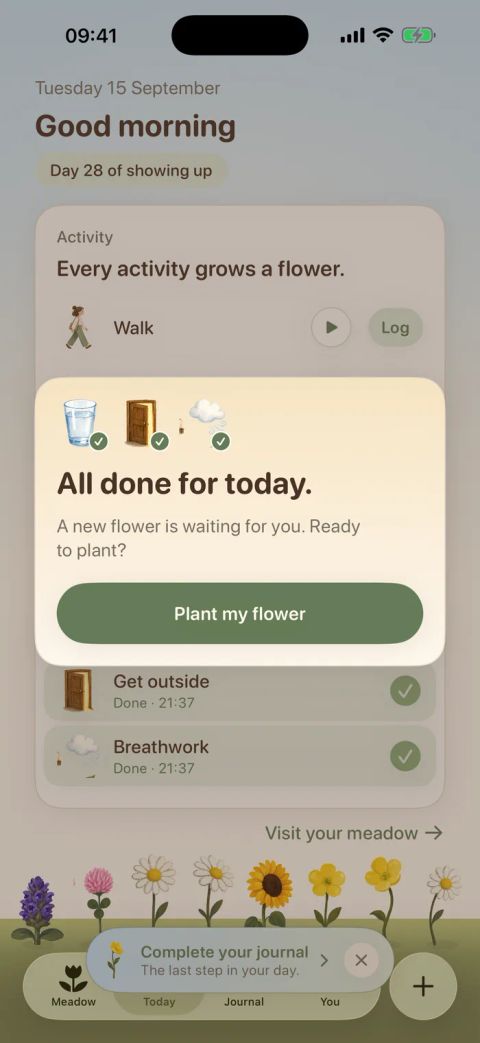
Some days you'll manage the walk and the standing spells, and some days you won't get up from your chair once. Meadow is a gentle movement app that treats both the same way and picks up where you left off. You log a walk or a few minutes of movement, tick off a small habit like getting outside, and each day you show up a new wildflower blooms in your own meadow. There are no streaks, so a day glued to your desk resets nothing you've grown. It's built for turning up often rather than turning up perfectly. You can find it at growyourmeadow.com.
Common questions
How long should I stand at a standing desk each day?
There's no fixed number, but hour-on-hour standing isn't the goal. Alternating spells of 30 to 60 minutes with sitting and regular movement is a sensible pattern, and building up gradually saves your legs and back.
Does standing burn belly fat?
Not meaningfully. Standing burns only about eight extra calories an hour over sitting, so it won't target fat anywhere. If weight is your aim, walking, wider activity and what you eat carry far more weight than desk height. Speak to your GP before making big changes.
Can standing all day cause varicose veins?
Prolonged standing is associated with varicose veins, because staying still lets blood pool in your leg veins. Sitting more won't fix it. Moving more will: shift your weight, walk about, and don't stand rooted to one spot for hours.
Is a standing desk worth it?
It can be, used well. A sit-stand desk makes it easy to change position and break up long sits, and that's worth having. Buy one expecting it to replace exercise or melt fat and you'll be disappointed.
The one thing to take from all this: set a quiet reminder to get up every half hour, and take a short walk at some point today. That single habit will do more for you than any desk ever could.
AUTHOR
Co-founder of Meadow.
Ash is co-founder of Meadow, a habit and movement tracking app that turns small acts of self-care into a growing wildflower meadow.
Every little bit counts
Five minutes counts. So does a dance in the kitchen.
Log the movement you enjoy and the small habits that help you feel good, and watch them bloom into something you can see.
Download Meadow