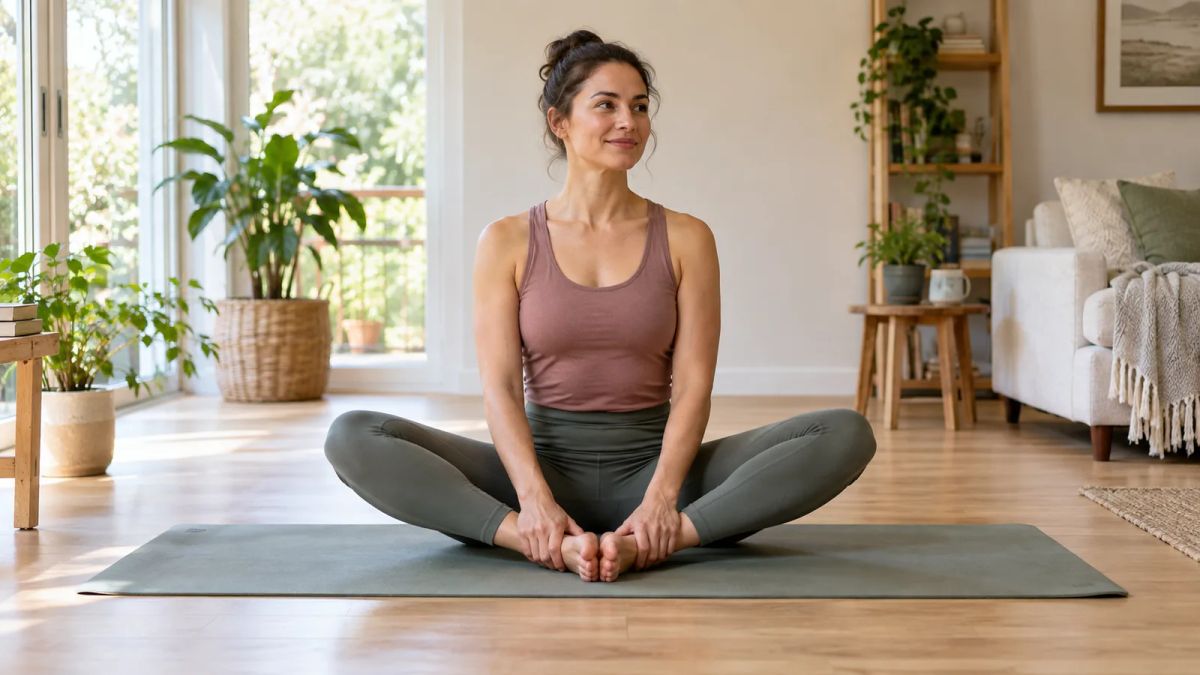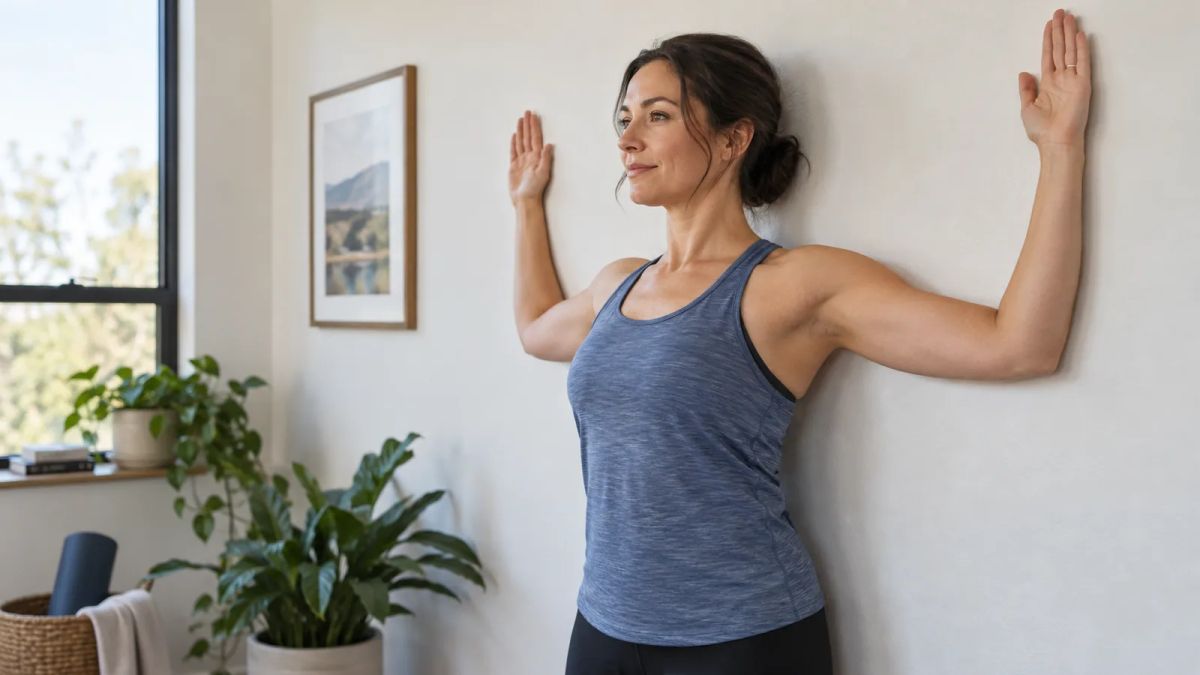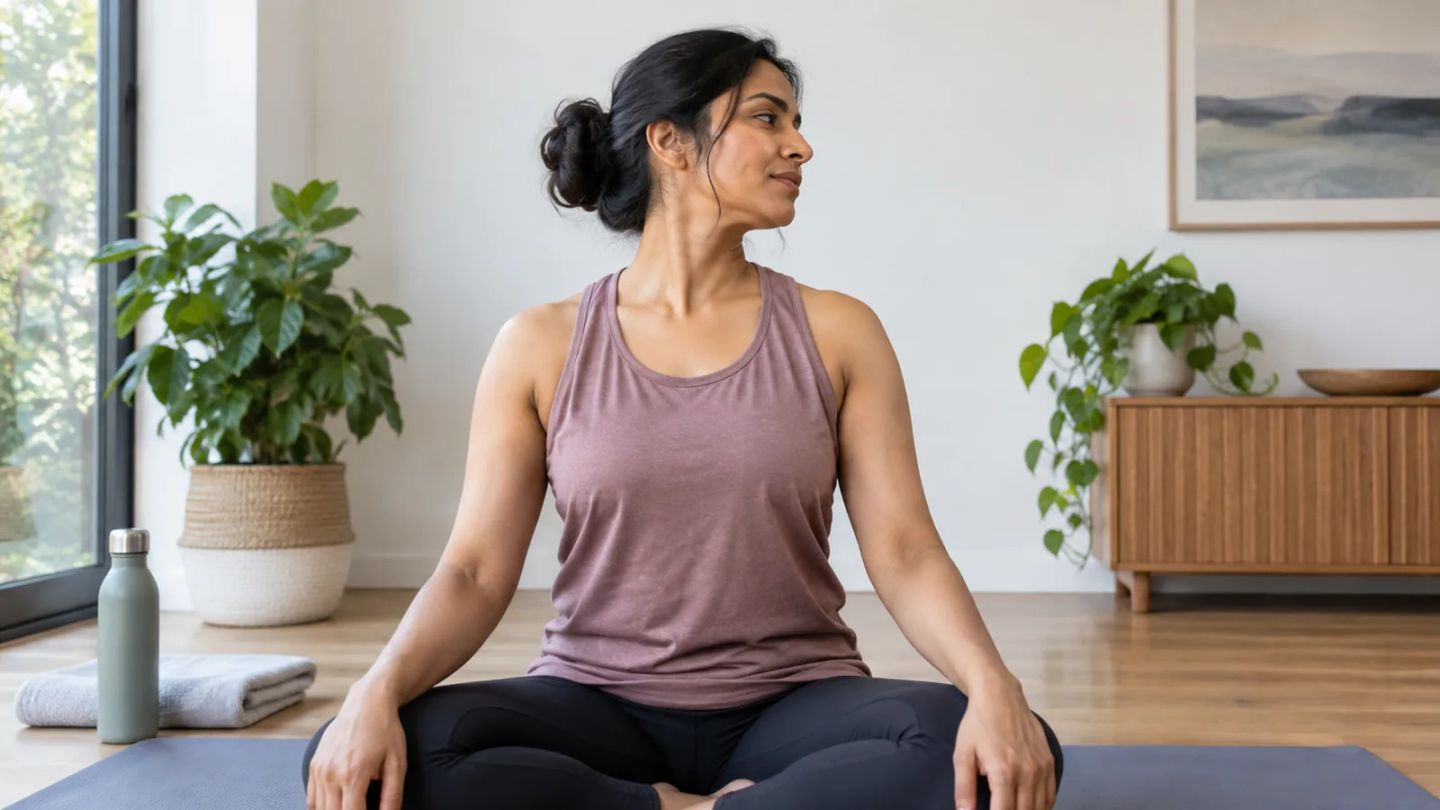
A stiff neck usually comes from holding your head in one position too long, and a few minutes of easy stretching most days is the reliable way to loosen it. Below is a six-stretch plan you can do sitting at your desk or standing in the kitchen, working through the muscles that seize up when you spend the day looking down: the sides of the neck, the upper traps across the top of your shoulders, and the muscle that runs from your neck to your shoulder blade.
You don't need a mat, kit or a change of clothes. Every move happens where you already are, takes about five minutes as a set, and asks only that you go slowly and stop short of anything sharp.
Loosening a tight neck is one half of the job. Not letting it tighten so far again is the other, and there's a short section below on how often to do this and how to hold your head so it helps.
Why necks get stiff
Your neck holds up a head that weighs ten to twelve pounds, and it does that most easily when your ears sit over your shoulders. Tip the head forward to read a phone in your lap and the load climbs fast. Cleveland Clinic puts a slight downward glance at the equivalent of a 27-pound weight, a 30-degree tilt at around 40 pounds, and a head dropped right down over a phone at up to 60 pounds of force on the neck. The muscles at the back of the neck carry that weight the whole time you scroll.
Do that for hours, day after day, and they complain.
The everyday triggers are ordinary. Cleveland Clinic lists them as sleeping with your neck in an unusual position, looking at a screen for too long, and plain stress. The NHS names the same big two, a neck locked in an awkward position overnight and bad posture from sitting at a desk for a long time.
Stress adds its own squeeze. When you're wound up, you clench through the neck, jaw and shoulders, and the trapezius muscles across the top of your back stay switched on, never getting the signal to let go. A tense week can leave your neck as sore as a slouched one.
Over years, the forward-head habit does more than ache. Cleveland Clinic notes that the cervical discs in the spine can degenerate under sustained forward-head posture. That's the long game, and a reason to treat a stiff neck as a nudge to change how you hold your head.
Ease into these, and know when to get checked
Every stretch here should feel like a mild pull down the side or back of the neck and nothing sharper. The neck is a sensitive area, so ease in and back off the moment anything pinches, shoots, or sends pins and needles down an arm. The NHS gives the same steer for flexibility work: move only as far as is comfortable and build up slowly over time.
The slow turns that open the routine are your warm-up, so start there and let the neck loosen before you hold any stretch.
Some stiff necks need a professional, not a stretch. See a GP if the pain hasn't eased after a few weeks, if painkillers aren't touching it, or if you get pins and needles or a cold arm, which the NHS flags as possibly something more serious. And treat a stiff neck that comes with a fever, nausea, sensitivity to light, confusion or a rash as urgent: Cleveland Clinic lists that combination as a reason to seek emergency care, because it can point to meningitis.
The routine: six stretches for a stiff neck
Work through these in a comfortable seat or standing tall. Breathe steadily, keep every movement slow, and where a stretch is one side at a time, do both. As a set it takes about five minutes, and you can also pull out one or two whenever your neck feels tight.
1. Neck rotation
Sit or stand tall with your shoulders relaxed. Turn your head slowly to look over one shoulder, going only as far as feels easy, hold for a breath, then turn to look over the other shoulder. Keep your chin level, as if it's resting on a shelf. Do five slow turns each way. This wakes the joint up and shows you where today's tight spots are before you stretch into them.
2. Side flexion
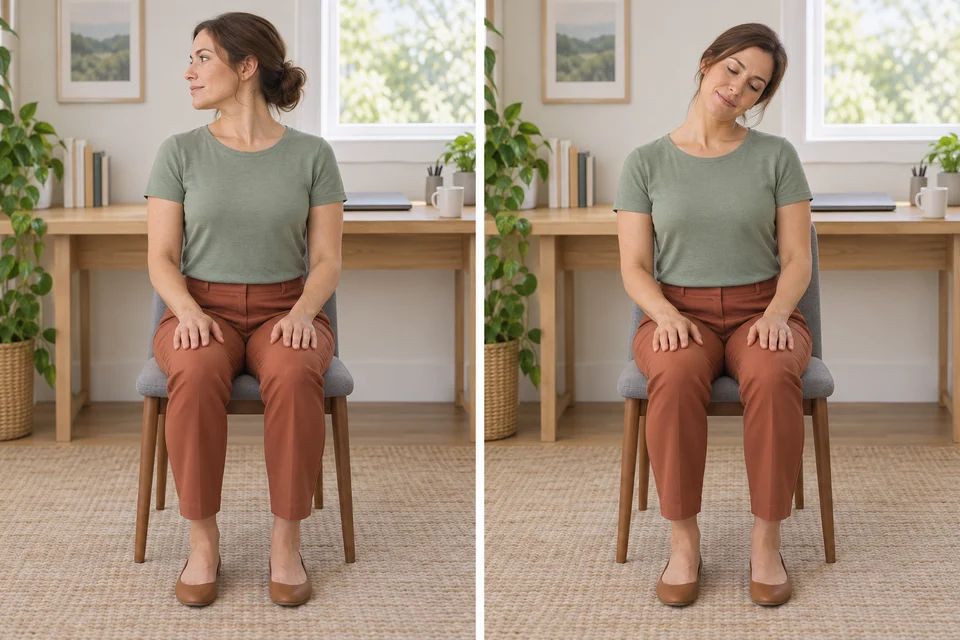
Facing forward, tip one ear down towards that shoulder until you feel a light stretch up the opposite side of your neck. Keep both shoulders down and let the weight of your head do the work. Hold for a few seconds, come back to the middle, and tilt the other way. Do five each side, easing a little further only as the neck allows.
3. Upper trapezius stretch
This targets the ropey muscle along the top of your shoulder that a stressful day tightens. Sit tall and hold the edge of your chair with one hand to anchor that shoulder down. Tilt your head away from it, ear towards the opposite shoulder, and for a touch more, rest your free hand lightly over the top of your head, adding only its weight and no real pull. Hold for about 30 seconds, release, and swap. Physiotherapists at IMPACT Physical Therapy use this same drop-the-shoulder, tilt-away position, held for 30 seconds, three to five times a side.
4. Levator scapulae stretch
The levator scapulae runs from the top of your neck down to your shoulder blade, and it's often the exact spot people rub after a long day at a screen. Turn your head about 45 degrees to one side, as if looking towards your armpit, then drop your chin down that line until you feel the stretch at the back and side of the neck. Rest the hand on that same side lightly on the back of your head for a little more reach. Hold and swap. A physical therapist at the Hospital for Special Surgery advises holding each neck stretch for at least 20 to 30 seconds to get anything from it.
5. Chin tucks
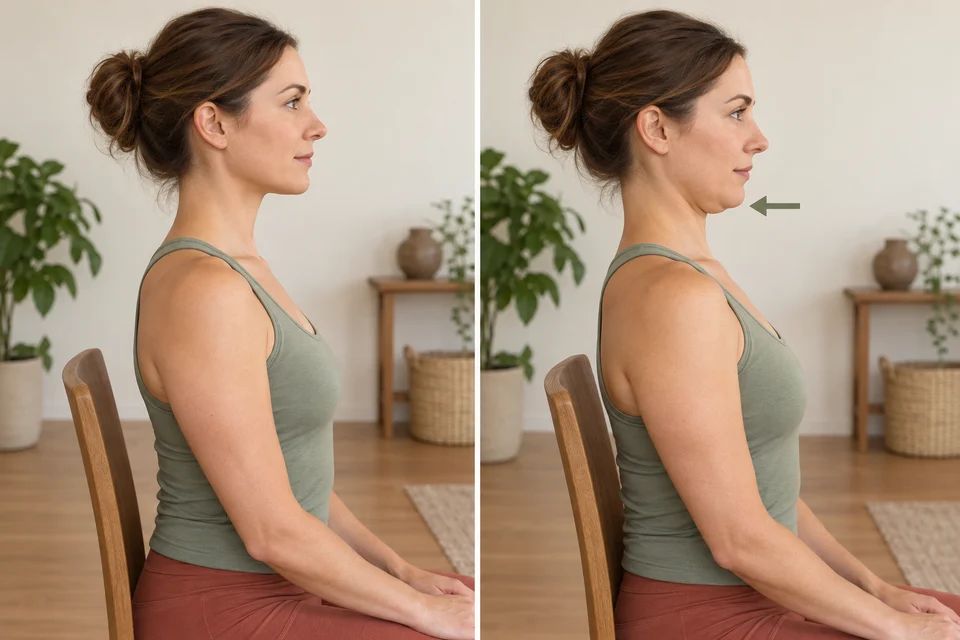
This is the posture reset, and the one to do most. Sit or stand tall and, without tipping your head up or down, draw your chin straight back to make a double chin, feeling the muscles at the back of the neck lengthen. Hold for around five seconds, then release, and do ten. HSS physiatrist Dr Kathleen Davenport describes the move as sliding the chin backward and downward, like giving yourself a double chin, to strengthen the neck and take pressure off the sore structures. The NHS suggests the same tuck and hold, about ten times.
6. Gentle neck extension
Finish by reversing the forward tilt the day builds in. Cradle the back of your head with one or both hands, then tip your head slowly backwards as far as feels comfortable, opening the front of the neck, and come back up under control. Keep it small and stop well short of any pinch. Do it around ten times. The NHS includes this backward tip, done with your hands supporting your head, as a standard part of easing a stiff neck.
That's the full round. On a first go, move through slowly, and after a week or two the whole thing runs on its own.
How often to do it
Little and often beats one big session. A stiff neck responds to being moved gently through the day, so a set in the morning and a few loose turns whenever you notice tightness will do more than a single ten-minute effort you dread.
The NHS advice for an aching neck is to do the gentle exercises often through the day, especially while it's sore, and to keep the neck moving instead of holding it stiff in a collar. Cleveland Clinic makes the matching point for prevention: a quick stretch and a few head movements, plus small posture resets across your day and your screen raised nearer to eye level so your head stops dropping forward.
Be patient with the deeper change. A stretch leaves the neck looser for an hour or two, but a tight neck built over months of desk time eases over weeks of steady practice, not in a session or two. Harvard Health is blunt that getting more flexible takes weeks to months of regular work, and that you have to keep it up to hold on to any gains. Stretching alone won't hold you upright either, so the lasting fix pairs these moves with lifting your screen and catching yourself before the head creeps forward.
Keep the habit going on the ordinary days

The stretching is the easy part. Remembering to do it on a normal, busy day is where it slips. Meadow is a habit app for iPhone built for that gap. You log a few minutes of movement, a set of neck stretches or a walk, tick off small daily habits, and note your mood and energy. Each day you show up grows a wildflower in your own meadow, with rarer flowers and small animal visitors turning up as it fills in. There are no streaks, so a run of frantic days when the stretches get skipped resets nothing, and your flowers never wilt. You can find it at Meadow.
On a busy day, and after you skip it
Decide your smaller version now, before the day gets away from you. On a packed day, one thing still counts: sit up, do ten chin tucks and five slow turns each way. Thirty seconds keeps the thread going, and the thread is what turns this into something your neck expects.
You'll skip it, and that's fine. A fortnight of deadlines will bury the routine, and nothing is undone by the gap. The stiffness that creeps back comes from staying still, not from any failure on your part. Pick tomorrow, start with the chin tucks, and let the rest follow.
A stiff neck rarely travels alone. If your shoulders seize up with it, our shoulder mobility exercises work the joint below. If the whole desk-bound slump is the problem, stretches for sitting all day loosen the hips and chest a long sit tightens, and desk exercises at work break up the sitting that starts it.
Common questions
How do I get rid of a stiff neck fast? Move it gently instead of resting it rigid. Slow turns and side tilts, a set of chin tucks, and a warm compress or shower to loosen the muscles will usually ease a run-of-the-mill stiff neck over a day or two. Keep the neck moving within comfort, and take a painkiller if you need one to move more freely.
Should I stretch a stiff neck or rest it? Gentle movement, in almost every ordinary case. The NHS advises keeping the neck moving and skipping a collar, because holding it still tends to stiffen it further. Ease off anything sharp, but don't wrap the neck in cotton wool.
How often should I stretch my neck? Most days, in short bursts. A morning set plus a few loose turns whenever you notice tension does more than one long weekly session. If your work keeps your head down, a quick reset every hour or so helps.
When is a stiff neck something to worry about? If it lasts more than a few weeks, painkillers don't help, or you get pins and needles or weakness down an arm, see a GP. Treat a stiff neck alongside a fever, nausea, light sensitivity, confusion or a rash as an emergency, since that combination can signal meningitis.
Right now, before you look back at your screen, do this: sit tall, draw your chin straight back into a double chin, hold for five seconds, and let go. Do it ten times. That's the first undo, and the habit starts there.
AUTHOR
Co-founder of Meadow.
Ash is co-founder of Meadow, a habit and movement tracking app that turns small acts of self-care into a growing wildflower meadow.
Little and often, with Meadow
Consistency, not intensity.
Meadow turns the movement you enjoy and the habits that help you feel good into a meadow of wildflowers. No streaks to break, and your flowers never wilt.
Download Meadow