Shoulder mobility is how freely your shoulders move through their full range, in every direction the joint is built for, and this is a routine of seven moves to keep it. It takes about ten minutes, needs a doorway and a light band or a rolled towel, and works whether you're stiff from a desk or want to reach overhead without a catch.
Your shoulder moves further than any other joint you own. Physiotherapy references describe it as a ball-and-socket joint with more range of motion than any other joint in your body. That freedom is what lets you scratch between your shoulder blades, pull a jumper over your head, and lift a box onto a high shelf. It is also what makes the shoulder quick to seize up, because a joint that can go everywhere slowly stops going much of anywhere when you spend your days folded over a keyboard.
The routine works in a sensible order. It wakes the joint with easy rolls, frees the upper back, opens the chest, stretches the back of the shoulder, grooves the overhead reach, then switches on the muscles that steer your shoulder blades. You can do the whole thing standing near a wall and a doorway, with a band or towel within reach.
Why shoulder mobility is worth ten minutes
Most stiff shoulders are built at a desk. A physiotherapist at Hinge Health explains that when you sit for a while without getting up, your upper back slouches and the thoracic spine stiffens, and a rigid upper back leaves your shoulders less room to move. The chest tightens, the shoulders round forward, and the reach overhead you don't think about until you need it starts to shrink.
That reach does fade with the years, and you can measure it. A study of 2,404 adults from the North West Adelaide Health Study found that shoulder movement declined steadily with age, with mean active flexion dropping by around 43 degrees in men and 40.6 in women between the youngest and oldest groups, and abduction, the reach out to the side, falling by a similar amount. Some of that is the tissue and the joint changing over decades. A fair slice of it is decades of sitting still.
Here is the everyday cost. When the shoulder loses range, the movements that use it get harder or find another way to happen. Hinge Health lists the plain ones a stiff shoulder makes awkward, reaching overhead, brushing your hair and getting dressed. Keeping the joint moving keeps those small acts easy.
The benefit worth being honest about is that. Mobility work can help you move through ordinary days with a fuller, freer range and less of that reaching-and-wincing feeling. There's a hint of more, too. Hinge Health points to a 2020 review suggesting shoulder mobility work may help reduce overuse shoulder injuries in athletes, though that is a specific group and a may, not a promise for everyone.
Move within your range, and check first if you need to
Every move here should feel like a mild pull or honest effort, never a sharp, pinching or radiating pain. The NHS gives the same steer for flexibility work, to move as far as is comfortable and build the repetitions up slowly over time. Range comes with patience, not with forcing.
Warm the joint before you push into a deep stretch. Harvard Health warns that stretching muscles before they're warmed up can hurt them and suggests five to ten minutes of light activity first. The shoulder rolls that open this routine are that warm-up.
Some shoulders need a word with a professional before they start. If you can't lift your arm overhead, if you feel numbness down the arm, or if the pain came on suddenly and sharply, that is a reason to see a GP or a physiotherapist rather than stretch through it. The same goes if you have a shoulder injury, arthritis or a condition that affects how the joint moves. The guidance on the exercises themselves is short and worth keeping in mind, from the American Academy of Orthopaedic Surgeons: you should not feel pain during an exercise, and if you do, stop and talk to your doctor or physiotherapist.
The routine: seven moves for freer shoulders
Work through these in order. Breathe steadily, keep the movements smooth, and where a move is one side at a time, do both. The whole sequence takes roughly ten minutes.
1. Shoulder rolls
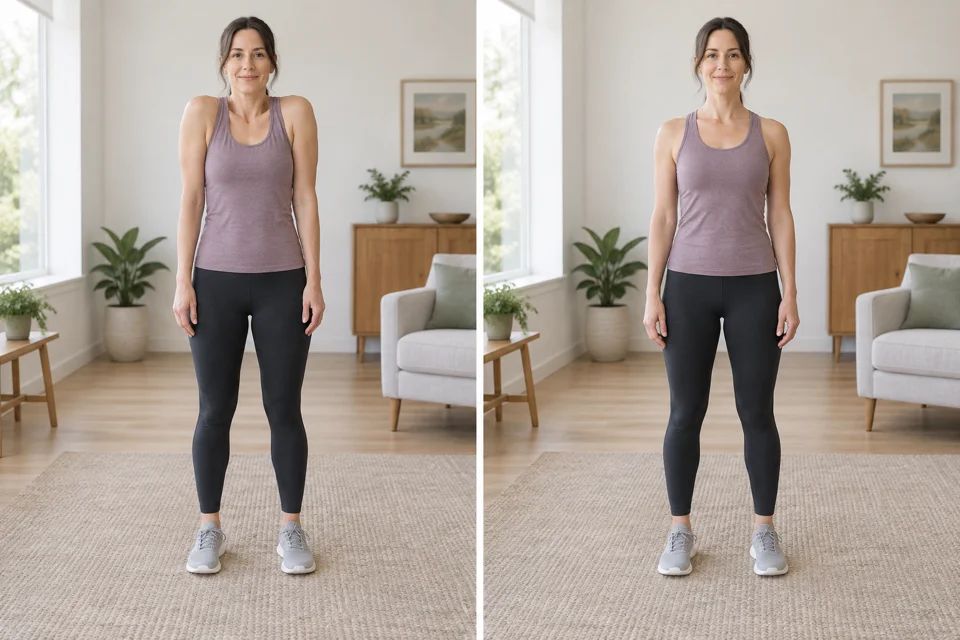
Stand tall, arms loose by your sides. Roll both shoulders up towards your ears, back, down and around in a big slow circle, ten times, then reverse and roll them forward ten times. Let the movement be easy. This is the warm-up, so you're oiling the joint, not stretching it. If you want a bit more, add ten slow arm circles each way with your arms out to the sides.
2. Thread the needle
On all fours, hands under shoulders and knees under hips, slide one arm underneath your body and across, palm up, until the shoulder and the side of your head rest gently towards the floor. Feel the stretch through the upper back and back of the shoulder. Hold for 20 to 30 seconds, breathing into it, then unwind and swap sides. Do two rounds each side. This frees the thoracic spine that sitting stiffens, which is what gives your shoulders room to move.
3. Doorway pec stretch
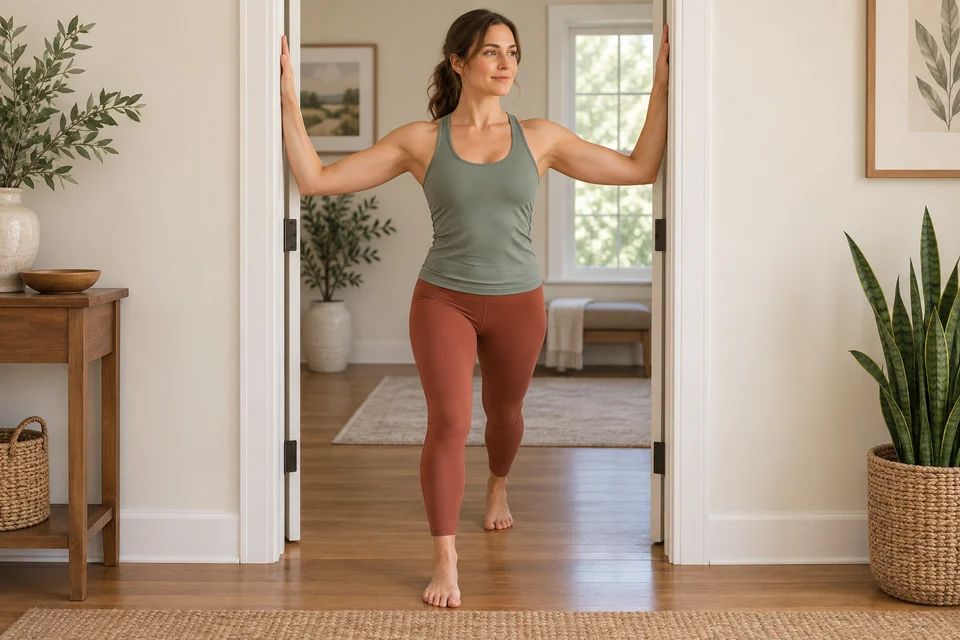
Stand in an open doorway and place your forearms on the frame with your elbows bent to about 90 degrees, like a pair of cactus arms. Step one foot through and let your weight ease forward until you feel a stretch across the chest and the front of the shoulders. Keep your chest tall and your ribs down. Hold for around 30 seconds, ease off, and repeat two to three times. Cleveland Clinic uses this same doorway position with 90-degree elbows to open a chest that desk work has tightened. To move the stretch around, try it with your forearms higher and lower on the frame.
4. Cross-body shoulder stretch
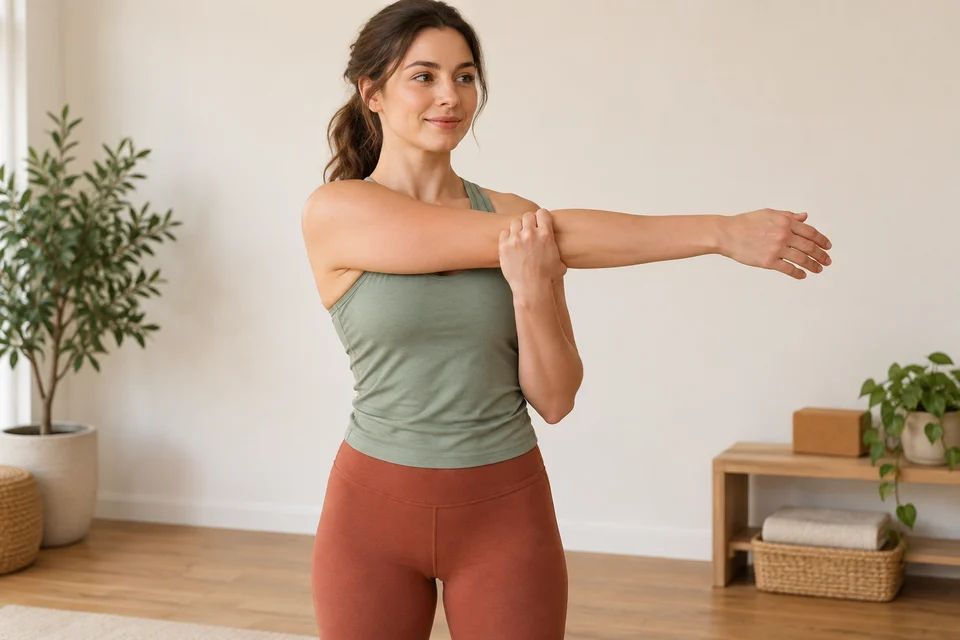
Bring one arm straight across your body at about chest height. Hook the other forearm under it, above the elbow, and draw it gently in towards your chest until you feel the stretch at the back of the shoulder. Keep the shoulder down, not hitched up by your ear. Hold for 30 seconds, relax, and repeat three to four times each side. This is the crossover arm stretch the American Academy of Orthopaedic Surgeons recommends at a 30-second hold, four times each side for the back of the shoulder.
5. Wall slides
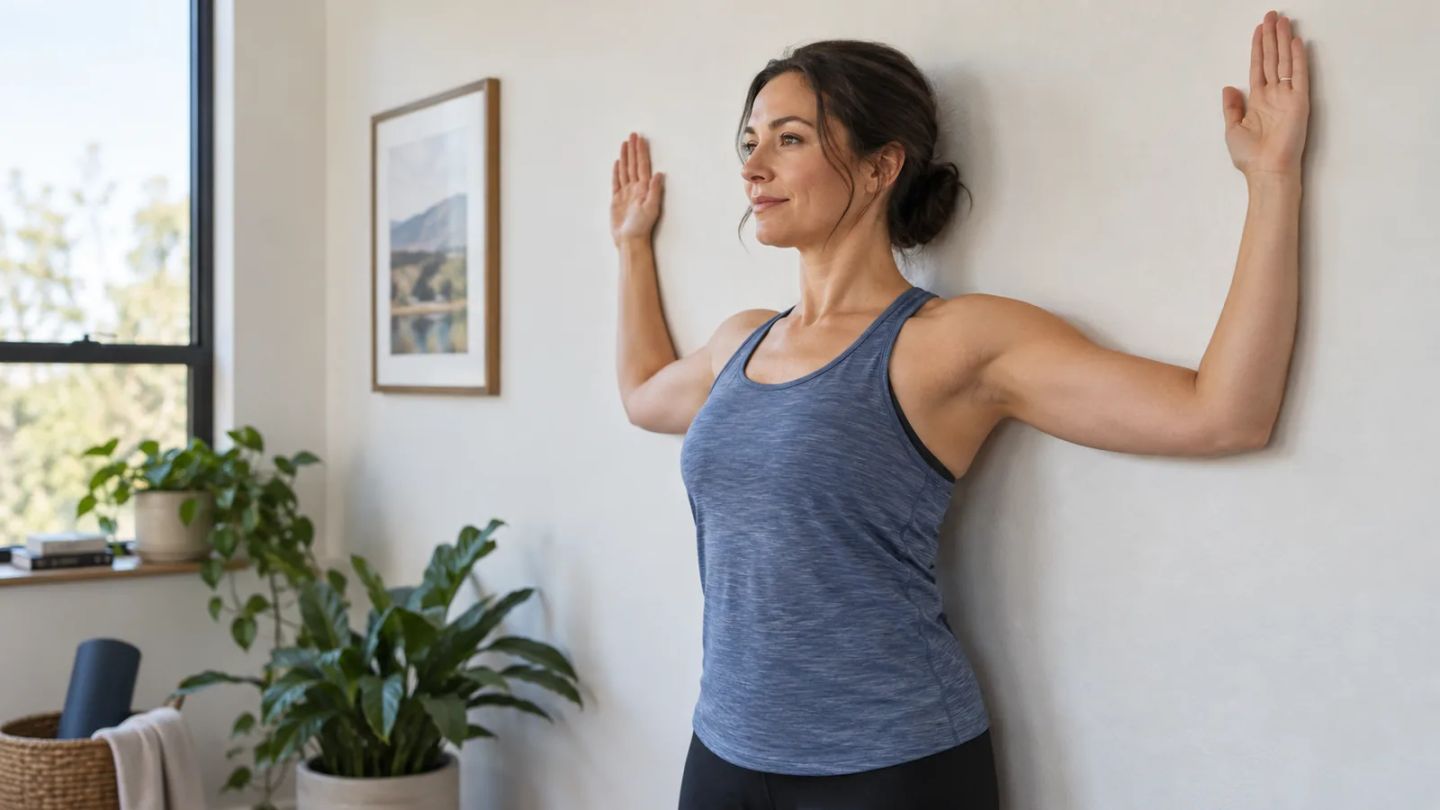
Stand with your back, head and hips against a wall and your feet a few inches out from it. Put the backs of your arms and hands against the wall in a goalpost shape, elbows bent. Keeping everything touching the wall as much as you can, slide your arms slowly up overhead, then back down. Do eight to ten slow slides. Some people can't keep the wrists flat the whole way, and that's fine, go as far as you can keep contact. This grooves the overhead reach and teaches the shoulder blades to glide, a version of the wall angels Cleveland Clinic uses for posture.
6. Scapular squeezes
Sit or stand tall, arms relaxed. Draw your shoulder blades down and back, as if you're gently tucking them into your back pockets, without shrugging up or arching your lower back. Hold the squeeze for about five seconds, then release. Do ten reps. These wake up the muscles between your shoulder blades that hold your shoulders back, the ones a slouched day switches off.
7. Banded shoulder pass-throughs
Hold a light resistance band, a towel or a broom handle in both hands, wider than shoulder-width, arms straight in front of you. Keeping your arms long, lift the band up and over your head and behind you as far as feels comfortable, then bring it slowly back to the front. Go wide on the grip to start, and only narrow it as your shoulders open up over the weeks. Do eight to ten slow, controlled passes. This takes the shoulder through its fullest arc and pulls the routine together.
That's the sequence. On the held stretches, 20 to 30 seconds is a fair default, and the doorway and cross-body stretches sit comfortably at the 30-second mark the orthopaedic guidance uses.
What shoulder mobility work can and cannot do
Done regularly, this kind of routine can help you reach, dress and carry with less stiffness and a fuller range. That is the honest, day-to-day benefit, and it's a good one to have.
Be patient with it. Harvard Health is clear that becoming more flexible takes weeks to months of regular work, and that you have to keep it up to hold on to any gains. One session leaves you feeling looser for an hour or two. Lasting change is a slow build.
There are limits worth stating plainly. Mobility work is not a treatment for a specific injury, and it won't fix a shoulder that has been painful, catching or weak for weeks. That one wants looking at, not stretching through. Some of the age-related loss in the range-of-motion study reflects changes in the joint and the tissue, so movement helps you make the most of what you have, not turn the clock all the way back. Kept up, that still changes how everyday reaching feels.
Building it into your day
A routine you mean to fit in somewhere tends to evaporate. One pinned to a moment that already happens tends to stick.
The American Heart Association suggests tying a new action to a routine you already have, so it rides along with something automatic instead of asking for a fresh decision each day. Hook the shoulders to a cue you never skip. "After I sit down at my desk, I do my shoulder rolls and a doorway stretch" is the kind of plan that holds, because the trigger is already there. A stiff afternoon at the screen is the perfect prompt to stand up and run through a few of these.
There's a neat overlap with other gentle movement, so you can fold this in instead of adding a separate chore. It sits well beside a morning stretch routine, and if you're working through the body from the ground up, the same approach applies to hip mobility exercises and ankle mobility exercises. Ten minutes on the shoulders, or a few minutes each on hips and ankles, adds up over a week.
On a hard day, and after a missed one
Decide your smaller version before you need it. On a rushed, sore or low day, ten shoulder rolls each way, one doorway stretch and a set of scapular squeezes still count. Two minutes standing by the doorway keeps the thread going, and keeping the thread going is what turns this into something your shoulders expect, not something you have to talk yourself into.
If you miss a day, or a fortnight, nothing is undone. A tight shoulder after a gap is the result of sitting still, not a mark against you, and the fix is the one you already know. Pick the next day and start with the rolls again. Starting small after a break beats trying to make up for it in one long, ambitious session.
Watch a few minutes a day add up

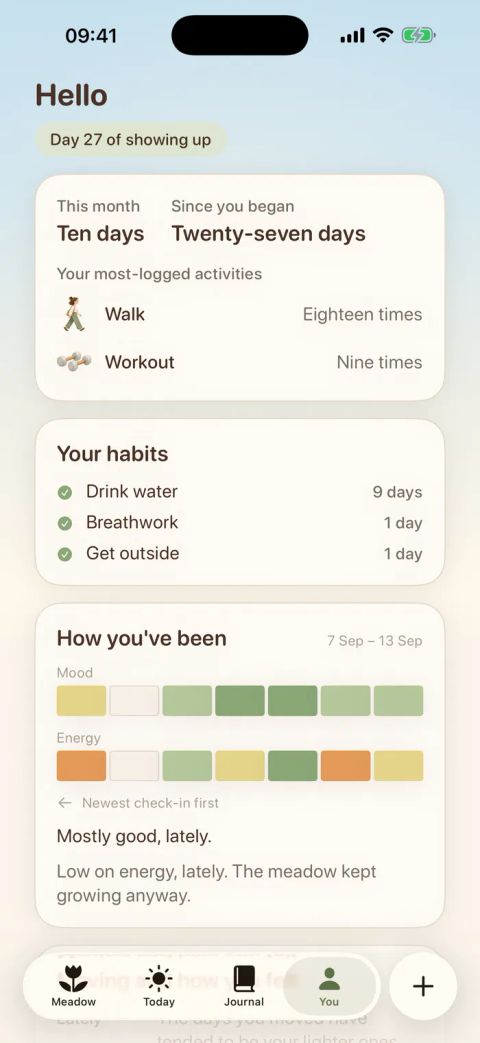
Some days the routine happens and some days it doesn't, and Meadow is built for that. It's a habit app for iPhone where you log the movement you do, tick off small daily habits, and note your mood, a daily win and an affirmation. Each day you show up grows a wildflower in your own meadow, with rare flowers and little animal visitors turning up over time. There are no streaks, so a busy week where the shoulders get skipped resets nothing and your flowers never wilt. You can find it at Meadow.
Today, pick your cue, the moment you sit down at your desk or the end of the working day, and do the shoulder rolls and one doorway stretch while it happens. That's enough to begin.
AUTHOR
Co-founder of Meadow.
Ash is co-founder of Meadow, a habit and movement tracking app that turns small acts of self-care into a growing wildflower meadow.
See how far you've come
Your habits, moods and little wins, all in one place
Meadow keeps track of the walks, the water and the good days, so you can look back and watch your effort add up.
Download Meadow