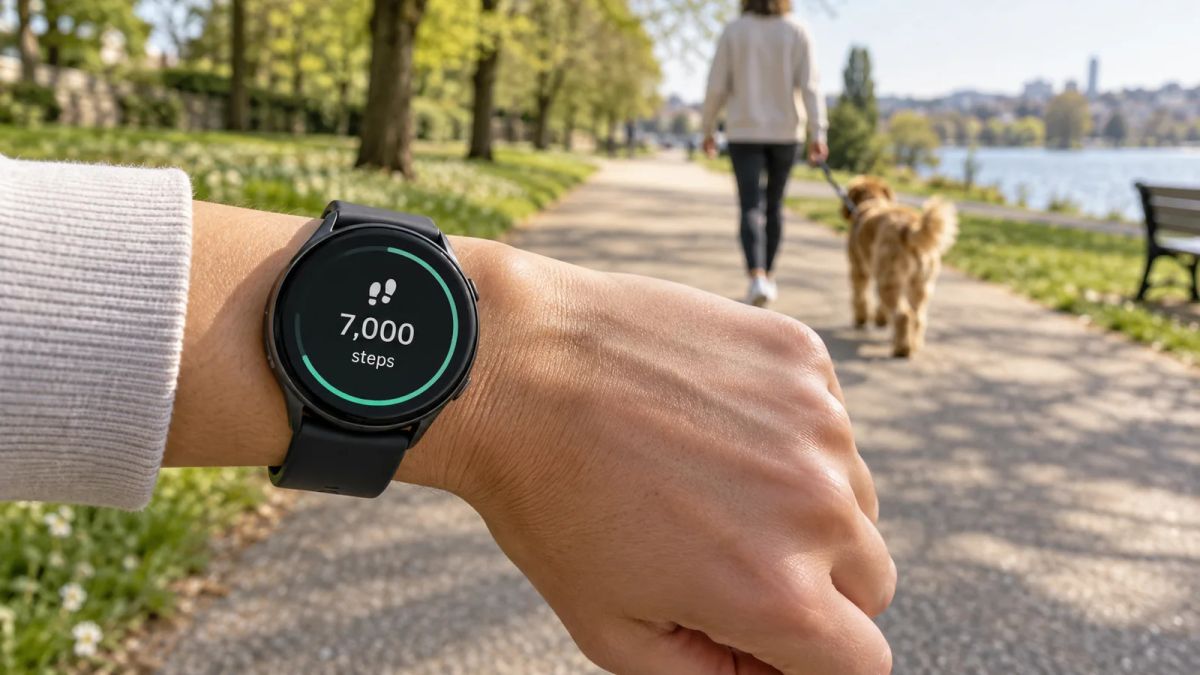
Is 5,000 steps a day good? It is good in the plainest sense: it beats sitting still, and it brings measurable health benefits over doing very little. It does sit low on the scale, though. On the standard step scale, 5,000 sits right at the bottom of the "low active" band, one rung up from sedentary, which makes it a fair floor for some people and a starting point to build from for others.
In everyday terms, 5,000 steps is a little under two and a half miles, or around 50 minutes of walking spread across a day. Whether it's enough depends on who you are and what you want from it. It helps to see where 5,000 falls on the scale, what the evidence says it does for your health, how it compares with 7,000 and 10,000, what the research suggests for different ages, and how to nudge it higher if you decide you want more.
Where 5,000 steps sits on the scale
Researchers who study walking group daily counts into rough activity bands, and the lines are worth knowing before you judge your own total. Cleveland Clinic lists them as fewer than 5,000 steps a day for sedentary, about 5,000 to 7,499 for low active, around 7,500 to 9,999 for somewhat active, and more than 10,000 for active.
So 5,000 is the doorway out of the sedentary category and into low active. That framing cuts both ways. It means a flat 5,000 is not a high bar, and it also means that reaching it moves you off the bottom rung, which is where the biggest health gain tends to happen.
The line isn't arbitrary. A 2013 review led by the walking researcher Catrine Tudor-Locke, published in Applied Physiology, Nutrition, and Metabolism, backed fewer than 5,000 steps a day as the marker of a sedentary lifestyle in adults. It found that taking under 5,000 steps was consistently linked with less favourable body composition and heart and metabolic risk markers. When healthy, active young people cut from over 10,000 steps to under 5,000 for between three days and two weeks, their insulin sensitivity and blood sugar control got worse.
Most people are closer to this range than they assume. Cleveland Clinic notes that a typical adult already walks around 6,000 steps a day going about ordinary life, so 5,000 is not far off what many of us clock without trying.
What 5,000 steps does for your health
The reassuring part is how early the benefits of walking begin. You don't need a big number to see them.
A widely cited study led by Harvard's I-Min Lee looked at older women and found the returns arriving well below the famous 10,000. Reporting the work, the Harvard T.H. Chan School of Public Health explains that women in their 70s who managed about 4,400 steps a day had roughly a 40 percent lower risk of early death than those taking 2,700 or fewer. The benefit kept improving as steps rose, then flattened at around 7,500.
A much larger pooled analysis points the same way. A 2023 meta-analysis in the European Journal of Preventive Cardiology, covering 17 studies and nearly 227,000 people, found the risk of death from any cause started to fall below 4,000 steps a day, and the risk of dying from heart and circulatory disease at around 2,300, as EurekAlert reported. On those figures, 5,000 clears both lines.
The same analysis found that each extra 1,000 steps a day went with a 15% lower risk of dying from any cause. The link held across age groups and places, and it was strongest in adults under 60.
Read against that, 5,000 steps a day is doing real work. It clears the low baseline where risk is highest and lands inside the range where the mortality curve is still climbing steeply. For someone moving up from 2,000 or 3,000 steps, getting to 5,000 is one of the most valuable changes they can make.
A note on what these figures can and cannot tell you. This is observational research, so it shows that people who walked more tended to be healthier without proving the steps alone caused it. Treat the numbers as a strong, consistent signal, not a personal promise, and remember they describe groups, not you.
Steps and mood
The benefit isn't only physical. A 2024 meta-analysis in JAMA Network Open pooled 33 studies and more than 96,000 adults. People taking 5,000 to 7,499 steps a day reported fewer depressive symptoms than those under 5,000. In the studies that followed people over time, 7,000 or more was linked to a 31% lower risk of depression, and each extra 1,000 steps a day went with a 9% lower risk.
These were observational studies, so they can't show that the walking caused the lift. Walking is no substitute for treatment either. If low mood is hanging around, speak to your GP.
Is 5,000 enough, or should you aim higher?
Here is the honest tension. Five thousand steps brings clear benefit, and yet most of the recent evidence points to a bit more being better for the average adult.
The strongest number to appear lately is 7,000. A 2025 dose-response review in The Lancet Public Health, reported by Harvard Health, pooled 57 studies of device-measured steps and found people around 7,000 steps a day had a 25 percent lower risk of cardiovascular disease and a 47 percent lower risk of dying from any cause, compared with those near 2,000. Going higher, up to 10,000, brought further gains, but they were fairly modest.
That leaves 5,000 in a fair but honest position. It captures a good share of the available benefit without reaching the point where the evidence is firmest. If you can hold 5,000 comfortably and want the strongest return for the effort, edging towards 7,000 is a sensible next aim, and we look at that number closely in is 7,000 steps a day good? If you are not there yet, 5,000 is a target worth being pleased with rather than apologising for.
None of this makes 10,000 a health rule. As the Harvard Gazette notes, the figure's origin is unclear, but it may trace back to 1965, when a Japanese company began selling a pedometer called manpo-kei, which translates as 10,000 steps meter. The evidence gathered since has landed lower. If the history interests you, we cover it in 10,000 steps a day.
Recommended steps a day by age
UK guidance sets activity in minutes, so there's no official step target for any age. Researchers have translated those minutes into rough step counts, though, and they show where 5,000 sits across a lifetime.
- For primary-school-age children, a 2011 review led by Tudor-Locke in the International Journal of Behavioral Nutrition and Physical Activity linked the recommended hour a day of moderate-to-vigorous activity with about 13,000 to 15,000 steps for boys and 11,000 to 12,000 for girls.
- For teenagers, the same review put it at about 10,000 to 11,700 steps a day.
- For adults under 60, a meta-analysis led by Amanda Paluch, pooling 15 studies and nearly 50,000 people, found the risk of early death levelled off at roughly 8,000 to 10,000 steps a day, as the UNC Gillings School of Global Public Health reports.
- For adults aged 60 and over, the same analysis found the benefit levelled off sooner, at around 6,000 to 8,000 steps a day.
The children's figures are early estimates, and the adult ones describe where the benefit flattens, not a pass mark. Read together, they say 5,000 is well short for a child, a starting point for a younger adult, and within touching distance of the sweet spot for an older one. If you're in your 60s or beyond and want a figure in distance, we cover that in how far should a 65-year-old walk every day.
Who 5,000 steps suits
For plenty of people, 5,000 is the right number.
If you are returning to activity after a long break, or after illness, 5,000 is a solid first destination that keeps the walk easy enough to stick. Push too hard too soon and the walk becomes a chore you drop by the second week.
If you are older or less mobile, 5,000 can already sit close to your healthy range, since the benefit for over-60s tends to level off from about 6,000 steps. The gap between where you are and where the curve flattens may be a single short walk a day.
And on a busy, broken day, 5,000 is a realistic floor that keeps the habit going when 7,000 is out of reach. A target you can hit on your worst days is worth more than one you only manage on your best.
One caveat belongs here. If you are returning to activity after a long gap, are pregnant, or live with a health condition or any concerns, it is worth a word with your GP before you build up. A general figure cannot account for your particular situation, and a short conversation can set a starting point that fits you.
How to build up from 5,000 if you want more
If you have decided 5,000 is your floor and not your ceiling, the way to climb is in small, boring stages that your week can absorb.
- Note your real average first. If your phone counts steps, look back over a normal seven days across a busy day and a quiet one, so you know your true starting point, not a guess.
- Add about 1,000 steps to that average and hold it for a week or two until it feels ordinary and not effortful.
- Once it settles, add another 1,000, and repeat until you are near the number you are aiming at.
- Anchor the extra steps to things you already do, so they cost no fresh willpower.
That last point does most of the work. Ten unhurried minutes of walking adds roughly 1,000 steps for many people, which turns the gap between 5,000 and 7,000 into a couple of small errands stitched through the day. A loop of the block after lunch, getting off the bus a stop early, a walk to the postbox, pacing the kitchen while the kettle boils, a phone call taken on your feet.
Effort counts alongside the tally. UK guidance leans on time and intensity over steps, and the NHS suggests adults aim for at least 150 minutes of moderate activity a week plus strengthening on two or more days. Brisk walking, the kind where you can talk but not sing, ticks the moderate box, so your step counter and the clock are pointing at the same habit from different angles.
If you'd like a number for "brisk", use your cadence. A 2018 review in the British Journal of Sports Medicine found that about 100 steps a minute is a sound rule of thumb for moderate intensity in adults, which makes a 30-minute brisk walk roughly 3,000 steps. For living longer, pace seems to count for less. The Paluch analysis found no clear link with walking speed once total steps were taken into account. Count the total, then make some of it brisk.
There's no universal right answer to how many steps you need, and a personal figure built from your own week will serve you better than a borrowed one. For a fuller method of finding and nudging your own baseline, we walk through it in how many steps a day should I walk.
Smaller on hard days, and starting again after a gap
Some days even 5,000 will be out of reach, and that's worth planning for. Keep a smaller version ready. If the day falls apart, walk to the end of the road and back, or step outside for three minutes. A short walk logged as a short walk keeps the habit breathing in a way a blank day does not.
Miss a day, or a week, and the walking still counts when you pick it up. There's no debt to repay by doubling your steps tomorrow. Take the next reasonable chance and carry on at whatever figure fits the day in front of you.
The research is kind to uneven weeks, too. A 2025 study of 13,547 older women in the British Journal of Sports Medicine, reported by UNC Gillings, found that reaching 4,000 steps on only one or two days a week was linked to a 26% lower risk of death over the following decade, compared with never reaching it. Total volume across the week seemed to count for more than hitting a number every day. The women were older, American and mostly white, so the finding may not carry over to everyone, but it's a fair reason not to write off a week because a few days fell short.
A gentler way to keep count

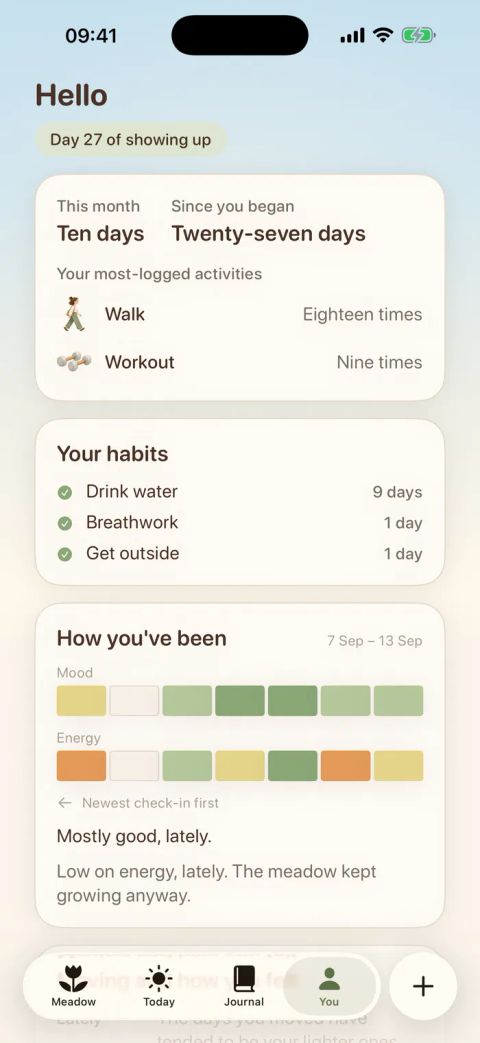
If you would rather keep count on your phone, Meadow is built for a habit measured over weeks rather than perfect days. Made by Wildcard Wellness for iPhone, it lets you log a walk with a timer, tick off small daily habits like drinking water or getting outside, and note your mood, energy and a daily win, and each day you move a new wildflower blooms in your own meadow. There are no streaks, so a day you fall short of 5,000 resets nothing and your flowers never wilt.
Common questions
Is 5,000 steps a day considered active?
Not quite. On the standard scale, 5,000 to 7,499 steps a day counts as "low active", one band above sedentary and below "somewhat active", which starts at 7,500. It is a clear step up from sitting still, and for older or less mobile people it can sit close to their healthy range, but for a broadly healthy adult it reads as a floor, not a peak.
Is 5,000 steps a day lazy?
No. It's the exact line researchers use to mark the edge of a sedentary day, so reaching it puts you on the right side of that line. It sits at the low end of active, which makes it a base to hold and build on. If 5,000 is a stretch for you right now, hitting it most days is an achievement worth keeping.
How far is 5,000 steps, and is it a mile?
It's more than a mile. Cleveland Clinic puts 10,000 steps at almost five miles, so 5,000 comes to a little under two and a half miles, and a mile takes around 2,000 steps. Taller people with a longer stride will cover a bit more ground. At a brisk 100 steps a minute, 5,000 steps is about 50 minutes of walking, which rarely happens in one go. It adds up from short walks, errands and moving around the house.
Can you lose weight walking 5,000 steps a day?
It can help, but steps alone rarely decide it. The CDC says most weight loss comes from eating fewer calories, and that regular activity is what helps you keep weight off afterwards. It adds that the amount of activity needed to hold a healthy weight "varies greatly from person to person". Walking 5,000 steps a day supports that effort and is well worth keeping for its own sake, though it's no guarantee of weight loss. If you're trying to lose weight for a health reason or have a condition that affects your weight, your GP can help you set a plan. For the detail, see how many steps a day to lose weight.
Is walking 5,000 steps enough exercise on its own?
It is a strong aerobic base for many people, but it is not the whole picture. The guidelines also ask for muscle-strengthening activity on two or more days a week, because steps and strength work cover different needs. For the wider case for a daily walk, see the benefits of walking.
For your first step this week, check your typical daily count. If it is under 5,000, aim to hold 5,000 most days before you think about more. If you are already there, set your sights about 1,000 steps higher and stay with it until it feels ordinary. Either way you're building from your own week, not a number off a screen.
AUTHOR
Co-founder of Meadow.
Ash is co-founder of Meadow, a habit and movement tracking app that turns small acts of self-care into a growing wildflower meadow.
See how far you've come
Your habits, moods and little wins, all in one place
Meadow keeps track of the walks, the water and the good days, so you can look back and watch your effort add up.
Download Meadow