Consistency with ADHD comes from redesigning the conditions around a habit, not from finding more willpower on a Monday. Make the reminder impossible to miss, give your brain a reason it responds to, shrink the action so a bad day can't take it, and treat each miss as a return rather than a failure. Do that and turning up stops riding on how you feel.
Most advice assumes the opposite. It tells you to pick a good habit, want it badly enough, and hold the line every day, which is exactly the setup an ADHD brain finds hardest to keep. The willpower runs out, the daily streak snaps on a chaotic Tuesday, and one skipped day quietly turns into three weeks of nothing.
This is general support for staying consistent, not treatment for ADHD, and there's a note near the end on when to see a GP. If you're building the habit from scratch, start with how to build habits with ADHD, and if it's mornings you're fighting, the ADHD morning routine guide is the one to read. This piece is about the harder bit that comes after: keeping something going once the novelty has worn off.
Why consistency is harder with ADHD
The word consistency hides four separate jobs, and ADHD makes each of them shakier. None of this is about caring less or trying less.
The first job is letting a habit turn automatic. A behaviour is meant to fade into the background until you do it without deciding to, and that fading leans on executive function, which CHADD describes as "the brain's ability to prioritize and manage thoughts and actions". When that machinery is stretched, a new action never quite drops below conscious effort, so every single day it asks to be decided again.
The second is motivation. An ADHD nervous system doesn't run on importance the way most advice assumes. Psychiatrist William Dodson puts it bluntly: a person with ADHD "has never been able to use the idea of importance or rewards to start and do a task," and instead gets going through interest, novelty, challenge or urgency. A habit that's only "good for you" gives that brain almost nothing to grab.
Third is time. The Attention Deficit Disorder Association describes ADHD time blindness as "the inability to sense how much time has passed and estimate the time needed to get something done." A habit you meant to slot into your evening gets swallowed, because the evening didn't feel like it was passing.
And fourth is working memory, already busy holding everything else. "I'll remember to do it later" asks the exact system that's overloaded to also run the reminder. It won't.
Put those four together and standard consistency advice is asking your brain to lean on the four things it supplies least reliably. The fix isn't to push harder against that. It's to build the habit so it needs less of all four.
Build it around interest, not willpower
Since interest and novelty switch an ADHD brain on, the most useful thing you can do is stop treating a habit like medicine and start attaching it to something you'd want anyway.
Pair the boring action with a genuine draw. A walk becomes the only time you let yourself listen to a particular podcast. Tidying happens to one specific loud album. Stretching goes on while a show you're halfway through plays. The habit borrows the pull of the thing next to it, which is steadier than hoping you'll feel disciplined at 9pm.
Willpower is the least reliable fuel you own. Interest is the one your brain spends. Design the habit so the interesting part is baked in from the start, and you're not relying on a feeling that fades by Wednesday.
Put the reminder somewhere you can't miss it
A habit needs a trigger, and your memory is the worst one available when it's already carrying the day. Move the cue out of your head and into a spot your day physically passes through.
A water bottle on the desk is a cue. Trainers by the front door are a cue. A resistance band over the door handle, vitamins next to the kettle, a phone alarm named after the action instead of the time. The point is that the room does the remembering, so the habit doesn't depend on your working memory volunteering it at the right second.
Make it visible and make it specific. "Yoga mat left unrolled by the bed" beats a vague plan to stretch, because the mat is there whether or not your brain brings it up.
Make the reward quick and a bit of a game
An interest-based brain answers to feedback it can feel now, not to a payoff six months out. So build in a small, immediate reward and let a visible record supply the rest.
Ticking the thing off is more than record-keeping. A meta-analysis of 138 studies found that monitoring your progress towards a goal makes you more likely to reach it, and the effect was stronger when people recorded it somewhere they could see. Each mark is a quick hit of done, the kind of fast payoff your brain will turn up for. Keep the record in your eyeline: a wall calendar you cross off with a thick pen, boxes on the fridge, a habit tracker app you open.
Then turn the dull part into a small game. Race the kettle. Beat yesterday's five-minute tidy. Give yourself a proper reward at ten ticks. It sounds childish, and it works, because a game is interesting and a chore is not.
Borrow someone else's focus to start
Task initiation is a classic ADHD wall. You know what to do, you want to do it, and the first move still won't come. For that exact problem there's a strategy with a name: body doubling.
Body doubling means doing your task while another person is present, each of you working on your own thing. The Attention Deficit Disorder Association says the other person's job is "to keep the individual with ADHD focused on the task at hand," partly through a quiet sense of accountability, the feeling that "I can't waste this gift of time." Nobody's supervising you. You've got company that makes starting lighter.
In practice that's a friend on a silent video call while you both crack on, a partner reading in the room while you do your habit, or a co-working stream on a laptop. If nobody's about, a set playlist or a specific podcast gives you a thinner version of the same nudge.
Shrink it until a bad day can't take it away
The most common reason a habit collapses is that it was built for your best days, and your best days aren't most days.
Shrink the action to the smallest version that still counts. Not a workout but one set. Not thirty minutes of reading but one page. Not a run but trainers on and out the door. A habit small enough to do while you're tired, rushed and flat is one that survives the conditions it has to live in, and starting was the hard part anyway.
You'll often do more once you've begun, and that's fine. Keep the official target tiny, so even a wreck of a day ends with the box ticked and the thread unbroken.
Refresh it before you get bored
Here's the part that decides whether a habit lasts months rather than weeks. Novelty is what got you started, and Dodson is honest that "novelty is short-lived," so the version that felt fresh in week one will go flat by week five. That flatness is the fuel running low, and it's a signal to top it up.
Change the surface, keep the habit. A new route for the walk. A different pen for the tracker. A fresh playlist, a new podcast series, a rearranged corner where the habit happens. When you feel the interest draining, treat it as a cue to tweak something small, not to quit the whole thing. A habit you keep re-decorating outlasts one you white-knuckle.
Make the restart easy, because that's the real skill
You'll miss days. A flat week, a chaotic patch, a stretch where it doesn't happen at all. Most advice treats a slip as a failure to atone for, which for an ADHD brain usually ends the project entirely.
The research is far kinder. A well-known study on how habits form, summarised by the British Psychological Society, found that a single missed day had little effect on how automatic the behaviour eventually became, and that the time to feel automatic varied hugely from one person to the next. There's no clean streak to protect and no universal number of days to hit. ADDitude makes the same point about routines: they "do not demand perfection," and "a few days out of the week is enough to make progress and keep overwhelm at bay."
So consistency is a pattern you keep coming back to, and the skill that holds it together is the easy restart. Miss a day, drop to the bad-day version, and pick the habit back up in its usual spot with no attempt to make up the gap. Decide the whole plan now, while things are calm, so a bad day has nothing left to invent. Here's a card to fill in and keep where you'll see it.
Sticking-with-it plan (blank)
The habit, at its smallest:
The cue I'll see:
The quick reward:
The bad-day version:
How I restart after a miss:
And the same thing filled in.
Sticking-with-it plan (example)
The habit, at its smallest: a five-minute walk
The cue I'll see: trainers left by the front door
The quick reward: a favourite podcast, saved for walks only
The bad-day version: to the end of the road and back
How I restart after a miss: next day, same trainers, no catching up

If you want the general, non-ADHD version of this approach, we walk through it in how to be consistent, and tiny habits is the full method for shrinking an action down.
See the days you show up build into something
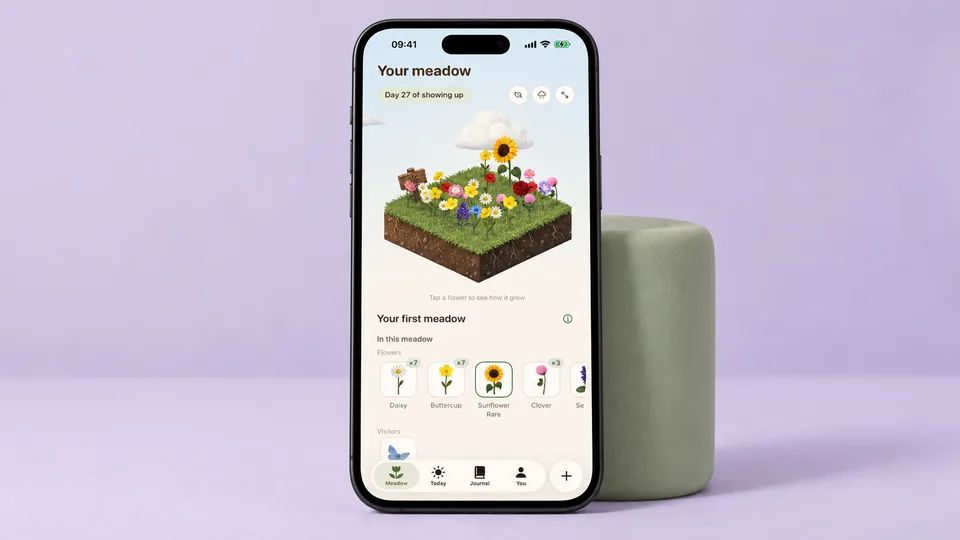
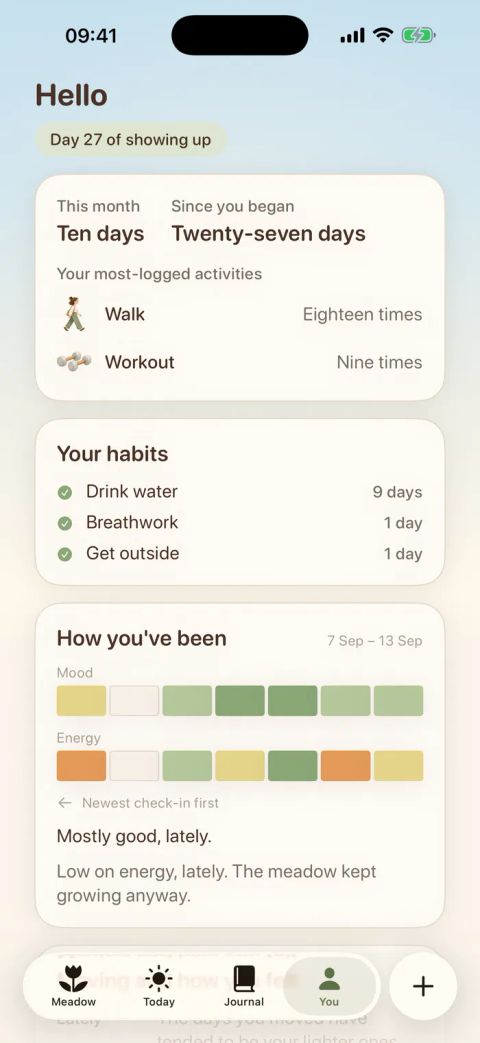
Meadow is built for the shape this tends to take, some days on and some off. It's a gentle habit app for iPhone from Wildcard Wellness where you tick off a small daily habit, log any movement you manage, and note your mood and energy. Each day you show up grows a wildflower in your own meadow, with rare flowers and little animal visitors turning up as it fills in, so your progress is something you can see building, a reason an interest-based brain comes back. There are no streaks, so a missed day resets nothing you've grown and you carry on whenever you're ready.
A note on getting support
Staying consistent with a habit is a coping tool, not a treatment for ADHD. If your symptoms are wearing you down at work, in your studies or in your relationships, that deserves proper support, not another life hack. The NHS advises that "if your ADHD symptoms are affecting your studies, work or relationships, make an appointment with a GP" to find out what support is available. If you've never been assessed and this pattern has followed you your whole life, that same appointment is a good place to start.
Common questions
Why can I be consistent with some things and not others? An ADHD brain engages with interest, novelty, challenge and urgency far more than with importance, so the things you stick to are usually the ones that hit one of those, and the ones you drop are the "good for you" tasks that offer none. Build the missing interest in on purpose and the gap narrows.
How do I stay consistent once the novelty wears off? Expect it to, and plan to refresh the surface details before you're bored, not after you've quit. A new route, a new playlist, a different reward. You're keeping the same habit and changing the wrapping.
Is it my fault I can't stay consistent? No. Weaker automaticity, interest-based motivation and a shaky sense of time are features of how ADHD works, not proof of laziness. The point of everything here is to stop leaning on the parts that are unreliable.
How many days a week counts as consistent? More than you'd think and fewer than perfect. A few days a week keeps real progress going, so judge yourself on whether you keep returning, not on whether you managed a flawless run.
Do I need a diagnosis to work on this? No, these are supports anyone can use today. But if this has been a lifelong pattern that's affecting your work or relationships, an assessment through your GP is worth pursuing alongside them.
Pick one habit, shrink it to its smallest honest version, and fill in the sticking-with-it card above, including the line for how you restart after a miss. That restart line, decided today while you're calm, is the part that keeps the whole thing alive.
AUTHOR
Co-founder of Meadow.
Ash is co-founder of Meadow, a habit and movement tracking app that turns small acts of self-care into a growing wildflower meadow.
See how far you've come
Your habits, moods and little wins, all in one place
Meadow keeps track of the walks, the water and the good days, so you can look back and watch your effort add up.
Download Meadow