Being consistent comes down to a few design choices, not a reserve of willpower you top up each morning. Make the action small, tie it to something you already do, plan for the days you slip, keep a simple record, and showing up stops depending on how you feel that day.
Most people try the opposite. They pick an ambitious version of the habit, promise themselves they'll stay motivated, and treat one missed day as proof they've failed. Motivation fades by Wednesday, the ambitious version needs energy they don't have, and the first slip becomes a reason to quit.
The fix is to stop relying on the feeling and start building the setup around it. Here's how to do that with any habit or goal, including the parts most guides skip: what to do on a bad day, and how to come back after you miss.
Build a system rather than chase motivation
Motivation is the least reliable thing you own. It runs high when you're fresh and inspired, and it's gone by the end of a long day, which is when most habits are meant to happen. Lean on it and your consistency rides the same rollercoaster.
James Clear, who wrote Atomic Habits, puts it plainly. "Goals are good for setting a direction, but systems are best for making progress." A goal is the outcome you want. A system is the set of small, repeatable actions that get you there, and it's the actions you can control.
Think of it this way. "Lose a stone" is a goal, and you can't do it today no matter how badly you want to. "Walk for ten minutes after lunch" is a system, and you can do that this afternoon. Point yourself at the system and the outcome follows on its own timetable.
This also takes the pressure off the finish line. When your job each day is to run the process, a slow week isn't a failure, it's a week where you kept the process going. That's the mindset that survives the months a real change takes.
Make it small enough to keep on a bad day
The single biggest reason habits collapse is that people build them for their best days, and their best days aren't most days.
Shrink the action until it's almost too small to skip. Not a workout but one set. Not thirty minutes of reading but one page. Not a run but your trainers on and out the door. BJ Fogg, the Stanford behaviour scientist behind the Tiny Habits method, argues that a behaviour you can do when you're tired, rushed and unmotivated is a behaviour that sticks, because those are the conditions it has to survive.
A single page looks too small to matter. That's the point. You're not trying to get the whole result in one go, you're making the starting so light that it stops being a decision you have to win every day. On the days you have more in you, the action grows by itself. One page becomes a chapter. Ten minutes becomes half an hour. Let that happen, but keep the official target tiny, so a flat day still ends with the box ticked.
If you want the full method for shrinking a habit down, we cover it in tiny habits.
Anchor it to something you already do
A habit with no fixed moment drifts to a "later" that never arrives. Give it a slot by hooking it onto a routine that already happens every day without you thinking about it.
The American Heart Association's advice for making habits stick is to attach the new action to an established one, so it rides along on a cue you can't miss. Clear calls the same move habit stacking, with a formula worth memorising: after I [current habit], I will [new habit].
Some anchors that hold up well:
- After I pour my morning coffee, I'll drink one glass of water.
- After I sit down at my desk, I'll write one line in my journal.
- After I brush my teeth at night, I'll lay out tomorrow's kit.
Pick an event, not a clock time. "After my morning tea" survives a day that starts an hour late, while "at 8am" breaks the moment your morning slips. Choose something that happens every single day and leaves a natural gap right after it.
Shape the space around the habit
Willpower gets far too much credit. Where you keep things, and how many steps stand between you and the action, quietly decides most of what you do.
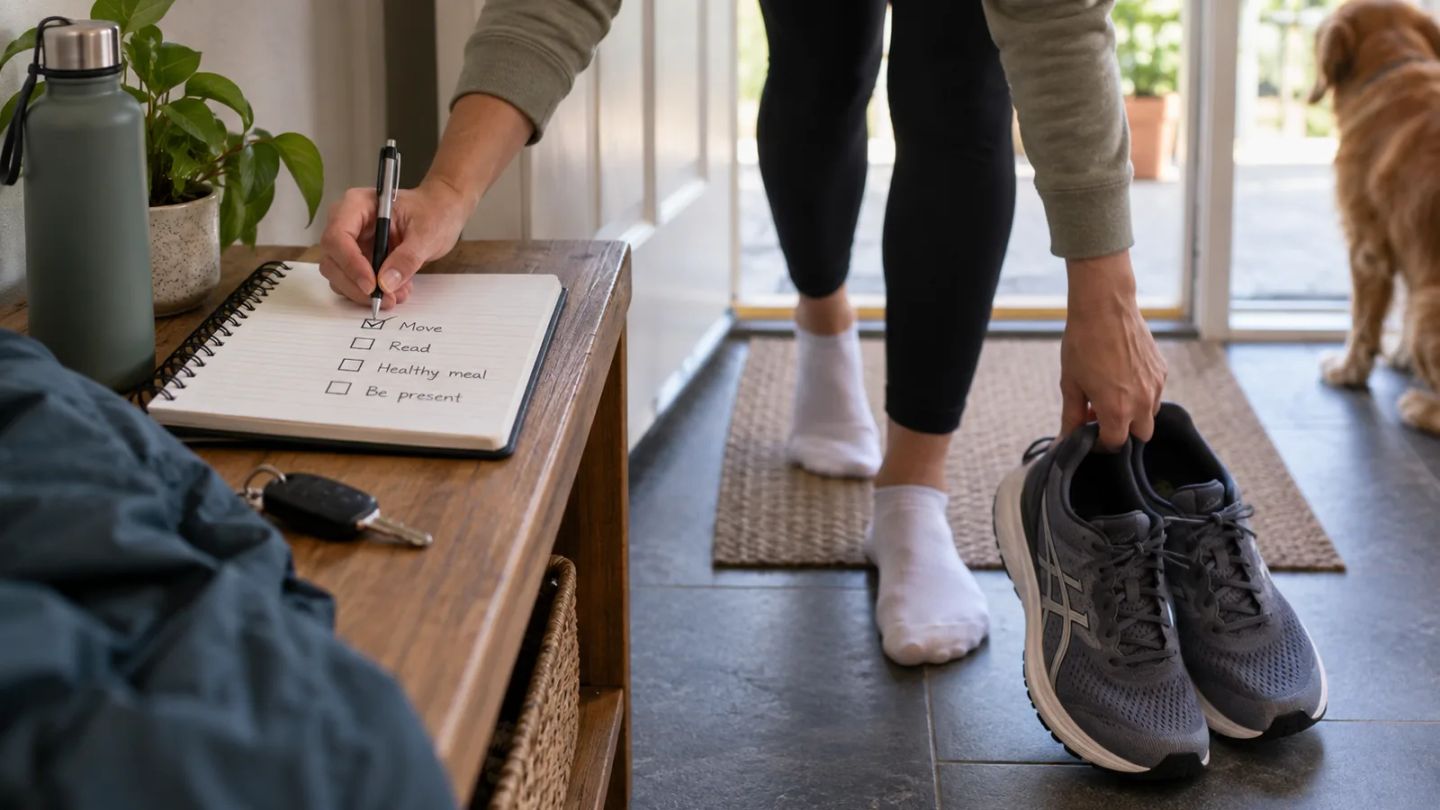
Clear's rule for designing your environment is to cut the number of steps for the habits you want and add steps for the ones you don't. Want to drink more water? Fill a bottle and leave it on your desk where you'll see it. Want to walk in the morning? Put your shoes by the door the night before. Want to stop scrolling in bed? Charge the phone in another room.
Make the good habit the obvious, easy option and the bad one a small hassle, and you spend almost no effort steering yourself. The setup does the steering.
Plan for the slips before they happen
You will miss a day. A cold, a bad night, a work crisis, a birthday. Consistency isn't a spotless run, it's a pattern you keep returning to, and the people who last are the ones who've already decided what a miss means before it happens.
Clear's rule is the one to hold onto: never miss twice. Missing once is an accident. Missing twice is the start of a new pattern, the one where you don't do the thing. As he puts it, the damage isn't the individual missed day, it's "the cumulative impact of never getting back on track."
The research backs the calm response. In a real-world study of how habits form, summarised by the British Psychological Society, a single missed day had little effect on how automatic the behaviour eventually became. One gap doesn't undo the weeks behind it. What does the damage is the story you tell afterwards, the "I've blown it now" that turns one skipped session into a fortnight of nothing.
The smaller version for hard days
Decide now, while you're thinking clearly, what the habit looks like on a day when even the small version feels like too much.
If your habit is a ten-minute walk, the bad-day version might be one lap of the garden. If it's a page of reading, it might be a paragraph. If it's a workout, one squat. It sounds almost silly, and that's what makes it work. You keep the thread unbroken when the alternative is dropping the lot.
Restart the moment you notice
Don't wait for Monday, the first of the month, or some clean starting point. Those are excuses dressed as fresh starts. The next chance is the next meal, the next morning, the next time your anchor comes round. Take it, keep the record you've already built, and carry on as if the gap was the exception it was.
Keep a record you'll come back to
Open our free printable: Habit Tracker (PDF). Save or print it to use alongside this guide. No sign-up needed.
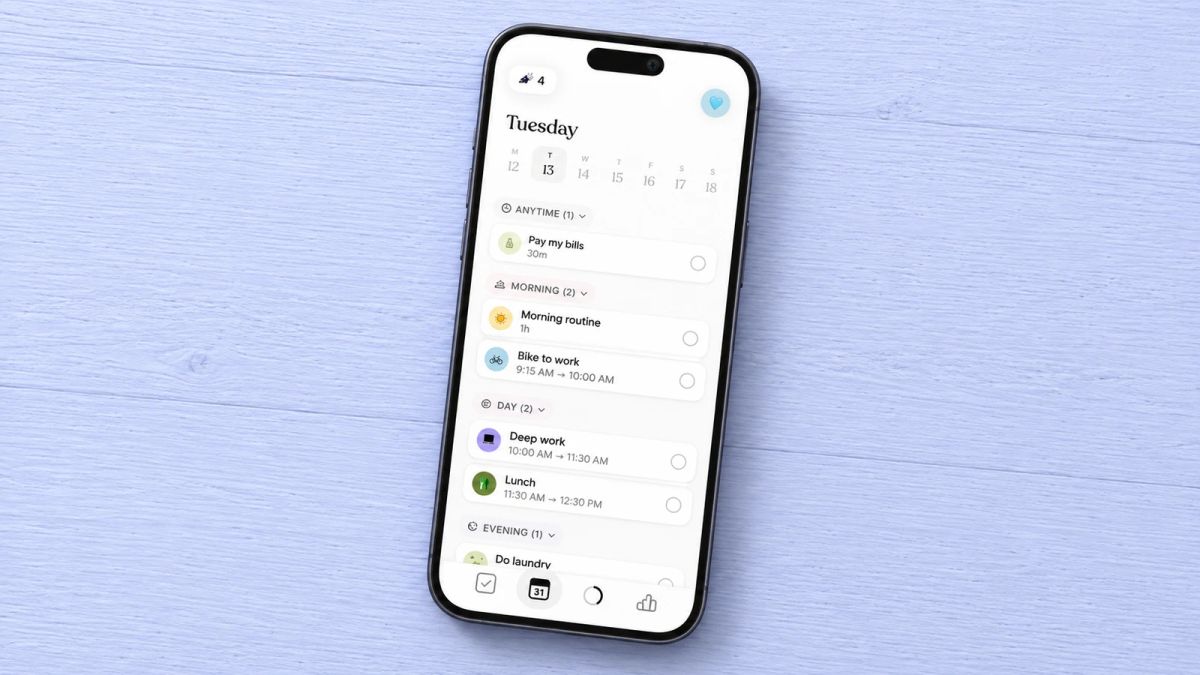
A tick a day does two jobs. It gives you a small hit of "done" in the moment, and over weeks it shows you the pattern you're building, which is quietly motivating on the days you can't see progress any other way.
This isn't busywork. A meta-analysis of 138 studies found that prompting people to monitor their progress towards a goal improved how often they reached it. Watching the thing is part of doing the thing.
Keep it dead simple. A wall calendar by the kettle, a line in a notebook, a note on your phone, whatever sits where the action happens and takes two seconds. Here's a one-week grid you can copy onto paper:
Habit: ________ Anchor: after I ________
Mon ☐ Tue ☐ Wed ☐ Thu ☐ Fri ☐ Sat ☐ Sun ☐
Filled in, it might look like this:
Habit: Ten-minute walk Anchor: after I finish lunch
Mon ☑ Tue ☑ Wed ☐ Thu ☑ Fri ☑ Sat ☐ Sun ☑
Two missed days in that week, five kept, and the habit lives on. That's a good week. For more on choosing what to track and how, see our guides to using a habit tracker and picking your habits to track.
Be as kind to yourself as you'd be to a friend
The instinct after a slip is to give yourself a hard time, on the theory that a good telling-off keeps you in line. It does the reverse. Harsh self-criticism tends to trigger shame, and shame makes you want to hide from the habit, not face it.
The self-compassion researcher Kristin Neff has spent years showing that treating yourself kindly after a setback supports steadier motivation than self-attack does. People who can think "everybody slips up now and then" recover and keep going, while people who catastrophise a single miss are the ones who quit. Being kind to yourself isn't letting yourself off the hook, it's staying in a state where you can pick the habit back up.
Talk to yourself the way you'd talk to a friend who missed a couple of runs. You wouldn't call them a failure. You'd say it's fine, life happens, go again tomorrow.
See the days you show up add up
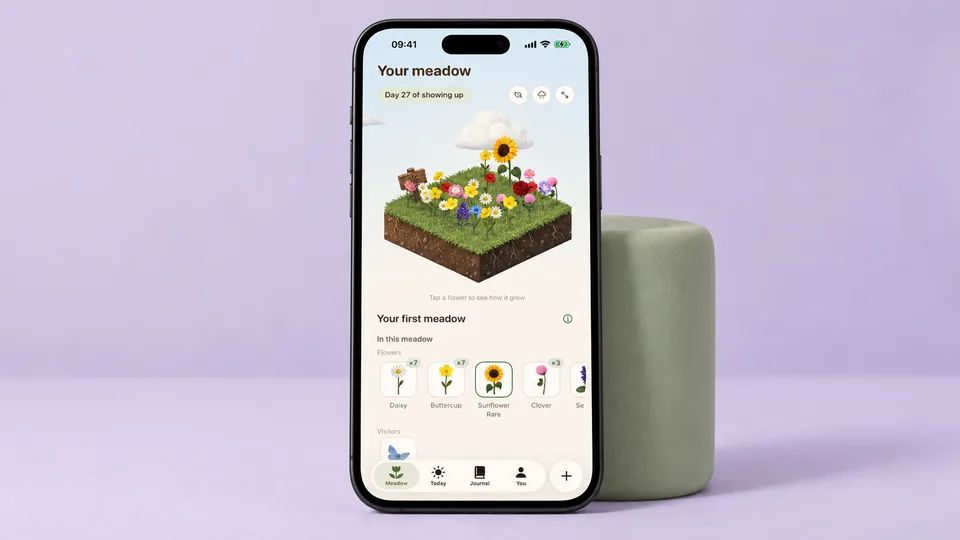
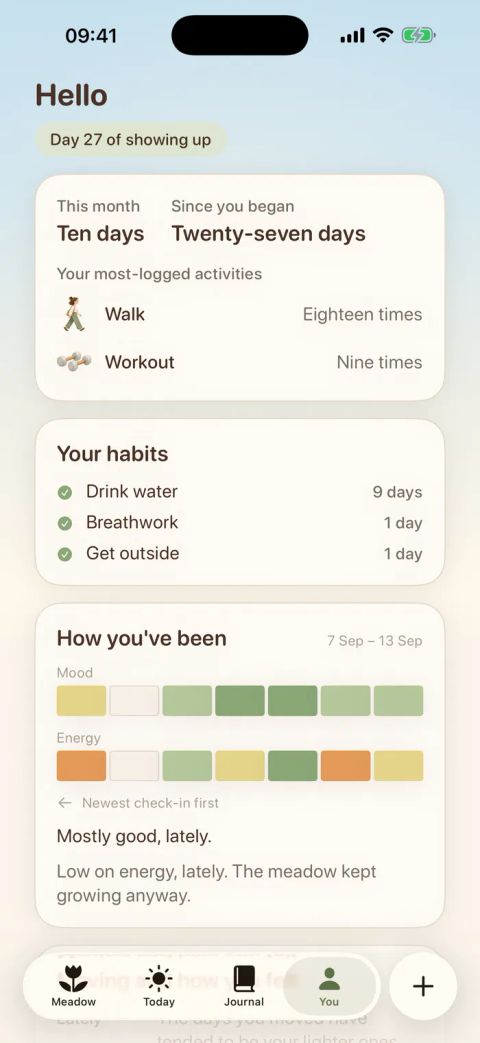
Some weeks go to plan and some don't, and a habit app that punishes the messy ones tends to get deleted. Meadow is built the other way. It's a gentle iPhone app from Wildcard Wellness where each day you show up, by logging a little movement or ticking off a small habit, grows a new wildflower in a meadow that's yours. You can note your mood and energy and jot down a daily win too.
The part that fits this article is what happens when you miss. There are no streaks, so a rained-off walk or a skipped morning resets nothing. Your flowers never wilt, and you pick up whenever you're ready, which is exactly the "never miss twice" habit made easy to keep.
A few common questions
How long before it feels automatic? Longer than the "21 days" you'll see quoted, and it varies a lot between people and between habits. A simple action settles in far sooner than a demanding one, so judge yourself on whether you're still turning up, not on whether it's clicked yet. We go deeper in how long it takes to build a habit.
What if I keep missing the same habit? That's the habit telling you it's still too big or badly placed. Shrink it further, or move it behind a more reliable anchor. A habit you keep skipping isn't a willpower problem, it's a design problem.
Should I build several habits at once? Start with one. Get it running on its own, then add the next. Trying to install five at once splits your attention and usually ends with none of them sticking.
Is it too late if I've already fallen off? No. The record you built before the gap still counts, and the next rep is available right now. Falling off and climbing back on is the normal shape of this, not a sign you've done it wrong.
Pick one habit and shrink it to its smallest honest version, then write a single line: after [something you already do every day], I will [the tiny action]. That sentence is your whole system, and it's small enough to start today.
AUTHOR
Co-founder of Meadow.
Ash is co-founder of Meadow, a habit and movement tracking app that turns small acts of self-care into a growing wildflower meadow.
See how far you've come
Your habits, moods and little wins, all in one place
Meadow keeps track of the walks, the water and the good days, so you can look back and watch your effort add up.
Download Meadow