If you are here for a number of days, the useful truth is that there is not a dependable one. How long it takes to break a habit turns on which habit it is, how long you have carried it, what it quietly does for you, and how often ordinary life throws you off course. The tidy figures that circulate as rules fall apart the moment you look at where they came from.
A better question than how many days is this: what will you do when the old cue arrives, and how will you keep going after the days you slip. Answer those two and the calendar starts to matter far less than you would think.
Where "21 days" and "66 days" came from, and why both mislead
The "21 days" line is the stickiest idea in this whole area, and there was never a study of habits behind it. It came from a 1960 book by a plastic surgeon, Maxwell Maltz, who noticed that his patients took around three weeks to get used to a new nose or a missing limb. He offered that as a rough minimum time to adjust to a change, as James Clear has traced, and across years of retelling the caveat dropped away and the figure hardened into a promise it was never built to make.
The "66 days" figure at least comes from real research, though it tends to be quoted in a way that loses the point. In a habit-formation study covered by the British Psychological Society, volunteers repeated a chosen daily action for twelve weeks and reported how automatic it felt. The average time to reach maximum automaticity was 66 days, but the spread ran from 18 days to a predicted 254, and only about half the group settled into a habit at all inside that window. A light action like drinking a glass of water bedded in far sooner than a demanding one. No shared finishing line existed.
Both numbers describe building a new habit rather than breaking an old one, and breaking is usually the harder job, because you are working against a routine that already has a groove worn into it. If you take one thing from the research, take the width of the range, not the midpoint.
Breaking a habit means replacing it, not erasing it
A bad habit resists sheer refusal because it does not float free in your mind. It is welded to a cue. Behavioural research set out in Wood and Neal's work on how habits form describes a habit as a learned link between a context and a response: a place, a time, a feeling or a preceding action that has reliably come before the behaviour. Once that link is strong, the context alone sets the routine running before you have decided anything.
That is why wiping a habit out is close to impossible. The stress that sends you to your phone, the kettle that pairs with a biscuit, the sofa that pairs with a scroll, none of it vanishes because you have resolved to stop. What you can do is keep the cue and give it a different ending.
Here is where breaking parts ways with building a habit from scratch. You are not starting on a blank patch of your day. You are overwriting a slot that is already spoken for.
Find the cue, the routine and the reward
Every habit runs on a loop of three parts. There is the cue that sets it off, the routine you carry out, and the reward you get for it. People tend to attack the routine and ignore the reward, and the reward is what keeps the loop alive.
Ask what the habit does for you. The mid-afternoon biscuit might be less about sugar and more about a two-minute break from a screen. The evening scroll might be a way to switch off rather than a love of the feed. Your brain's reward circuit, which the National Institute on Drug Abuse describes as the same system that drives us to repeat eating, socialising and other rewarding acts, learns to chase whatever pay-off it found. If your replacement gives back nothing, it will not hold.
So pick a new routine that answers the same need. If the biscuit is a break in disguise, the swap might be standing up and stepping outside for two minutes. If the scroll is a wind-down, it might be a few pages of a book. The American Heart Association recommends hanging a new action on a routine that already happens, so the cue you kept becomes the trigger for the better routine.
Writing the loop down before you are in the moment makes the swap easier to reach for. Fill in a line like this, blank first:
Cue: __________ Old routine: __________ Reward I want: __________ New routine that gives it: __________
And a worked example:
Cue: I sit on the sofa after dinner Old routine: scroll for an hour Reward I want: to switch off and rest New routine: ten minutes with a book, phone left in the kitchen
Make the old routine harder and the new one easier
Willpower is a poor thing to rely on day after day, so lean on your surroundings instead. Add friction to the old routine and strip it from the new one.
If the phone is the problem, charge it in another room so reaching for it costs a walk. If the biscuits are the cue's payoff, keep them out of the cupboard you open first. Put the book on the pillow, the trainers by the door, the water glass beside the kettle. Small changes to where things sit do a surprising share of the work that gritting your teeth cannot keep up for long.
Keeping the replacement small matters as much as placing it well. A swap you can manage on a tired, busy, low sort of day is a swap you will keep, which is the thinking behind tiny habits. A version built for your best days collapses the first time a normal day arrives, and normal days are most of them.
Plan for the slips before they happen
You will miss. A single slip is not the failure it feels like. In the study covered above, a missed day here or there had little effect on the habit that was forming, although missed days do count against you when they pile up. One skipped evening does not wipe out the weeks behind it.
The harm tends to arrive in the story you tell afterwards, the "I've blown it now" that turns one slip into a fortnight off. Head it off by deciding your smaller version in advance, while you are calm rather than bargaining with yourself at ten at night. If the swap is a fifteen-minute walk, the bad-day version might be stepping out of the front door for two minutes. If it is cooking instead of ordering in, it might be assembling something from the freezer. These sound too small to count, and that is the point. They keep the thread unbroken on the days the full version is beyond you, and an unbroken thread is far easier to pull on tomorrow.
How long it takes, by type of habit
What you can expect depends on what you are changing.
- Light, low-stakes habits with a weak pull and a clear cue can shift in a few weeks once the new routine is running.
- Comfort habits that soothe stress or boredom take longer, often a few months, and the pull tends to fade in waves rather than in a straight line, so plan for wobble.
- Habits bound to a physical craving, such as smoking, drinking or other substance use, sit in a different category altogether.
That last group is worth taking seriously. Repeated use changes the brain's reward system, as the research on addiction sets out, and stopping can bring withdrawal that willpower alone is not built to carry. If you are trying to change something like that, treat it as a health matter and speak to your GP or a specialist service, who can offer support that makes a real difference. For the everyday sort of habit, our guide to breaking bad habits goes further on the day-to-day tactics.
Track the change so you can see it
Watching your own progress helps more than it sounds like it should. A meta-analysis of 138 studies found that prompting people to monitor how they were doing towards a goal improved how often they reached it. The goals in those studies varied a great deal, so a tick cannot promise to change any one habit. Even so, noticing whether you did the thing tends to help rather than feeling like a chore for its own sake.
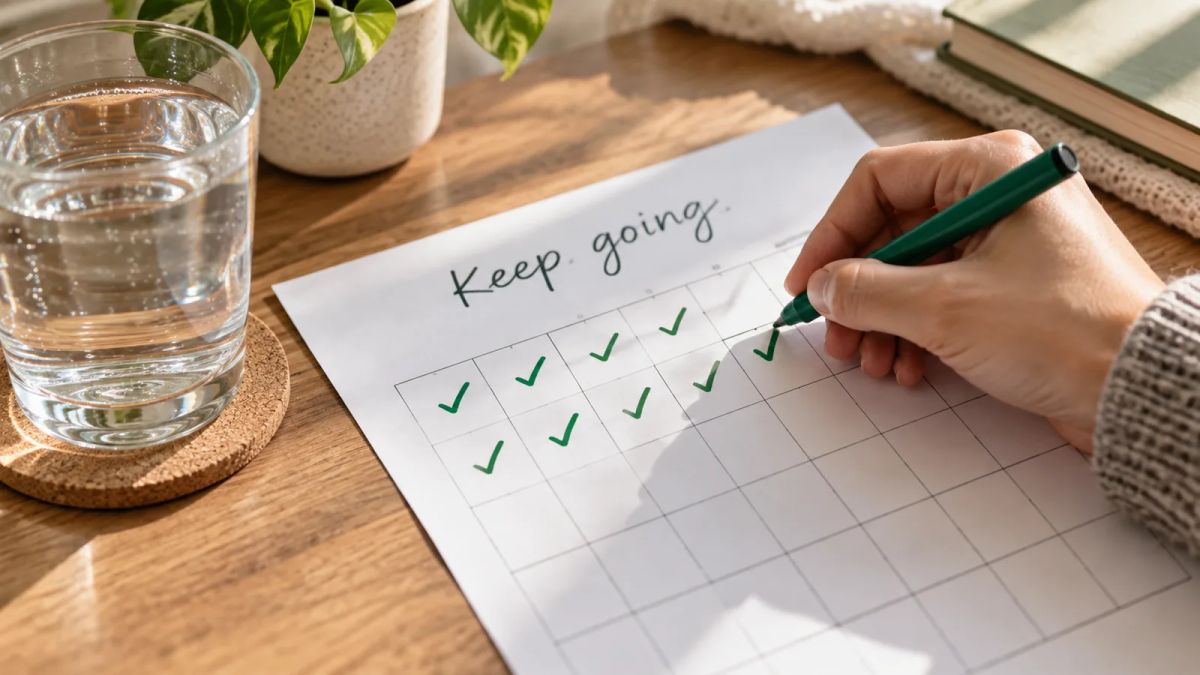
A record also survives the slips. Seeing the weeks you have already put in makes it far easier to begin again than facing a blank page. Any format works, from a mark on the wall calendar to a line in a notebook to a habit tracker on your phone. The best one is the one you will look at.
Meadow, without the reset
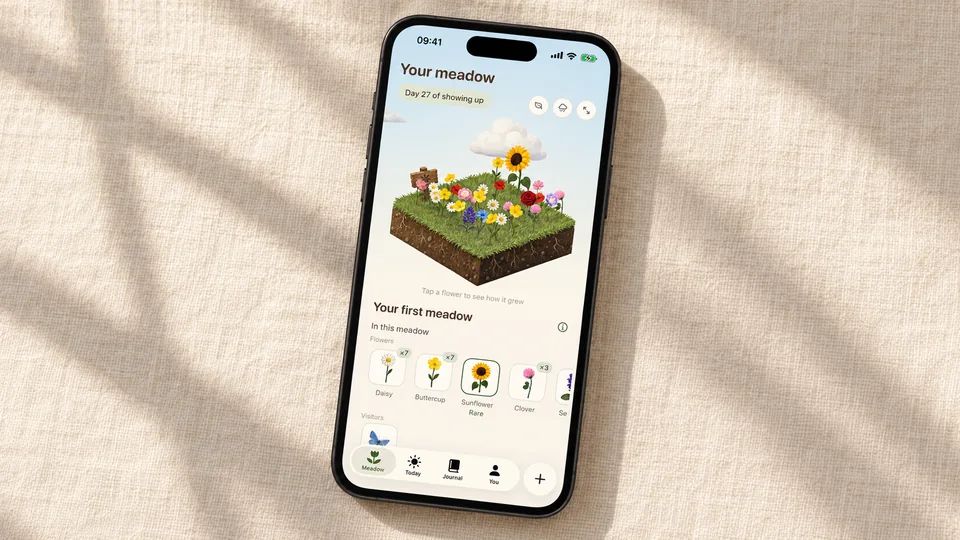
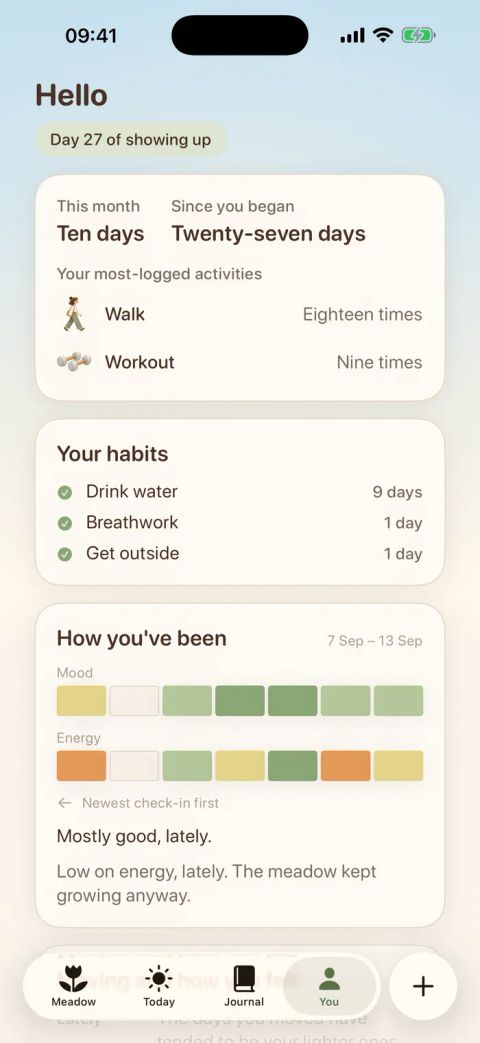
Another app worth a look is Meadow, a gentle habit tracker for iPhone from the team behind this site. You tick off the habit you are changing, log movement you enjoy like a walk or a little yoga, and note your mood, a daily win and a small affirmation. Every day you show up grows a wildflower, and rare flowers and little animal visitors turn up over time. There are no streaks, so a missed day resets nothing and your flowers never wilt, which fits the pick-it-back-up approach that breaking a habit needs. It costs $39.99 a year or $9.99 a month after a seven-day free trial.
Common questions
Is 21 days enough to break a habit? Not as a rule. That number came from a plastic surgeon's notes on patients adjusting to surgery, not from any study of habits, and even then it was offered as a minimum for getting used to a change. Some light habits do shift in about that time, but plenty take much longer, so treat 21 days as a myth rather than a target.
Is breaking a habit harder than building one? Usually, yes. Building a habit starts on an open slot in your day, while breaking one means overwriting a routine your brain already runs on cue. The same tools work for both, but breaking asks for more patience.
What if I keep slipping back? Slipping is part of the process, not proof you cannot change. Go back to the cue and the swap you chose, shrink the new routine right down for a few days, and keep whatever record you were keeping rather than tearing it up. A run of bad days is a pause, not a verdict.
Can you ever erase a habit completely? The old link between cue and response tends to stay in the background, which is why an old habit can resurface under stress or in old surroundings. The aim is not deletion but a new default that wins most of the time, and holds up when you are tired.
Pick one habit and write a single line naming its cue and what you will do instead, in the shape "when X happens, I will do Y". Keep the new routine small enough for a bad day, move one object to make it easier to reach, and treat the days you miss as pauses rather than proof. That sentence is the plan, and it is small enough to start today.
See how far you've come
Your habits, moods and little wins, all in one place
Meadow keeps track of the walks, the water and the good days, so you can look back and watch your effort add up.
Join the Meadow waitlist