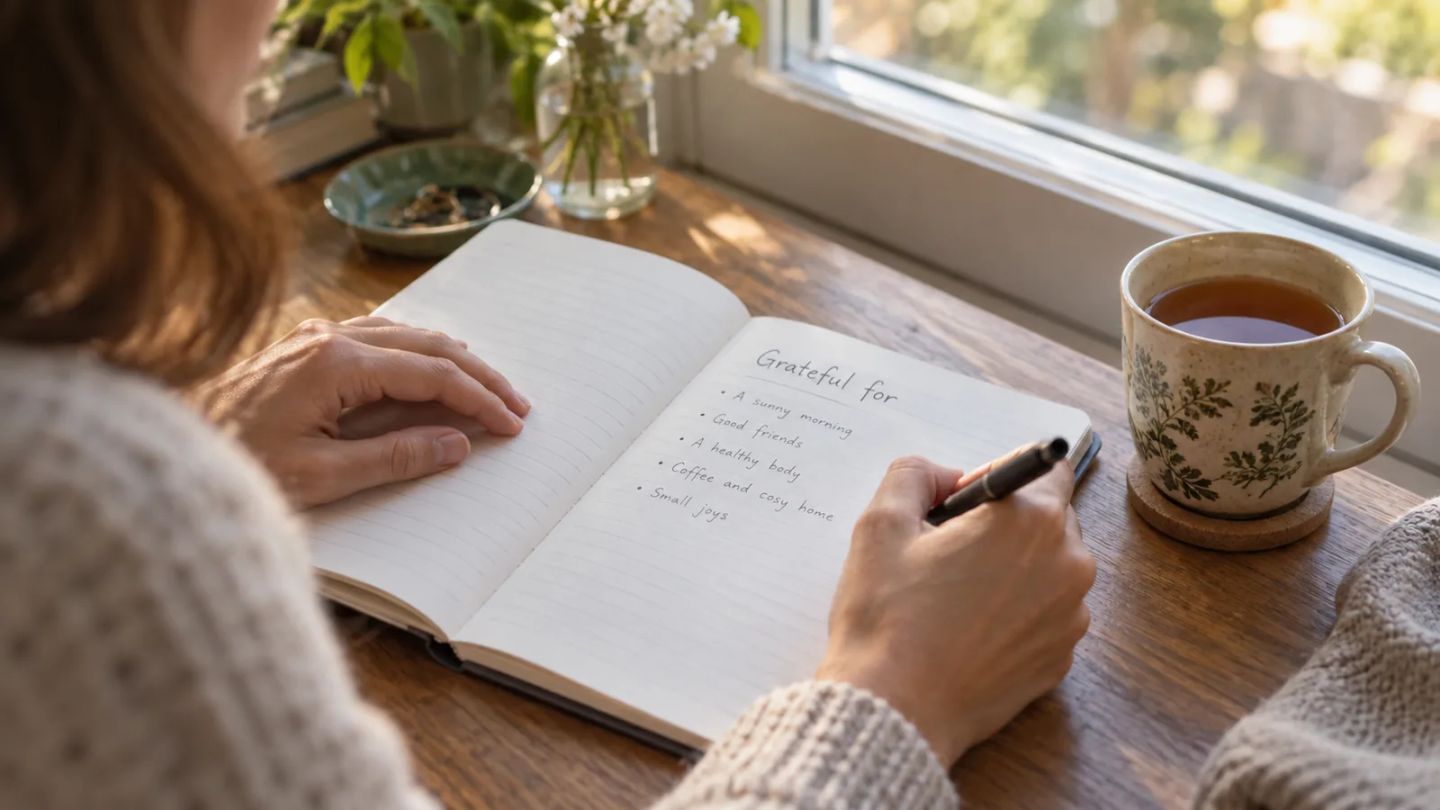
A gratitude journal is a place where you write down a few things you're thankful for on a regular basis. To start tonight, you need a pen, any notebook and one minute: write three things from today that you were glad of, however small, and close the book. The tea someone made you. A message that arrived at the right time. The fact the rain held off until you got home.
That's the whole practice. What makes it worth doing, and what stops most people keeping it up, is a bit more involved, so this guide covers what a gratitude journal is, what the research does and doesn't show, and how to start one and still be writing in it a month from now.
What a gratitude journal is
It's a running record of the good you notice. Some people write full sentences about one thing. Others jot a bare list of three. A few keep it to a single word on the hardest days and a paragraph when they have more in them.
There's no correct object of gratitude either. It can be a person, a small comfort, a piece of luck, something your body managed, a problem that finally sorted itself out. The point isn't to produce a tidy list. It's to spend a moment looking for what went right, on purpose, when the mind's default is to replay what went wrong.
You don't need a special notebook, an app or a set time, though any of those can help. You need somewhere to write and a habit of coming back to it.
What the evidence shows, and what it doesn't
The honest version is that gratitude journalling seems to help a fair number of people a modest amount, and it doesn't work for everyone. That's worth saying plainly, because a lot of writing online oversells it.
The study people quote most is Emmons and McCullough's 2003 experiment, which asked people to keep weekly or daily records of things they were grateful for and compared them with groups writing about hassles or neutral events. The gratitude groups came out ahead on several wellbeing measures, though the authors are careful to say it was across several, not all, of what they measured, and that the clearest effect was on positive mood.
Bigger reviews since then keep that caution. A 2023 systematic review and meta-analysis pooling dozens of trials found real but small improvements in gratitude, mood and symptoms of anxiety and depression, while noting that most of the studies carried a high risk of bias and that the certainty of the evidence was low. The reviewers described the effect as small next to something like medication, and framed gratitude as a possible complement, not a treatment.
So the fair summary reads like this. A gratitude journal is associated with feeling a little better, often, for a lot of people. It's a wellbeing habit, not medicine, and the science behind it is promising rather than settled.
There's one more thing the evidence quietly warns against, and it's the mistake that does the most harm. A gratitude journal is not an order to feel positive about things that are painful. Writing "I'm grateful I lost my job" when you feel no such thing tends to leave people flatter and more alone, not lighter. The NHS makes the same point about mindfulness, noticing that some people find these practices unhelpful or feel worse for them. Notice what's true and good where you can find it, let the hard things stay hard, and if the writing leaves you cold, put it down for the night.
How to start one tonight
Open our free printable: Tonight I was glad of (PDF). Save or print it to use alongside this guide. No sign-up needed.
Here's a starter you can copy into the front of a notebook. Fill the top line once, then work down the days.
My cue: after I get into bed
Where I keep it: notebook on the bedside table
Tonight I was glad of:
One. _______________________
Two. _______________________
Three. _______________________
And the same thing filled in, so you can see how ordinary the entries are meant to be:
My cue: after I get into bed
Where I keep it: notebook on the bedside table
Tonight I was glad of:
One. My sister rang for no reason and we laughed for ten minutes
Two. The first proper cold morning, and a warm coat that still fits
Three. I finished the thing I'd been putting off since Monday
To get going from a standing start:
- Put a notebook and pen somewhere you'll see them at the same time each day. The bedside table is the classic spot for a reason.
- Pick your cue now, while you're calm. "After I brush my teeth", "after I get into bed", "while the kettle boils". The American Heart Association suggests attaching a new action to a routine you already have, so the old habit becomes the reminder.
- Write three things. Keep them short. Aim for what happened today, not gratitude in the abstract.
- Stop. You don't have to fill the page or find something profound. Three ordinary lines is a complete entry.
How often, and how much
More is not better here, which surprises people. In the research above, Emmons and McCullough saw benefits from weekly writing, and the Greater Good Science Center at Berkeley, drawing on Emmons's later work in its tips for keeping a gratitude journal, goes as far as saying that writing once or twice a week can do more than writing every day. Daily can start to feel like ticking a box, and a box you tick without feeling anything does little.
The American Psychological Association, in a classroom activity on practising gratitude, lands in a similar place, suggesting people write down three things they're grateful for two or three times a week. So if daily feels heavy, two or three nights a week is a perfectly good target, and possibly a better one.
On how much to write, the Greater Good guidance is to go for depth over breadth. One thing described in detail carries more than five things listed in a hurry.
A few small choices make each entry count for more:
- Be specific. "I'm grateful my neighbour took the bins out while I was away" beats "I'm grateful for my neighbour", because the detail is where the feeling sits.
- Lean towards people. The same guide notes that gratitude aimed at the people in your life tends to move you more than gratitude aimed at possessions.
- Try subtraction. Instead of listing what you have, picture the day or the person not being there, and notice what you'd miss. It's a sharper way in on evenings when the usual answers feel worn out.
- Favour surprises. Things that were unexpected tend to stir stronger gratitude than the reliable good you've stopped seeing.
Formats that work
The notebook-by-the-bed version suits most people, but it isn't the only shape a gratitude journal can take. Pick whichever you'll keep coming back to.
- The nightly three. Three short lines before sleep. Quick, forgiving, easy to restart.
- The weekly sit-down. One longer entry once a week, a paragraph or two, going deeper on fewer things. This fits the every-few-days rhythm the research favours.
- The gratitude letter. Now and then, write to a specific person about what they did and what it meant, even if you never send it. It's a stronger version of the same idea, and it points gratitude at a person, which tends to land harder.
- The one-word entry. For nights when a full line is too much. "Warmth." "Rest." "Her." A single word keeps the thread alive, and a live thread is the whole game.
You can mix them. A one-word Tuesday and a proper paragraph on Sunday is a real practice, not a failed one.
Getting past the stall
Most gratitude journals don't end with a decision to stop. They end with a blank page and a tired mind that keeps writing the same three words, until one night you don't bother, and the notebook drifts under a pile of other things.
Two problems cause most of it. The first is the blank page. "What am I grateful for?" is a wide, vague question, and a specific prompt narrows it to something you can answer in a sentence. Keeping a set of gratitude journal prompts tucked in the front of the notebook means you never sit there with nothing.
The second is the missed night. Miss one, and the practice feels broken, so you quietly abandon it instead of facing the gap. This is the thinking to drop. A gratitude journal has no streak to protect. If you skip Tuesday, or the whole week, you've undone nothing, and there's no need to make up the days you missed. You pick the next evening and write your three lines. Coming back after a gap is the skill that keeps a habit alive, and it's covered more fully in our guide on how to be consistent.
Decide your smaller version now, before a bad day forces the question. On a night when even one line is too much, let a single word stand. That keeps the habit breathing until you've got more to give it.
A place to keep the reflection close
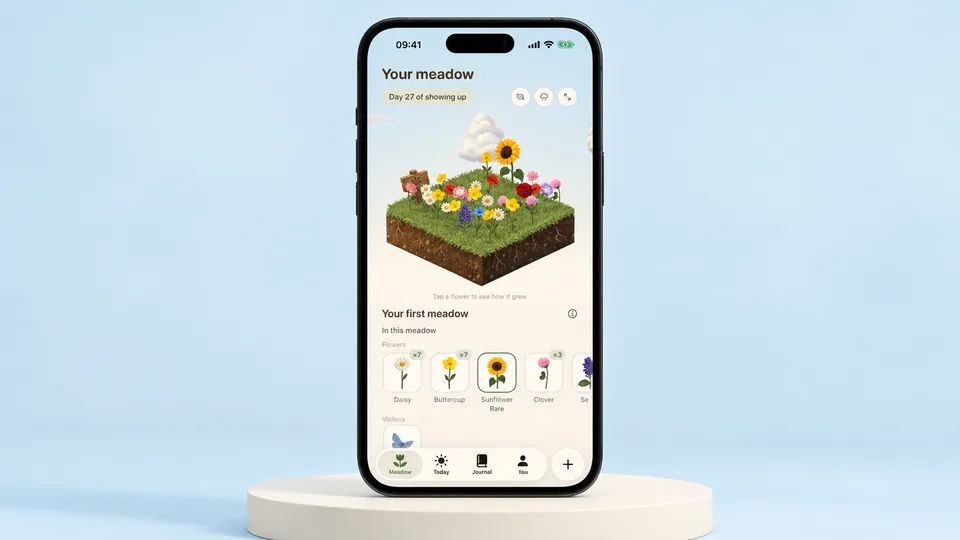
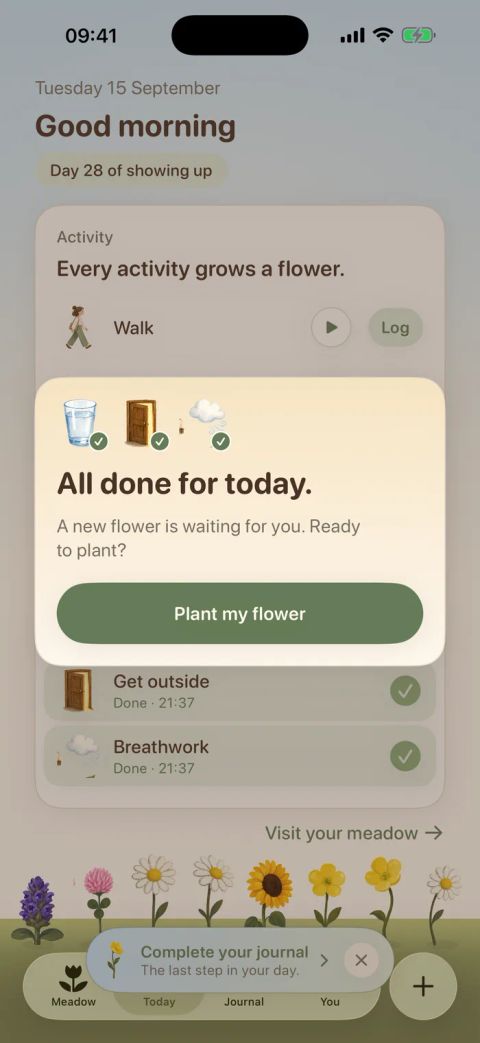
Some people would sooner do this on their phone than in a notebook, and Meadow is built for that kind of small daily check-in. You note your mood and energy, write down a daily win and read a short affirmation, all of which sit close to the spirit of a gratitude line. Each day you show up grows a new wildflower in your own meadow, and because there are no streaks, a night you forget resets nothing and your flowers never wilt. You can find it at Meadow.
Common questions
How many things should I write?
Three is a good default, and one written in detail beats five written in a rush. On a full day, add more. On an empty one, one line counts.
Morning or night?
Whichever you'll keep. Night suits most, because the day's done and you've something to look back on. If your evenings are chaos, tie it to the morning cup of tea instead.
Does it have to be daily?
No. Two or three times a week is well supported and often feels more meaningful, because you're choosing what to write rather than filling a slot.
What if nothing comes to mind?
Reach for a prompt, or drop to the smallest thing that's true. A warm bed. A hot drink. The day being over. Small and honest beats big and forced.
Is a notes app as good as a notebook?
For the effect, it's the regular noticing that counts, not the paper. Use whatever you'll open. A phone is on you already, which for some people wins.
When a notebook isn't enough
A gratitude journal sits alongside the ordinary business of looking after yourself, next to sleep, daylight and a bit of movement, the sort of small acts covered in our self-care ideas. It's a support, not a repair. If low mood or anxiety carries on for weeks, gets in the way of daily life, or feels heavier than you can manage alone, that's a good reason to talk to your GP. Asking for help is a sensible step, and it doesn't mean the journalling failed you.
The one thing to do tonight is small. Put a notebook and pen by your bed, and before you turn off the light, write three things from today you were glad of.
AUTHOR
Co-founder of Meadow.
Ash is co-founder of Meadow, a habit and movement tracking app that turns small acts of self-care into a growing wildflower meadow.
Every little bit counts
Five minutes counts. So does a dance in the kitchen.
Log the movement you enjoy and the small habits that help you feel good, and watch them bloom into something you can see.
Download Meadow